How Many Lumens Do I Need for a Garage? What to Know
How many lumens a garage needs for parking, storage, and detailed workshop tasks: fixture types, brightness levels, color temperature, and layout planning.

On this page
Top picks at a glance
As an Amazon Associate we earn from qualifying purchases.
- 1
 hykolity 2FT 150W LED Linear High Bay Shop Light9.8/10View on Amazon
- 2
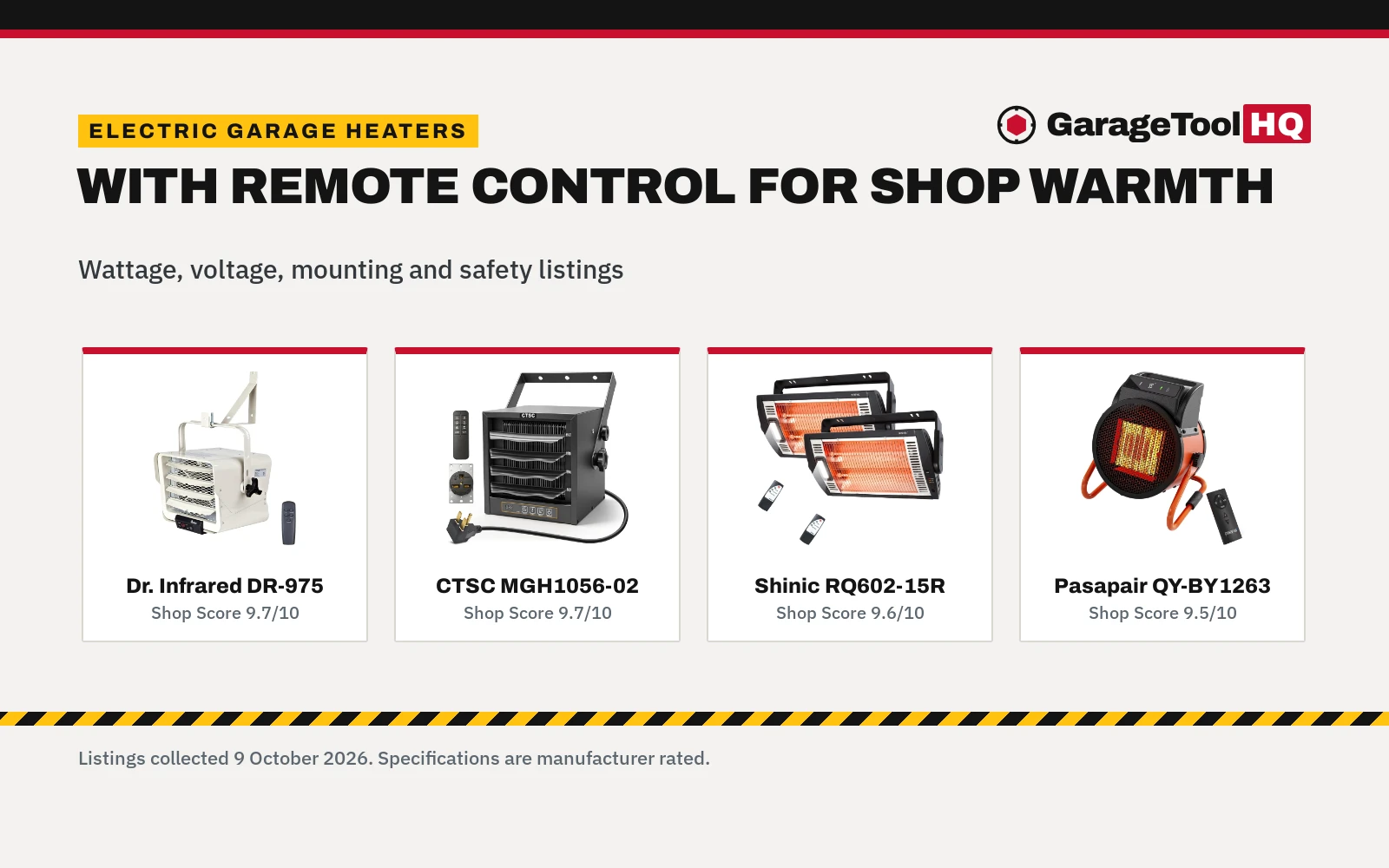
 Comfort Zone Hard-Wired Ceiling Mount Garage Electric Space9.7/10View on Amazon
- 3
 Comfort Zone Hard-Wired Ceiling Mount Garage Space Heater9.7/10View on Amazon
- 4
 Dr. Prepare LED Work LightView on Amazon
- 5
 GT-Lite 3000 Lumens LED Garage LightView on Amazon
- 6
 SMA 18W LED Work Light 2400 Lumens Aluminum Alloy HighView on Amazon
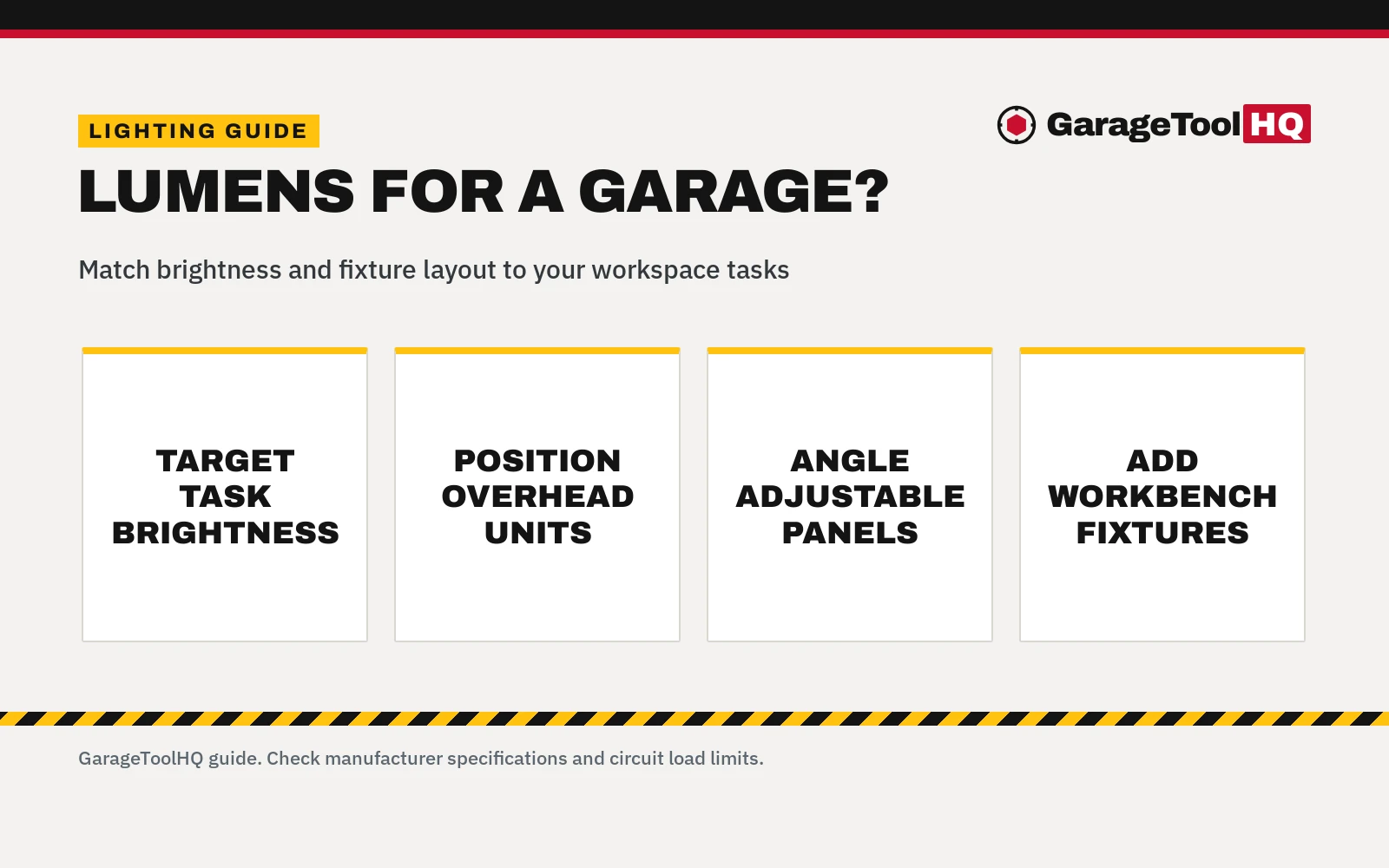
How many lumens do I need for a garage? A typical garage requires between 4000 lumens and 20000 lumens of light output depending on bay size, ceiling height, and the work you plan to do. Basic vehicle parking and household storage function well with 4000 lumens to 8000 lumens across overhead sockets. Active home mechanics, woodworkers, and car detailers require 12000 lumens to 20000 lumens or more across multiple fixtures to eliminate shadows around engine bays and workbenches. The right total brightness depends on dividing that output across the ceiling rather than relying on a single bare bulb.
More options to compare
 Dr. Prepare LED Work LightCheck price on Amazon
 GT-Lite 3000 Lumens LED Garage LightCheck price on Amazon
 SMA 18W LED Work Light 2400 Lumens Aluminum Alloy HighCheck price on Amazon
GarageToolHQ earns a commission when you buy through links on our product pages, at no extra cost to you. Read our affiliate disclosure.
Below: how garage tasks determine overall lumen requirements, how deformable ceiling bulbs compare with linkable shop light fixtures, and a checklist to plan your overhead layout.
How many lumens do i need for a garage? Sizing by space and task
Lumen output measures the total quantity of visible light emitted by a fixture. In an enclosed garage with dark concrete floors, exposed studs, and minimal natural daylight, light gets absorbed quickly. Working out how many lumens you need starts by identifying how you use each section of the space:
- Vehicle parking and passage. Moving between the car and the house door requires general ambient visibility. A single ceiling socket fitted with an adjustable multi-panel bulb delivering 4000 lumens or 8000 lumens provides adequate coverage so you can walk without stumbling over hoses or storage bins.
- General storage and utility shelves. Searching through storage totes, seasonal boxes, or wall shelving calls for broad illumination. A fixture producing 7000 lumens to 12000 lumens spreads illumination into recessed corners and upper shelving racks.
- Mechanical maintenance and repair. Working under vehicle hoods, checking fluid levels, and changing brake pads demands higher brightness to distinguish grime, worn hardware, and fluid leaks. A multi-fixture arrangement providing 20000 lumens across the bay creates clear sightlines without dark shadows under open hoods.
- Precision detailing and surface finishing. Paint correction, sanding, and fine assembly work need intense illumination. Combining 20000 lumens of overhead ambient output with dedicated bench lights ensures fine scratches and imperfections stay visible.
Common garage lighting fixture outputs and coverage
| Fixture style | Published lumen output | Stated wattage | Best garage location |
|---|---|---|---|
| Compact flush-mount ceiling fixture (Ultralux) | 500 lumens | 9W | Closet alcove, utility corner, interior doorway |
| Exterior photocell security light (UME) | 2000 lumens | 19W | Garage exterior entry, outdoor walkway |
| Outdoor cutoff wall pack (DAKASON) | 3300 lumens | 30W | Exterior garage apron, side door entrance |
| Adjustable panel LED ceiling bulb (Feit Electric) | 4000 lumens | 35W | Single-bay central ceiling socket |
| Linkable 4-foot LED shop light fixture (XLNYUUI) | 7000 lumens | 50W | Above workbench surface, along vehicle roofline |
| Three-panel deformable ceiling bulb (Meiqils) | 8000 lumens | 80W | General bay illumination, utility workspace |
| Multi-panel deformable ceiling bulb (Aoretic) | 12000 lumens | 60 watts to 120W | Large single bay, high-ceiling central socket |
| High-output deformable shop light (CHENGCHILIT) | 20000 lumens | 200W | Main automotive repair bay, wide overhead coverage |
| High-output deformable shop light (POLARPRA) | 20000 lumens (40000 lumens per 2-pack) | 200W | Dual-bay layout, deep workshop ceiling |
The published specifications in manufacturer listings demonstrate how fixture designs target distinct garage zones. For small utility alcoves, a compact flush fixture like Ultralux provides 500 lumens at 9W, which suits an enclosed closet but falls short in an open bay. Exterior perimeter walls benefit from dedicated wall packs like DAKASON at 3300 lumens or UME security fixtures at 2000 lumens, both sealed against weather. Inside the main garage area, overhead fixtures step up significantly: Feit Electric offers 4000 lumens from 35W, XLNYUUI delivers 7000 lumens in a 4-foot housing, Meiqils produces 8000 lumens, Aoretic lists 12000 lumens, and heavy-duty screw-in units from CHENGCHILIT and POLARPRA reach 20000 lumens each.
How to calculate garage lighting layout: step-by-step checklist
- Map existing ceiling sockets and outlets. Count whether your ceiling has standard screw sockets or grounded wall outlets. A screw socket accepts deformable multi-panel bulbs directly, while plug-in shop fixtures require an overhead outlet or an extension adapter.
- Divide total lumens across the space. Rather than installing a single massive light source in the center, distribute your target brightness across multiple points. Two fixtures rated at 8000 lumens or 12000 lumens spread light more evenly across a bay than one central fixture, cutting harsh shadows under car hoods.
- Check fixture wattage and socket ratings. Verify that your ceiling fixture can handle the electrical draw. While efficient LED designs draw modest power, high-output units like CHENGCHILIT or POLARPRA draw 200W, whereas a moderate bulb like Feit Electric draws 35W. Ensure old plastic or porcelain sockets are in good repair before installing heavy or high-draw units.
- Angle adjustable panels to eliminate dark spots. Deformable ceiling lights feature multi-leaf panels that pivot from 0 to 90 degrees, as seen on Meiqils and Aoretic models, while Feit Electric offers 180-degree panel rotation. Angle side panels toward wall cabinets, tool storage chests, and side vehicle panels.
- Position dedicated task lighting over work surfaces. Overhead ceiling fixtures cannot push past your head and shoulders when you lean over a workbench. Suspend a 4-foot fixture, such as the XLNYUUI 7000 lumens shop light, directly over the front edge of your bench.
- Consider fixture beam angle. Wide beam angles reduce bright glare spots. Models like POLARPRA list a 120-degree beam angle, while V-shaped tube lights like XLNYUUI specify a 270-degree emitting angle to throw light onto upper walls as well as floors.
- Maintain uniform color temperature. Mixing cool daylight fixtures with warm incandescent bulbs causes visual fatigue. Choose a consistent color profile across all overhead fixtures, such as 5000K or 6500K daylight.
- Keep corded runs clear of overhead hardware. When hanging linkable shop fixtures, secure all cords with clips away from garage door opener tracks, torsion springs, and overhead storage racks.
High-output LED fixtures draw significantly less current than old halogen lamps, but multiple fixtures add up on a shared circuit. High-output units like POLARPRA draw 200W each. If your garage shares a circuit with an air compressor, power tools, or a vehicle battery charger, confirm total circuit load, and consult a licensed electrician for dedicated wiring.
Use rated jack stands on solid ground, wear eye protection with power and air tools, keep fuel-burning equipment out of a closed garage, and follow the manual for every tool. Read our Safety Disclaimer.
Screw-in deformable bulbs vs linkable shop light fixtures
Most garage owners choose between two modern LED fixture formats: screw-in multi-panel bulbs that thread into existing ceiling sockets, and 4-foot linear shop light fixtures suspended from chains or mounted flush. Here is how they compare:
- Installation convenience: Screw-in bulbs like Meiqils (80W, 8000 lumens) or Feit Electric (35W, 4000 lumens) fit standard E26 ceiling sockets without wiring or mounting brackets. Linkable shop fixtures like XLNYUUI (50W, 7000 lumens) require ceiling hooks, chains, or surface mounting clips, plus access to a wall or ceiling outlet.
- Light distribution: Multi-panel deformable bulbs concentrate high brightness in a circular pattern around the central ceiling socket, using adjustable leafs to direct output. Linear 4-foot shop fixtures cast a long, narrow rectangle of light that aligns naturally with vehicle hoods, chassis lengths, and long work surfaces.
- Shadow control: A single central bulb, even one delivering 12000 lumens like Aoretic or 20000 lumens like CHENGCHILIT, casts shadows whenever you stand between the fixture and your work. Linking several 4-foot fixtures down the length of the bay spreads light from multiple angles, reducing harsh shadow lines.
- Circuit expansion: Screw-in bulbs operate independently in their respective sockets. Linkable fixtures provide daisy-chain convenience; XLNYUUI allows connecting a maximum of 6 lights in a series from a single power cord, simplifying multi-fixture layouts across a deep garage.
If you already have ceiling sockets centered over each bay, multi-panel bulbs offer the fastest upgrade path. If your ceiling lacks sockets or has dark zones along side walls, browse our picks for the best LED garage lights and dedicated overhead fixtures in our guide to the best garage lights ceiling LED.
Why overhead lighting alone is not enough for mechanical work
Even when your ceiling produces 20000 lumens of ambient light, overhead fixtures cannot bend rays around vehicle bodies. When you work inside an engine bay, the raised hood blocks overhead ceiling rays. Similarly, suspension components, wheel wells, and chassis undersides remain shaded by fenders and vehicle floor pans.
For thorough illumination during repairs, pair your overhead lighting with dedicated portable lights. A magnetic or under-hood rechargeable work light for mechanics attaches directly to hood latches or frame rails, placing bright illumination inches from fasteners, belts, and brake lines where ceiling light cannot reach.
Frequently Asked Questions
Can a garage have too many lumens?
Yes. Excessive brightness from unshielded LED panels can cause intense glare and visual discomfort, especially if fixtures reflect off glossy epoxy floors or vehicle windshields. Distributing 8000 lumens to 12000 lumens across multiple fixtures provides better visual comfort than concentrating an overwhelming burst of brightness at a single ceiling point.
What color temperature is best for a garage?
Color temperatures between 5000K and 6500K daylight work best for garage tasks. Units like DAKASON and UME provide 5000K cool daylight, while Feit Electric offers selectable 3CCT options across 3000K, 4000K, and 5000K. Fixtures from Meiqils, Aoretic, and XLNYUUI use 6500K, which renders high contrast for mechanical inspection and reading small labels.
Do deformable LED garage lights require an electrician to install?
Standard screw-in deformable lights do not require electrical work if your garage already has functioning E26 or E27 light sockets. Models from Meiqils, Aoretic, and CHENGCHILIT screw directly into standard sockets just like an ordinary light bulb. If your ceiling lacks sockets or requires new branch circuits, hire a licensed electrician.
How many shop lights can you link together on one cord?
Always follow the manufacturer rating for daisy-chaining. For example, XLNYUUI specifies connecting a maximum of 6 lights in a series on its 50W 4-foot fixtures. Exceeding the stated linking limit overloads internal wiring and creates a fire hazard.
Can existing porcelain sockets support heavy multi-panel bulbs?
Check socket condition and fixture weight. Moderate bulbs like Feit Electric and Meiqils weigh 9.6 ounces, while larger high-output assemblies like POLARPRA weigh 2.3 pounds. If your existing socket is cracked, loose, or wobbles when tightened, replace the socket before mounting heavy multi-panel units.
Do garage lights need to be waterproof?
Interior garage ceiling fixtures do not need waterproof ratings under normal dry conditions. However, outdoor entryways and exterior walls require weather-sealed fixtures. Exterior wall units like DAKASON and UME carry IP65 waterproof ratings, while indoor units like Meiqils and XLNYUUI are rated for indoor, dry locations.
Related: our guide to the best LED garage lights, overhead picks in best garage lights ceiling LED, portable illumination with a rechargeable work light for mechanics, and our garage upgrades hub.