Paddock Stand vs Motorcycle Lift Stand: Which One Should You Buy?
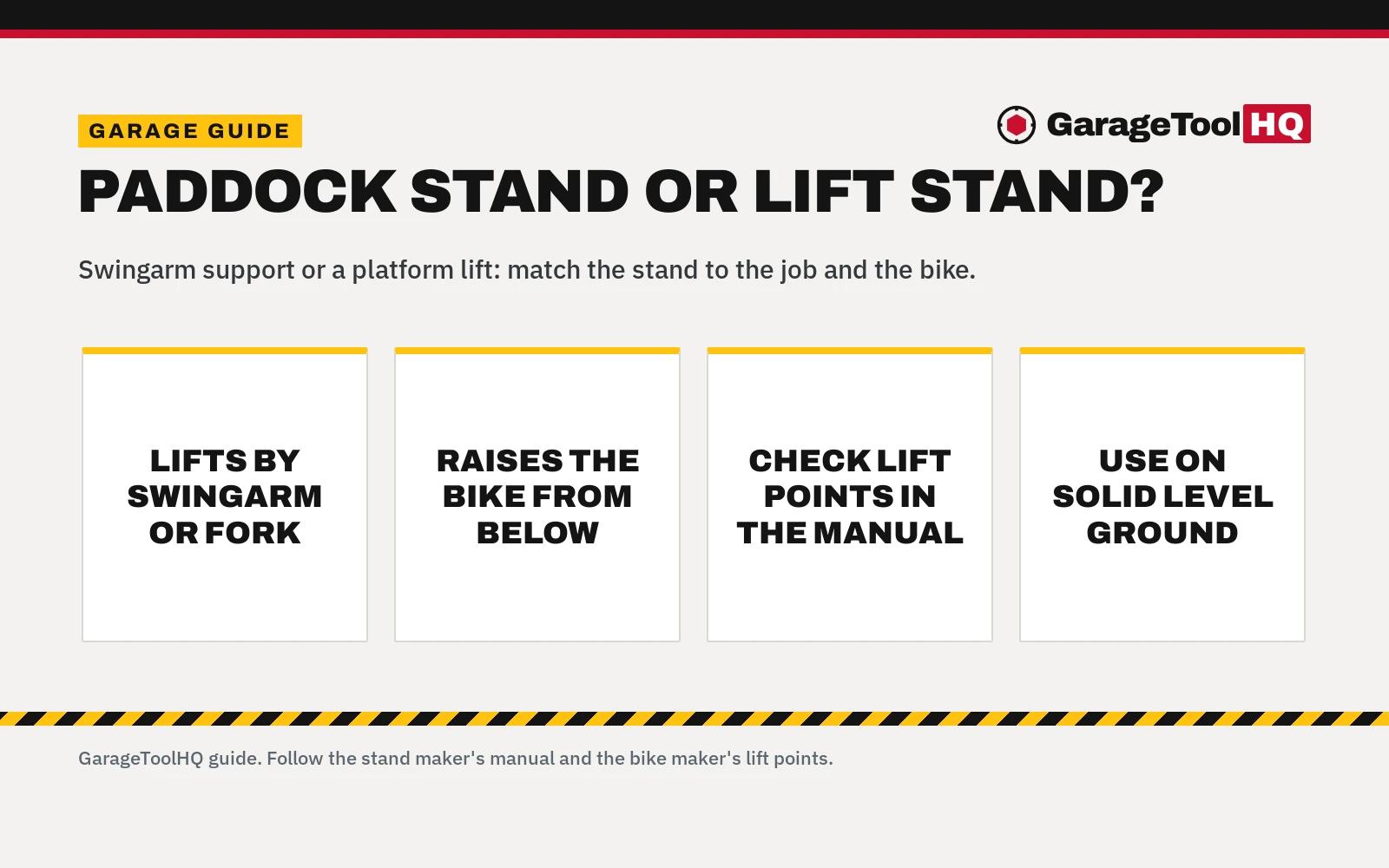
A paddock stand lifts a bike by its swingarm or fork for wheel and chain work, while a motorcycle lift stand raises the bike from below for broader maintenance.

On this page
A bike that needs chain cleaning or a wheel off the ground calls for support that holds it steady while work goes on. For paddock stand vs motorcycle lift stand shoppers, the short answer is that a paddock stand lifts from the swingarm or fork for routine wheel and chain work, while a motorcycle lift stand raises the bike from below for a stable platform during broader maintenance. The right choice depends on the job, the bike, and the lift points the bike maker lists.
As an Amazon Associate I earn from qualifying purchases. GarageToolHQ earns a commission when you buy through links on our product pages, at no extra cost to you. Read our affiliate disclosure.
Below: how the two types differ, the gear in this guide in ranked order, safety basics for stands and lift stands, help choosing between the types, and answers to common questions.
How paddock stand vs motorcycle lift stand choices differ
A paddock stand and a motorcycle lift stand both hold a bike off the ground, but they reach the bike in different places and suit different jobs. A paddock stand hooks to the swingarm or the fork, so the wheel it lifts stays free to turn for cleaning, inspection, and wheel work. A motorcycle lift stand slides under the frame or the engine area and raises the bike on a platform, so the bike sits at a working height for broader maintenance. The table below sums up the split in plain terms.
| Type | How it lifts | Typical job |
|---|---|---|
| Paddock stand | Hooks to the swingarm spool or the fork | Chain cleaning, wheel work, and tire work |
| Motorcycle lift stand | Raises the bike from below on a platform | Broader maintenance at a working height |
Width adjustment matters on a paddock stand, because the fork head must match the swingarm or fork it hooks to. Height adjustment matters on a platform lift stand, because the platform must reach the frame at a height that leaves room to work. Capacity matters on either type, because the stated capacity must cover the bike it lifts. Check the bike maker’s lift points in the owner’s manual before choosing, and check that the stand fits the bike it will lift.
The gear in this guide, in ranked order
The gear below is listed in ranked order. Each entry uses only the figures its own listing states, and a figure that a listing does not state is marked as not stated.
DAYIMADE Adjustable Dirt Bike Stand. The listing states a 1000 lbs capacity and an adjustable height from 9.65 inches to 16.73 inches. The listing states 4 built-in tool trays in the base and a rubberized top surface on the platform. The listing states a stand weight of 7.5 kg and a warranty term of 1 Year. The listing describes the stand for a dirt bike, an ATV, and a motorcycle, which gives it the widest stated use in this guide.
Jack Boss Motorcycle Stand Lift. The listing states a 1100 lbs capacity and a lift height of 12.6 inches. The listing states a 2-pack with a front fork stand and a rear swingarm spool stand. The listing states a front fork width from 8.56 inches to 11.61 inches and a rear swingarm spool width from 9.06 inches to 13.78 inches. The listing states four caster wheels for moving the stand. No concrete warranty term is stated for this listing.
GRAND PITSTOP Motorcycle Stand. The listing states a 529 lbs capacity in the title and a 500 lbs capacity in the bullets, so the two figures do not agree. The listing states a lift height of 12.6 inches. The listing states a front fork width from 8.56 inches to 11.61 inches and a rear swingarm spool width from 9.06 inches to 13.78 inches. The listing states a stand weight of 6.85 kg and a warranty term of 7 days. The listing lists 1 item, and the short warranty term and the capacity mismatch hold this listing below the two listings above it.
SPECSTAR Motorcycle Stand. The listing states a 441 lbs capacity and a stand weight of 9.5 pounds. The listing states dimensions of 30.9 inches by 14.4 inches by 14.4 inches. The listing states a U-shaped fork head adjustable from 11.2 inches to 14.4 inches and L-shaped fork heads adjustable from 10.2 inches to 13.6 inches. The listing states four rolling wheels for moving the stand. No concrete warranty term is stated for this listing, and the stated capacity is the lowest in this guide.
Safety basics for stands and lift stands
Never get under a vehicle that rests on a jack alone. Use rated stands on solid level ground, follow the lift points in the owner’s manual, and follow the stand maker’s ground and setup requirements before starting work.
Check the lift's rated capacity against your heaviest vehicle, and its ceiling and concrete requirements (thickness and strength) before you buy. Install it exactly as the manufacturer specifies, use the mechanical locks before you go under, and look for ALI certification on the model. See the Automotive Lift Institute (ALI). Read our Safety Disclaimer.
Set the stand on solid level ground, where it cannot slip or sink during the job. Check the bike maker’s lift points in the owner’s manual, and check that the fork head or platform meets the bike at those points. Check compatibility before buying, since a fork head that does not match the swingarm or fork will not hold the bike as intended. Keep hands and clothing clear of moving parts while lifting, and lower the bike in a controlled way when the job ends. Never run a fuel engine in a closed garage.
Which type fits the job
For chain cleaning and rear wheel work, a rear paddock stand is the direct tool, because it lifts the rear wheel and leaves it free to turn. For front wheel work with a paddock stand, a front fork stand is the matching option, because a rear stand alone does not lift the front wheel. For broader maintenance that needs the bike at a working height, a platform lift stand is the direct tool, because it raises the bike from below to a working height. For a garage that serves dirt bikes and pit bikes, the DAYIMADE platform lift stand in this guide is worth a close look, because its height adjusts to the bike it lifts. In every case, match the stated capacity to the bike and confirm the lift points in the owner’s manual before buying. For a paddock stand, also match the width range to the swingarm or fork; for the platform lift stand in this guide, check its stated height range instead.
FAQ: garage tools
Can a paddock stand lift the front wheel?
A rear paddock stand lifts the rear wheel only. Front wheel work with a paddock stand needs a front fork stand, which hooks to the fork and lifts the front wheel clear of the ground.
Can a lift stand be used for a dirt bike?
Yes, where the listing describes the stand for dirt bikes. A platform lift stand raises the bike from below, which suits dirt bike maintenance that needs the bike at a working height. Check the stated capacity and the height range against the bike before buying.
What should be checked before buying a stand?
Check the bike maker’s lift points in the owner’s manual, the stated capacity, and the ground where the stand will sit. For a paddock stand, also check the width range of the fork head and that it matches the swingarm or fork. Check that the stand suits the job planned for it.
Can a stand be used on uneven ground?
No. Use a stand only on solid level ground, where it cannot slip, sink, or tip during the job. Uneven or soft ground undermines the support the stand provides.
Is a higher stated capacity always better?
No. Capacity must cover the bike, but fit matters as much as capacity. For a paddock stand, a high stated capacity still fails the job if the fork head does not match the swingarm or fork, or if the lift points do not line up with the bike.
Related: the jacks and stands hub and the car lifts hub.