Sandpaper vs File: Which One Should You Buy?
Sandpaper and file compared by grit, form and reach, with 220 grit sheets and a washable sponge set as examples.

On this page
Verdict: Choose sandpaper if you want to smooth paint, wood or metal and swap grits as the job changes. Choose a file if you need to shape a hard edge or take material off metal in a straight line, where a rigid bar holds its shape better than paper.
A rough edge on a bracket, a scuffed patch of paint, a wooden handle that needs smoothing before it goes back on the car: hand finishing jobs like these come down to one choice. Sandpaper vs file is the question, and this comparison covers how each side works, then the sandpaper examples from the listings we reviewed.
As an Amazon Associate I earn from qualifying purchases. GarageToolHQ earns a commission when you buy through links on this page, at no extra cost to you. Read our affiliate disclosure.

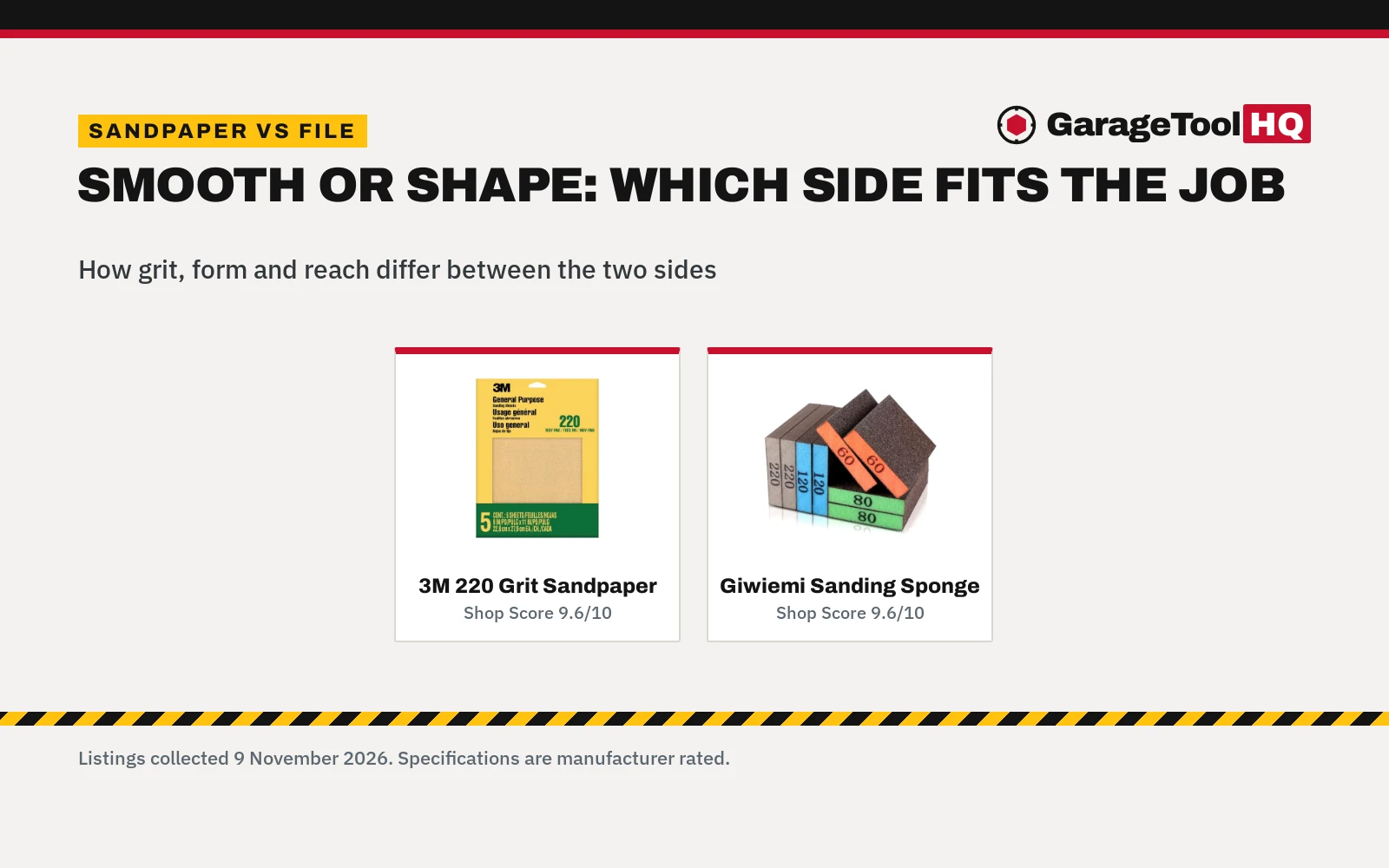
3M Sandpaper, 220 Grit, 5 Sheets, 9 x 11
220 grit, very fine aluminum oxide sandpaper in 9 x 11 in sheets, 5 to a pack, for paint, wood and metal.
Pros
- 220 grit, very fine, for general purpose sanding
- Aluminum oxide mineral sands paint, wood and metal
- 9 x 11 in sheets, 5 in the pack
- Listing advises skipping no more than one grit in a sequence
Cons
- Warranty field reads only "Warranty" with no term stated
- Only 220 grit in the pack; no coarse grits
- Wet use is not stated on the listing
- No safety listing is stated

Giwiemi 8 Pack Sanding Sponge
An 8 pack of washable sanding sponges in 60, 80, 120 and 220 grit, color coded by grit, for drywall, wood, metal and furniture.
Pros
- 4 grits in one pack: 60, 80, 120 and 220
- Washable and reusable, works wet or dry
- Color coded sponges with grit numbers printed on them
- Sponge form suits flat and irregular surfaces
Cons
- No warranty term is stated on the listing
- No weight is stated on the listing
- No safety listing is stated
- Only 2 sponges per grit in the 8 pack
Side by side
| Sandpaper | File | ||
|---|---|---|---|
| How it works | Grit on paper or sponge wears material away | Teeth on a rigid bar cut with each stroke | |
| Grit and cut | 220 grit on the 3M example; 60, 80, 120 and 220 grit on the Giwiemi example | Cut comes from the teeth, not a grit number; no file example in this roundup | |
| Form | Sheets 9 x 11 in; sponges 4.0 x 2.75 x 0.65 in | A rigid bar that holds its shape on edges | |
| Wet or dry | Giwiemi sponges work wet or dry and wash clean | Not stated; no file example in this roundup | |
| Pack size | 5 sheets in the 3M example; 8 sponges, 2 per grit, in the Giwiemi example | Not stated; no file example in this roundup | |
| Weight | 0.13 lb in the 3M example | Not stated; no file example in this roundup | |
| Warranty | Field reads “Warranty” with no term, 3M example | Not stated; no file example in this roundup |
Example figures are manufacturer rated, as published on each listing and collected 10 November 2026.
Sandpaper vs file: how each side works
Sandpaper cuts with grit stuck to paper or a sponge: the grit wears the surface away a little at a time, and you swap to a finer grit as the surface smooths. A file cuts with teeth on a rigid bar: each stroke removes a small amount of material, and the rigid bar resists flexing. Both examples in this roundup are sandpaper, so the file side is judged on how files work, not on a listed example.
Grit and cut
Grit is the sandpaper side’s language. The 3M example is 220 grit, very fine, for general purpose sanding, and the Giwiemi example packs 4 grits, 60, 80, 120 and 220, with 2 sponges per grit. The 3M listing advises skipping no more than one grit in the sanding sequence. A file has no grit number: its cut comes from the spacing and shape of its teeth, so there is no grit figure to compare across the two sides.
Form and reach
Form decides where each side can work. The 3M sheets are 9 x 11 in, while the Giwiemi sponges are 4.0 x 2.75 x 0.65 in each and suit flat and irregular surfaces, including drywall, woodworking and metal polishing. A rigid file reaches edges and slots where paper flexes. Neither example needs power.
Wet or dry
The Giwiemi sponges work wet or dry, reduce dust and wash clean for reuse. The 3M listing does not state wet use, so the listing leaves that unclear. For the file side, no example listing states wet or dry use, so the roundup leaves that unclear rather than calling it a win for either side.
What the listings leave unclear
Both listings in this roundup are sandpaper, so the file side has no example to score. Neither listing states a warranty term: the 3M warranty field reads only “Warranty”, and the Giwiemi listing states none at all. Neither states a safety listing. The 3M example lists a weight of 0.13 lb, while the Giwiemi example lists no weight. Where a figure is missing, this comparison says so instead of scoring the gap as a win.
Choose sandpaper if
- You smooth paint, wood or metal by hand
- You want to step through grits, from 60 to 220
- You work wet or dry with a washable sponge
- You want sheets or sponges that store flat
Choose a file if
- You shape a hard edge or remove metal in a straight line
- You want a rigid tool that holds its shape
- You work on edges and slots where paper flexes
- You want a rigid tool with no grit to swap
Example sandpaper
For more choices, see the best sandpaper kit for cars, and for sponge work, the best sanding sponge for paint.
Wear eye protection with every air tool, use impact-rated sockets on impact wrenches, disconnect the air line before changing accessories, and finish lug nuts with a torque wrench to the vehicle's spec. See OSHA eye and face protection. Read our Safety Disclaimer.
Garage Fit Check
- Space: the 3M sheets are 9 x 11 in; each Giwiemi sponge is 4.0 x 2.75 x 0.65 in.
- Power: neither example needs power; both are hand tools for the bench.
- Storage: the 3M pack holds 5 sheets and the Giwiemi pack holds 8 sponges; the sponges are washable and reusable.
- Check the grit: the 3M pack is 220 grit only, while the Giwiemi pack covers 60, 80, 120 and 220.
FAQ: garage tools
Is sandpaper or a file better for metal?
It depends on the job. The sandpaper examples here state metal: the 3M sheets sand paint, wood and metal, and the Giwiemi sponges suit metal polishing. For smoothing, sandpaper fits; for shaping a hard metal edge, a file holds its shape where paper flexes. No file example is listed here, so the file side is judged on how files work.
What grit sandpaper should I start with?
Step through the grits in order. The Giwiemi pack covers 60, 80, 120 and 220 grit, with 2 sponges per grit, and the 3M pack is 220 grit only. The 3M listing advises skipping no more than one grit in the sanding sequence.
Can I use sandpaper wet?
The Giwiemi sponges work wet or dry and wash clean for reuse. The 3M listing does not state wet use, so the listing leaves that unclear. The file side has no example listing, so wet use for files is left unclear here.
Can sandpaper replace a file?
For smoothing paint, wood or metal, sandpaper fits: the 3M sheets sand paint, wood and metal, and the Giwiemi sponges suit wood, metal and furniture. For shaping a hard edge, a rigid file holds its shape where paper flexes.
How many sheets come in a pack?
The 3M example lists 5 sheets in a 9 x 11 in pack. The Giwiemi pack is different: 8 sponges, not sheets, with 2 per grit. Count the grits you need before you buy, since the 3M pack is 220 grit only.
Related: wet vs dry sandpaper, sanding sponge vs sandpaper, the best sandpaper for metal rust, the best file set for metal and our air tools hub.