AC Refrigerant Types: R-134a vs R-1234yf Explained
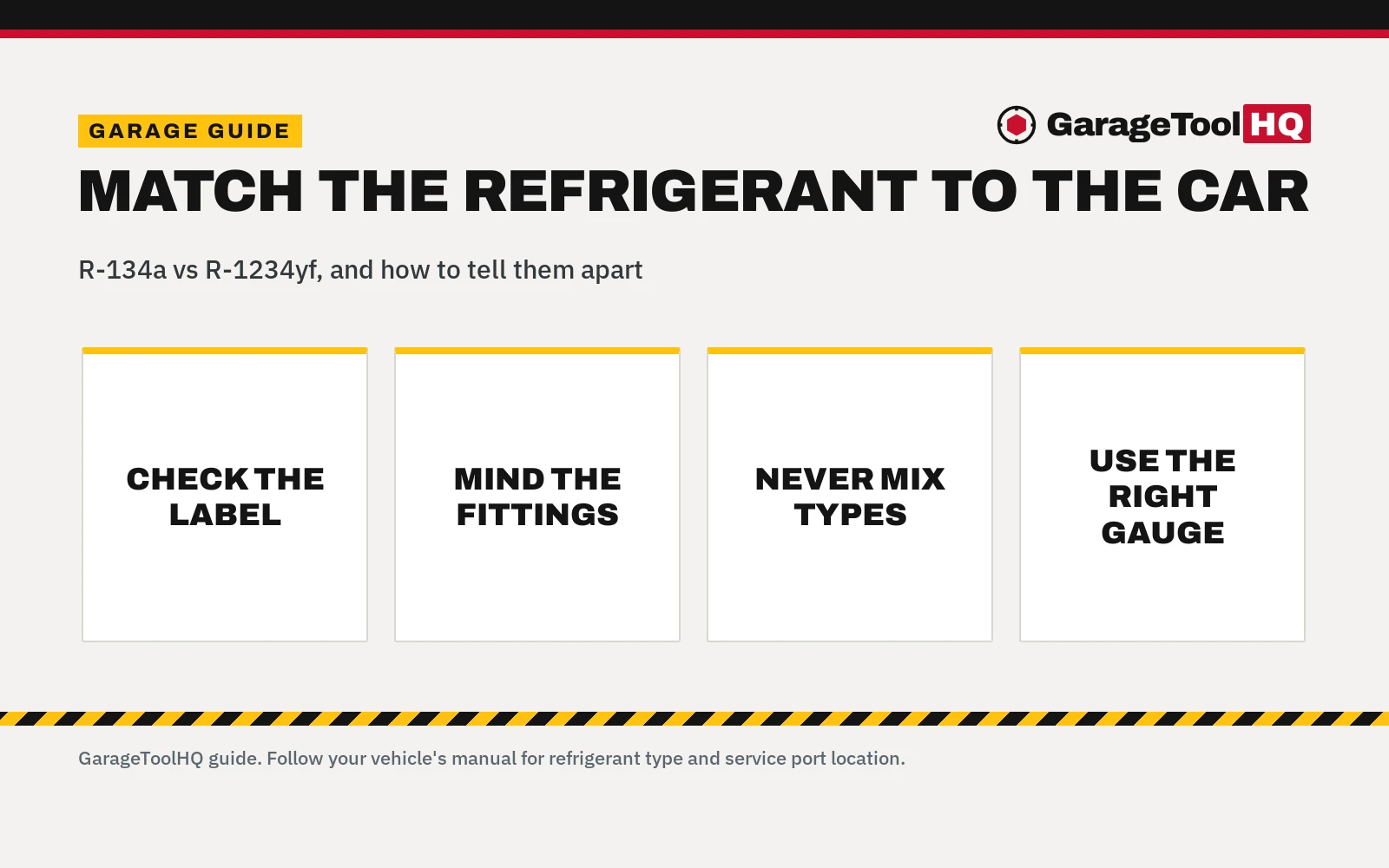
Car AC systems take one refrigerant type, so check the label under the hood and match the can and the coupler to it before you connect any gauge or recharge kit.

On this page
The AC blows warm on a hot afternoon, and the can on the shelf promises a cold cabin again. AC refrigerant types: your car takes one type, and the label under the hood names it. The wrong type may cool poorly, and mixing types can damage the system, so match the refrigerant to the car before you connect anything.
As an Amazon Associate I earn from qualifying purchases. GarageToolHQ earns a commission when you buy through links on our product pages, at no extra cost to you. Read our affiliate disclosure.
Below: the car refrigerants, the home AC refrigerants, how to tell which one your car takes, and the gauge kit that reads them.
AC refrigerant types for cars: R-134a vs R-1234yf
Most cars on the road today run on R-134a or R-1234yf. R-134a is the refrigerant found in older cars, and R-1234yf is the refrigerant found in newer cars. Each car takes one type, and each type uses its own service fittings, so a can or coupler made for one type does not fit the other.
The fittings are the guard against a mix-up. A R-134a coupler seats on a R-134a port, and a R-1234yf coupler seats on a R-1234yf port. If the coupler does not seat, stop: the refrigerant in the can may not match the car, and forcing the connection risks damage to the service port and the system.
| Refrigerant | Where it is used | Fittings |
|---|---|---|
| R-134a | Older cars | R-134a couplers |
| R-1234yf | Newer cars | R-1234yf couplers |
R-134a served cars for years as the standard car refrigerant, and R-1234yf is the type fitted to newer cars. The change came with new fittings, so the older coupler does not seat on the newer port. That is why the label matters more than the can: the can cannot tell you which car it fits.
The label decides, not the can. Check the label under the hood or the manual before you buy a recharge can or connect a gauge, and buy the type the label names. A shop can also read the label and confirm the type if the label is worn.
Home AC refrigerants: R-410A, R-32 and R-454B
Home and commercial AC systems run on a different set of refrigerants from cars. R-410A is common in home AC systems, and R-32 and R-454B are the newer refrigerants made for home and commercial systems. None of these belong in a car: the fittings and the system design differ, so keep car and home refrigerants apart.
A manifold gauge kit reads the system and shows pressure and temperature readings for the refrigerant it is set to. The Elitech digital manifold gauge covers 88 refrigerants, including R-410A, R-32, R-454B and R-1234yf, with ±1% accuracy and pressure and temperature readings on the display. The kit comes with three 5ft color-coded hoses, R-410A adapters, R-134a quick couplers, a can tap and a valve core wrench, and the maker states a 1-year warranty.
The same gauge kit can read car and home systems when it covers the refrigerant in the system. The Elitech kit uses the industry-standard 1/4″ SAE connection, and its display shows pressure and temperature readings for the refrigerant it is set to. Set the gauge to the refrigerant on the label before you read it, and use the coupler that matches that type.
How to tell which refrigerant your car takes
Work through the list in order. The label is the answer; the fittings and the gauge only confirm it.
- Read the label under the hood. The label names the refrigerant type. If the label is worn, the manual lists the same type.
- Check the manual. The manual states the refrigerant type for the car. Match the can and the coupler to that type, and nothing else.
- Match the coupler. Use the coupler made for the type on the label. If the coupler does not seat on the port, stop and re-check the label: the type in the can may not match the car.
- Read the gauge. A digital manifold gauge set to the right refrigerant shows pressure and temperature readings for that type. Our picks for the best digital AC manifold gauge set compare kits that cover car and home refrigerants.
- Leave recovery to a shop. If the system needs refrigerant removed, or the manual calls for a recovery machine, take the car to a shop with the right equipment. Never vent refrigerant to the air.
If the label is gone and the manual is lost, do not guess. A shop can read the service port and the system parts and name the type, and that answer is worth more than a can bought on a guess.
Mixing types in one system can damage the compressor and the rest of the system, and the mix cannot be undone by adding more of the right type. If the wrong type went in, or the system holds an unknown mix, take the car to a shop with a recovery machine.
Use rated jack stands on solid ground, wear eye protection with power and air tools, keep fuel-burning equipment out of a closed garage, and follow the manual for every tool. Read our Safety Disclaimer.
Recharge cans, hoses and the recovery machine
A recharge kit adds refrigerant to a car system through the low side port, and a charge hose links the can to the port. Read our guide to the DIY AC recharge kit before you connect one, and compare hoses in our picks for the best AC refrigerant charge hose. A recovery machine pulls refrigerant out of the system for service, and that job belongs in a shop: our guide to the recharge kit vs recovery machine sets out which tool fits which job.
An electronic charging scale weighs the refrigerant as it goes in, so the amount added is measured rather than guessed. Compare scales in our picks for the best electronic refrigerant charging scale, and match the scale and the hose to the refrigerant on the label.
FAQ: garage tools
What AC refrigerant does my car take?
Check the label under the hood or the manual: it names the type, most often R-134a or R-1234yf. Match the can and the coupler to that type, and use nothing else.
Can I mix R-134a and R-1234yf?
No. Each car takes one type, and each type uses its own fittings. Mixing them can damage the system, so use only the type on the label.
Can I use a home AC refrigerant in my car?
No. R-410A, R-32 and R-454B are made for home and commercial systems, not cars. The fittings and the system design differ, so keep car and home refrigerants apart.
Do I need a special gauge for R-1234yf?
You need a gauge set for the type on the label, with the coupler that seats on that type. A digital manifold gauge that covers 88 refrigerants reads R-134a and R-1234yf, plus home refrigerants such as R-410A.
What do I do with leftover refrigerant?
Keep it in the sealed can and take it to a shop that handles refrigerant. Never vent refrigerant to the air.
Can a shop convert my car from R-134a to R-1234yf?
No. The types use different fittings and system parts, so a car built for one type stays on that type. A shop can confirm the type on the label and service the system it was built for.
Related: the AC manifold gauge vs recharge kit guide, AC refrigerant charge hoses, recharge kit vs recovery machine and the engine and shop equipment hub.