Air Compressor Capacity: CFM and Tank Size Guide
Air compressor capacity is the CFM your tools need and the gallons your tank holds, and this guide explains both with real tank sizes and pressures.

On this page
Top picks at a glance
As an Amazon Associate I earn from qualifying purchases.
- 1
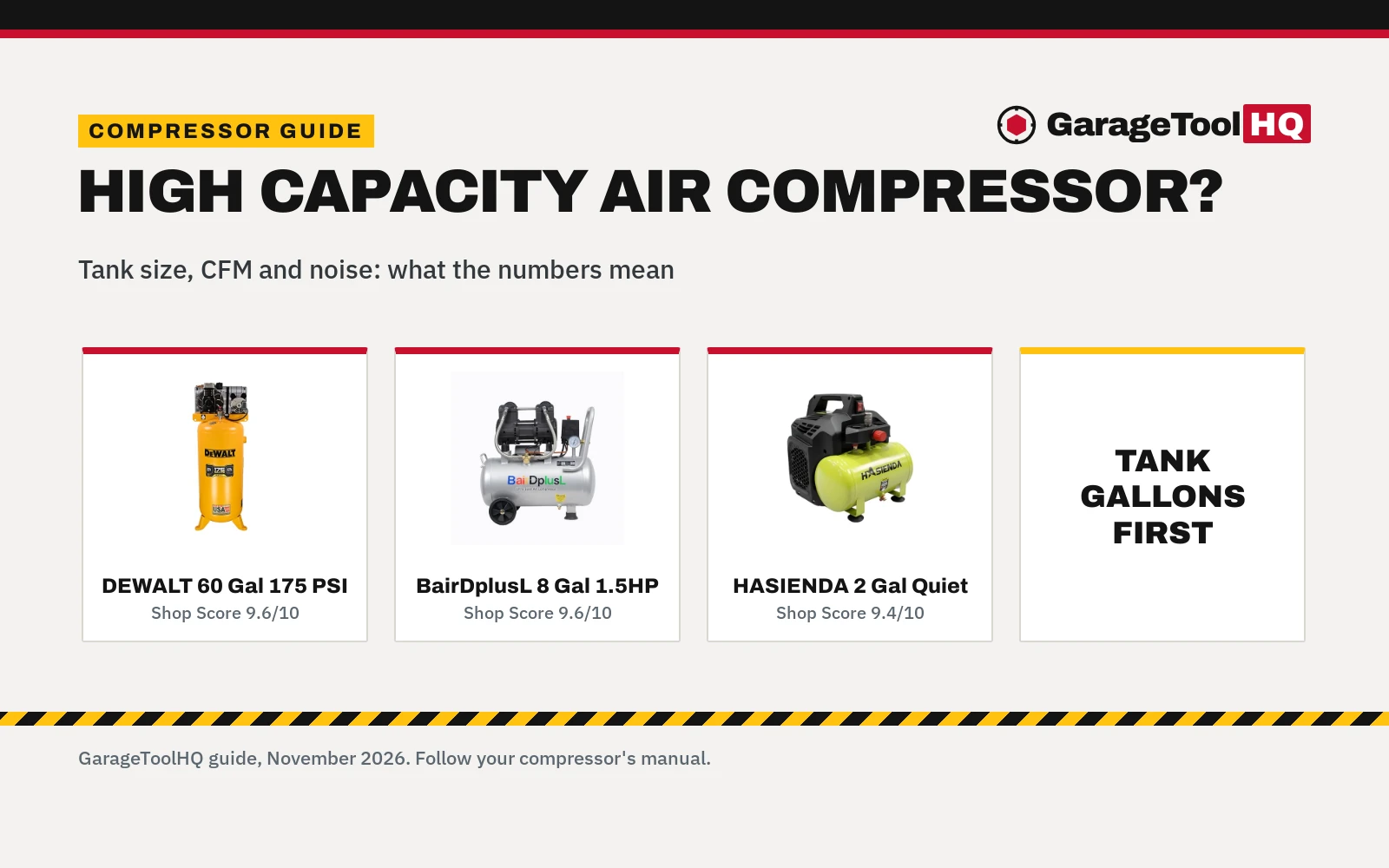
 DEWALT 60 Gal. 175 PSI Stationary Electric Air Compressor.9.6/10View on Amazon
- 2
 BairDplusL 8 Gallon Ultra Quiet Air Compressor 110V/60Hz9.6/10View on Amazon
- 3
 TRIAX Kompressor ISO 46 SAE 209.5/10View on Amazon
Air compressor capacity comes down to CFM and tank size: the CFM a compressor delivers and the gallons its tank holds. A tire inflator sips air and runs fine on a small tank, while an impact wrench gulps air and needs steady flow plus a bigger reserve. This guide explains both numbers, how they work together, and how to read them off a listing before you buy.
GarageToolHQ earns a commission when you buy through links on our product pages, at no extra cost to you. Read our affiliate disclosure.
Below: what CFM means, what tank size does, how they work together, and how to check a listing before you buy.
Air compressor capacity: the two numbers that matter
CFM, cubic feet per minute, is the flow rate: how much air the compressor pushes out while it runs. Tank size, in gallons, is the reserve: how much compressed air sits ready in the tank. A tool draws air at its own rate, and the tank covers the gap when the tool draws faster than the pump can refill it. Read both numbers together, because either one alone can mislead: a big tank with weak flow runs dry on a long job, and strong flow with a tiny tank cycles the pump constantly.
The listings here show the range. The Tooluxe tank (on Amazon) holds 5 gallons, the CNRAQR tank (on Amazon) holds 3 gallons, and the HPDAVV tank (on Amazon) holds 30 gallons. The Tooluxe tank is rated to a maximum pressure of 125 PSI, while the HPDAVV tank and the CNRAQR kit are each rated to 200 PSI. The CNRAQR compressor delivers full duty cycles at 100 PSI and partial throttle operation at 200 PSI.
Tank size: what gallons do
Gallons decide how long a tool can draw before the pump must catch up. A small tank is light and portable and suits short bursts: topping up tires, blowing out a filter, or running a brad nailer for a few shots. A large tank suits a shop, where it stores a big reserve and lets the pump rest between jobs. The table below shows the tanks in the listings here.
| Tank | Size | Max pressure | Notes |
|---|---|---|---|
| Tooluxe portable tank | 5 gallons | 125 PSI | 140 PSI safety valve, 40-inch hose |
| HPDAVV receiver tank | 30 gallons | 200 PSI | ASME certified, vertical |
| CNRAQR onboard tank | 3 gallons, 12 liters | 200 PSI | With compressor, 100 PSI full duty |
The Tooluxe tank is built to carry: it has a handle, a 3.3 ft reinforced PVC hose, and a 1/4-inch NPT hose and chuck for quick connections. The HPDAVV tank is built to stay put: a slim vertical design that takes up less floor space in a shop, with a 3/4-inch NPT drain port for draining moisture. The CNRAQR kit is built for a vehicle: a 3-gallon aluminum tank with a compressor, made for onboard air systems and air horns.
How CFM and tank size work together
Think of the tank as a bucket and CFM as the tap refilling it. A tool that draws in bursts, like an impact wrench or a nailer, leans on the tank: each burst pulls from the reserve, and the pump refills between bursts. A tool that draws steadily, like a sander or a spray gun, leans on CFM: the pump must keep up with the tool for as long as it runs. If the tank runs low, pressure drops and the tool slows until the pump catches up.
That is why neither number alone decides a purchase. A bigger tank gives longer bursts before pressure drops, and higher CFM shortens the wait while the pump refills. A small tank with strong flow can still run a steady tool well, and a big tank with weak flow still runs dry on a long job. Check the tool’s CFM requirement in its manual, then compare it with the compressor’s CFM rating at the pressure the tool needs. Our guide to what CFM air tools need explains the tool side.
How to read a listing
Read the listing the same way every time, and check each figure against the job:
- Tank size in gallons. The listings here run from 3 gallons to 30 gallons. Bigger is not better by itself: match the tank to how long the tool draws air without a break.
- Maximum pressure in PSI. The Tooluxe tank is rated to 125 PSI, and the HPDAVV tank and the CNRAQR kit are each rated to 200 PSI. The tool’s working pressure must sit below the tank’s maximum.
- Safety valve. The Tooluxe tank has a 140 PSI safety valve, which vents air if pressure climbs past its limit. A relief valve is part of safe tank design, and the HPDAVV tank pairs its 200 PSI rating with ASME certification.
- Fittings. The Tooluxe and CNRAQR kits use 1/4-inch NPT connections, and the HPDAVV tank has a 3/4-inch NPT drain port. See our air compressor fittings guide for the common sizes.
- Duty cycle. The CNRAQR compressor delivers full duty cycles at 100 PSI and partial throttle operation at 200 PSI. Match the duty cycle to the job, not just the maximum pressure.
- Power and protection. The CNRAQR kit lists a 30A fuse and an IP67 rating, which the maker describes as dust and water resistant for short periods of time. If a compressor needs a dedicated circuit, have a licensed electrician install it.
- Size. The CNRAQR tank measures 10.6 by 4.0 by 6.87 inches, so check it fits where it will live before you buy.
Drain the tank after use so water does not rust it from the inside, never exceed the tool's rated pressure, wear eye protection, and run 240V units on the circuit the manual calls for. Do not run a gas engine compressor in a closed garage. Read our Safety Disclaimer.
FAQ: garage tools
What size air compressor tank do I need?
It depends on the job. The CNRAQR 3-gallon tank suits onboard air and air horns, the Tooluxe 5-gallon tank is portable for topping up tires and small jobs, and the HPDAVV 30-gallon tank works as shop storage or an auxiliary tank. Match the tank to how long the tool draws air without a break.
What does PSI mean on an air compressor?
PSI is the pressure of the air in the tank. The Tooluxe tank is rated to a maximum of 125 PSI with a 140 PSI safety valve, while the HPDAVV tank and the CNRAQR kit are each rated to 200 PSI. A higher maximum pressure means the tank can be filled to a higher pressure, but compare it with the gallons: the tank’s volume and its pressure together decide how much air it holds.
Does a bigger tank mean more CFM?
No. Tank size and CFM measure different things: gallons measure stored air, and CFM measures flow. A 30-gallon tank with a slow pump still refills slowly, and a 3-gallon tank with a strong pump still runs out fast on a steady tool. Check both numbers on the listing.
What is an ASME certified tank?
ASME certification is a stated standard for pressure vessels. The HPDAVV 30-gallon tank is ASME certified and rated to 200 PSI maximum. Look for a certified tank with a relief valve when you buy shop storage.
Can I add a second tank to my compressor?
Yes, with an auxiliary receiver tank. The HPDAVV 30-gallon tank works as a vertical auxiliary storage tank with a compressor, and it has a 3/4-inch NPT drain port. Match the fittings to your system: the Tooluxe and CNRAQR kits use 1/4-inch NPT connections.
Related: what air compressor CFM means, CFM vs PSI, what CFM air tools need, our air compressors hub and the air compressor maintenance guide. Also see our air compressor fill time calculator.