Air vs Electric Die Grinder: Which One Should You Buy?
Air and electric die grinders compared for a home garage: power source, speed, collet size and the jobs each side suits, with one air and two electric examples from the listings.

On this page
Top picks at a glance
As an Amazon Associate I earn from qualifying purchases.
- 1
 VOTOER 500W Electric Mini Die Drill Grinder Carver9.6/10View on Amazon
- 2
 AOBEN Power Electric Die Grinder Tool, 28000 RPM9.5/10View on Amazon
- 3
 Ingersoll Rand 5208MAX 1/4" Collet Air Die Grinder9.5/10View on Amazon
Verdict: Choose an air die grinder if you already run a compressor in the garage and want the light 1.4 pound Ingersoll Rand example for tight spots. Choose an electric die grinder if you want to grind without running a compressor or an air line.
A rusted bolt head that needs shaping, a weld bead that needs smoothing, a port edge that needs cleaning up: jobs like these call for a die grinder, and the power source is where the choice starts. Air vs electric die grinder is the question this comparison answers, with air and electric examples from the listings.
GarageToolHQ earns a commission when you buy through links on this page, at no extra cost to you. Read our affiliate disclosure.
Example grinders
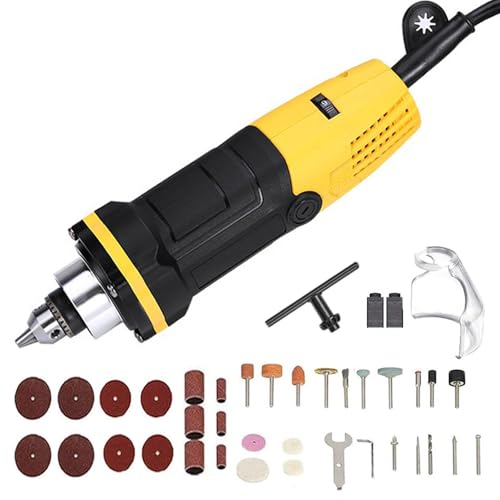
VOTOER 500W Electric Mini Die Drill Grinder Carver
A 500W electric die grinder with 8,000 to 31,000 RPM, 6-step variable speed, a three claw chuck and 35 attachments in the set.
Pros
- 500W motor with speeds from 8,000 to 31,000 RPM
- 6-step variable speed for different jobs
- 35 attachments included in the set
- Removable transparent safety guard redirects debris and sparks
Cons
- No weight stated
- No warranty term stated
- Chuck range tops out at 6.5 mm, so larger shank bits do not fit
- 6 speed steps are fixed settings, not stepless control
AOBEN Power Electric Die Grinder Tool, 28000 RPM
A corded electric die grinder with up to 28,000 RPM, a 1/4 in collet and a paddle switch that turns the tool off when released.
Pros
- Up to 28,000 RPM from a pure copper motor
- 1/4 in collet for standard grinding bits
- Paddle switch turns the tool off when released
- Straight-body design reaches tight areas
Cons
- No weight stated
- No warranty term stated
- Corded, so it needs an outlet at the bench
- No attachments stated with the tool
Ingersoll Rand 5208MAX 1/4" Collet Air Die Grinder
A 1/4 in collet air die grinder with a 0.4HP motor, up to 25,000 rpm, lube-free vanes and a 1.4 pound body.
Pros
- 0.4HP motor with speeds up to 25,000 rpm
- Lube-free vanes, no daily oiling
- Weighs 1.4 pounds with an ergonomic grip
- Low profile level throttle for extended use
Cons
- 25,000 rpm is the lowest stated free speed here
- Needs a compressor and an air line
- Warranty states no concrete term
- No box contents stated
Other tools worth a look
 Ingersoll Rand 3107G 1/4" Collet Air Die GrinderCheck price on Amazon
 WORKPRO Air Angle Die GrinderCheck price on Amazon
 Angle air die grinder 1/4" with 4 pcs 2" roll lock sandingCheck price on Amazon
 Makita GD0603 1/4" Compact Die GrinderCheck price on Amazon
 DEWALT Die GrinderCheck price on Amazon
 Makita GD0800C 1/4" SJS™ Die GrinderCheck price on Amazon
Air vs electric die grinder side by side
| Air die grinder | Electric die grinder (AOBEN) | Electric die grinder (VOTOER) | |
|---|---|---|---|
| Power source | Compressed air | Electricity | Electricity |
| Example speed | Up to 25,000 rpm | Up to 28,000 RPM | 8,000 to 31,000 RPM |
| Motor | 0.4HP (0.3kW) | Pure copper motor | 500W |
| Collet or chuck | 1/4 in collet | 1/4 in collet | Three claw chuck, 0.6-6.5 mm |
| Weight | 1.4 pounds | Not stated | Not stated |
| Speed control | Low profile level throttle | Paddle switch | 6-step variable speed |
| Attachments stated | Not stated | Not stated | 35 attachments |
| Oiling | Lube-free vanes, no daily oiling | Not stated | Not stated |
These numbers are the tool makers’ rated figures, as their listings print them on 15 November 2026.
How each one is powered
An air die grinder runs on compressed air from a compressor, so it needs an air line and no power cord. The Ingersoll Rand example weighs 1.4 pounds and measures 9.6 by 2.56 by 1.6 inches, which suits tight spots. An electric die grinder carries its own motor, so there is no compressor to run and no air line to drag. The AOBEN example is a corded straight grinder that plugs into an outlet, and the VOTOER example runs on a 500W motor.
Speed and control
Speed figures are stated on both sides. The Ingersoll Rand example lists a max free speed of up to 25,000 rpm. The AOBEN example lists up to 28,000 RPM, and the VOTOER example lists a range from 8,000 to 31,000 RPM with 6-step variable speed. A higher stated speed is not a win by itself: the VOTOER example pairs its range with a step control, the AOBEN example with a paddle switch that turns the tool off when released, and the Ingersoll Rand example with a low profile level throttle.
Collet and chuck
The Ingersoll Rand example and the AOBEN example each list a 1/4 in collet, so 1/4 in shank bits fit either. The VOTOER example takes a different route with a three claw chuck and a 0.6-6.5 mm range, which holds more accessory types. Check the collet or chuck range against the bits on the bench before ordering.
Weight, size and what is in the box
Weight is stated for one example only: the Ingersoll Rand example weighs 1.4 pounds. The AOBEN example and the VOTOER example state no weight, so the listings leave that comparison unclear. The VOTOER example is the only one that states what comes with it: 35 attachments in the set. The Ingersoll Rand example states lube-free vanes, which the maker says removes the need for daily oiling.
Where each side fits
Air suits a garage that already has a compressor running, and the Ingersoll Rand example is light at 1.4 pounds with a low profile level throttle for extended work in tight spaces. Electric suits a garage without a compressor, or a job away from the air line. The VOTOER example adds a removable transparent safety guard, and the AOBEN example adds a paddle switch for direct control. Either side grinds and polishes metal; the choice turns on the power already in the garage and the control each example offers.
Choose an air die grinder if
- You already run a compressor in the garage
- You want the light 1.4 pound Ingersoll Rand example for tight spaces
- You would rather skip daily oiling
- Your bits fit a 1/4 in collet
Choose an electric die grinder if
- You have no compressor to run
- You want the 6-step variable speed of the VOTOER example
- You want the paddle switch of the AOBEN example or the safety guard of the VOTOER example
- You want the 35 attachments of the VOTOER set
For more choices, see the best air die grinder under 100 and the brushless vs brushed die grinder comparison, plus the die grinder vs rotary tool guide.
Wear eye protection with every air tool, use impact-rated sockets on impact wrenches, disconnect the air line before changing accessories, and finish lug nuts with a torque wrench to the vehicle's spec. See OSHA eye and face protection. Read our Safety Disclaimer.
Garage Fit Check
- Air supply: the Ingersoll Rand example runs on compressed air, so check the compressor and hose reach before the first job.
- Power: the AOBEN example is corded, so check the outlet and cord reach. The VOTOER example runs on a 500W motor.
- Bits: the Ingersoll Rand and AOBEN examples take a 1/4 in collet, while the VOTOER example takes a three claw chuck with a 0.6-6.5 mm range.
- Attachments: the VOTOER set includes 35 attachments, so keep the guard and bits together.
- Size: the Ingersoll Rand example measures 9.6 by 2.56 by 1.6 inches and weighs 1.4 pounds, so check the shelf space it needs.
FAQ: garage tools
Is an air or electric die grinder better for a home garage?
It depends on the power already in the garage. Air suits a garage with a compressor running, and the Ingersoll Rand example is light at 1.4 pounds. Electric suits a garage without a compressor, with stated speeds up to 28,000 RPM and 31,000 RPM.
Do I need a compressor for an air die grinder?
Yes. An air die grinder runs on compressed air, so it needs a compressor and an air line. The Ingersoll Rand example states lube-free vanes, which the maker says removes the need for daily oiling.
What collet size do these die grinders take?
The Ingersoll Rand example and the AOBEN example each list a 1/4 in collet. The VOTOER example uses a three claw chuck with a 0.6-6.5 mm range instead.
Which die grinder has the highest stated speed?
By stated speed, the VOTOER example lists up to 31,000 RPM, the AOBEN example up to 28,000 RPM, and the Ingersoll Rand example up to 25,000 rpm. Speed alone does not decide the job: control, collet fit and power source matter as much.
What comes with the VOTOER die grinder?
The maker states 35 attachments in the set, a removable transparent safety guard, and a three claw chuck. The other examples state no box contents.
Related: the best air die grinder under 100, the brushless vs brushed die grinder comparison, the die grinder vs rotary tool guide and the corded vs cordless die grinder guide.