Anti Seize vs Thread Locker: Which One Should You Buy?
Anti seize vs thread locker explained: when a fastener must come apart again, when it must stay put, and four anti-seize products compared by temperature range and uses.

On this page
Top picks at a glance
As an Amazon Associate I earn from qualifying purchases.
- 1
 Permatex 80078 Anti-Seize Lubricant with Brush Top Bottle9.5/10View on Amazon
- 2
 Permatex 25210 High Strength Orange Threadlocker9.7/10View on Amazon
- 3
 BTAS Copper Anti Seize Thread Lubricant High Temp Never Seize9.4/10View on Amazon
- 4
 Loctite 34395 Marine Grade Anti-Seize Compound 1 EachView on Amazon
- 5
 Loctite 77124 Nickel Anti-SeizeView on Amazon
- 6
 ESKONKE 3 Pack Thread Locker Blue 243 + Red 271 Removable &View on Amazon
- 7
 ESKONKE Thread Locker Blue 243View on Amazon
- 8
 Loctite 88442 Red 272 High Temperature/Strength Thread LockerView on Amazon
- 9
 Loctite 37617 Silver-Grade Anti-Seize StickView on Amazon
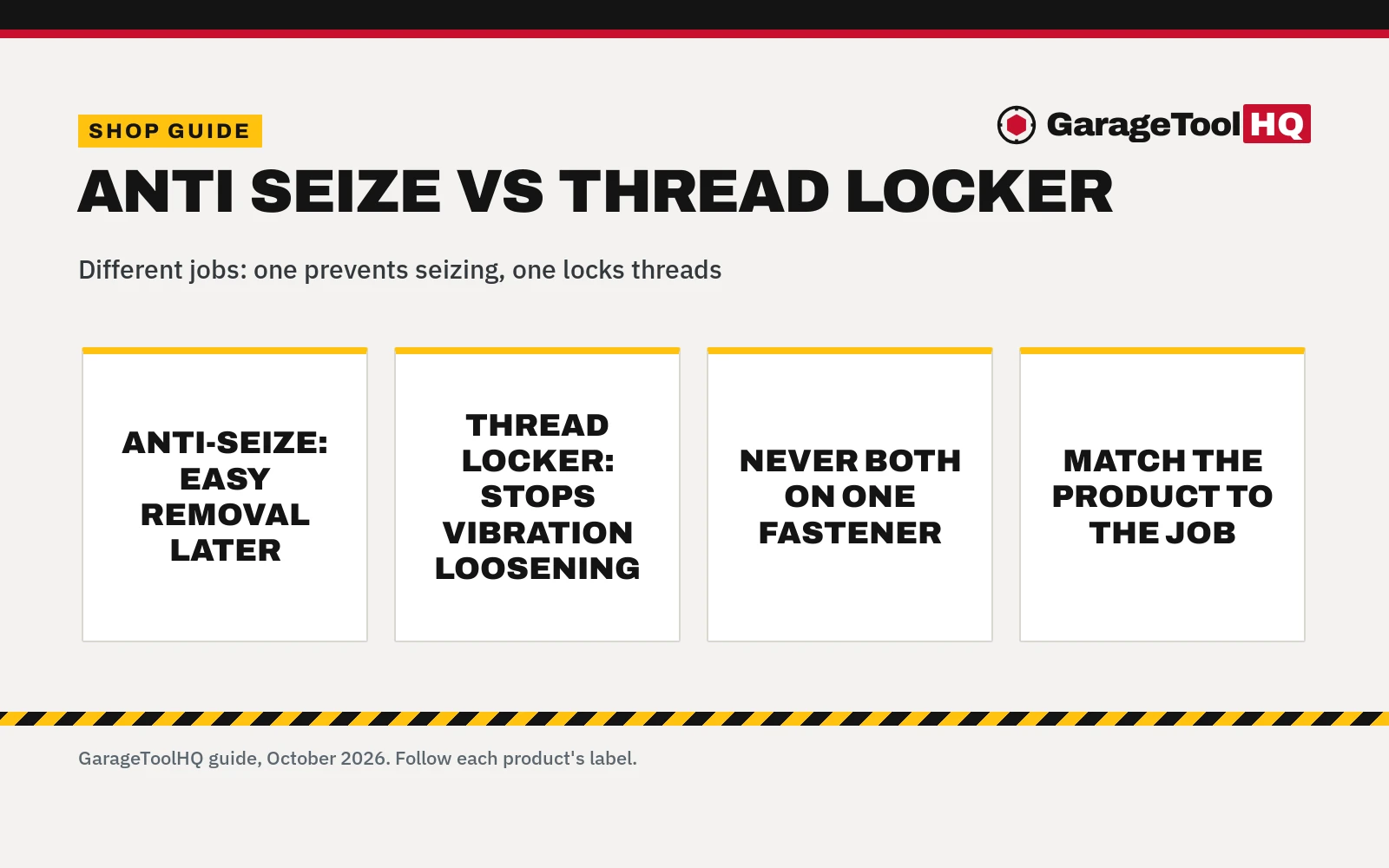
Anti seize vs thread locker: use anti-seize when a fastener must come apart again later, and use thread locker when a fastener must stay put against vibration. They do opposite jobs. Anti-seize is a lubricant that prevents galling, corrosion and seizing so spark plugs, exhaust bolts and lug nuts come off more easily at the next service. Thread locker is an adhesive that locks threads together so a fastener resists shaking loose. Never use both on the same fastener, since one frees threads and the other glues them.
Other tools worth a look
 Loctite 34395 Marine Grade Anti-Seize Compound 1 EachCheck price on Amazon
 Loctite 77124 Nickel Anti-SeizeCheck price on Amazon
 ESKONKE 3 Pack Thread Locker Blue 243 + Red 271 Removable &Check price on Amazon
 ESKONKE Thread Locker Blue 243Check price on Amazon
 Loctite 88442 Red 272 High Temperature/Strength Thread LockerCheck price on Amazon
 Loctite 37617 Silver-Grade Anti-Seize StickCheck price on Amazon
GarageToolHQ earns a commission when you buy through links on our product pages, at no extra cost to you. Read our affiliate disclosure.
Below: how the two products differ, when each one belongs on a fastener, and the four anti-seize products in the data, ranked by temperature range and stated uses.
Anti seize vs thread locker: what each one does
Anti-seize coats threads with a metal-filled lubricant. The Permatex 12-pack listing describes a blend of aluminum, copper and graphite lubricants that resists salt, corrosion and moisture, while the Keze listing describes copper powder with lithium composite and petroleum distillates, and the BTAS listing describes a semi-synthetic grease infused with micro copper flakes. The shared job across the listings is protection from galling, corrosion and seizing; the Keze, BTAS and 12-pack listings also state easier removal or disassembly. Thread locker works the other way: it fills the thread gaps and hardens, holding the fastener against vibration. That is why the choice is about the job, not about which product is stronger in general.
| Product | How it works | Reach for it when |
|---|---|---|
| Anti-seize | Lubricates threads, resists corrosion and seizing | The fastener must come off again at the next service |
| Thread locker | Locks threads against vibration | The fastener must not shake loose in service |
When to use anti-seize
Use anti-seize on fasteners that live in heat, moisture or corrosive conditions and will need removal later. The listings name spark plug threads, exhaust manifold studs and bolts, lug nuts, brake assemblies, oxygen sensors, bushings and thermostat housing bolts. The Permatex 12-pack listing adds cylinder head and exhaust head bolts and marine use, and the Keze listing adds brake guide pins, brake hub bolts and lawnmower parts. The BTAS listing adds wheel hub nuts, brake pad bolts, engine bolts, knock sensors and battery cable connections, and notes that only a neat, thin film is needed. If the fastener is one you will fight with at the next service, anti-seize is the right call.
When to use thread locker instead
Use thread locker on fasteners that must not move once torqued, especially where vibration is the enemy. Think of fasteners whose failure mode is loosening, not seizing: brackets, mounts and hardware where vibration, not corrosion, is the problem. Do not use thread locker as a substitute for anti-seize on exhaust and spark plug threads, where heat and corrosion make future removal the problem. And do not coat a fastener with both products: the lubricant defeats the locking action, and the adhesive defeats the easy removal. Pick the failure mode you are preventing, then pick the product. A strong thread locker guide covers locking products in more detail.
The anti-seize products in the data, ranked
Keze Anti Seize Lubricant, 8 oz. A range of -30°F to 1800°F, tied with BTAS for the highest top end here, with a bottle brush for application, and the broadest stated uses: spark plug threads, lug nuts, brake assemblies, bushings, oxygen sensors, exhaust manifold studs, brake guide pins, brake hub bolts and lawnmower parts. It also claims salt and moisture resistance for marine, heavy-duty and industrial engines.
BTAS Copper Antiseize Grease, 8 oz. The same -30°F to 1800°F range, with micro copper flakes for conductivity and anti-oxidation, plus rust and corrosion inhibitors for damp conditions. Its stated uses run from spark plug threads and wheel hub nuts to knock sensors, thermostat housing bolts and battery cable connections, and the listing stresses a thin film only.
Permatex 80078, 8 oz bottle. Withstands temperatures up to 1,600 °F, with a liquid formula for smooth, even coverage on lug nuts, fasteners and threaded connections. The listing names aluminum and stainless steel surfaces and fleet and plant maintenance, and the single 8 fl. oz. can fits a toolbox for quick access.
Permatex 80078-12PK, 8 oz, pack of 12. The aluminum, copper and graphite blend the 12-pack listing states, rated from -60F to 1600F, with salt, corrosion and moisture resistance for marine use. The pack format suits a shop that goes through anti-seize steadily, while a home garage will likely do better with the single bottle. A ceramic anti-seize guide covers a different formulation for high-heat work.
Use rated jack stands on solid ground, wear eye protection with power and air tools, keep fuel-burning equipment out of a closed garage, and follow the manual for every tool. Read our Safety Disclaimer.
FAQ: garage tools
Can I use anti-seize and thread locker together?
No. Anti-seize lubricates threads so they come apart later, while thread locker holds threads so they do not move. Using both on one fastener fights itself: the lubricant weakens the lock and the adhesive weakens the easy removal.
Which anti-seize here handles the highest temperature?
The Keze and BTAS listings both state a range of -30°F to 1800°F, the highest top end in this group. The Permatex listings state up to 1,600 °F, with the 12-pack rated from -60F to 1600F.
Does anti-seize belong on spark plug threads?
The 12-pack, Keze and BTAS listings name spark plug threads among their suggested uses, along with exhaust bolts, lug nuts and brake parts. Follow the plug and vehicle maker’s guidance for the specific application, since the listings state uses, not torque figures.
How much anti-seize should I apply?
The BTAS listing states the method plainly: clean off excess dirt or grease, apply the product, wipe away any excess, and leave only a neat, thin film. More is not better on threads.
Which product suits a home garage best?
The single 8 oz bottles suit a home garage: the Keze for its -30°F to 1800°F range and brush bottle, the BTAS for conductivity and damp conditions, or the Permatex single bottle for a liquid formula in a toolbox-sized can. The 12-pack suits a shop that uses anti-seize steadily.
Related: strong thread locker, ceramic anti-seize, spark plug gap tool and the engine and shop equipment hub.