Auto Body Repair Hammer: Types and How to Choose
An auto body repair hammer moves sheet metal a little at a time with a dolly behind the panel: bumping, pick and finish and reverse curve hammers, and how to choose a set.

On this page
Top picks at a glance
As an Amazon Associate I earn from qualifying purchases.
- 1
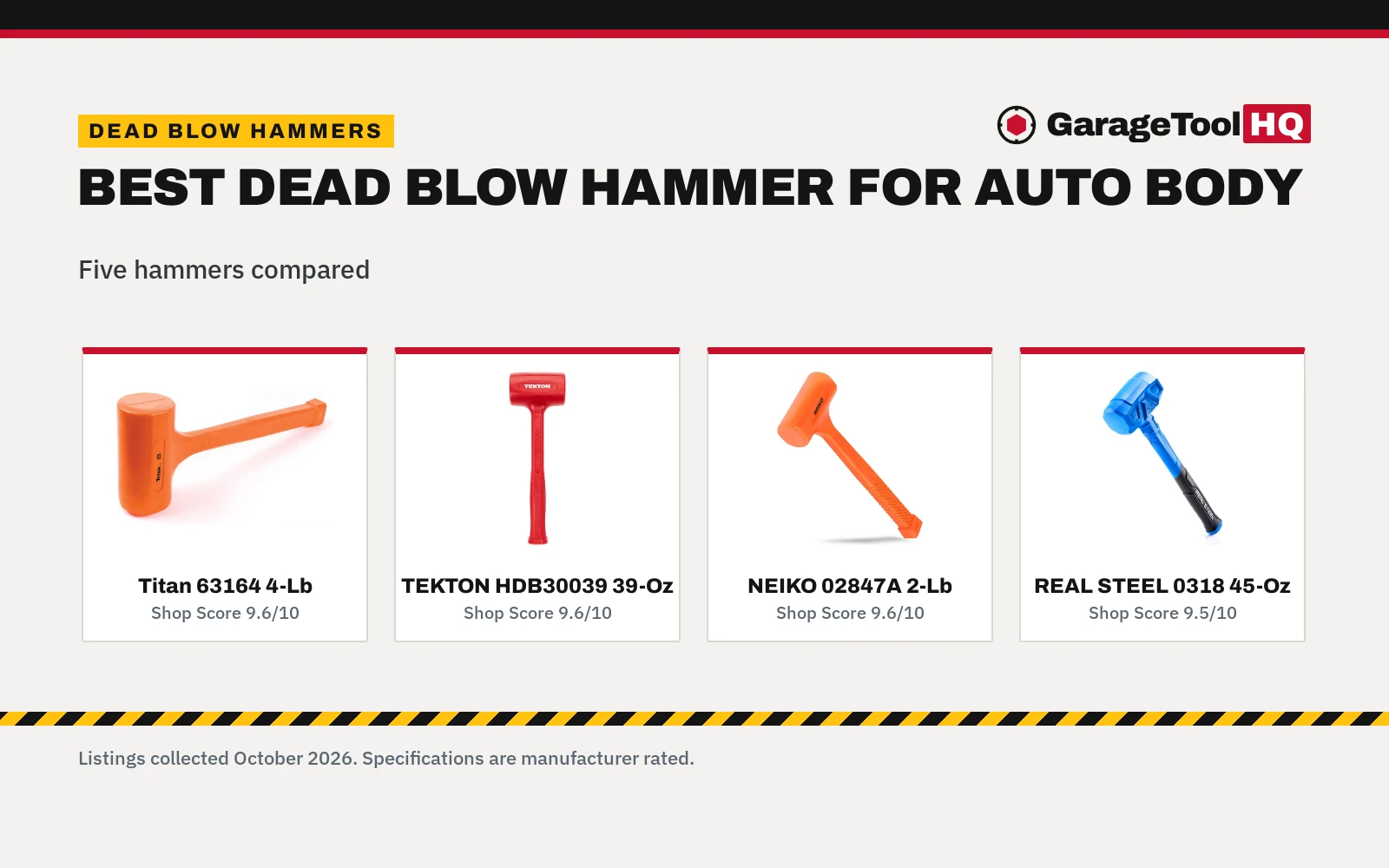
 XtremepowerUS 32oz Dead Blow Hammer Dual Head 2lbs Pound Ball9.5/10View on Amazon
- 2
 Titan 63164 4lb Dead Blow Hammer with Steel Shot Filled Head9.6/10View on Amazon
- 3
 TEKTON 39 oz. Dead Blow Hammer9.6/10View on Amazon
A dent in a fender looks like a job for a hammer, and it is, but not the kind of hammer that hangs on a pegboard for nails. An auto body repair hammer is a light, flat-faced hammer made to move sheet metal a little at a time, working with a dolly held behind the panel. This guide explains the hammers in a standard kit, what each dolly does, and how to choose a set for the garage.
GarageToolHQ earns a commission when you buy through links on our product pages, at no extra cost to you. Read our affiliate disclosure.
Below: what an auto body repair hammer is, the hammers and dollies in a standard kit, how the pair works a dent out, and how to choose a set.
Auto body repair hammer: what it is and what it is not
An auto body repair hammer moves sheet metal, it does not drive nails or break things loose. The head is flat and smooth, so it spreads each blow across the panel instead of marking it, and the handle is sized for light, controlled taps rather than heavy swings. The hammer works with a dolly, a shaped block of steel held behind the panel, so the metal is pressed between the two tools. Used together, hammer and dolly flatten high spots, raise low spots and smooth the panel back toward its shape.
The hammers and dollies in a standard kit
| Tool | What it does | When to reach for it |
|---|---|---|
| Standard bumping hammer | Flattens high spots and shapes panels | General dent work on fenders, doors and bumpers |
| Pick and finish hammer | Raises small low spots, then finishes the surface | Small dings that need a light lift before finishing |
| Reverse curve hammer | Works curved panels and edges | Panels and edges with a curve the flat face cannot match |
| Curved dolly | Backs curved metal from behind | Circular and curved shapes in the panel |
| Utility dolly | General backing for flat and curved areas | Everyday shaping where no special curve is needed |
| Double-end hand dolly | Two shapes in one tool | Switching between two curves without changing tools |
| Shrink dolly | Shrinks stretched metal | Metal that has stretched out of shape around a dent |
Most kits hold 7 pieces: 3 hammers and 4 dollies. Larger kits hold 9 pieces, with 4 hammers and 5 dollies or spoons. The LALO&KODA 9-piece kit lists a chisel and finishing hammer, a door skin hammer, 3 dollies and 2 spoons. The 9-piece kits suit a shop that sees more panel shapes, while a 7-piece kit covers the common dent work on fenders, doors and bumpers.
How hammer and dolly work a dent out
- Clean the panel and look at the dent from the side, so the high and low spots show before any hammering starts.
- Hold the dolly behind the low spot and tap the high spot around it with the flat face of the bumping hammer.
- Work from the edges of the dent toward the middle, with light taps, checking the panel often as it moves.
- Use the pick end only on small low spots, then finish with the flat face so the surface stays smooth.
- Stop when the panel reads flat to the eye and the hand, and leave filler and paint for the next stage of the repair.
Do not hit a panel with the hammer unless a dolly sits behind it. Without the dolly the blow stretches the metal instead of shaping it, and the dent gets worse.
Read the manual before first use, wear eye protection, keep the work area clear and ventilated, and stay within every stated rating. Read our Safety Disclaimer.
Choosing a set: handles, steel and case
Handles come in fiberglass, hardwood and hickory, with rubber non-slip grips on some sets. Fiberglass handles resist weather and give a firm hold, hardwood and hickory handles absorb vibration, and rubber grips add hold when hands are slick. Heads and dollies are carbon steel, heat-treated or forged, with a rust-resistant coating on several sets. A blow-molded case keeps each tool in its own compartment, while a cardboard box still stores the set. Kits list warranties of 1 year on several sets and 3 months on one, so check the warranty before ordering.
Weight matters when the set travels: the NEIKO kit (on Amazon) lists 11.0 lb and the LALO&KODA 9-piece kit lists 20.0 lb. The Hiceeden kit (on Amazon) lists an 11.6-inch standard bumping hammer, the longest stated hammer length in this guide. Match the kit to the work: a 7-piece kit for common dents, a 9-piece kit when the shop sees more panel shapes.
FAQ: garage tools
What is an auto body repair hammer?
A light, flat-faced hammer for moving sheet metal, used with a dolly held behind the panel. It taps high spots down and raises low spots a little at a time, without the force of a framing or ball peen hammer.
What is a dolly in auto body repair?
A shaped block of steel held behind the panel while the hammer taps from the front. The metal is pressed between hammer and dolly, which flattens and shapes it. Common shapes are curved, utility, double-end hand and shrink dollies.
How many pieces are in a body hammer kit?
Most kits hold 7 pieces: 3 hammers and 4 dollies. Larger kits hold 9 pieces, with 4 hammers and 5 dollies or spoons.
Can a body hammer fix a dent without paint work?
It can move the metal back toward shape, but paint that is cracked or missing still needs paint work. A hammer and dolly move metal, not paint, so check the paint after the metal is straight.
What handles are best on a body hammer?
Fiberglass handles are common and give a firm, weather-resistant hold, while hardwood and hickory handles absorb vibration. Rubber non-slip grips add hold. Pick the handle that feels secure in the hand, since control matters more than material.
Related: best body hammer and dolly set, the car dent repair puller guide, DIY dent puller options, best rubber mallet for auto body and the engine and shop equipment hub.