Bar Clamp vs C Clamp: Which One Should You Buy?
Bar clamps slide along a bar for long reach, while C clamps grip an edge with a fixed frame, compared with three bar clamps from the listings.

On this page
Top picks at a glance
As an Amazon Associate I earn from qualifying purchases.
- 1
 VEVOR 36" Bar Clamps for Woodworking9.7/10View on Amazon
- 2
 4 Pcs C Clamp Set 8 Inch Heavy Duty G-Clamps Automotive and9.7/10View on Amazon
- 3
 Jorgensen 24" Medium-Duty Steel Bar Clamp Set9.6/10View on Amazon
- 4
 HORUSDY 8-Pack Bar Clamps for WoodworkingView on Amazon
- 5
 HORUSDY 6-Pack Wood Clamps for WoodworkingView on Amazon
- 6
 IRWIN Quick-Grip 1964758 One-Handed Mini Bar Clamp 4 PackView on Amazon
- 7
 IRWINQUICK-GRIPOne-Handed Mini Bar Clamp 2 PackView on Amazon
- 8
 VEVOR 36" Bar Clamps for WoodworkingView on Amazon
- 9
 WORKPRO 6" Mini Bar Clamps for WoodworkingView on Amazon
Bar clamp vs C clamp: which should you buy? A bar clamp usually wins for long glue-ups, while a C clamp wins for gripping an edge with a fixed frame. The right choice depends on reach, force and the shape of the workpiece, not on which clamp looks stronger on the shelf.
Other tools worth a look
 HORUSDY 8-Pack Bar Clamps for WoodworkingCheck price on Amazon
 HORUSDY 6-Pack Wood Clamps for WoodworkingCheck price on Amazon
 IRWIN Quick-Grip 1964758 One-Handed Mini Bar Clamp 4 PackCheck price on Amazon
 IRWINQUICK-GRIPOne-Handed Mini Bar Clamp 2 PackCheck price on Amazon
 VEVOR 36" Bar Clamps for WoodworkingCheck price on Amazon
 WORKPRO 6" Mini Bar Clamps for WoodworkingCheck price on Amazon
GarageToolHQ earns a commission when you buy through links on our product pages, at no extra cost to you. Read our affiliate disclosure.
Below: how the two shapes differ, what to check before buying, and three bar clamps from the listings, listed strongest first.
Bar clamp vs C clamp: how the two shapes differ
A bar clamp slides one jaw along a bar, so the opening adjusts across a long range and the clamp can reach across a panel or a frame. Many bar clamps are F-clamps, with a fixed jaw at one end and a sliding jaw that locks along the bar. A C clamp, by contrast, is a fixed C-shaped frame with a screw that closes the gap, so it grips an edge or a small part from one side and holds it tight.
The practical difference is reach against grip. A bar clamp suits work where the jaws must span a distance, such as holding boards together while glue sets or holding a frame square. A C clamp suits work where the part is near an edge and the clamp must bite down hard in a compact space. One listing here also shows a second use: the HORUSDY clamp can act as a spreader when the jaws are reversed, pushing parts apart instead of pulling them together.
| Type | How it works | Reach | Typical job |
|---|---|---|---|
| Bar clamp | Sliding jaw locks along a bar | Long, set by bar length | Panels, frames, glue-ups |
| C clamp | Screw closes a fixed C frame | Short, set by frame size | Gripping an edge or a small part |
What to check before buying
Opening comes first. The bar clamp listings here span a wide range, from a 6″ mini clamp for smaller workpieces and confined areas to a 36″ clamp for standard-sized woods and larger panels. Match the opening to the widest piece the clamp must span, with room to position the jaws where they hold best, rather than buying the longest bar on the shelf for every job.
Force comes second. The listings here state clamping force from 140 lbs up to 600 lbs. A lighter clamp suits small glue-ups and home repairs, while a heavier clamp suits large panels, cabinets and steel materials. Force alone does not decide a purchase: jaw material, bar material and pad design decide whether that force lands evenly and without marking the work.
Materials and pads come third. The listings describe nylon bodies, resin construction, hardened steel bars, cast iron jaws and carbon steel slide bars. Pads matter too: the IRWIN listing states non-marring pads that protect the workpiece from scratches and scuffs, and the HORUSDY listing describes a pad with a flexible material and a non-slip texture. Check pad and bar material for the work in hand, especially when the workpiece must stay unmarked.
Pack size and extras come last. The listings here offer a 4-pack of mini clamps, an 8-pack mixing sizes and spring clamps, and a 4-pack of large clamps. A mixed set covers more jobs in a home garage, while a set of large clamps suits repeated panel work. Spreader function, quick-release design and one-handed operation are worth weighing when the work involves holding a part with one hand while positioning it with the other.
The gear: three bar clamps from the listings
VEVOR 36″ Bar Clamps, 4-Pack
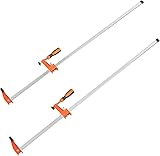
The VEVOR set is the strongest here, with a 600 lbs load limit and a 36-inch jaw opening, in a 4-pack. The jaws are cast iron, described as sturdy and not easy to deform, and the slide bar is 45# carbon structural steel, described as long-lasting and crack-proof. The depth is 2-1/2 inch, and the listing states the clamps suit wood, wood products such as tables, chairs and cabinets, and steel materials, for cutting, joining and installing work. An extended rod design is listed for meeting the operating range needs of different thicknesses.
That strength and reach suit large panels and assembly work, where a smaller clamp would run out of opening or force. The trade-off is size and weight for small jobs: a 36″ clamp is more tool than a small glue-up needs, and the listing states no spring clamp or spreader function. Buy this set for large work, not as the only clamps in a small garage.
HORUSDY 8-Pack Bar Clamps, 6″ and 12″
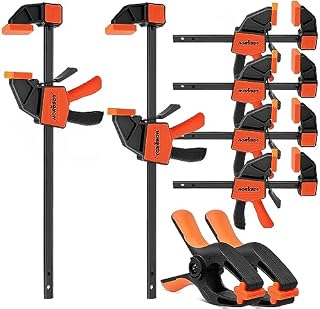
The HORUSDY set is the most versatile here, with an 8-pack that includes 4pcs 6″ bar clamps, 2pcs 12″ bar clamps and 2pcs 6″ spring clamps. The 6″ clamps suit spreaders up to 11-9/64″ and the 12″ clamps suit spreaders up to 17-21/64″, with up to 150 lbs of squeeze capacity. The body is strong nylon with a high-quality hardened steel bar, and a quick-change button design lets the F-clamp function as a spreader: push the red button, remove the jaws, reverse them and put them back in place.
That mix covers small repairs, medium glue-ups and spreading jobs in one set, with a metal ratchet construction and a pad of flexible material with a non-slip texture. The trade-off is force: at 150 lbs, this set does not match the VEVOR set for heavy assembly. Buy this set when one purchase must cover the most jobs in a home garage.
IRWIN Quick-Grip Mini Bar Clamp, 4-Pack, 6″
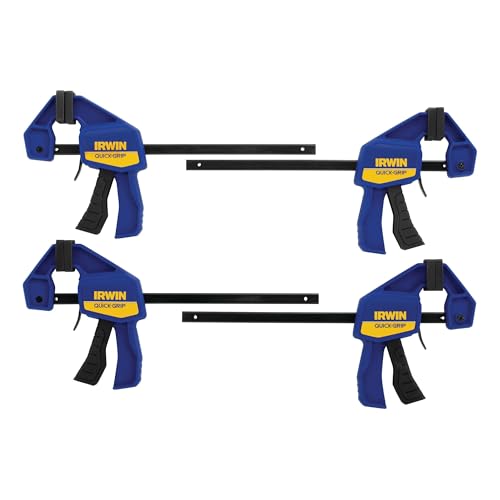
The IRWIN set is the specialist for small and confined work, with a 4-pack of one-handed mini bar clamps in 6″. The design uses one-handed triggers that release the clamps instantly, with a patented pistol grip for comfort, and resin construction with hardened steel bars to prevent flexing and bending. Non-marring pads grip firmly while protecting the workpiece from scratches and scuffs, and the listing states the clamps are 25% smaller than regular IRWIN QUICK-GRIP clamps, for smaller projects or confined spaces.
One point needs care: the listing states both 140LBS of force and 150LBS of force in different bullets, with a further bullet stating up to 150 lbs of clamping pressure, so the force figure should be read as stated in the listing rather than as a single settled number. The listing also states backing by the IRWIN lifetime guarantee. Buy this set for small workpieces and tight spaces, where one-handed use and non-marring pads matter more than a long bar.
Use rated jack stands on solid ground, wear eye protection with power and air tools, keep fuel-burning equipment out of a closed garage, and follow the manual for every tool. Read our Safety Disclaimer.
FAQ: garage tools
Can a bar clamp work as a spreader?
Yes, where the listing states it. The HORUSDY listing describes a quick-change button design that lets the F-clamp function as a spreader by reversing the jaws. Not every bar clamp listing here states that function, so check the listing for the exact model before counting on it.
What size bar clamp do I need?
Match the opening to the workpiece. The listings here offer 6″ clamps for smaller workpieces and confined areas, 12″ clamps for medium work, and 36″ clamps for standard-sized woods and larger panels. A clamp that just spans the piece leaves little room to position the jaws, so allow room beyond the widest point the clamp must hold.
Do bar clamps mark the workpiece?
They can, which is why pads matter. The IRWIN listing states non-marring pads that protect against scratches and scuffs, and the HORUSDY listing describes a flexible pad material with a non-slip texture. Check the pad description for the model in hand, and keep pads clean, since grit trapped under a pad can mark a surface.
Are bar clamps good for metalwork?
The VEVOR listing states its clamps suit steel materials as well as wood and wood products, with cast iron jaws and a carbon steel slide bar. Other listings here focus on woodworking and home repairs, so match the clamp to the material: a clamp listed for wood only should not be assumed suitable for steel work.
How much clamping force do I need?
The listings here range from 140 lbs up to 600 lbs. Smaller glue-ups and home repairs suit the lower end, while large panels, cabinets and steel materials suit the higher end. Force should be weighed with opening, jaw material and pad design, since a high force on a poor pad can damage the work it is meant to hold.
Related: C clamp vs F clamp, the best C clamp set, the best metal bar clamp, brake pad spreader vs C clamp and the engine and shop equipment hub.