Best Car Battery Desulfator (2026): 4 Picks Compared
4 car battery desulfators, 2 pulse devices and 2 liquid additives, compared by voltage range, capacity, safety features and warranty.

On this page
Top picks at a glance
As an Amazon Associate I earn from qualifying purchases.
- 1
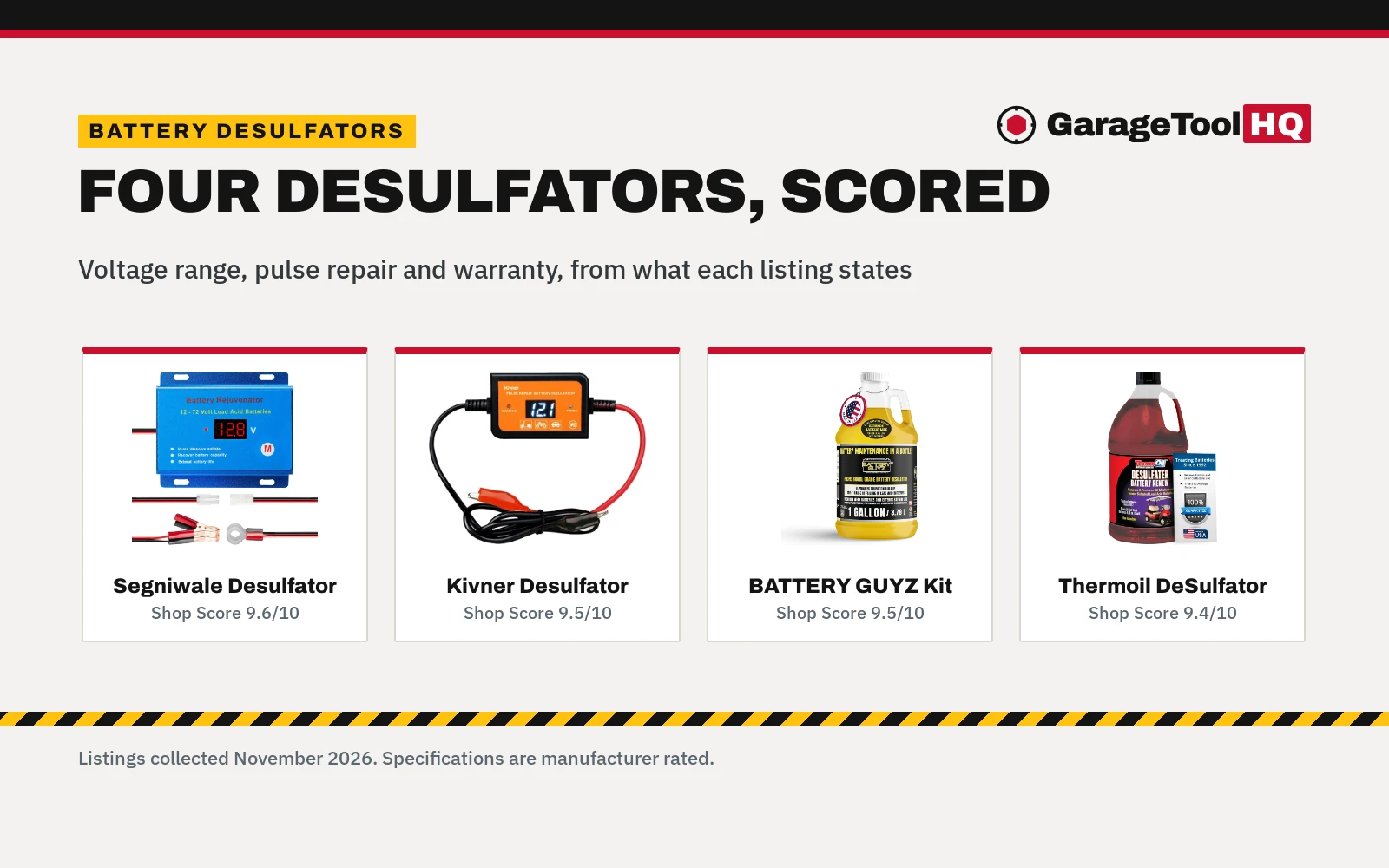
 Best OverallSegniwale Desulfator9.6/10View on Amazon
- 2
 Best Auto-SettingKivner Desulfator9.5/10View on Amazon
- 3
 Best KitBATTERY GUYZ Kit9.5/10View on Amazon
- 4
 Best Liquid AdditiveThermoil DeSulfator9.4/10View on Amazon
A car that cranks slow on a cold morning often has a battery with sulfate on its plates, and a new battery is not the only answer. A desulfator works on the sulfate that builds up in a lead-acid battery, and the best car battery desulfator is the desulfator that fits the battery voltage, the battery type, and the way the owner wants to work. This guide compares pulse desulfator devices and liquid additives for lead-acid batteries by voltage range, capacity, safety features and warranty.
GarageToolHQ earns a commission when you buy through links on this page, at no extra cost to you. Read our affiliate disclosure.
Quick picks
- Best Overall Segniwale Desulfator: A pulse desulfator for 12V to 72V lead-acid batteries, with reverse polarity protection, internal fuses and a rugged aluminum shell. Check price on Amazon
- Best Auto-Setting Kivner Desulfator: A 12V to 48V pulse desulfator for up to 400AH batteries, with automatic voltage recognition and a 2 year warranty. Check price on Amazon
- Best Kit BATTERY GUYZ Kit: A 1 gallon desulfator kit with gloves, a hydrometer and a funnel, for 6V to 48V golf cart and lead-acid batteries. Check price on Amazon
- Best Liquid Additive Thermoil DeSulfator: A 64 oz non-hazardous electrolyte additive for 12V lead-acid batteries, treating sulfation since 1992. Check price on Amazon
Picks for the garage

Battery Desulfator Reconditioner for 12V–72V
A pulse desulfator for 12V to 72V lead-acid batteries, with high-frequency low-current pulses, up to 30 cycles, and reverse polarity protection.
Pros
- Widest voltage range here: 12V, 24V, 36V, 48V, 60V and 72V
- Reverse polarity protection, internal fuses and smart low-voltage cutoffs
- Rugged aluminum shell for heat dissipation, per the listing
- Compatible with AGM, GEL, VRLA, SLA and flooded batteries
Cons
- No warranty term in the listing
- Bullets say low-current pulses while the spec table lists 30 A
- Takes 2 to 4 weeks to see improvements, per the listing
- Not a charger, so it needs a charging cycle for best results
400AH Lead-Acid Battery Desulfator Battery
A pulse desulfator for 12V to 48V lead-acid batteries up to 400AH, with automatic voltage recognition and a 2 year warranty.
Pros
- Automatic voltage recognition, with no manual setting
- Covers 12V to 48V batteries up to 400AH
- 2 year warranty stated in the listing
- High-frequency peak pulse to break down lead sulfate
Cons
- No safety features stated in the listing
- Takes 2 to 3 weeks to feel an improvement, per the listing
- Batteries below 11.5V must be charged first, per the listing
- No weight or dimensions stated beyond 2.9 by 1.9 by 1 in

Complete Battery Maintenance Kit
A 1 gallon desulfator kit with gloves, a hydrometer and a funnel, for 6V to 48V golf cart and lead-acid batteries, usable up to 10 times.
Pros
- 1 gallon kit with gloves, a hydrometer and a funnel included
- Covers 48V, 12V, 8V and 6V golf cart batteries
- Usable up to 10 times, per the listing
- 1 gallon per deep cycle battery, per the listing
Cons
- No warranty term in the listing
- Not effective for gel batteries, dry cells or frozen batteries
- Cannot repair a bad cell, per the listing
- Best results for batteries 1 to 5 years old, per the listing

DeSulfator Lead-Acid Battery Care Solution 64 oz
A 64 oz non-hazardous electrolyte additive for 12V lead-acid batteries, with no Epsom salts, treating sulfation since 1992.
Pros
- Non-hazardous formula, safe for all lead-acid batteries, per the listing
- Contains zero Epsom salts, per the listing
- Treating batteries since 1992, per the listing
- Add as an electrolyte additive, with no device to wire in
Cons
- No warranty term in the listing
- Listed for 12 volts only, with no wider voltage range
- Claims resistance elimination by up to 50 percent, with no method stated
- No size beyond 64 oz stated
Compared on paper
| Model | Shop Score | Type | Voltage range | Capacity | Warranty |
|---|---|---|---|---|---|
| Segniwale Desulfator | 9.6/10 | Pulse device | 12V to 72V | Not stated | Not stated |
| Kivner Desulfator | 9.5/10 | Pulse device | 12V to 48V | Max 400AH | 2 years |
| BATTERY GUYZ Kit | 9.5/10 | Liquid additive kit | 6V to 48V | 1 gallon | Not stated |
| Thermoil DeSulfator | 9.4/10 | Liquid additive | 12V | 64 oz | Not stated |
Specifications are manufacturer rated, as published on each listing and collected 28 October 2026. Where a listing contradicts itself, both figures are shown.
How scoring works
Each desulfator is scored on performance, build, value, safety and warranty, with the weights published on the method page. Only 2 listings state safety features, and only 1 states a warranty term.
| Product | Shop Score | Perf. /35 | Build /25 | Value /25 | Safety /10 | Warranty /5 |
|---|---|---|---|---|---|---|
| Segniwale Desulfator | 9.6 | 30 | 21 | 20 | 6 | 0 |
| Kivner Desulfator | 9.5 | 29 | 20 | 20 | 0 | 3 |
| BATTERY GUYZ Kit | 9.5 | 29 | 20 | 21 | 0 | 0 |
| Thermoil DeSulfator | 9.4 | 27 | 19 | 18 | 3 | 0 |
Scores run from 9.2 to 9.8: each product’s point total is placed on that range, so more points always means a higher score.
What the listings tell you
2 picks here are pulse devices and 2 are liquid additives. The Segniwale and Kivner devices send high-frequency pulses to the battery, while the Thermoil and BATTERY GUYZ liquids are added to the battery as an electrolyte additive. Every pick covers 12V, and the Segniwale covers the widest range at 12V to 72V.
Time is the honest difference. The Segniwale listing says it typically takes 2 to 4 weeks to see improvements, and the Kivner listing says 2 to 3 weeks. The BATTERY GUYZ listing says the solution cannot repair a bad cell, and gives voltage limits for replacement: a 12-volt battery below 11 volts, an 8-volt battery below 7 volts, or a 6-volt battery below 5 volts. A contradiction to note: the Segniwale bullets describe low-current pulses while the spec table lists an amperage of 30 A.
Buying guide: best car battery desulfator for the garage
This guide sits in the diagnostics and electrical range. The points below use only what the listings state.
Pulse device or liquid additive
A pulse device clips to the battery terminals and sends pulses while the battery charges, discharges or stands by. A liquid additive is poured into the battery as an electrolyte additive. The Segniwale and Kivner picks are devices, and the Thermoil and BATTERY GUYZ picks are liquids.
Voltage range
Match the range to the battery. The Thermoil liquid is listed for 12 volts. The Kivner device covers 12V to 48V, the BATTERY GUYZ kit covers 6V to 48V, and the Segniwale device covers 12V to 72V, naming 12V, 24V, 36V, 48V, 60V and 72V systems.
How long it takes
Desulfation is slow work, per the listings. The Segniwale listing says 2 to 4 weeks to see improvements, with up to 30 cycles of desulfation, and the Kivner listing says 2 to 3 weeks. The BATTERY GUYZ listing says to use the solution annually, up to 10 times.
Safety features
Only 2 listings state safety features. The Segniwale device lists smart low-voltage cutoffs, internal fuses, reverse polarity protection and a rugged aluminum shell, plus a RoHS specification. The Thermoil liquid is described as a non-hazardous formula, safe for all lead-acid batteries. The Kivner and BATTERY GUYZ listings state no safety features.
Warranty
Only the Kivner listing states a warranty term: 2 years. The other listings state no warranty term, so the warranty score for those picks is zero.
Lead-acid batteries can release hydrogen while charging, so charge in a ventilated space away from sparks and flames, connect positive first and negative last, set the charger to the battery type (flooded, AGM, gel, lithium), and wear eye protection. Read our Safety Disclaimer.
FAQ: garage tools
What does a battery desulfator do?
A desulfator works on the lead sulfate that builds up on battery plates. The Segniwale listing says its pulses prevent and dissolve lead sulfate buildup, and the Thermoil listing says its additive melts lead sulphate crystals. The Kivner listing says its peak pulse prevents lead sulfate crystals from sticking to the electrode and gradually decomposes them.
Does a battery desulfator work?
The listings describe gradual results, not instant ones. The Segniwale listing says it typically takes 2 to 4 weeks to see improvements, and the Kivner listing says 2 to 3 weeks. The BATTERY GUYZ listing says the solution cannot repair a bad cell, and that a battery below the stated voltage limits must be replaced.
Can a desulfator be used on a gel battery?
The listings disagree. The BATTERY GUYZ listing says the solution is not effective for gel batteries, while the Segniwale listing names GEL among the compatible battery types, along with AGM, VRLA, SLA and flooded. Check the listing for the battery type before ordering.
What voltage desulfator fits a car battery?
A car battery is 12V, and every pick here covers 12V. The Thermoil liquid is listed for 12 volts, the Kivner device covers 12V to 48V, the BATTERY GUYZ kit covers 6V to 48V, and the Segniwale device covers 12V to 72V.
How long does desulfation take?
The Segniwale listing says 2 to 4 weeks to see improvements, depending on the battery condition, with up to 30 cycles of desulfation. The Kivner listing says 2 to 3 weeks, depending on the use of the battery and the amount of lead sulfate crystals. The more crystals that have built up, the longer it takes, per the Kivner listing.
Related: the diagnostics and electrical hub, the battery disconnect switch for RV, and the battery cut off switch for car. Also see how much is a battery charger. Also see car battery charger problems. Also see types of battery terminals. Also see car battery maintenance charger. Also see manual battery disconnect switch. Also see how to clean corroded car battery. Also see the dielectric grease for battery terminals. Also see the battery terminal connectors. Also see deep cycle vs starting battery charger. Also see the smart battery charger. Also see the battery charger for lead acid batteries. Also see the battery hydrometer.