Car Battery Charger Problems and Fixes
Car battery charger problems traced in order: power, connection, battery condition and settings, with the figures the charger listings state.

On this page
Top picks at a glance
As an Amazon Associate I earn from qualifying purchases.
- 1
 Innova 1000 Bluetooth OBD2 Scanner for iPhone & Android9.5/10View on Amazon
- 2
 OTC 5609 Cylinder Leakage Tester Kit with Storage Case9.7/10View on Amazon
- 3
 Fluke 88V Deluxe Automotive Multimeter9.6/10View on Amazon
A charger that will not charge is a familiar garage frustration after a dead battery itself, and the cause is usually simple: no power at the outlet, clamps on the wrong terminals, a battery too flat for the charger to recognize, or a setting that does not match the battery. Car battery charger problems come down to power, connection, battery condition and settings, and most of them can be traced in order before the charger is blamed. The guide below walks through each problem in turn, with the figures the charger listings state, so the fix starts with a check instead of a guess.
GarageToolHQ earns a commission when you buy through links on our product pages, at no extra cost to you. Read our affiliate disclosure.
Below: the short list of problems, then each one in turn, and the questions owners ask most.
Car battery charger problems: what usually goes wrong
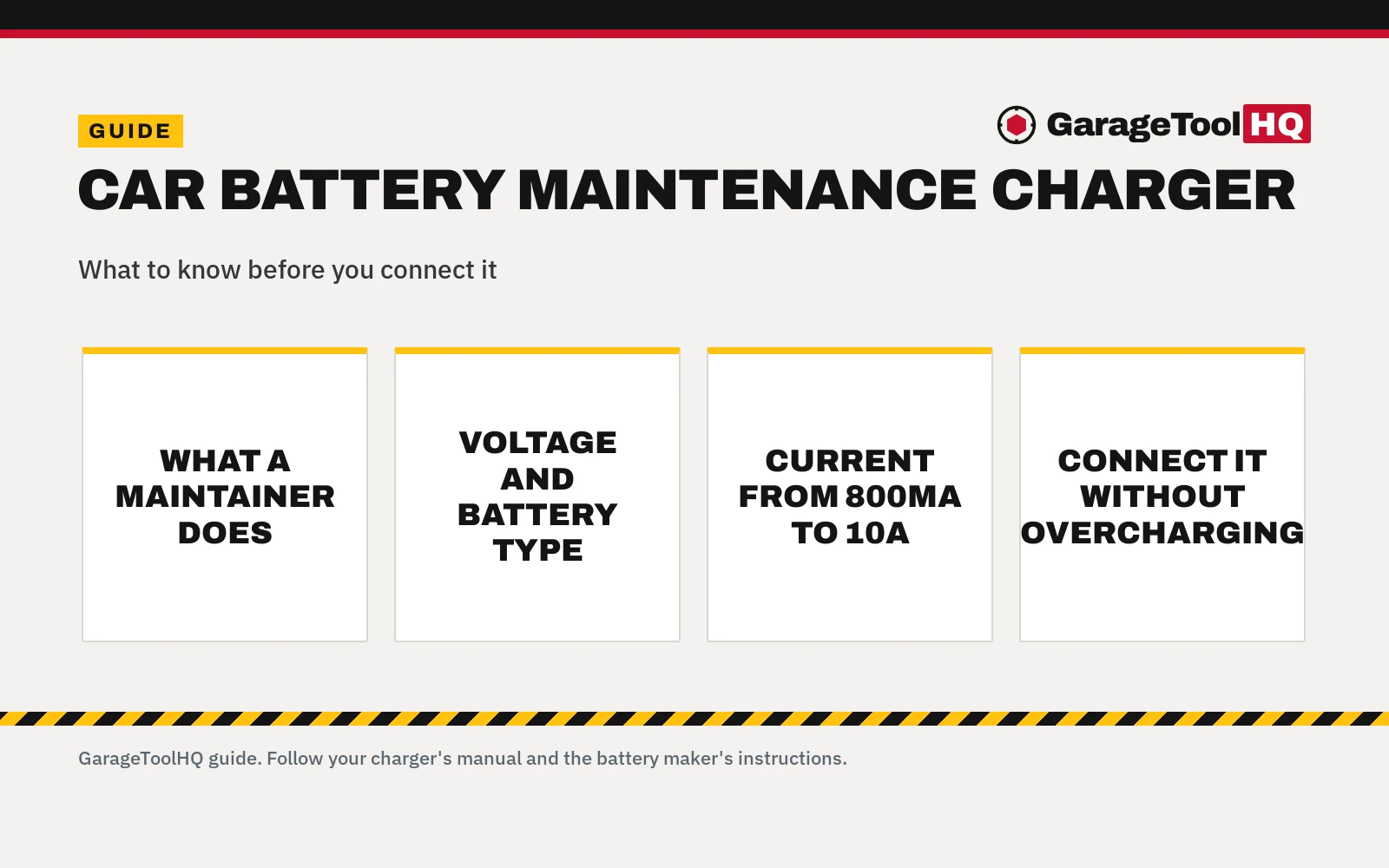
Charger problems fall into a short list. The charger shows no power at all, and nothing lights up. The charger has power but will not start charging a dead battery. The charger starts, then stops early or runs hot. Or the charger runs on the wrong voltage or the wrong battery type, and the battery never reaches a full charge. The reference chargers in this guide range from a 1A maintainer to a 25A rapid charger, for 6V, 12V and 24V batteries, and the problems below can show up across that range.
The charger shows no power
Start at the wall. 2 listings state an input range: 100-240V on the E-FAST 0-20A, and 110-240V at 50-60Hz on the YDBAO, so the outlet has to be live and the plug seated. Then check the clamps: the YDBAO, E-FAST and CRAFTSMAN listings describe reverse polarity or reverse hook-up protection, which guards against damage from clamps on the wrong terminals, so make sure the clamps sit on the right terminals. The CRAFTSMAN listing gives its charger a 6-foot AC cord and 6-foot battery cables, for 12 feet of total reach, so check whether the outlet sits within reach of the battery before blaming the charger. If the outlet is live and the clamps are right, check the fuse or breaker on the circuit before blaming the charger.
The charger will not charge a dead battery
Some smart chargers need to sense voltage in the battery before they start, and a battery that is too flat looks like no battery at all. The NOCO GENIUS1 listing states it charges batteries from as low as 1 volt, and its Force Mode manually charges completely dead batteries down to zero volts. The CRAFTSMAN listing describes its 12A charger as a way to revive dead batteries. The E-FAST 0-20A listing states the opposite limit plainly: it cannot activate a dead battery or jump-start the car, so that charger needs some voltage left in the battery to start. The E-FAST 25A listing offers a booster mode instead: a maximum current surge for 200 seconds to revive a depleted battery, for 12V batteries only. If the battery reads no voltage at all, the charger may need a force mode, a booster mode or a jump start before charging can begin.
The charger stops early or runs hot
A charger that stops early or runs hot is often set for the wrong battery size. The E-FAST 25A listing offers five manual current selections, 2A, 8A, 20A, 25A and Auto mode, and states to select 2A for small batteries such as motorcycles and lawn mowers to prevent overheating, or 25A for rapid charging on large vehicles from 75-400Ah. The Auto mode detects battery internal resistance to choose the charge rate. The YDBAO listing states not to let the charger operate unattended for more than 12 hours. Heat also follows the weather: the NOCO listing describes a thermal sensor that adjusts the charge with ambient temperature, the YDBAO listing describes Winter and Summer modes, and the E-FAST 25A listing states a Winter Mode below 10 C and a Summer Mode above 28 C. If the charger stops early, check the amp setting against the battery size first, then the temperature mode.
Wrong voltage or wrong battery type
Voltage has to match the battery. The NOCO and CRAFTSMAN listings cover 6V and 12V batteries, the E-FAST listings cover 12V and 24V with automatic detection, and the YDBAO listing covers 12V batteries from 4Ah to 100Ah. A 12V charger on a 6V battery risks overcharging it, and a 6V setting on a 12V battery will not bring it to a full charge. Battery chemistry matters too: the NOCO listing covers lead-acid and lithium LiFePO4, the E-FAST listings cover lead-acid and LiFePO4, and the YDBAO listing states it is not compatible with lithium batteries. Check the battery type on the label before connecting, and use the charger mode that matches it.
Sulfation and the repair mode
A battery that has sat idle can sulfate, and the charger listings answer that with a repair mode. The NOCO listing describes precision pulse charging that detects and reverses sulfation and acid stratification. The YDBAO listing describes a pulse repair mode for mild sulfation. The E-FAST 25A listing describes an 8-stage charging process with a repair mode of 16 hours for old, idle or sulfated batteries, and the E-FAST 0-20A listing describes a 7-stage process with pulse repair. The CRAFTSMAN listing describes a desulfation mode. On the E-FAST 25A, the repair mode runs 16 hours, so a repair run takes hours, not minutes, and a battery that is damaged rather than sulfated will not come back from it.
Charging makes heat and gas, so give the garage fresh air while a charger runs, and never run a charger on a cracked or leaking battery. The YDBAO listing states not to let the charger operate unattended for more than 12 hours.
Lead-acid batteries can release hydrogen while charging, so charge in a ventilated space away from sparks and flames, connect positive first and negative last, set the charger to the battery type (flooded, AGM, gel, lithium), and wear eye protection. Read our Safety Disclaimer.
FAQ: garage tools
Why is my battery charger not charging?
Check power, clamps and battery voltage in that order. The outlet has to be live, the clamps have to sit on the right terminals, and the battery has to hold enough voltage for the charger to recognize it. The NOCO listing states its charger starts from as low as 1 volt, while the E-FAST 0-20A listing states it cannot activate a dead battery.
Can a charger bring back a dead battery?
Sometimes. The NOCO listing describes a Force Mode for completely dead batteries down to zero volts, and the E-FAST 25A listing describes a booster mode of 200 seconds for 12V batteries. A battery that is damaged rather than discharged will not come back, and the E-FAST 0-20A listing states it cannot activate a dead battery.
How long can I leave a charger connected?
It depends on the charger. The NOCO listing describes a maintainer that can stay connected for worry-free maintenance, while the YDBAO listing states not to let the charger operate unattended for more than 12 hours. Read the listing for the limit on the charger in hand.
What amp setting should I use?
Match the amps to the battery size. The E-FAST 25A listing offers 2A, 8A, 20A, 25A and Auto mode, and states 2A for small batteries such as motorcycles and lawn mowers and 25A for large vehicles from 75-400Ah. The YDBAO listing covers batteries from 4Ah to 100Ah at 6A.
Can I charge a lithium battery with a lead-acid charger?
Only if the charger lists lithium. The NOCO and E-FAST listings cover LiFePO4 lithium batteries, while the YDBAO listing states it is not compatible with lithium batteries. Check the battery type on the label and the charger mode before connecting.
Why does my charger get hot?
Heat follows amps and weather. The E-FAST 25A listing describes a cooling fan and an aluminum alloy shell for heat dissipation during high-amp charging, and its Winter Mode below 10 C and Summer Mode above 28 C adjust the charge with temperature. A charger set too high for a small battery overheats, so check the amp setting first.
Related: the best smart battery charger, 12V vs 24V battery charger, and the deep cycle vs starting battery charger guide. Also see our best heavy duty battery charger 12/24V. Also see our diagnostics and electrical hub.