Best Cylinder Hone Grit (2026): 5 Hones Compared
Five cylinder hones compared by grit, bore range, hone style and stated finish, from 220 grit stone hones to 240 grit ball hones.

On this page
Top picks at a glance
As an Amazon Associate I earn from qualifying purchases.
- 1
 Best OverallGarhgi 4 Inch Ball Hone9.6/10View on Amazon
- 2
 Best Small BoreGarhgi 3.25 Inch Ball Hone9.6/10View on Amazon
- 3
 Widest RangeEWK 2-7 Inch Stone Hone9.6/10View on Amazon
- 4
 Best Stone KitUTMALL Cylinder Deglazer9.5/10View on Amazon
A glazed cylinder wall will not hold oil, and rings will not seat on a slick bore. When an engine comes apart for a rebuild, the bore needs a fresh crosshatch before new rings go in, and that is the job the best cylinder hone grit has to do. This guide compares hones by grit, bore range, hone style and stated finish, so the pick matches the bore on the bench.
GarageToolHQ earns a commission when you buy through links on this page, at no extra cost to you. Read our affiliate disclosure.
Quick picks
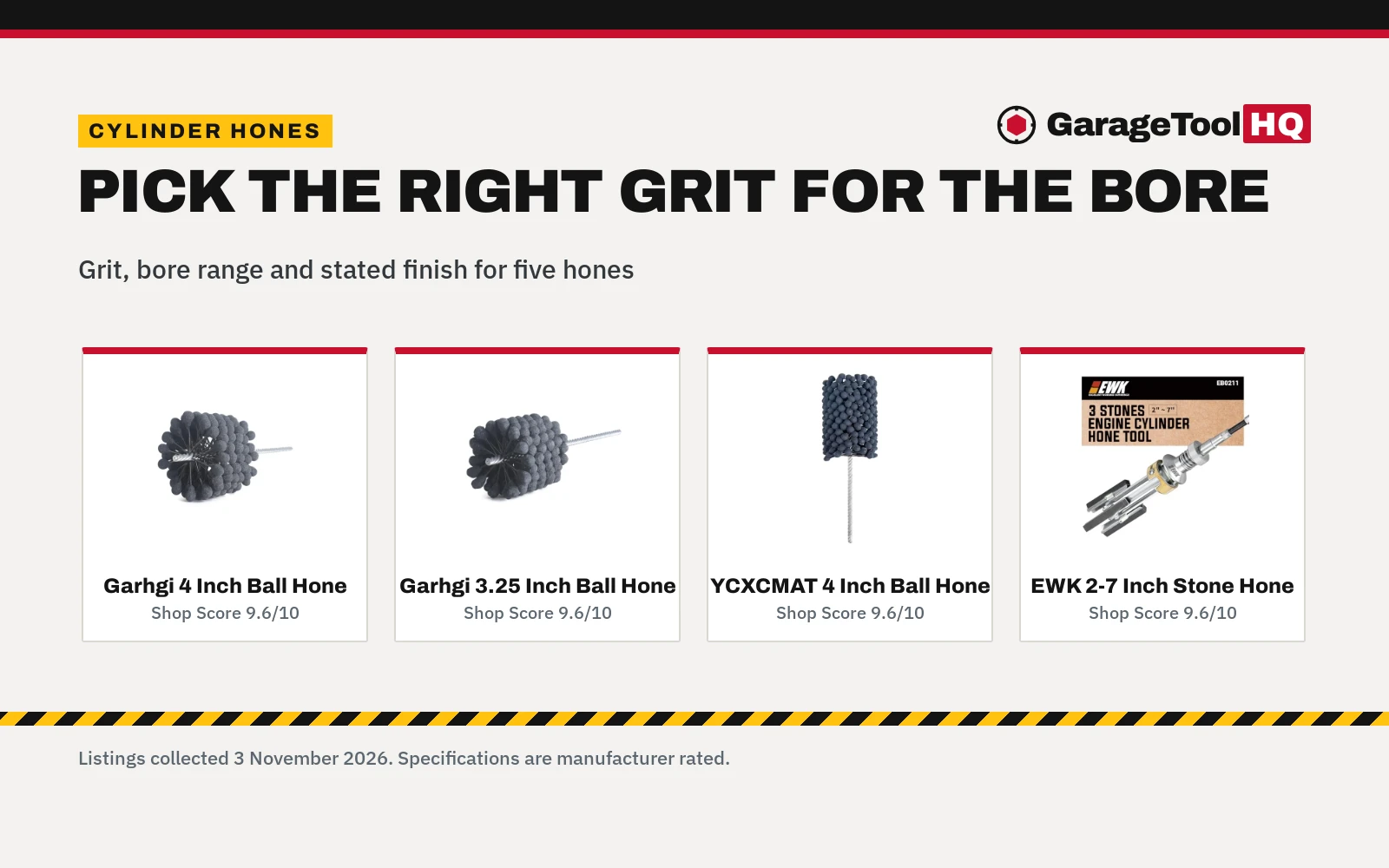
- Best Overall Garhgi 4 Inch Ball Hone: 240 grit ball hone for 3.751 to 4.000 inch bores with a stated 0.8-1.2 Ra finish. Check price on Amazon
- Best Small Bore Garhgi 3.25 Inch Ball Hone: 240 grit ball hone for 3.001 to 3.250 inch bores with the same stated finish. Check price on Amazon
- Widest Range EWK 2-7 Inch Stone Hone: Adjustable 220 grit stone hone covering 2 to 7 inch cylinders. Check price on Amazon
- Best Stone Kit UTMALL Cylinder Deglazer: Adjustable deglazer with 3 stone sets and a black case. Check price on Amazon
Picks for the garage
Garhgi 4 Inch Flexible Cylinder Hone 240 Grit
A 4 inch ball-style cylinder hone in 240 grit silicon carbide for bore diameters from 3.751 inches to 4.000 inches, with a stated 0.8-1.2 Ra(μm) finish.
Pros
- 240 grit silicon carbide for a stated 0.8-1.2 Ra(μm) finish
- Self-centering ball style for even contact pressure
- Fits bores from 3.751 inches to 4.000 inches
- Works with a hand drill, drill press or CNC
Cons
- No warranty term stated on the listing
- No safety listing stated
- One fixed bore size, no adjustment
- No replacement abrasive stated
Garhgi 3-1/4"(83mm) Cylinder Hone Tool 240 Grit SC
A 3.25 inch ball-style cylinder hone in 240 grit for bore diameters from 3.001 inches to 3.250 inches, with a stated 0.8-1.2 Ra(μm) finish.
Pros
- 240 grit for a stated 0.8-1.2 Ra(μm) finish
- Self-centering ball style for even contact pressure
- Fits bores from 3.001 inches to 3.250 inches
- Works with a hand drill, drill press or CNC
Cons
- No warranty term stated on the listing
- No safety listing stated
- One fixed bore size, no adjustment
- No replacement abrasive stated

YCXCMAT Ball Style Engine Cylinder Hone 4 Inch 240
A 4 inch ball-style cylinder hone in 240 grit silicon carbide for bore sizes from 3.751 inches to 4 inches, with a stated 24-32 Ra finish.
Pros
- 240 grit silicon carbide for a stated 24-32 Ra finish
- Deburrs cross holes while finishing the bore
- Self-centering oversized design for even wall pressure
- Works with a hand drill, drill press or CNC
Cons
- No warranty term stated on the listing
- No safety listing stated
- Finish stated as 24-32 Ra, a different scale from the Garhgi listings
- One fixed bore size, no adjustment
EWK 2" to 7" 3 Stones Engine Cylinder Hone Tool
An adjustable 3-stone cylinder hone in 220 grit for cylinders from 2 inches to 7 inches, with replaceable stones and an adjustable tension screw.
Pros
- Widest bore range here: 2 inches to 7 inches (50.8mm to 177.8mm)
- Replaceable 220 grit stones
- Adjustable tension screw controls stone pressure
- Self-aligning flexible shaft for an even hatch pattern
Cons
- Coarser 220 grit than the 240 grit ball hones
- No warranty term stated on the listing
- No safety listing stated
- Made to work with a 1/4 inch power drill
Engine Cylinder Hone Deglazer 2 inches to 6-1/2
An adjustable cylinder hone deglazer for cylinders from 2 inches to 6-1/2 inches with 4 inch blades, 3 sets of stones and a black case.
Pros
- Adjustable range from 2 inches to 6-1/2 inches
- 3 sets of stones included
- Black case for storage and carrying
- Premium steel build for strength and durability
Cons
- No warranty term stated on the listing
- No safety listing stated
- No dimensions or weight stated
Compared on paper
| Model | Shop Score | Type | Grit | Bore range | Finish | Drive | Warranty |
|---|---|---|---|---|---|---|---|
| Garhgi 4 Inch Ball Hone | 9.6/10 | Ball-style | 240 grit | 3.751″-4.000″ | 0.8-1.2 Ra(μm) | Hand drill, drill press or CNC | Not stated |
| Garhgi 3.25 Inch Ball Hone | 9.6/10 | Ball-style | 240 grit | 3.001″-3.250″ | 0.8-1.2 Ra(μm) | Hand drill, drill press or CNC | Not stated |
| YCXCMAT 4 Inch Ball Hone | 9.6/10 | Ball-style | 240 grit | 3.751″-4″ | 24-32 Ra | Hand drill, drill press or CNC | Not stated |
| EWK 2-7 Inch Stone Hone | 9.6/10 | 3-stone adjustable | 220 grit | 2″-7″ | Not stated | 1/4″ power drill | Not stated |
| UTMALL Cylinder Deglazer | 9.5/10 | Adjustable deglazer | 220 grit (title lists 100, 220, 400) | 2″-6-1/2″ | Not stated | Not stated | Not stated |
Every rating comes from the brand’s listing and is not a shop test (gathered 2 November 2026). Where a listing contradicts itself, both figures are shown.
How the points were given
Each hone is scored on performance, build, value, safety and warranty, with the weights published on the How We Pick page. None states a UL, ETL or CSA listing, so all score zero on safety, and none states a warranty term.
| Product | Shop Score | Perf. /35 | Build /25 | Value /25 | Safety /10 | Warranty /5 |
|---|---|---|---|---|---|---|
| Garhgi 4 Inch Ball Hone | 9.6 | 30 | 21 | 21 | n/a | 0 |
| Garhgi 3.25 Inch Ball Hone | 9.6 | 29 | 21 | 21 | n/a | 0 |
| YCXCMAT 4 Inch Ball Hone | 9.6 | 29 | 20 | 21 | n/a | 0 |
| EWK 2-7 Inch Stone Hone | 9.6 | 28 | 21 | 19 | n/a | 0 |
| UTMALL Cylinder Deglazer | 9.5 | 27 | 20 | 19 | n/a | 0 |
No score drops under 9.2 or climbs past 9.8; a tool’s place inside those bounds is set by its weighted point total. Safety is scored for corded, cordless and air tools and for listings that state safety features; hand tools without either are scored on 90 points.
What the listings tell you
Three of the hones are ball-style tools at 240 grit, and the other two are adjustable stone-style tools. The two Garhgi ball hones state the same 0.8-1.2 Ra(μm) finish, while the YCXCMAT ball hone states its finish as 24-32 Ra, a different scale that does not compare directly with the Garhgi figures. The stone hones state no finish figure at all. Bore ranges run from a narrow band for the small ball hone to a wide adjustable span for the stone hones, so matching the bore before ordering matters more than grit alone.
Buying guide: best cylinder hone grit
Grit choice: 220 or 240
Two grits appear in this roundup: 220 grit on the stone hones and 240 grit on the ball hones. The finer 240 grit suits finish work where the listing states a fine Ra figure, while 220 grit suits deglazing where the goal is breaking the glaze and cutting a fresh crosshatch. Grit alone does not set the finish: the ball hones state Ra figures and the stone hones do not, so compare stated finish figures only within the same scale.
Ball hone or stone hone
A ball-style hone is flexible and oversized, so it self-centers and self-aligns and keeps even pressure around the bore. It also deburrs cross holes while it finishes the bore. A stone-style hone uses adjustable stones with a tension screw, so the same tool covers a range of bore sizes and the stones can be replaced when they wear.
Match the bore range
Measure the bore before ordering: the EWK listing says exactly that, and every hone here states a bore range. A ball hone is sized to a narrow band, such as 3.001 inches to 3.250 inches or 3.751 inches to 4.000 inches, while the stone hones adjust across a wider span. A hone outside its stated range will not hold even pressure on the wall.
Finish and crosshatch
The crosshatch holds oil on the wall and helps rings seat. Two listings state a 0.8-1.2 Ra(μm) finish and one states 24-32 Ra, and those scales do not compare directly. Where no finish figure is stated, judge the hone on grit, bore range and stone or ball style instead.
Drive and setup
The ball hones work with a hand drill, drill press or CNC, while the EWK stone hone is made to work with a 1/4 inch power drill. Keep the hone moving and never dry hone: the Garhgi listings state that directly, along with wearing safety glasses, gloves and ear protection.
Read the manual before first use, wear eye protection, keep the work area clear and ventilated, and stay within every stated rating. Read our Safety Disclaimer.
Garage Fit Check
- Bench space: the ball hones state an overall length of 300mm, and the EWK stone hone measures 13.78 inches long, so allow room to pass the tool through the bore without hitting the bench.
- Power: a hand drill runs the ball hones, and the EWK hone is made for a 1/4 inch power drill, so check the chuck before starting.
- Storage: the UTMALL deglazer comes with a black case, while the other listings state no case, so plan a spot where stones and balls stay clean.
- Before the first job: measure the bore and match it to the stated range, since a ball hone fits a narrow band and a stone hone adjusts across its span.
FAQ: garage tools
What does a cylinder hone do?
A cylinder hone deglazes the bore wall and cuts a crosshatch pattern that holds oil and helps piston rings seat. It also removes burrs and carbon from the wall, and a ball-style hone deburrs cross holes at the same time.
What grit should I use to deglaze a cylinder?
Use 220 grit where the job is breaking glaze on a bore, as on the stone hones here, and 240 grit where a finer stated finish is wanted, as on the ball hones here. Match the grit to the bore range first: the right grit on the wrong size hone will not cut an even crosshatch.
Can you hone a cylinder with the piston still installed?
No. The hone needs a bare bore to cut an even crosshatch, so the piston and rings must come out before honing. Honing with the piston in place would score the piston and leave an uneven wall.
Ball hone or stone hone: which fits my bore?
Match the stated bore range: ball hones fit narrow bands, while stone hones adjust across a wider span. Measure the bore first, then pick the hone whose stated range covers it.
Do I need to keep the hone wet?
Yes. The Garhgi listings state never to dry hone, so keep the bore lubricated through the pass and follow the safety guideline on glasses, gloves and ear protection.
Related: the best cylinder hone tool, cylinder hone vs ball hone, our engine and shop equipment hub, the best piston ring compression tool and the best engine stand for engine rebuilds.