Best High Pressure Smoke Machine (2026): 4 Leak Detectors Compared
Four automotive high pressure smoke machines compared by output pressure, built-in pump, pressure gauge, included adapters and manufacturer warranty.

On this page
Top picks at a glance
As an Amazon Associate we earn from qualifying purchases.
- 1
 Top PickAutoLine Pro APM-HS159.6/10View on Amazon
- 2
 Best Metal HousingANCEL S3000 PRO9.6/10View on Amazon
- 3
 Most CompactAutoLine Pro APM-HS119.5/10View on Amazon
- 4
 Highest Output PressureCsttler B0029.4/10View on Amazon
- 5
 ANCEL L8000 EVAP&Turbo High Pressure Automotive Smoke MachineView on Amazon
- 6
 Automotive Smoke MachineView on Amazon
- 7
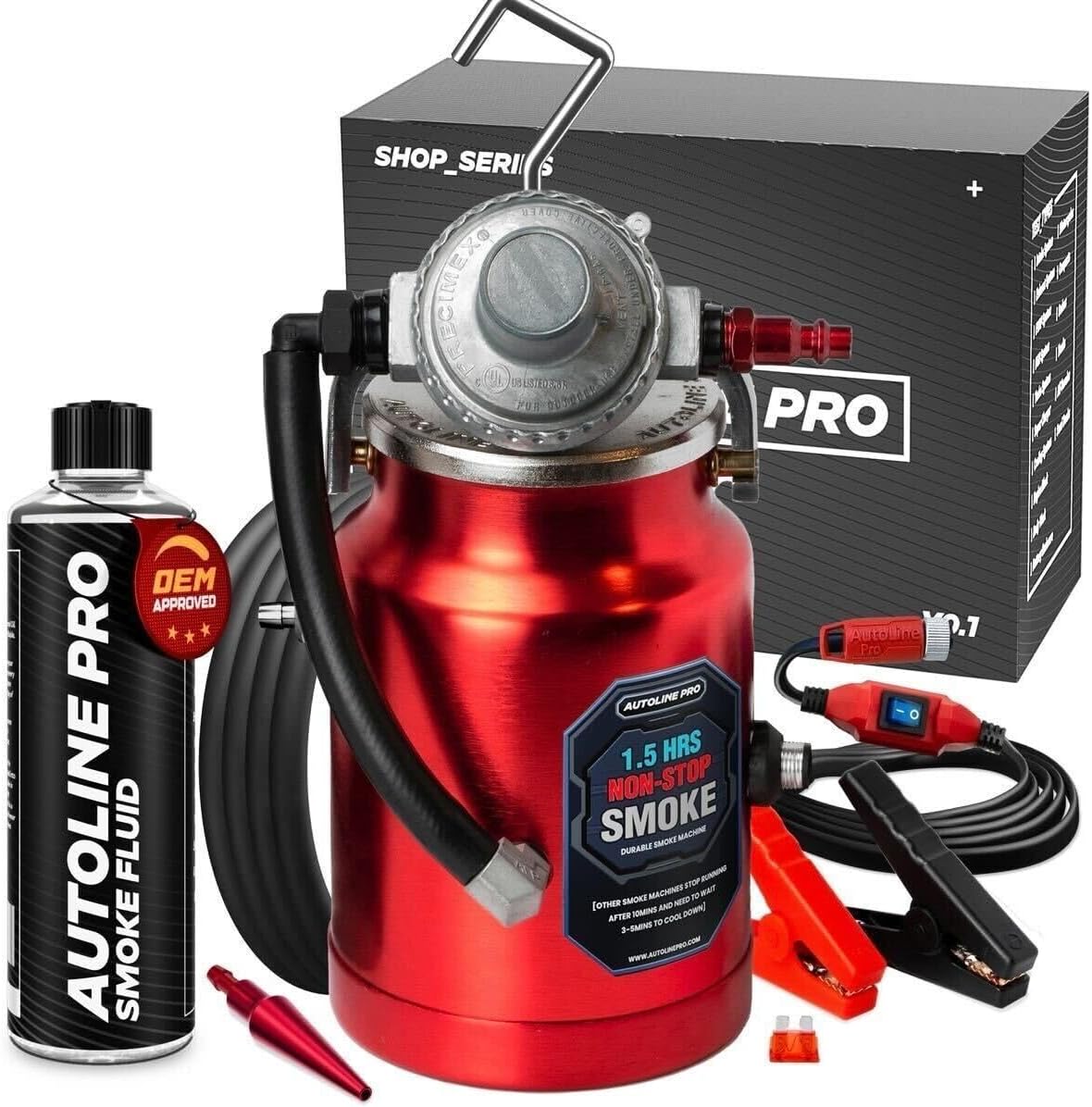 AutoLine Pro Shop Series Smoke MachineView on Amazon
- 8
 Solary Automotive Smoke Machine Leak DetectorView on Amazon
When a stubborn check engine light flags a lean code or a rough idle points to an elusive vacuum leak, the best high pressure smoke machine pinpoints the opening in minutes. By feeding dense vapor into intake tracts, vacuum lines, and pressurized turbo plumbing, these units reveal escaping vapor without teardown. This roundup compares four models across output pressure, built-in pumps, pressure gauges, adapters, and warranty terms.
GarageToolHQ earns a commission when you buy through links on this page, at no extra cost to you. Read our affiliate disclosure.
Quick picks
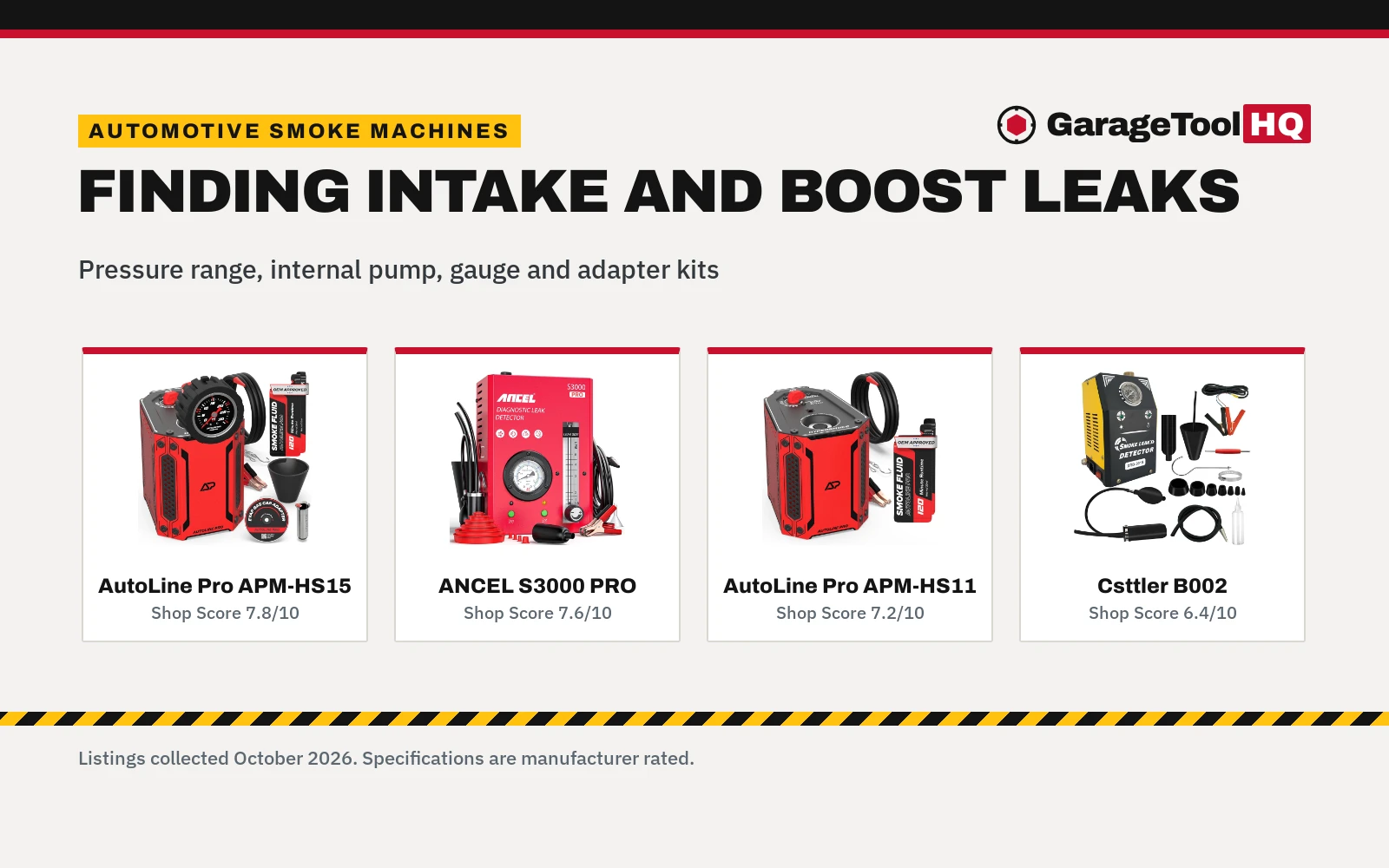
- Top Pick AutoLine Pro APM-HS15: Adjustable pressure for EVAP and turbo boost, built-in air motor, integrated pressure gauge, and 3-year warranty. Check price on Amazon
- Best Metal Housing ANCEL S3000 PRO: Thick solid metal body, built-in air pump, pressure gauge, adjustable flow meter, and a 23-piece cap plug kit. Check price on Amazon
- Most Compact AutoLine Pro APM-HS11: Weighs 1.1 lb with adjustable EVAP and boost modes, built-in compressor motor, and 240 minutes of smoke fluid. Check price on Amazon
- Highest Output Pressure Csttler B002: Delivers 20 to 25 PSI from an internal compressor with 10-second smoke output, pressure gauge, and spare bladder. Check price on Amazon
The picks

AutoLine Pro HyperSmoke™ Automotive Smoke Machine
A diagnostic smoke machine with built-in air motor, integrated pressure gauge, dual EVAP and boost pressure modes, and fluid included.
Pros
- Built-in pressure gauge for monitoring system pressure
- Adjustable pressure with under 1 PSI EVAP mode and boost mode
- Internal air compressor motor requires no shop air hookup
- Includes OEM approved smoke fluid rated for 240 minutes
Cons
- Higher weight at 1.8 lb compared to APM-HS11 at 1.1 lb
- Power supply requires vehicle battery clamps
- No UL, ETL or CSA safety listing stated
- No flow meter column included

ANCEL S3000 PRO Automotive Smoke Machine
A heavy-duty metal smoke detector with built-in air pump, pressure gauge, adjustable flow meter, and a 23-piece cap plug kit.
Pros
- Thick solid metal housing with thermal shutoff protection
- Integrated pressure gauge and adjustable flow meter
- Includes 23-piece tapered automotive cap plug kit
- Long 8.2 ft power cable and 8.2 ft smoke delivery hose
Cons
- Smoke fluid not included (requires baby oil or mineral oil)
- Weight is not stated on the listing
- Listing contains clerical errors describing a car paint machine and release horse
- No UL, ETL or CSA safety listing stated

AutoLine Pro HyperSmoke™ Automotive Smoke Machine
An ultra-lightweight 1.1 lb smoke machine with built-in air compressor, adjustable EVAP and boost modes, and two bottles of fluid.
Pros
- Lightweight 1.1 lb design for effortless garage portability
- Dual pressure modes for EVAP under 1 PSI and turbo boost
- Built-in air compressor motor eliminates external air tanks
- Includes two bottles of OEM approved fluid for 240 minutes of runtime
Cons
- No built-in pressure gauge or dial
- No visual flow meter to monitor leak rates
- No UL, ETL or CSA safety listing stated
- Requires separate vehicle battery connection

Smoke Machine, All Accessories & Built-in Air
A high-output smoke machine generating 20 to 25 PSI with built-in air pump, pressure gauge, and rapid 10-second smoke production.
Pros
- High pressure output generating 20 to 25 PSI for boost lines
- Produces visible smoke output within 10 seconds
- Built-in pressure gauge and internal air pump
- Includes spare intake bladder and full-size cap plugs
Cons
- No warranty term is stated
- Spec table lists erroneous 8.19 in screen size and no power source
- Fluid capacity restricted to a 15 ml maximum
- Smoke fluid not included (empty bottle supplied)
More options to compare
 ANCEL L8000 EVAP&Turbo High Pressure Automotive Smoke MachineCheck price on Amazon
 Automotive Smoke MachineCheck price on Amazon
 AutoLine Pro Shop Series Smoke MachineCheck price on Amazon
 Solary Automotive Smoke Machine Leak DetectorCheck price on Amazon
Compare the picks
| Model | Shop Score | Pressure Range | Pressure Gauge | Air Source | Smoke Fluid | Weight | Warranty |
|---|---|---|---|---|---|---|---|
| AutoLine Pro APM-HS15 | 9.6/10 | Under 1 PSI to turbo boost | Yes | Built-in air motor | Included (240 min) | 1.8 lb | 3 years |
| ANCEL S3000 PRO | 9.6/10 | Not stated | Yes (with flow meter) | Built-in air pump | Not included | Not stated | 1 year |
| AutoLine Pro APM-HS11 | 9.5/10 | Under 1 PSI to turbo boost | No | Built-in compressor motor | Included (240 min) | 1.1 lb | 3 years |
| Csttler B002 | 9.4/10 | 20 to 25 PSI | Yes | Built-in air pump | Not included | 5.5 lb | Not stated |
Specifications are manufacturer rated, as published on each listing and collected 14 October 2026. Where a listing contradicts itself, both figures are shown.
How we scored them
Each smoke machine is scored out of 10 on performance, build, value, safety and warranty, with the weights published on our How We Pick page. None states a UL, ETL or CSA listing, so all score zero on safety, and one gives no clear warranty.
| Product | Shop Score | Perf. /35 | Build /25 | Value /25 | Safety /10 | Warranty /5 |
|---|---|---|---|---|---|---|
| AutoLine Pro APM-HS15 | 9.6 | 32 | 21 | 21 | 0 | 4 |
| ANCEL S3000 PRO | 9.6 | 30 | 22 | 21 | 0 | 2 |
| AutoLine Pro APM-HS11 | 9.5 | 28 | 20 | 20 | 0 | 4 |
| Csttler B002 | 9.4 | 28 | 18 | 19 | 0 | 0 |
Scores run from 9.2 to 9.8: each product’s point total is placed on that range, so more points always means a higher score.
What the listings tell you
Evaluating the four listings reveals distinct design choices for garage diagnostics. All four units incorporate internal air pumps or compressor motors, eliminating the need to plumb into an external workshop compressor. However, pressure ranges differ sharply: two models feature dual modes with under 1 PSI for EVAP circuits and higher output for turbo boost, one delivers high pressure between 20 and 25 PSI, and one does not state its operating range. Three units include an analog pressure gauge, while only one adds an adjustable flow meter. Three listings state concrete manufacturer warranties, ranging from 1 year to 3 years, while one lists warranty as other with no term. None provides a third-party safety listing.
Buying guide: choosing the best high pressure smoke machine
Operating pressure and EVAP protection
Pressure control is the most critical factor when introducing smoke into an engine. Modern EVAP systems use delicate purge valves, fuel tank pressure sensors, and charcoal canisters that can rupture if exposed to high pressure. Safe EVAP diagnosis requires pressure strictly under 1 PSI. Conversely, diagnosing intake piping, intercoolers, and turbocharger connections requires higher pressure up to 25 PSI to open check valves and simulate real engine boost. Look for machines offering dedicated dual modes or regulated outputs to handle both delicate emission lines and high-boost plumbing safely.
Internal compressor vs shop air
All four models compared here feature an internal electric pump or compressor motor powered by vehicle battery clamps. An internal pump makes the tool completely portable for driveway diagnostics and roadside troubleshooting without dragging heavy pneumatic hoses. Units with built-in motors generate continuous airflow and instant smoke output within 10 seconds.
Self-contained electric pumps also avoid moisture contamination from workshop pneumatic piping that can spoil internal heating coils. Generous hose reach, such as an 8.2 ft power cable paired with an 8.2 ft smoke delivery hose, allows you to navigate large engine compartments, exhaust tailpipes, and underbody lines without repositioning the vehicle battery hookup.
Pressure gauge and decay diagnosis
An integrated pressure gauge serves two vital diagnostic functions. First, it verifies that line pressure remains within safe operational limits. Second, it enables pressure decay diagnosis: once a closed circuit reaches target pressure, shutting off smoke delivery while monitoring the gauge reveals whether the needle holds steady or steadily drops, confirming whether an invisible pinhole leak exists.
A visual flow meter complements the gauge by indicating the physical volume of leakage. When a closed line is airtight, the indicator settles to zero. If the indicator floats while line pressure steadily drops, smoke is actively escaping through a split hose, damaged connector, worn gasket, or cracked boot.
Adapters and port sealing
A smoke machine is only as effective as its connection to the vehicle. Look for kits that provide expanding intake bladders, stepped cone adapters, and dedicated cap plugs. Expanding bladders seal round or oval intake boots, while 23-piece cap sets block open vacuum ports and PCV bungs during system isolation.
Stepped cone adapters seal exhaust tailpipes and rigid intake ducting, while universal bladders inflate to seal irregular throttle openings. A 23-piece tapered plug kit allows mechanics to block off open vacuum ports and PCV bungs, isolating individual lines to confirm exactly which component failed.
Smoke fluid selection
Automotive smoke units generate vapor by heating mineral oil or pharmaceutical-grade baby oil over an internal heating element. Certain models include OEM approved fluid pre-packaged for 240 minutes of runtime, while others require purchasing fluid separately. Always respect reservoir limits, such as a 15 ml maximum, to prevent heating element fouling or dry burning.
Thermal protection and duty cycles
Vaporizing fluid generates substantial internal heat, making thermal protection essential for tool durability. Diagnostic units feature automatic thermal shutoffs that cut power if internal temperatures exceed safe limits, preventing coil burnout. Others use specialized internal engineering to prevent overheating, protecting heating chambers against dry burning when fluid levels run low.
Garage Fit Check
- Power hookup: Connect the battery clamps directly to a fully charged vehicle battery, ensuring clean terminal contact before activating the smoke switch.
- Pressure limits: Always keep EVAP system diagnostic pressure strictly under 1 PSI to avoid damaging charcoal canisters, reserving higher pressure modes up to 25 PSI for turbo boost and intake tracts.
- Fluid capacity: Never exceed 15 ml when filling fluid reservoirs to avoid startup failures, and keep mineral oil or baby oil on hand when fluid is not pre-packaged.
- Storage footprint: Compact machine housings ranging from 4 by 3 by 4 inches to 5 by 3 by 7 inches store easily on a standard garage shelf or rolling tool cart.
Use rated jack stands on solid ground, wear eye protection with power and air tools, keep fuel-burning equipment out of a closed garage, and follow the manual for every tool. Read our Safety Disclaimer.
Frequently Asked Questions
How do automotive smoke machines work?
An automotive smoke machine uses an internal heating element to vaporize mineral oil or baby oil into thick white smoke. An internal pump or air compressor pushes this smoke through a delivery hose into sealed automotive systems, allowing technicians to locate leaks visually wherever vapor escapes.
How to use an automotive smoke machine?
Connect the power cables to the vehicle battery, add the specified amount of smoke fluid, and insert the delivery cone or expanding bladder into the intake or vacuum port. Turn on the pump and smoke switches, allow vapor to fill the system, and inspect hoses, seals, and connections for emerging smoke.
Why is low pressure required for EVAP systems?
Vehicle EVAP systems are engineered to operate at very low pressures. Applying pressure exceeding 1 PSI can permanently rupture the charcoal canister, damage vapor pressure sensors, or dislodge fuel vapor lines, causing costly component failure.
How to fix a smoke machine if smoke output stops?
First verify that the vehicle battery is fully charged and supplying sufficient power. Next, check fluid levels, as low fluid can trigger thermal protection and shut down the heating element. Ensure fluid volume does not exceed 15 ml, and clear any fluid pooling in the delivery hose.
What fluid does an automotive smoke machine use?
Most automotive smoke machines use OEM approved smoke fluid, pharmaceutical-grade mineral oil, or standard baby oil. Never use synthetic oils, brake fluids, or flammable solvents, as these produce toxic fumes and damage internal heating components.
Related: the best automotive smoke machine, the best air compressor for home garage, our diagnostics and electrical hub and our best automotive borescope. Also see our best bluetooth obd2 scanner. Also see our best obd2 scanner for diy. Also see our best automotive multimeter. Also see our how to choose an obd2 scanner. Also see our obd2 scanner types. Also see our best obd2 scanner for professional. Also see our best bidirectional diagnostic scan tool. Also see our what do obd2 codes mean. Also see our what is a bidirectional scan tool.