Best Low Speed Bench Grinder (2026): 4 Grinders Compared
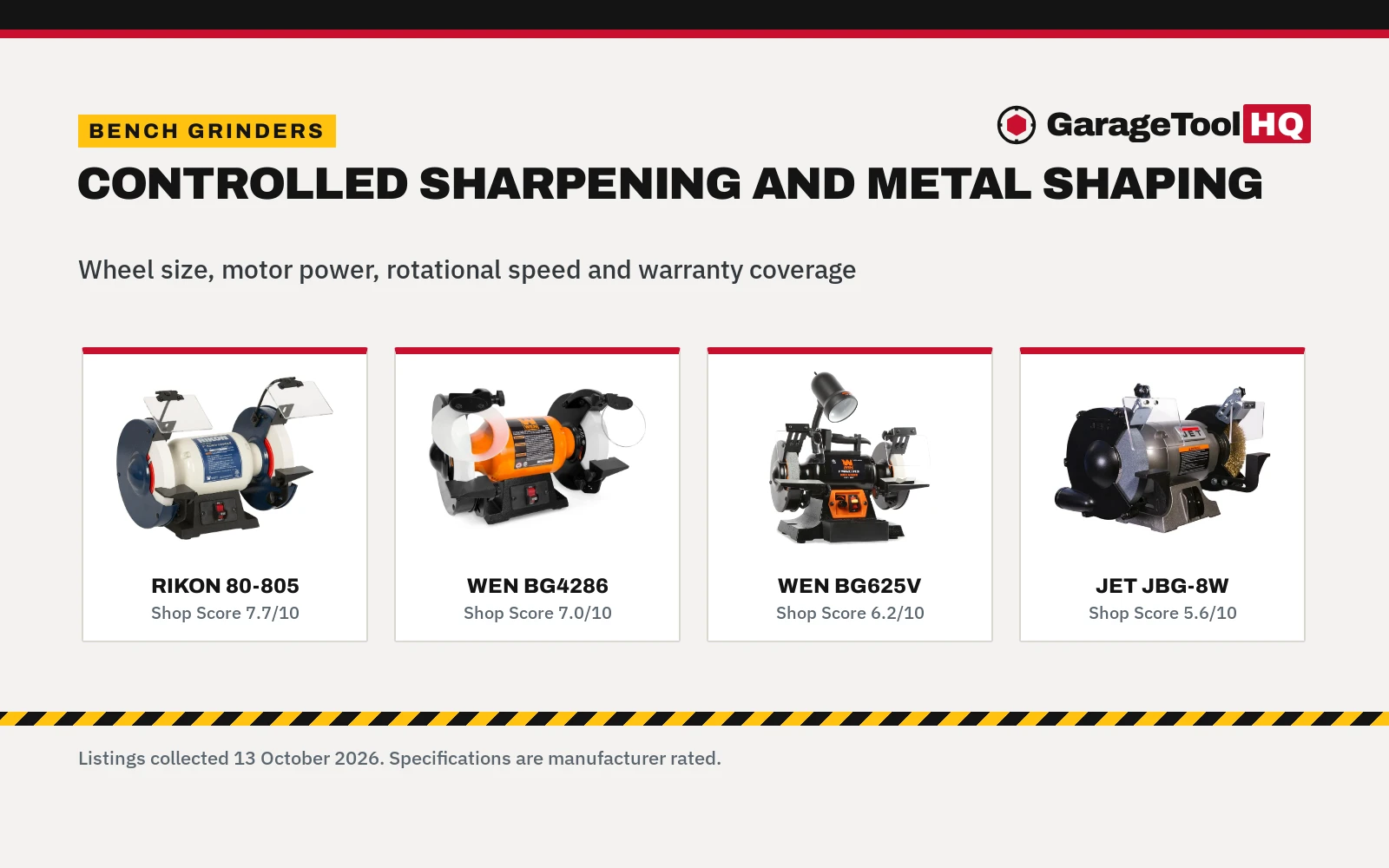
Four bench grinders for sharpening and garage metalwork, compared by wheel size, rotational speed, motor horsepower, tool rests and warranty terms.

On this page
Top picks at a glance
As an Amazon Associate we earn from qualifying purchases.
- 1
 Best OverallRIKON 80-8059.6/10View on Amazon
- 2
 Best Dedicated Slow SpeedWEN BG42869.5/10View on Amazon
- 3
 Best Variable SpeedWEN BG625V9.3/10View on Amazon
- 4
 Best Heavy Duty for MetalworkJET JBG-8W9.2/10View on Amazon
- 5
 JET 8-Inch Industrial Bench GrinderView on Amazon
- 6
 WEN BG4276 2.1-Amp 6-Inch Single Speed Bench Grinder withView on Amazon
- 7
 WEN BG4260 2.1-Amp 6-Inch Single Speed Bench GrinderView on Amazon
- 8
 DEWALT DW758 8-Inch Bench GrinderView on Amazon
- 9
 Ingersoll Rand 3101G 1/4" Collet Air Die Grinder Max freeView on Amazon
- 10
 Ingersoll Rand 301B 1/4" Collet Air Die Grinder Max freeView on Amazon
Sharpening a nicked wood chisel or truing a mower blade after hitting a stray rock in the yard requires steady, cool cutting. High-speed shop grinders can quickly overheat delicate tool steel and draw out its temper, turning the cutting edge blue and soft. A dedicated machine turning at reduced rotational speed keeps heat under control while giving you deliberate control at the wheel. In this guide, we evaluate four models to help you find the best low speed bench grinder for sharpening and metalwork in your home shop.
GarageToolHQ earns a commission when you buy through links on this page, at no extra cost to you. Read our affiliate disclosure.
Quick picks
- Best Overall RIKON 80-805: 1/2 HP motor running at 1,750 RPM with 8-inch 60- and 120-grit wheels, cast-iron base, diamond dresser and 5-year warranty. Check price on Amazon
- Best Dedicated Slow Speed WEN BG4286: 8-inch slow-speed grinder with soft-start 3-amp motor at 1,750 RPM, 60- and 120-grit wheels and pre-drilled base. Check price on Amazon
- Best Variable Speed WEN BG625V: 6-inch wheels with 2.5-amp variable-speed motor from 2,000 to 3,400 RPM, flexible work light and pivoting tool rests. Check price on Amazon
- Best Heavy Duty for Metalwork JET JBG-8W: 54 lb cast-iron build with 1 HP motor, 8-inch 36-grit wheel and crimped steel wire wheel for rust stripping. Check price on Amazon
The picks

RIKON 80-805 Professional 8-Inch Low Speed Bench
An 8-inch low-speed bench grinder running at 1,750 RPM with a 1/2 HP motor, 60- and 120-grit wheels, cast-iron base and diamond wheel dresser.
Pros
- True slow-speed 1,750 RPM motor limits heat buildup
- Includes 8 x 1 in. 60-grit and 120-grit wheels
- Cast-iron base with anti-vibration rubber feet at 37 lb
- Includes diamond wheel dresser and 5-year warranty
Cons
- Spec table lists material as aluminum while bullets state cast iron
- Spec table mentions stand under components while bullets note stand is separate
- No safety listing stated on the listing
- 16.38 x 10.75 in. footprint requires dedicated bench space

WEN BG4286 3-Amp 8-Inch Slow Speed Bench Grinder
An 8-inch slow-speed bench grinder with a soft-start 3-amp motor running up to 1,750 RPM, 60- and 120-grit wheels and pivoting tool rests.
Pros
- Slow-speed operation up to 1,750 RPM for cool sharpening
- Soft-start 3-amp motor reduces startup torque jolt
- Comes with 8 x 1 in. 60-grit and 120-grit wheels
- Pre-drilled mounting holes in a 34.1 lb base
Cons
- No warranty term is stated on the listing
- Spec table lists 127 volts of alternating current
- No safety listing stated on the listing
- Material type listed as metal and plastic

WEN BG625V 2.5-Amp 6-Inch Variable Speed Bench
A 6-inch variable-speed bench grinder with a 2.5-amp motor adjusting from 2,000 to 3,400 RPM, flexible work light and pivoting tool rests.
Pros
- Variable speed adjusts from 2,000 to 3,400 RPM
- Flexible work light illuminates the workpiece
- Includes 36-grit and 80-grit wheels with pivoting rests
- Includes adjustable eye guards and spark shields
Cons
- Lowest speed is 2,000 RPM, above traditional 1,750 RPM low speed
- Item weight is not stated on the listing
- Smaller 6-inch wheels offer less surface than 8-inch models
- No safety listing stated on the listing
JET 8" Bench Grinder with Wire Wheel - 1 HP
An 8-inch industrial bench grinder with a 1 HP motor, cast-iron build, 36-grit grinding wheel and crimped steel wire wheel.
Pros
- Heavy 54 lb cast-iron base, housing and tool rests
- 1 HP motor provides high power under heavy load
- Crimped steel wire wheel cleans rust, scale and burrs
- Backed by a 2-year limited warranty
Cons
- Runs at 3,450 RPM, generating high friction heat for edge tools
- Severe listing contradictions between bullets and spec table
- Supplied 36-grit wheel is too coarse for fine edge sharpening
- No safety listing stated on the listing
More options to compare
 JET 8-Inch Industrial Bench GrinderCheck price on Amazon
 WEN BG4276 2.1-Amp 6-Inch Single Speed Bench Grinder withCheck price on Amazon
 WEN BG4260 2.1-Amp 6-Inch Single Speed Bench GrinderCheck price on Amazon
 DEWALT DW758 8-Inch Bench GrinderCheck price on Amazon
 Ingersoll Rand 3101G 1/4" Collet Air Die Grinder Max freeCheck price on Amazon
 Ingersoll Rand 301B 1/4" Collet Air Die Grinder Max freeCheck price on Amazon
Compare the picks
| Model | Shop Score | Wheel size | Speed | Motor | Included wheels | Weight | Warranty |
|---|---|---|---|---|---|---|---|
| RIKON 80-805 | 9.6/10 | 8 x 1 in. | 1,750 RPM | 1/2 HP, 120V | 60 & 120 grit | 37 lb | 5 years |
| WEN BG4286 | 9.5/10 | 8 x 1 in. | Up to 1,750 RPM | 3 A, 250 W | 60 & 120 grit | 34.1 lb | Not stated |
| WEN BG625V | 9.3/10 | 6 in. | 2,000 to 3,400 RPM | 2.5 A, 300 W (0.4 hp) | 36 & 80 grit | Not stated | Not stated |
| JET JBG-8W | 9.2/10 | 8 in. (spec table: 6 in.) | 3,450 RPM | 1 HP, 8 A (spec table: 1/2 HP, 5 A) | 36 grit + wire wheel | 54 lb (spec table: 32 lb) | 2 years |
Specifications are manufacturer rated, as published on each listing and collected 12 October 2026. Where a listing contradicts itself, both figures are shown.
How we scored them
Each bench grinder is scored on performance, build, value, safety and warranty, with the weights published on our How We Pick method. None states a UL, ETL or CSA listing, so all score zero on safety, and two give no stated warranty.
| Product | Shop Score | Perf. /35 | Build /25 | Value /25 | Safety /10 | Warranty /5 |
|---|---|---|---|---|---|---|
| RIKON 80-805 | 9.6 | 32 | 22 | 20 | 0 | 3 |
| WEN BG4286 | 9.5 | 30 | 19 | 21 | 0 | 0 |
| WEN BG625V | 9.3 | 26 | 18 | 19 | 0 | 0 |
| JET JBG-8W | 9.2 | 21 | 21 | 12 | 0 | 2 |
Scores run from 9.2 to 9.8: each product’s point total is placed on that range, so more points always means a higher score.
What the listings tell you
Examining the manufacturer listings reveals significant differences in published specifications. Two models run at a dedicated slow speed of 1,750 RPM, one provides variable speed from 2,000 to 3,400 RPM, and one industrial model runs at 3,450 RPM. Wheel sizes range from 6 inches to 8 inches. Only two listings state explicit manufacturer warranties: one offering 5 years and one offering 2 years, while two provide no stated warranty term. None of the four listings publishes an electrical safety certification such as a UL, ETL or CSA listing. In addition, one listing exhibits severe internal contradictions between its bullet points and its specification table regarding horsepower, wheel dimensions, amperage and weight.
Choosing the best low speed bench grinder
Wheel speed and heat control
Standard bench grinders typically run at 3,450 RPM. While that speed works well for rapid stock removal, heavy deburring and rough shaping, it generates intense friction heat at the contact point. On thin edged tools like wood chisels, plane irons and drill bits, excessive heat softens hardened steel. Dedicated slow-speed grinders turn at 1,750 RPM, cutting wheel surface speed in half and substantially reducing heat buildup. Variable-speed models allow dialing between 2,000 and 3,400 RPM for versatility across different workshop tasks.
Wheel diameter and grit selection
Wheel size determines both working surface and wheel longevity. Common workshop models feature 6-inch or 8-inch wheels. An 8-inch wheel provides a flatter grinding bevel and greater surface area than a 6-inch wheel. Grit selection is equally critical for sharpening. Coarse 36-grit wheels are suited for heavy shaping and rust removal, while 60-grit wheels handle general grinding. For refining cutting edges on tools and drill bits, finer 80-grit or 120-grit wheels provide a smoother finish without gouging metal.
Cast-iron base and vibration damping
Vibration is the enemy of clean sharpening. A grinder with a heavy cast-iron base and anti-vibration rubber feet absorbs motor harmonics and prevents the tool from walking across your workbench. Weights among these units range from 34.1 pounds up to 54 pounds. Pre-drilled mounting holes allow bolting the base firmly to a solid wooden bench or dedicated stand.
Tool rests and spark shields
Stable tool rests are essential for maintaining accurate bevel angles during grinding. Dual adjustable rests support workpieces firmly against the wheel face, and some rests include specialized grooves for sharpening drill bits. Clear eye shields and spark arrestors protect the operator from flying sparks and abrasive grit while keeping the work area visible.
Wire wheel attachments for metal cleanup
In addition to abrasive grinding wheels, bench grinders can accept crimped steel wire wheels. Wire wheels strip rust, scale, old paint and burrs from metal hardware without removing underlying base material. Reversing the wire wheel on its arbor when tips become worn restores brushing bite.
Garage Fit Check
- Bench space: Overall dimensions span from 14.5 by 7.75 inches on compact units up to 18-1/2 by 13 inches on heavy-duty units. Clear adequate bench depth to accommodate the wheel guards and motor housing.
- Mounting support: Machine weights range from 34.1 pounds to 54 pounds. Fasten the base to a sturdy bench top or dedicated stand using the pre-drilled base mounting holes, which accept 3/8-inch bolts on heavy units.
- Electrical requirements: Motor draws range from 2.5 amps (300 watts) and 3 amps (250 watts) on 120-volt circuits up to 8 amps on a 15-amp circuit for a 1 HP motor. Connect directly to a standard wall outlet.
- Pre-operation checks: Verify that grinding wheels are rated for the motor speed, inspect tool rests and spark arrestors for proper positioning, and ensure anti-vibration rubber feet sit level before switching on.
Use rated jack stands on solid ground, wear eye protection with power and air tools, keep fuel-burning equipment out of a closed garage, and follow the manual for every tool. Read our Safety Disclaimer.
Frequently Asked Questions
What is a bench grinder for?
A bench grinder is a workshop power tool used for sharpening edged tools such as chisels, mower blades and drill bits, as well as shaping metal, grinding welds, deburring cut edges and removing rust with wire wheels.
What size bench grinder do I need?
For most home garages and workshops, an 8-inch bench grinder provides the best balance of wheel diameter, power and surface area. Compact 6-inch grinders fit smaller workbenches and handle lighter sharpening duties.
How to set up a bench grinder?
Place the grinder on a sturdy, level workbench and bolt the base down through its pre-drilled mounting holes. Adjust the tool rests close to the wheel surface without making contact, position the transparent eye shields to block sparks, and check that all wheel guard fasteners are tight before plugging into a grounded electrical outlet.
Why choose a low speed bench grinder over a standard grinder?
A low speed bench grinder operates at 1,750 RPM compared to 3,450 RPM on standard models. The slower rotational speed generates significantly less friction heat, protecting tool steel from overheating, losing hardness or changing temper during sharpening.
Can you mount a wire wheel on a bench grinder?
Yes, bench grinders with matching arbor shafts can mount crimped steel wire wheels. A wire wheel is effective for removing surface rust, paint and flaking scale from metal parts, bolts and hand tools without grinding away steel.
Related: the best bench grinder for garage, our guide to the best bench grinder under 100, our comparison of the best bench grinder wheels, our review of best bench grinder stands, the best bench vise for garage and our engine and shop equipment hub.