Can You Leave a Battery Maintainer on All Winter? What to Know
How smart battery maintainers protect vehicle batteries through cold storage, when continuous connection is safe, and step-by-step setup rules for winter.

On this page
Top picks at a glance
As an Amazon Associate we earn from qualifying purchases.
- 1
 TowerTop 2/10/25 Amp 12V Smart Car Battery Charger9.7/10View on Amazon
- 2
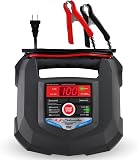 Schumacher Electric 15A Car Battery Charger & Maintainer9.8/10View on Amazon
- 3
 NOCO GENIUS2D 2A 12V Onboard Battery Charger9.8/10View on Amazon
- 4
 Deluxe 12V 750mA Battery Maintainer & Float Trickle ChargeView on Amazon
- 5
 Briidea Towed Vehicle Battery MaintainerView on Amazon
Can you leave a battery maintainer on all winter? Yes, you can safely leave a dedicated smart battery maintainer connected all winter, provided it automatically switches to a float or maintenance mode once the battery reaches full charge. Unlike a traditional manual trickle charger that supplies continuous current regardless of battery condition, an automatic maintainer monitors voltage and regulates output to prevent overcharging, electrolyte loss, and internal plate damage. Verify that your maintainer features automatic shutoff or float regulation, keep the battery in a ventilated space, and inspect your connections before leaving the vehicle unattended for cold storage.
More options to compare
 Deluxe 12V 750mA Battery Maintainer & Float Trickle ChargeCheck price on Amazon
 Briidea Towed Vehicle Battery MaintainerCheck price on Amazon
GarageToolHQ earns a commission when you buy through links on our product pages, at no extra cost to you. Read our affiliate disclosure.
Below: how smart maintainers differ from manual trickle chargers, winter storage dynamics, a setup checklist, and long-term care.
Can you leave a battery maintainer on all winter? How smart maintainers work
Leaving a vehicle parked unused throughout winter leads to gradual discharge and plate sulfation. While disconnected batteries slowly self-discharge, connected vehicles impose constant parasitic electrical draw from onboard computers and modules. When a battery remains discharged, lead sulfate hardens into crystals across internal plates, diminishing capacity and causing premature failure.
Leaving a dedicated maintainer or battery tender all winter connected to a seasonal vehicle keeps plates clean without overcharging. Smart maintainers use microprocessors to guide multi-stage charging. For example, LEICESTERCN lists a 3-stage profile, FOVAL uses a 4-step program, MOTOPOWER has 5 stages, Heagstat provides 8 stages, and GOOLOO features a 10-stage program.
During initial charging, the unit supplies its rated current to replenish energy. This rating ranges from 750mA on the LEICESTERCN, 800mA on the MOTOPOWER, 1A on the NOCO GENIUS1, 1.25 AMP on the Battery Tender Plus, or 1.5 AMP on the BatteryMINDer 1500, up to 4A on the GOOLOO S4, 5.5A on the Heagstat, or 10A on the NOCO GENIUS10. Regardless of rated amperage, a smart maintainer monitors voltage and tapers output as the battery fills. MOTOPOWER lists charging up to 14.4V before transitioning to maintain the battery at 13.6V for long periods to avoid gassing and prolong battery life.
This automated float transition makes continuous winter connection safe. NOCO GENIUS1 and NOCO GENIUS10 listings specify that continuous monitoring allows you to leave them connected safely and indefinitely. Battery Tender also emphasizes connect-and-forget automatic float switching. Additionally, BatteryMINDer lists automatic pulse desulfation that extends battery life up to four times compared to unmaintained batteries.
Selecting a dedicated battery charger maintainer ensures reliable starts when storage ends.
Battery maintainers vs trickle chargers vs standard chargers
Understanding circuit differences explains why a smart maintainer can remain connected all season while an unregulated charger damages battery cells.
| Charger Type | Current Regulation & Monitoring | Safe to Leave on All Winter? |
|---|---|---|
| Smart battery maintainer | Microprocessor monitors voltage and drops to float mode; ratings range from 750mA up to 10A | Yes, engineered for continuous, indefinite seasonal connection |
| Manual trickle charger | Supplies continuous low current without automatic shutoff or voltage monitoring | No, continuous current overcharges cells, boils electrolyte, and damages plates |
| Unregulated manual shop charger | Continuous high-amperage output without automated float regulation | No, causes severe overheating, excessive gassing, and plate warpage |
A manual trickle charger provides fixed low current indefinitely. Once a battery reaches capacity, continued charging decomposes water into hydrogen and oxygen gas, lowering electrolyte in flooded cells and drying out AGM mats. Unregulated high-current manual chargers are even more destructive, causing rapid overheating. Conversely, high-output smart units like the 10A NOCO GENIUS10 provide fast bulk charging but remain safe all winter because they automatically taper to float mode. Comparing a jump starter vs battery charger helps distinguish portable emergency starters from long-term maintenance tools.
How to leave a battery maintainer connected all winter: the setup checklist
Follow this checklist before leaving your vehicle unattended for winter storage:
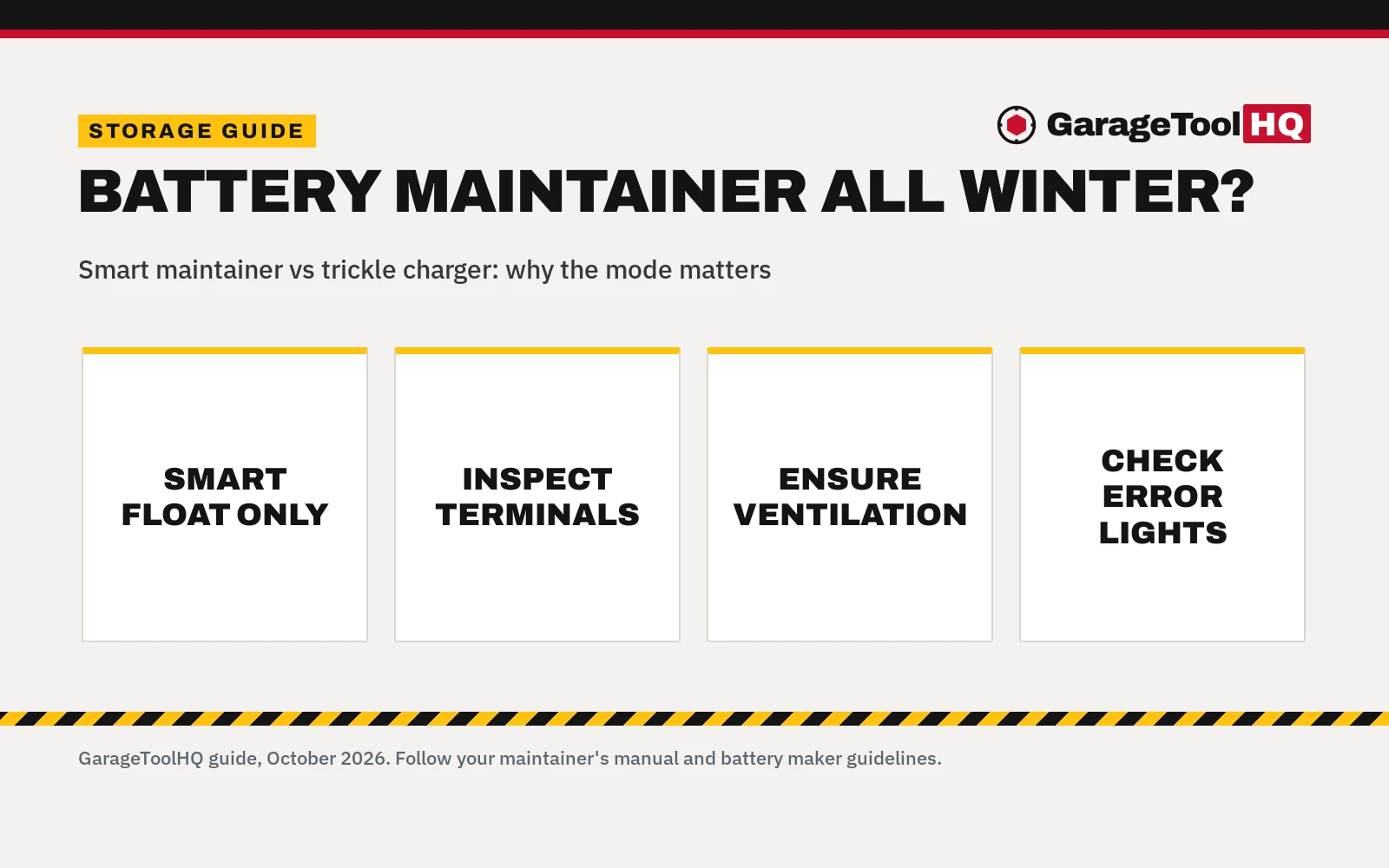
- Confirm automatic float mode. Verify that your maintainer features automatic float or smart multi-stage shutoff, as found on the NOCO GENIUS1 and Battery Tender Plus.
- Inspect terminals and casing. Clean corrosion from battery posts and inspect the casing for cracks or leaks. Never connect to a damaged or frozen battery.
- Check resting voltage. Inspect battery condition and check terminal voltage with an automotive multimeter to identify failing cells.
- Attach leads securely. Connect the red positive lead first, then connect the black negative lead to a chassis ground or negative post per your manual. Maintainers from NOCO, Battery Tender, and MOTOPOWER include spark-proof and reverse-polarity protections.
- Select voltage and chemistry. Match settings to your battery type, such as 6V or 12V on the Battery Tender Plus, or 6V, 12V, and 12.8V lithium modes on the Heagstat.
- Plug into a grounded outlet. Connect the maintainer to a grounded outlet and route cables safely away from pinch points and moving linkages.
- Observe initial charging. Confirm indicator status. FOVAL and LEICESTERCN use bi-color LEDs that change color when entering maintenance mode, while MOTOPOWER features a 24-hour timer that enters maintenance mode once voltage exceeds 14V, holding at 13.6V.
- Ensure ventilation. Keep the garage ventilated to disperse normal charging gasses and periodically check status lights through winter.
Manual chargers and basic unregulated trickle chargers do not reduce current at full charge. Continuous unregulated charging boils away electrolyte in flooded cells, dries out AGM mats, warps plates, and creates hazardous hydrogen gas. Only automatic maintainers belong on storage batteries.
Lead-acid batteries can release hydrogen while charging, so charge in a ventilated space away from sparks and flames, connect positive first and negative last, set the charger to the battery type (flooded, AGM, gel, lithium), and wear eye protection. Read our Safety Disclaimer.
Cold temperatures and winter garage battery storage
Winter cold increases internal battery resistance and drops cranking output. While low temperatures reduce self-discharge compared to summer heat, ongoing vehicle parasitic drain steadily depletes unattended batteries, and cold cells accept charge more slowly.
Freezing poses the greatest threat to discharged batteries. A fully charged battery contains sulfuric-acid-rich electrolyte that resists freezing. When a battery discharges, sulfate ions bond to plates, leaving electrolyte mostly water that freezes, expands, and cracks the case.
Advanced maintainers adjust charging for seasonal temperatures. BatteryMINDer features an ambient temperature sensor to regulate voltage, while NOCO GENIUS1 and GOOLOO use thermal sensors to prevent undercharging in cold weather. Heagstat provides a dedicated 12V/Winter mode. Reviewing how to keep a garage warm in winter also helps protect stored equipment.
Before seasonal storage, scanning vehicle modules with the best OBD2 scanner for DIY diagnostics helps uncover faults causing excessive parasitic draw.
For multiple vehicles, BatteryMINDer Model 1500 can maintain up to four batteries in parallel, while LEICESTERCN provides a 4-pack of independent maintainers.
Frequently Asked Questions
Can you leave a battery maintainer on all winter without unplugging it?
Yes. Smart maintainers from brands like NOCO, Battery Tender, and FOVAL are designed for indefinite connection. Microprocessors monitor voltage and supply current only as needed, preventing overcharging.
Does leaving a battery maintainer on all winter use a lot of electricity?
No. Once full, a maintainer enters float mode, consuming minimal power to hold target voltage (such as 13.6V on the MOTOPOWER) and offset natural discharge.
Should I disconnect the car battery before connecting a maintainer for winter?
Generally no. Maintainers like NOCO GENIUS1 and Battery Tender include fused eyelet cables for permanent terminal connection while leaving vehicle wiring intact.
Can a battery freeze in winter while connected to a maintainer?
A healthy battery on an active maintainer will resist freezing in winter garage conditions because maintaining full charge keeps acid concentration high.
What is the difference between a trickle charger and a battery maintainer?
A trickle charger supplies constant current without shutoff, risking overcharging. A maintainer monitors charge state and automatically drops into float mode.
Can a battery maintainer recover a completely dead battery?
Most maintainers need minimal voltage to start, such as 3 volt on the GOOLOO S4 or 1 volt on the NOCO GENIUS1. Units with manual override, like Force Mode on the NOCO GENIUS1, can charge batteries down to zero volts, though shorted cells cannot be restored.
Related: explore our diagnostics and electrical hub, compare top models in our guide to the best battery charger maintainers, see our guide on jump starter vs battery charger options, and review how to keep a garage warm in winter.