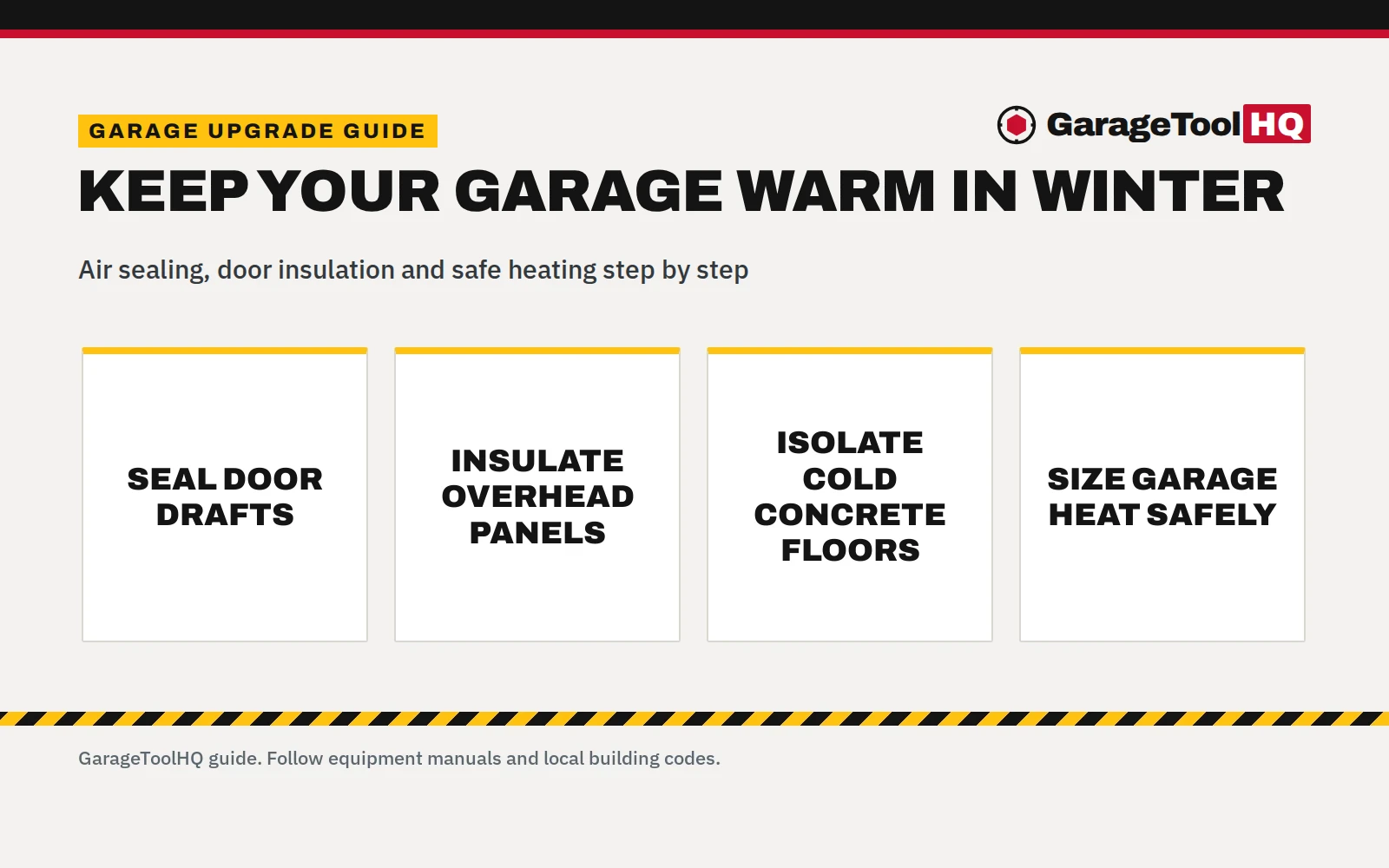
How to Keep a Garage Warm in Winter: Step-by-Step Guide
How to keep a garage warm in winter by sealing perimeter air drafts, insulating the overhead door, stopping floor chill, and adding safe supplemental heat.

On this page
Top picks at a glance
As an Amazon Associate we earn from qualifying purchases.
- 1
 hykolity 2FT 150W LED Linear High Bay Shop Light9.8/10View on Amazon
- 2
 Comfort Zone Hard-Wired Ceiling Mount Garage Electric Space9.7/10View on Amazon
- 3
 Comfort Zone Hard-Wired Ceiling Mount Garage Space Heater9.7/10View on Amazon
How to keep a garage warm in winter comes down to stopping warm air from escaping through air leaks and uninsulated surfaces, then introducing safe, controlled heat. In an unheated garage, sealing perimeter drafts around the vehicle door and adding door insulation panels reduces air infiltration and moderates temperature swings, though overall warmth depends on wall and ceiling insulation. For a workspace that stays comfortable during freezing weather, combine perimeter air sealing with an appropriately sized supplemental heater installed to local electrical or mechanical codes.
GarageToolHQ earns a commission when you buy through links on our product pages, at no extra cost to you. Read our affiliate disclosure.
Below: where garages lose thermal energy fastest, how insulation materials compare, a winter preparation checklist, and guidance on selecting garage heaters safely.
How to keep a garage warm in winter: where heat escapes
Garages lack the thermal boundaries of finished homes. Most feature uninsulated exterior framing, open attic spaces, and large stamped-metal doors. Without thermal barriers, indoor heat escapes rapidly through conduction across cold assemblies and air infiltration at open gaps.
The overhead garage door represents one of the largest surface areas where heat escapes. Thin metal panels have minimal thermal resistance, conducting indoor warmth directly outside. Perimeter gaps along the header, side jambs, and floor threshold allow cold winds to push straight into the shop. Additionally, concrete slab foundations pull heat away through conduction, making the workspace feel colder than ambient air, while unsealed wall outlets and attic hatches allow rising warmth to vent out.
Comparing garage heat retention and heating methods
| Approach | How It Works | Stated Specifications | Primary Benefit |
|---|---|---|---|
| Perimeter weatherstripping | Flexible PVC stop molding fastens along jambs to seal gaps | DuraSeal lists coiled trim in rolls of 34 ft with a thickness of 0.38 inches | Blocks cold drafts, snow, and wind around the door frame |
| Reflective foam panels | Reflective sheets fit inside door panel recesses | Reach Barrier lists 8 pre-cut panels measuring 24″ x 48″ and 5/32 inch thick for an 8ft x 8ft door; US Energy Products lists a maker-stated R8 value at 0.33 inches thickness | Reduces conductive and radiant heat transfer through metal doors |
| Insulated foam panels | Closed-cell foam panels adhere to door steel | BEEST lists 6 millimeters thick panels for 8×8 & 8×7 ft single doors, with adhesive installation between 50-90°F | Dampens noise while slowing heat conduction through garage doors |
| Thermal insulated curtain | Heavy fabric barrier hung over the door opening | Sjuznng lists an 8.3×7.15 ft curtain for 8×7 FT openings with 180G cotton padding and 28 pairs of magnets; VEVOR lists a 16x7FT curtain measuring 16.3 x 7.15 ft at 8.5 pounds | Provides draft protection without modifying door panels |
| Hardwired ceiling heater | Fan-forced heating element wired to dedicated power | Comfort Zone lists a 240 Volt unit rated at 10,000 Watt (with its spec table listing 5,000 Watts) delivering 34120 british thermal units with a maker-stated 1500 sq. ft. coverage | Delivers high heat output without generating combustion moisture |
Sealing drafts stops cold air currents immediately, while door insulation slows conductive heat loss. Combined with a properly sized heater, these measures keep heat inside the shop and reduce operational costs.
How to keep a garage warm in winter: step-by-step checklist
Address building envelope deficiencies before configuring supplemental heating equipment:
- Seal the overhead door perimeter. Inspect jambs for daylight. Fasten exterior stop molding so flexible vinyl fins compress against the closed door. For example, DuraSeal lists coiled weatherstripping in rolls of 34 ft with a thickness of 0.38 inches that nails directly into the frame. Replace worn bottom rubber seals to seal against the slab.
- Insulate garage door panels. Uninsulated metal doors conduct warmth outdoors. For lightweight radiant barriers, Reach Barrier lists an insulation kit for an 8ft x 8ft single door providing 8 pre-cut panels measuring 24″ x 48″ and 5/32 inch thick with 2 layers of bubble. For rigid foam, BEEST lists 6 millimeters thick panels for 8×8 & 8×7 ft doors, specifying surface cleaning with isopropyl alcohol and installation between 50-90°F. Alternatively, INSULATION MARKETPLACE lists reflective foil with an R-8 value and 5mm closed-cell foam.
- Hang a thermal curtain over drafty doorways. Where modifying door panels is impractical, a magnetic curtain provides draft protection. Sjuznng lists an insulated curtain sized at 8.3×7.15 ft to cover 8×7 FT openings, built with 180G cotton padding, a 1.5-inch wide mounting strip, and 28 pairs of magnets. For wider bays, VEVOR lists a 16x7FT curtain measuring 16.3 x 7.15 ft crafted from 300D Oxford fabric with an 8.5 pounds stated weight.
- Seal wall penetrations and ceiling openings. Apply caulk along window trim and baseboards, and use expanding spray foam around plumbing and electrical wall penetrations. Place weatherstripping and rigid foam over pull-down attic stairs to stop warm air from rising into the attic.
- Isolate cold concrete floors in work zones. Bare concrete pulls heat from your body. Lay anti-fatigue rubber mats or foam tiles in primary work zones. Compare options in our guide to garage floor mats vs epoxy.
- Install an appropriately sized supplemental heater. Select a heater matched to garage volume. Hardwired electric units, such as the Comfort Zone ceiling model rated at 240 Volt and 10,000 Watt (though its spec table states 5,000 Watts) with a 41.67 A draw and 34120 british thermal units, carry a maker-stated coverage of up to 1500 sq. ft. Calculate your exact heating requirements with our guide on what size garage heater do I need.
- Mount carbon monoxide and smoke alarms. Install carbon monoxide alarms inside the garage and adjacent to interior entry doors leading into the home. Maintain clear space around heaters and keep a fire extinguisher near the exit door.
Never run a vehicle engine, generator, outdoor-only heater, or camp stove inside a garage, even with the door partly open. For any indoor-rated fuel heater, maintain the manufacturer’s specified fresh-air opening and install a carbon monoxide alarm. When installing hardwired electric heaters, hire a licensed electrician to run dedicated circuits.
Never run a fuel-burning heater, generator or engine in a closed garage: carbon monoxide builds up fast and has no smell. Fit a CO alarm, keep clearances to cars and storage, use vented gas heaters installed to code, and put 240V electric heaters on a dedicated circuit. See CPSC carbon monoxide guidance. Read our Safety Disclaimer.
Electric vs gas garage heaters for winter warmth
Consider these distinctions when choosing between electric and gas heating options:
- Combustion byproducts: Electric heaters produce zero carbon monoxide, fumes, or moisture. Unvented portable gas heaters release combustion moisture and exhaust into the air, requiring ventilation. Vented gas unit heaters discharge exhaust safely outdoors through a flue.
- Heating output: Hardwired 240 Volt electric units provide clean heat for residential garages. For larger spaces, Comfort Zone lists its 240 Volt ceiling heater delivering 34120 british thermal units with a stated heating coverage of 1500 sq. ft. Uninsulated workshops often require vented gas heaters delivering higher BTU output.
- Installation requirements: High-output electric heaters require a dedicated branch circuit, heavy wiring, and a double-pole breaker installed by a licensed electrician. Review our sizing guide on what size breaker for a 240V garage heater. Vented gas units require rigid gas piping, venting, and mechanical permits.
- Operating safety: Electric units eliminate open flames inside the building. If considering portable fuel heat, review is it safe to use a propane heater in a garage before buying cylinders.
Compare technologies in our guide to garage heater gas vs electric, evaluate running costs with how much does it cost to heat a garage, and examine top equipment choices in our review of the best garage heater for a 2-car garage.
Protecting batteries, tools and liquids from freezing temperatures
Winter garage care also protects stored equipment, fluids, and sensitive tools:
- Vehicle battery maintenance: Freezing temperatures slow chemical reactions in lead-acid batteries and thicken engine oil. A discharged battery can freeze and crack its casing. Connecting a smart battery charger maintainer keeps stored vehicles fully charged without overcharging.
- Cordless tool batteries: Lithium-ion packs lose runtime in the cold and must never be charged below freezing, which causes permanent cell damage. Store cordless batteries in an insulated cabinet or indoors.
- Liquid chemicals: Water-borne paints, wood glues, and detailing chemicals spoil if frozen. Move temperature-sensitive products indoors before severe cold arrives.
- Condensation and rust: Heating a cold garage rapidly can cause airborne moisture to condense on cold cast iron tables and vises. Apply paste wax or corrosion inhibitor to bare metal surfaces throughout winter.
Frequently Asked Questions
How much does insulating a garage door help in winter?
Insulating an overhead door reduces heat loss through thin metal panels, slowing conductive and radiant heat transfer. Read our analysis in do garage door insulation kits work for material comparisons.
Should I seal air leaks before installing a garage heater?
Yes. Sealing perimeter drafts around jambs and windows prevents heated air from escaping immediately, reducing heater runtime and energy costs.
Can I leave an electric garage heater running unattended overnight?
Hardwired electric heaters with overheat protection and thermostats can cycle automatically, but require proper clearance from combustibles. Note that some models have minimum thermostat settings as high as 68 °F (as Comfort Zone lists for its digital unit), heating to full room temperatures rather than low freeze protection. Never leave portable space heaters unattended.
What size electrical service is needed for a 240V garage heater?
Electrical demand depends on wattage. Standard residential heaters draw moderate amperage, but high-output models require heavy circuits. For example, Comfort Zone lists its 10,000 Watt ceiling heater drawing 41.67 A, requiring a dedicated heavy-duty circuit installed by an electrician.
How do I keep a concrete garage floor from feeling so cold?
Concrete conducts heat away from your feet. Place interlocking foam tiles or heavy rubber mats across workstations to create an insulating thermal break.
Are portable propane heaters safe for indoor garage heating?
Only heaters explicitly rated for indoor use are acceptable. They consume oxygen and produce moisture, requiring the fresh-air opening specified in the manual, constant supervision, and an active carbon monoxide alarm.
Related: garage upgrades hub, do garage door insulation kits work, what size garage heater do I need, how much does it cost to heat a garage, and our guide to the best garage heater for a 2-car garage.