How Much Does It Cost to Heat a Garage? A Simple Formula
How to work out what it costs to heat a garage: BTU needed, energy values for electric, propane and natural gas, a worked example and ways to cut the bill.

On this page
Top picks at a glance
As an Amazon Associate we earn from qualifying purchases.
- 1
 Shinic 120V Electric Garage Heater9.7/10View on Amazon
- 2
 GASLAND MHA18B Propane heater Outdoor9.6/10View on Amazon
- 3
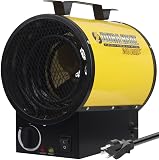 Dura Heat 240V Electric Space Heater for Garage9.6/10View on Amazon
- 4
 NewAir NGH160GA00View on Amazon
- 5
 Dura Heat Electric Forced Air HeaterView on Amazon
- 6
 Shinic 2-Pack 120V Electric Garage HeaterView on Amazon
- 7
 Electric Patio Heater with LED LightView on Amazon
- 8
 VAGKRI 42" 1500W Electric Outdoor Infrared Heater with RemoteView on Amazon
- 9
 Dyna-Glo EG10000DH Dual Heat 10View on Amazon
How much does it cost to heat a garage? It depends on how much heat the garage loses, how long you run the heater and what your energy costs per unit. You can work it out in three steps: find the BTU per hour the garage needs, convert that to kWh, gallons or therms of fuel, then multiply by your own rate from your utility bill. Fixed dollar figures would be wrong for most readers, so this guide gives you the formulas.
More options to compare
 NewAir NGH160GA00Check price on Amazon
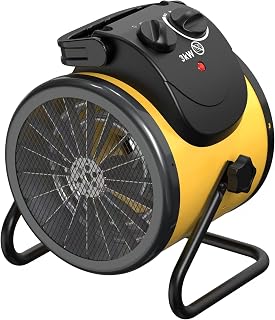 Dura Heat Electric Forced Air HeaterCheck price on Amazon
 Shinic 2-Pack 120V Electric Garage HeaterCheck price on Amazon
 Electric Patio Heater with LED LightCheck price on Amazon
 VAGKRI 42" 1500W Electric Outdoor Infrared Heater with RemoteCheck price on Amazon
 Dyna-Glo EG10000DH Dual Heat 10Check price on Amazon
GarageToolHQ earns a commission when you buy through links on this page, at no extra cost to you. Affiliate disclosure.
Below: the three-step method, an energy comparison for electric, propane and natural gas, and ways to cut the bill.
How much does it cost to heat a garage: the three-step method
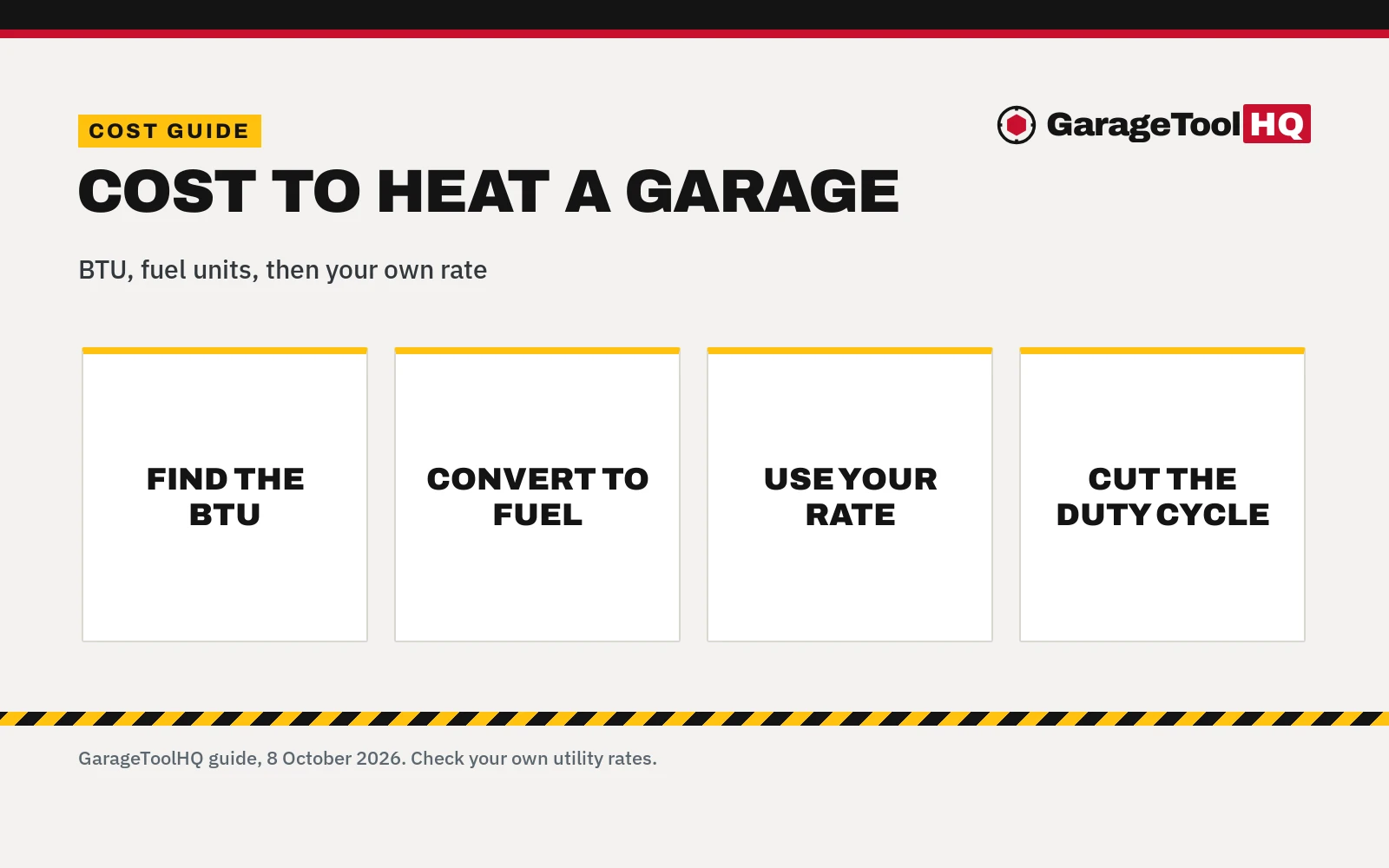
- Find the heat you need. Use our garage heater BTU calculator or the steps in what size garage heater do I need. The result is BTU per hour.
- Convert to fuel per hour. Use the energy values below.
- Multiply by your rate and your hours. Cost per hour = fuel per hour x your price per unit. Then multiply by the hours the heater runs.
Energy values for electric, propane and natural gas
| Fuel | Energy per unit | Fuel per hour for 20,000 BTU/h |
|---|---|---|
| Electric | 1 kWh = 3,412 BTU | About 5.9 kWh |
| Propane | About 91,500 BTU per gallon | About 0.22 gallon |
| Natural gas | 1 therm = 100,000 BTU | About 0.2 therm |
Those figures assume all the fuel’s energy becomes heat. A vented gas heater with 80% efficiency uses about 25% more fuel for the same heat in the room. Electric resistance heaters turn essentially all the electricity into heat.
Worked example for an electric heater
A 5,000 W heater delivers about 17,060 BTU per hour (5,000 x 3.412). It uses 5 kWh for each hour at full power. If a thermostat keeps it running half the time for four hours, that is 10 kWh. Multiply 10 by your price per kWh to see the cost of that session.
Why duty cycle matters more than the heater size
A heater only uses fuel when it is firing. A well-insulated garage reaches the set temperature, then the heater cycles on and off. A poorly insulated one runs nearly all the time. This is why two identical heaters can cost very different amounts to run.
Ways to lower the cost of heating a garage
- Heat only when you work. Turn the heater on 15 to 30 minutes before you start, not all day.
- Seal the garage door and gaps. Door seals and weatherstripping cut the biggest leak.
- Insulate the door and walls. A higher R-value lowers the BTU per hour you need.
- Choose a lower setpoint. Working temperatures of 50 to 60 F cost less than 70 F.
- Use a thermostat. A thermostat stops the heater overshooting.
- Spot heat. Radiant or infrared heaters warm you and the work area rather than the whole air volume.
Choosing between electric and gas for running cost
Which fuel is cheaper depends on local prices per kWh, gallon or therm. Compare by converting each to cost per 100,000 BTU: kWh price x 29.3 for electric, gallon price / 0.915 for propane, and therm price for natural gas. Use the lowest. Gas heaters need venting and ventilation; read is it safe to use a propane heater in a garage before choosing propane. An electric heater may also need a new 240 V circuit, so ask a licensed electrician before you buy.
Worked example for propane
A propane heater rated at 30,000 BTU per hour burns about a third of a gallon per hour at full fire (30,000 / 91,500 = 0.33). Run it for three hours at full output and it uses about one gallon. Multiply the gallons by your local price per gallon for the session cost. Remember that an unvented or indoor-rated portable propane heater needs fresh air and a CO alarm, and that a vented unit heater loses some heat up the flue.
What changes the answer most
Four things drive the running cost far more than the heater model: the temperature you want, the outside temperature, how well the garage is insulated and how long you run the heater. If you cut the setpoint by 10 degrees F or stop the draft under the door, you reduce the heater’s duty cycle and the bill together. Before you buy a bigger heater, fix the leaks.
Keep a simple log for a week: note the hours you run the heater and read the meter or tank gauge before and after. That gives you a real cost per hour for your garage, which is more accurate than any estimate.
Never run a fuel-burning heater, generator or engine in a closed garage: carbon monoxide builds up fast and has no smell. Fit a CO alarm, keep clearances to cars and storage, use vented gas heaters installed to code, and put 240V electric heaters on a dedicated circuit. See CPSC carbon monoxide guidance. Read our Safety Disclaimer.
Frequently Asked Questions
How do I calculate the cost to heat my garage?
Find the BTU per hour the garage needs, convert it to kWh, gallons or therms, then multiply by your price per unit and the hours of use.
Is it expensive to heat a garage?
It depends on size, insulation and how often you heat it. An insulated garage heated only while you work costs far less than one kept warm all day.
Is electric or propane cheaper for a garage?
Compare cost per 100,000 BTU using your local rates. Electric has no venting needs, while propane needs a vented or indoor-rated unit and a CO alarm.
How many watts do I need to heat a 2-car garage?
It depends on insulation and climate. Use the BTU calculator rather than a rule of thumb, then convert BTU to watts by dividing by 3.412.
Does insulating the garage door save money?
Usually yes. The door is often the largest heat leak, and a lower heat loss means the heater runs less.
Is a thermostat worth it on a garage heater?
Yes. It cycles the heater to hold the setpoint and prevents overshooting, which is where a lot of fuel is wasted.
Related: garage heater sizing by BTU, the best garage heaters for a 2-car garage, our garage upgrades hub and the safety disclaimer.