Corded vs Cordless Circular Saw: Which One Should You Buy?
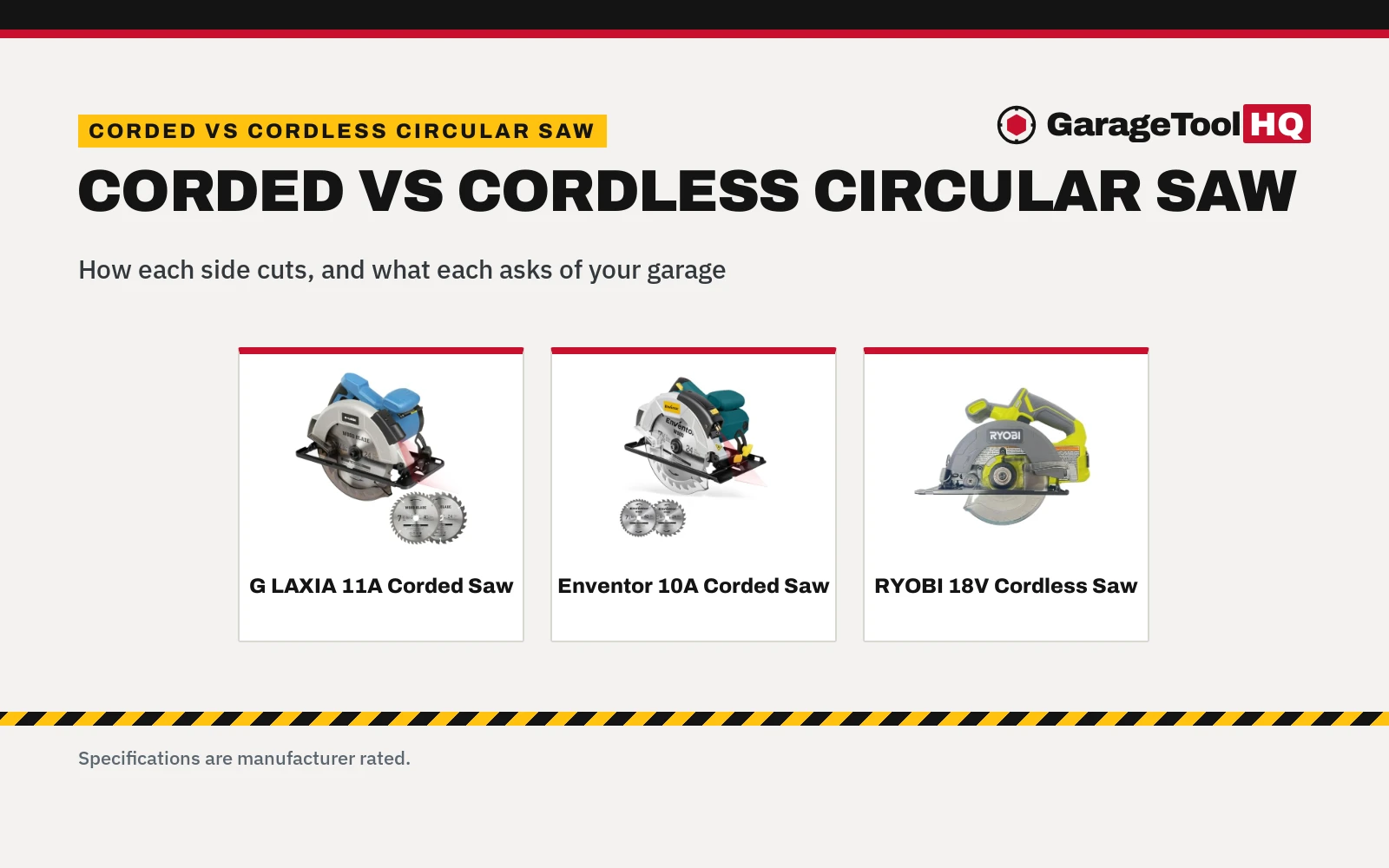
Corded and cordless circular saws compared on power, speed, blade size and cut depth, with two corded examples and one 18V cordless example.

On this page
Top picks at a glance
As an Amazon Associate I earn from qualifying purchases.
- 1
 G LAXIA Corded Circular Saw 6000RPM with Laser9.6/10View on Amazon
- 2
 Enventor Circular Saw with Laser Guide9.6/10View on Amazon
- 3
 ONEAND 18V Cordless 5 1/2 in. Circular Saw Tool9.2/10View on Amazon
Verdict: Choose a corded circular saw if you cut near an outlet and want the no-load speed the corded examples state, 6000 or 5800 RPM, and the stated cut depth they give. Choose a cordless circular saw if you cut away from power and already own the battery and charger, since this cordless example ships as a tool only.
A circular saw earns its keep cutting plywood, framing lumber and sheet goods to length, and the choice between corded and cordless comes down to where you cut and how long you cut. This comparison covers corded vs cordless circular saw options with examples of each side, then gives a clear pick for each side.
GarageToolHQ earns a commission when you buy through links on this page, at no extra cost to you. Read our affiliate disclosure.
Example saws
G LAXIA Corded Circular Saw 6000RPM with Laser
An 11A corded circular saw with a 6000 RPM no-load speed, a laser guide, a 7-1/4 inch blade and a rip guide.
Pros
- 11A motor with a 6000 RPM no-load speed
- Laser guide and rip guide included
- Rip guide, hex key and 24T blade in the box
- Dust blower keeps the cut line clear
Cons
- No warranty term is stated
- No weight is stated
- Corded, so it needs an outlet within reach
- Two-handed operation, so it needs a firm two-handed grip
Enventor Circular Saw with Laser Guide
A 10A corded circular saw with a 1200W motor, 5800 RPM, a laser guide and two blades in 24T and 40T.
Pros
- 10A motor rated at 1200W with 5800 RPM
- Two blades in the box: 24T and 40T
- Laser guide with a scale ruler
- Double protection switch
Cons
- No warranty term is stated
- No weight is stated
- Corded, so it needs an outlet within reach
- 6.56-foot cable limits how far the saw reaches from an outlet
ONEAND 18V Cordless 5 1/2 in. Circular Saw Tool
An 18V cordless 5-1/2 inch circular saw sold as a tool only, with battery and charger sold separately.
Pros
- 18V cordless cutting away from an outlet
- 5-1/2 inch blade
- 30-day limited warranty stated
- 4.45 pounds, the only weight stated here
Cons
- Battery and charger sold separately
- No no-load speed is stated
- No cut depth is stated
- No laser guide is stated
Other tools worth a look
 Milwaukee M18 BRUSHLESS 7-1/4" CIRCULAR SAWCheck price on Amazon
 Bosch CS10 7-1/4 In. Circular SawCheck price on Amazon
 Makita 5007F 7-1/4" Circular SawCheck price on Amazon
 DEWALT 7-1/4-Inch Circular SawCheck price on Amazon
 Makita 5007Mg Magnesium 7-1/4-Inch Circular SawCheck price on Amazon
 Makita HS0600 10-1/4" Circular SawCheck price on Amazon
Side by side: corded vs cordless circular saw
| Corded | Cordless | Notes | |
|---|---|---|---|
| Power | 11A and 10A motors | 18V battery | Corded examples state amps; the cordless example states volts |
| No-load speed | 6000 and 5800 RPM | Not stated | Both corded examples state RPM; the cordless example does not |
| Blade size | 7-1/4 in | 5-1/2 in | Corded examples use the bigger blade |
| Max cut at 90° | 2-1/2 in and 62 mm | Not stated | The corded examples state it; the cordless example does not |
| Laser guide | Both corded examples | Not stated | Both corded examples state a laser guide |
| Weight | Not stated | 4.45 pounds | Only the cordless example states a weight |
| Warranty | Not stated | 30 days | Only the cordless example states a warranty term |
Every rating comes from the brand’s listing and is not a shop test (gathered 24 November 2026).
How each saw gets its power
The corded examples run on wall power: the G LAXIA example has an 11A motor, and the Enventor example has a 10A motor rated at 1200W. A corded saw runs as long as the outlet holds. The RYOBI cordless example runs on an 18V battery, and it ships as a tool only with battery and charger sold separately, so the buyer supplies the power. The Enventor example has a 6.56-foot cable, which sets how far that saw reaches from an outlet.
Cut depth and bevel
Cut depth is where the corded examples show their figures. The G LAXIA example cuts 2-1/2 inches deep at 90 degrees and 1-7/8 inches at 45 degrees, with a bevel range of 0 to 45 degrees. The Enventor example cuts 62 mm deep at 90 degrees and 42 mm at 45 degrees, with a bevel range of 0 to 45 degrees. The RYOBI cordless example states no cut depth and no bevel range, so the listings leave that comparison unclear rather than handing either side a win.
Blades and laser guides
Both corded examples use 7-1/4 inch blades and both state a laser guide. The G LAXIA example comes with a 24T blade and a rip guide, and the Enventor example comes with a 24T blade and a 40T blade, a rip guide and a wrench. The RYOBI cordless example uses a 5-1/2 inch blade and states no laser guide. The corded examples carry the bigger blade here.
Weight and moving around the job
Weight is the one figure only the cordless example states: the RYOBI example weighs 4.45 pounds. Both corded examples state no weight, so the listings leave that comparison unclear. What the corded examples do state is the cable: the Enventor example has a 6.56-foot cable, so the saw stays within reach of an outlet. A cordless saw moves freely around the job, while a corded saw trades that freedom for wall power.
Choose a corded saw if
- You cut near an outlet most of the time
- You want the 6000 or 5800 RPM no-load speed the corded examples state
- You want a laser guide and a rip guide in the box
- You want a stated cut depth at 90 degrees
Choose a cordless saw if
- You cut away from power
- You already own an 18V battery and charger
- You want the 4.45-pound stated weight
- You cut with a 5-1/2 inch blade
For more choices, see the best corded circular saw, and for wood cutting, the best circular saw for wood cutting.
Read the manual before first use, wear eye protection, keep the work area clear and ventilated, and stay within every stated rating. Read our Safety Disclaimer.
Garage Fit Check
- Check the outlet situation first: both corded examples run on wall power, and the Enventor example has a 6.56-foot cable.
- Check the battery platform: the RYOBI example is a tool only, with battery and charger sold separately.
- Check the blade size: the corded examples use 7-1/4 inch blades, and the cordless example uses a 5-1/2 inch blade.
- Check the cut depth against the material: the G LAXIA example cuts 2-1/2 inches at 90 degrees, and the Enventor example cuts 62 mm at 90 degrees.
- Store the rip guide with the saw: both corded examples include one.
FAQ: garage tools
Can a cordless circular saw cut as deep as a corded one?
The corded examples state cut depths of 2-1/2 inches and 62 mm at 90 degrees; the RYOBI cordless example states no cut depth, so that comparison stays unclear.
What blade size do these circular saws use?
The corded examples use 7-1/4 inch blades, and the RYOBI cordless example uses a 5-1/2 inch blade.
Do these saws come with a battery?
The RYOBI cordless example is a tool only, with battery and charger sold separately. The corded examples run on wall power and need no battery.
Do the corded examples have a laser guide?
Both corded examples state a laser guide. The RYOBI cordless example states no laser guide.
How much does the cordless example weigh?
The RYOBI example weighs 4.45 pounds. Both corded examples state no weight.
Related: the best corded circular saw, the best 7 1/4 circular saw blade, the best circular saw guide, the circular saw vs reciprocating saw and the cordless tools hub.