Cordless Drill Torque Chart: Settings for Common Garage Jobs
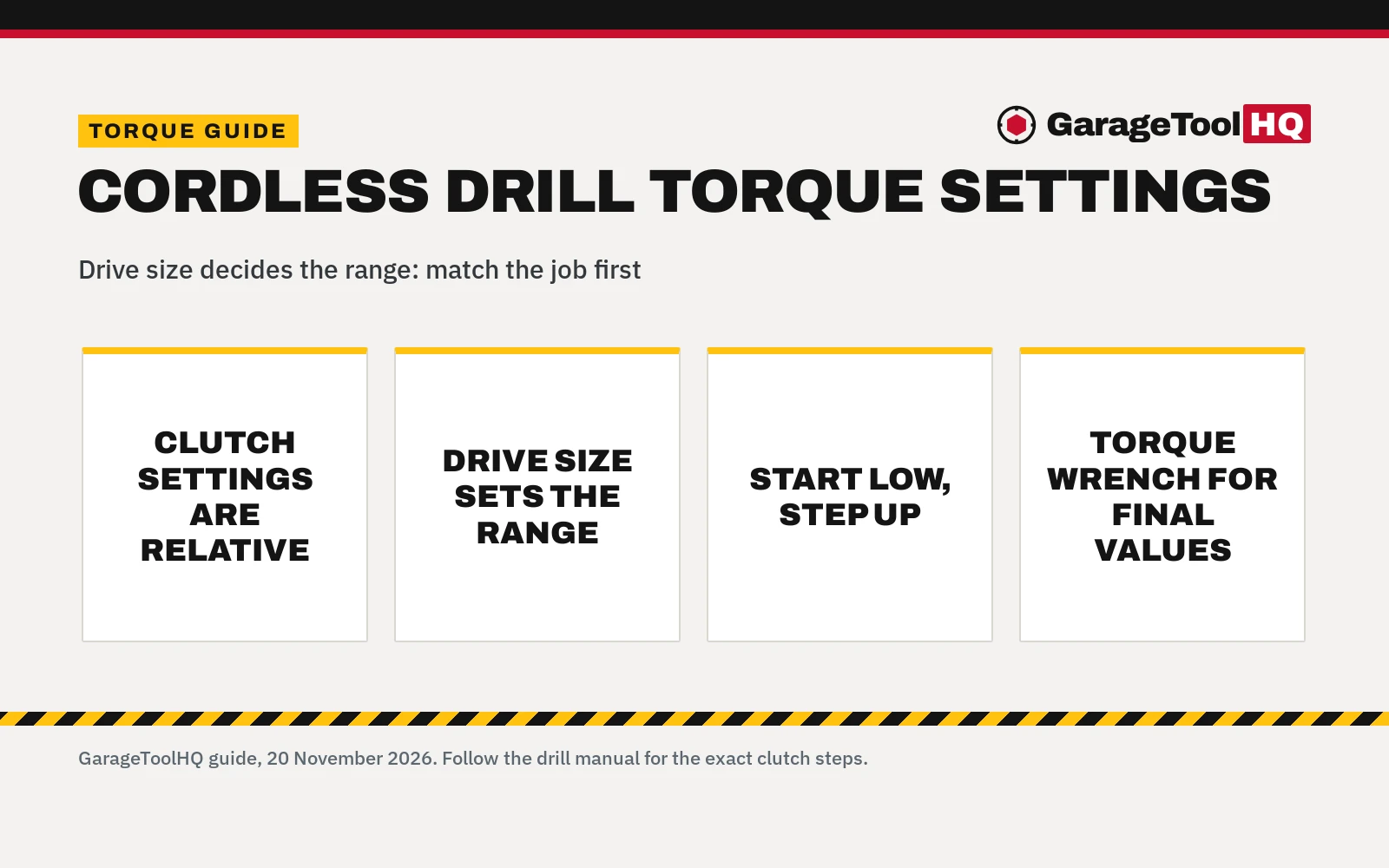
A cordless drill torque chart that maps drive sizes to stated torque ranges, with steps for setting the clutch by job.

On this page
Top picks at a glance
As an Amazon Associate I earn from qualifying purchases.
- 1
 CRAFTSMAN V20 MAX Cordless Drill and Impact Driver9.6/10View on Amazon
- 2
 DCA Cordless Drill Set9.5/10View on Amazon
- 3
 20V Cordless Drill with Battery and Charger9.5/10View on Amazon
A cordless drill clutch decides how far a fastener is driven, and a setting that is too high strips the screw head or splits the material. A cordless drill torque chart answers the question at the center of that dial: which setting suits the job in front of the drill. The short answer is that the clutch dial on a drill carries relative settings, not calibrated torque values, so the chart below maps each drive size to the torque range its maker states, and the steps that follow show how to pick a starting point and stop before the fastener or the material gives way.
GarageToolHQ earns a commission when you buy through links on our product pages, at no extra cost to you. Read our affiliate disclosure.
Below: how to read the chart, the stated ranges by drive size, the clutch steps, the mistakes that strip fasteners, and the point where a torque wrench takes over from the drill.
Cordless drill torque chart: what the numbers mean
A drill clutch slips when the resistance at the screw meets the setting on the dial, which keeps the screw from turning further. That slip point is a relative setting on the drill, and the dial figures do not match foot-pounds or inch-pounds on their own. The chart gives the stated torque ranges for torque tools in the same drive sizes, so a reader can see what each drive size covers before picking a clutch starting point.
Listings state small ranges in inch-pounds and larger ranges in foot-pounds, with newton-meters beside them where the maker gives both. A 1/4-inch drive covers the small end, a 3/8-inch drive covers the middle, and a 1/2-inch drive covers the large end. The ranges overlap, and that overlap is normal: a mid-size fastener can sit inside the range of a 3/8-inch tool and inside the range of a 1/2-inch tool at the same time.
| Drive size | Stated torque range | Maker example |
|---|---|---|
| 1/4-inch preset screwdriver | 10-70 in-lb | coobeast 49-piece set |
| 1/4-inch click wrench | 2-26 Nm (17.7-230.1 in-lb) | LEXIVON LX-191 |
| 1/4-inch click wrench | 20-200 in-lb | TEKTON TRQ95901 |
| 1/4-inch digital wrench | 1.1-22.1 ft-lb (1.5-30 N·m) | YIYEIE |
| 3/8-inch click wrench | 10-100 ft-lb | TEKTON TRQ95901 |
| 3/8-inch digital wrench | 3-62.5 ft-lb (4.25-85 N·m) | YIYEIE |
| 3/8-inch click wrench | 5-45 ft-lb | HORUSDY, XEIMILE, KELIN |
| 1/2-inch click wrench | 40-200 ft-lb | TEKTON TRQ95901 |
| 1/2-inch digital wrench | 8-162 ft-lb (11-220 N·m) | YIYEIE |
| 1/2-inch click wrench | 10-170 ft-lb | HORUSDY, XEIMILE, KELIN, VEVOR |
| 3-piece click sets | 20-240 in-lb, 5-50 ft-lb, 10-170 ft-lb | PUIBERS |
Read the chart from the fastener outward: find the range that holds the fastener, then pick the drive size whose range covers it with room to spare at both ends. A range that starts above the fastener leaves no room at the low end, and a range that ends below the fastener leaves no room at the high end. When two drive sizes both cover the fastener, the smaller one gives finer control on small work, while the larger one gives more leverage on large work.
Accuracy matters once the final value is stated. Most click wrenches in the chart state accuracy within ±3%, while the LEXIVON bike wrench (on Amazon) states ±4% clockwise and ±6% counter-clockwise, and the YIYEIE digital (on Amazon) set states ±2% accuracy. A 72-tooth ratchet needs only a 5° swing arc on the YIYEIE and KELIN sets, which helps in tight corners, while the TEKTON sets use a 90-tooth ratchet with a 4-degree swing arc. The LEXIVON wrench adds micro-adjustments to 0.2 Nm and a calibration certificate with a traceable serial number.
How to set a cordless drill clutch, step by step
The clutch dial turns through numbered settings from low to high, with a drill mode past the highest number. The steps below work for any drill with a clutch, and they need no torque figure at all.
- Start at the lowest clutch setting. The first drive should slip early rather than late, because a fastener driven too far is harder to save than one driven too little.
- Drive a fastener into scrap material of the same kind. The scrap shows how the clutch behaves on the real job before the real fastener goes in.
- Step the clutch up one click at a time. Drive again after each step until the fastener seats flush and the clutch slips at the same moment.
- Stop when the head sits flush. A fastener that sits proud needs one more step; a fastener that sinks below the surface has gone one step too far.
- Back down if the bit cams out or the head strips. Drop the clutch a step, swap in a fresh fastener, and drive again.
- Switch to a torque wrench for the final value. When the job states a torque figure, the drill only runs the fastener down, and the wrench sets the final value.
For drilling holes, set the dial to drill mode, not a clutch number. A clutch setting that is right for driving screws will slip under the load of a drill bit, and the bit will stall while the hole is still shallow. The drill mode locks the clutch out, so the full drive reaches the bit. The guide to cordless drill vs hammer drill covers which drill suits masonry and concrete work.
Which drive size suits which garage job
Small fasteners belong to the 1/4-inch drive. The coobeast preset screwdriver (on Amazon) covers 10-70 in-lb in 1 in-lb increments, and the LEXIVON LX-191 covers 2-26 Nm (17.7-230.1 in-lb) with micro-adjustments to 0.2 Nm, which suits bike parts and small brackets. The guide to the best inch pound torque wrench compares more wrenches in this small range.
Mid-size garage work belongs to the 3/8-inch drive. The TEKTON TRQ95901 states 10-100 ft-lb for its 3/8-inch wrench, and the HORUSDY, XEIMILE and KELIN sets state 5-45 ft-lb, which covers engine brackets, brake parts and car work. The best torque wrench for automotive guide compares sets for this kind of work.
Large fasteners and wheel work belong to the 1/2-inch drive. The TEKTON TRQ95901 states 40-200 ft-lb for its 1/2-inch wrench, the YIYEIE digital set states 8-162 ft-lb, and the HORUSDY, XEIMILE, KELIN and VEVOR sets state 10-170 ft-lb, which covers wheel lug nuts and fasteners on cars, trucks and tractors. The best impact wrench for lug nuts guide covers the tool that breaks lug nuts loose before the wrench sets the final value, and the best electric torque wrench guide compares digital wrenches with preset values: the YIYEIE set holds 10 preset values.
The YIYEIE digital set shows a green LED at 80% of the target, a red LED at 90%, and both LEDs plus a buzzer alarm at 100% of the target, with a 3-minute auto-shutdown. The maker warns not to exceed 110% of each wrench’s maximum torque value.
Common clutch mistakes
- Starting at the highest setting. A high setting drives a small screw past flush before the clutch can slip, and the head strips or the material splits.
- Driving screws in drill mode. Drill mode locks the clutch out, so nothing stops the screw at flush.
- Drilling with a clutch setting. The clutch slips under the bit load, the bit stalls, and the hole stays shallow.
- Using the drill for a final torque value. The clutch dial is relative, so a stated value needs a torque wrench, not the drill.
- Skipping the scrap check. A fastener driven into scrap first shows the right setting before the real piece is at risk.
Read the manual before first use, wear eye protection, keep the work area clear and ventilated, and stay within every stated rating. Read our Safety Disclaimer.
FAQ: garage tools
What torque setting should a cordless drill be on?
Start at the lowest clutch setting and step up one click at a time until the fastener seats flush. Small screws in soft material need the low end of the dial, and larger fasteners in hard material need the high end. The chart above shows the stated ranges by drive size: 10-70 in-lb at the small end with the coobeast preset screwdriver, and 40-200 ft-lb at the large end with the TEKTON 1/2-inch wrench.
Do drill clutch numbers mean foot-pounds?
No. The figures on a drill clutch dial are relative settings, and the dial does not state foot-pounds or inch-pounds. The chart maps drive sizes to the ranges their makers state, such as 20-200 in-lb for the TEKTON 1/4-inch wrench and 10-100 ft-lb for its 3/8-inch wrench, so the reader can see what each drive size covers.
What is the difference between in-lb and ft-lb on a torque chart?
Inch-pounds suit small fasteners and foot-pounds suit larger ones, and makers state both units across their ranges. The TEKTON TRQ95901 states 20-200 in-lb for its 1/4-inch wrench, 10-100 ft-lb for its 3/8-inch wrench, and 40-200 ft-lb for its 1/2-inch wrench, which shows how the unit changes as the drive size grows.
Can a cordless drill replace a torque wrench?
Not for a final torque value. A drill runs a fastener down fast, and a torque wrench sets the final value to the stated figure, with most click wrenches in the chart stating accuracy within ±3% (the LEXIVON bike wrench states ±4% clockwise and ±6% counter-clockwise) and the YIYEIE digital set stating ±2%. Use the drill to run the fastener down, then finish with the wrench.
Why does the clutch slip when drilling?
The clutch is set for driving screws, not for drilling holes. A drill bit loads the clutch harder than a screw does, so the clutch slips and the bit stalls. Set the dial to drill mode for holes, and save the numbered settings for driving fasteners.
Related: cordless tools, the best inch pound torque wrench, the best torque wrench for automotive and cordless drill vs hammer drill.