Dead Blow Hammer Uses for Auto Body, Assembly and the Garage
Dead blow hammers use a shot-filled head to strike with less bounce, and this guide covers when to reach for one and which weight fits the job.

On this page
A dead blow hammer earns its place in the garage the day a part needs to move and a regular hammer would bounce off it or mark it. Dead blow hammer uses cover the jobs where a controlled, non-marring strike matters more than a hard one: seating parts, tapping panels into place, and nudging assemblies together without damage. The shot-filled head does the work, and a heavier head carries more force into the part with each swing.
As an Amazon Associate I earn from qualifying purchases. GarageToolHQ earns a commission when you buy through links on our product pages, at no extra cost to you. Read our affiliate disclosure.

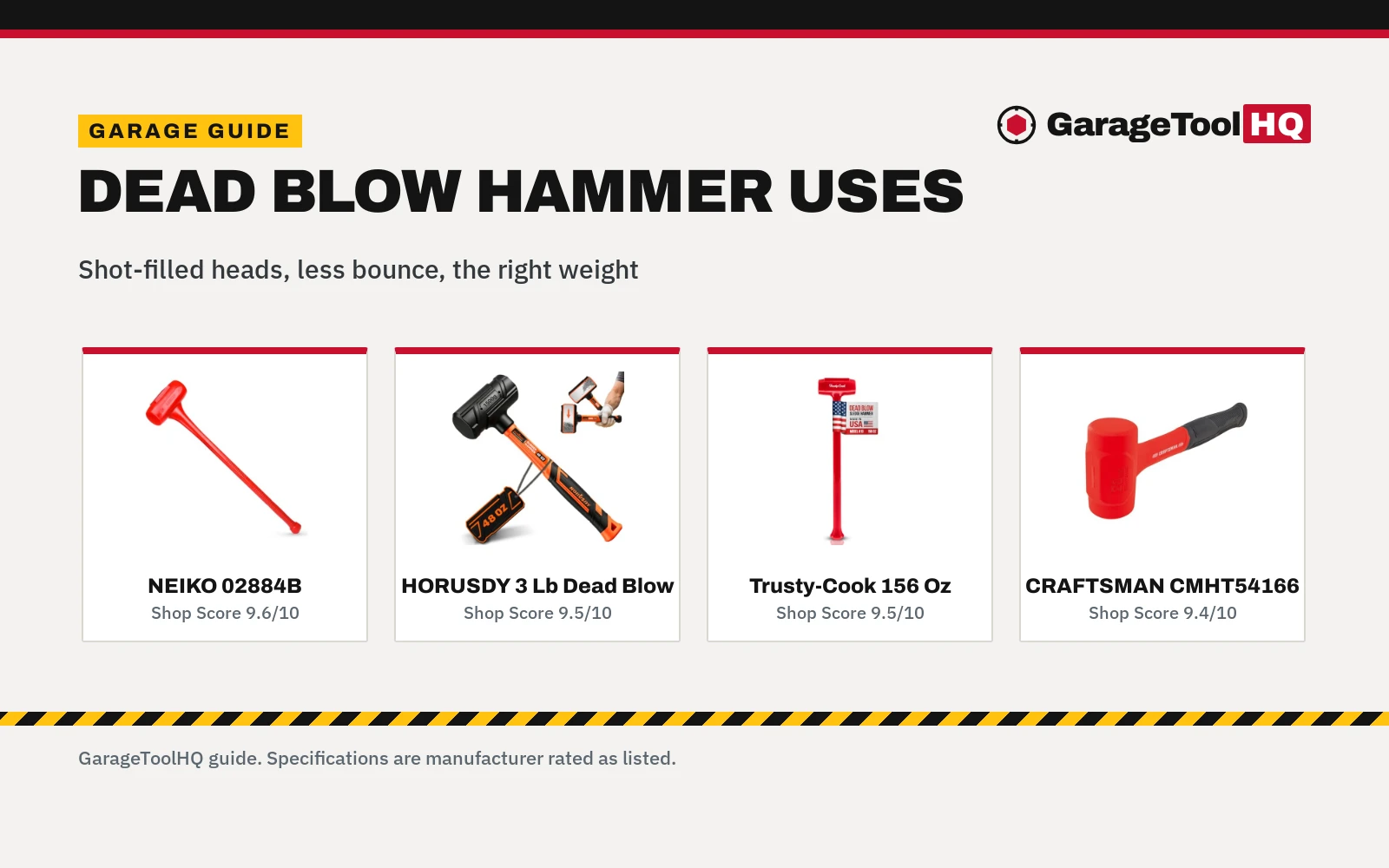
NEIKO 02884B 9 Lb Dead Blow Hammer, 30” Long, Red
A 9 lb dead blow sledge, 30 inches long with a 3 inch head, built on a one-piece steel core with a shot-filled head that resists spark and rebound.
Pros
- Steel shot filled head adds force and eliminates rebound
- One-piece steel core with a molded body that resists wear between head and handle
- Ergonomic textured handle with a non-slip grip
- Solid red color makes it easy to locate among other hammers
Cons
- No warranty term is stated
- 9 lb head and 30 inch length suit heavy work, not light taps
- Listed for auto body, woodworking and sheet metal forming, not for driving nails
- No spare face or replacement part is stated

3 LB Dead Blow Hammer, One-Piece Molded
A 3 lb one-piece molded dead blow hammer, 14.37 inches long with a 4.92 inch head, with steel shot inside and non-marring faces for controlled strikes.
Pros
- Steel shot inside absorbs impact shock and limits bounce and vibration
- One-piece molded body with no weak point between head and handle
- Textured handle holds firm in oily or sweaty conditions
- Non-marring faces suit auto body, carpentry, tile and metalworking
Cons
- No warranty term is stated
- 3 lb head suits light taps, not heavy seating work
- No stated replacement face or handle part
- No face size is stated, only a 4.92 inch head length

Trusty-Cook 156 oz Dead Blow Sledge Hammer
A 156 oz dead blow sledge with a 3 inch head and a 30 inch handle, built with a polyurethane-jacketed steel shot-filled head on a steel-core handle.
Pros
- Steel shot-filled head adds striking force while limiting rebound and vibration
- Polyurethane jacket gives impact without damaging finished surfaces
- Steel-core handle with a textured, contoured non-slip grip
- Made in the USA from materials sourced in the USA
Cons
- No warranty term is stated
- Title states 156 oz while the spec table lists 9.0 pounds
- 30 inch handle suits heavy work, not light taps
- No spare face or replacement part is stated

CRAFTSMAN 28 Oz Dead Blow Hammer (CMHT54166)
A 28 oz dead blow hammer with a steel shot-filled molded head and a soft face, on a steel reinforced handle with over-strike protection.
Pros
- Dead blow function eliminates bounce back on hardened surfaces
- Steel shot-filled head gives more driving force than a solid head
- Soft face helps prevent marring
- Steel reinforced handle gives strength and over-strike protection
Cons
- No warranty term is stated
- 28 oz suits light taps, not heavy seating work
- The listing gives no handle length or head size
- No spare face or replacement part is stated
Dead blow hammer uses in the garage
A dead blow hammer suits jobs where the strike must land with little rebound and no mark. The head holds loose steel shot that shifts forward on impact, so the force goes into the part instead of back into the handle. That makes it the hammer for seating, tapping and nudging rather than for driving nails or breaking things apart.
| Job | Why a dead blow fits | Picks that list it |
|---|---|---|
| Auto body work | Controlled strike with reduced rebound | NEIKO, HORUSDY |
| Woodworking | Controlled taps for joints and assembly | NEIKO, HORUSDY, Trusty-Cook |
| Sheet metal forming | Moves metal with a controlled strike and no hard rebound | NEIKO |
| Carpentry and tile work | Sets parts with a controlled, non-marring strike | HORUSDY |
| Metalworking and assembly | Concentrated impact for forming and assembly tasks | HORUSDY, Trusty-Cook |
How to pick the weight
A heavier head carries more force into the part with each swing. The 3 lb HORUSDY suits controlled taps on tile, trim and small assemblies, while the 9 lb NEIKO and the 156 oz Trusty-Cook suit heavier seating and forming work. The 28 oz CRAFTSMAN covers light taps where a full-size sledge would be too much. Match the weight to the part.
The gear for dead blow hammer uses
Each hammer below handles a slice of the work above: the heavy sledges seat and form, the 3 lb hammer taps tile and trim, and the 28 oz hammer covers light taps without bounce.
Use rated jack stands on solid ground, wear eye protection with power and air tools, keep fuel-burning equipment out of a closed garage, and follow the manual for every tool. Read our Safety Disclaimer.
FAQ: garage tools
When is a dead blow hammer the right hammer?
Reach for a dead blow hammer when the strike must land with little rebound and no mark on the part. The steel shot inside the head shifts on impact, so the force goes into the part instead of back into the handle. Use it for seating panels, tapping tile and trim, and nudging assemblies together.
What weight dead blow hammer fits the job?
The 3 lb HORUSDY suits tile and trim, the 28 oz CRAFTSMAN suits light taps, and the 9 lb NEIKO and the 156 oz Trusty-Cook suit heavier seating and forming work. Pick the hammer that still moves the part at the lowest weight, and step up in weight only when the part will not move.
Do dead blow hammers damage finished surfaces?
The faces on the HORUSDY, Trusty-Cook and CRAFTSMAN hammers are made to strike without marking the surface. The HORUSDY lists non-marring faces, the Trusty-Cook polyurethane body gives impact without damaging finished surfaces, and the CRAFTSMAN soft face helps prevent marring.
Why does a dead blow hammer bounce less?
Steel shot fills the head, and the shot shifts forward when the hammer lands. That shift absorbs the shock and pushes the force into the part, so the head rebounds less. The NEIKO listing states its shot-filled head eliminates rebound, and the HORUSDY listing states the shot absorbs impact shock.
Related: dead blow hammers for auto body, ball peen vs dead blow hammer, dead blow hammer vs rubber mallet and the engine and shop equipment hub.