Die Grinder vs Angle Grinder: Which One Should You Buy?
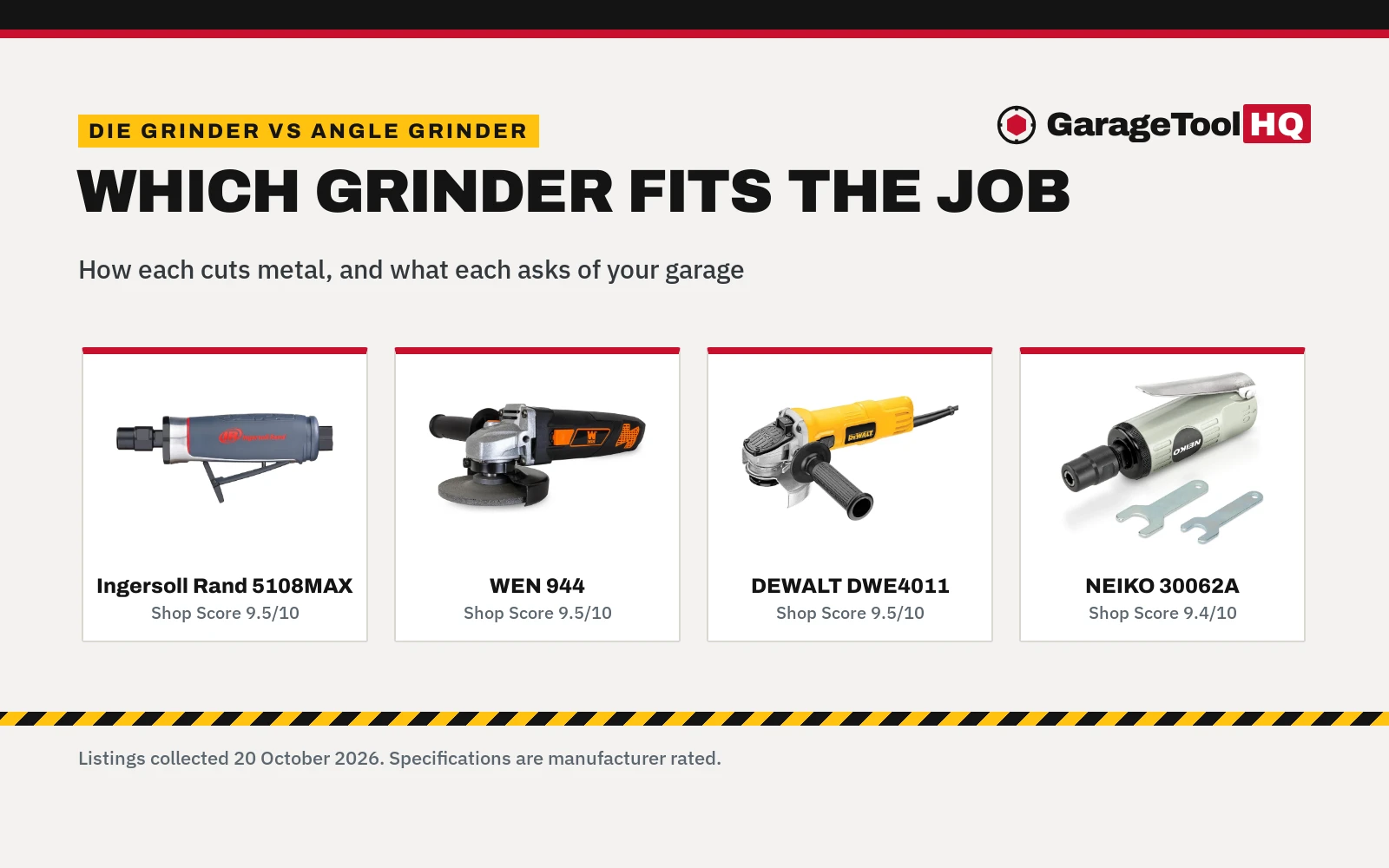
A die grinder vs angle grinder comparison for the home garage: how each tool works, the speed and power each listing states, and four examples ranked.

On this page
Top picks at a glance
As an Amazon Associate we earn from qualifying purchases.
- 1
 Chicago Pneumatic CP8759.6/10View on Amazon
- 2
 SHALL Right Angle Die Grinder9.5/10View on Amazon
- 3
 EYPINS Air Die Grinder 1/4 inch9.6/10View on Amazon
- 4
 Ingersoll Rand 3107G 1/4-Inch Straight Air Die Grinder withView on Amazon
- 5
 WORKPRO Air Angle Die GrinderView on Amazon
- 6
 PROSHI 1/4-Inch Mini Angle GrinderView on Amazon
- 7
 Makita GD0603 1/4" Compact Die GrinderView on Amazon
- 8
 JET 1/4-Inch Pneumatic Extended Die GrinderView on Amazon
- 9
 DEWALT Die GrinderView on Amazon
Verdict: Pick a die grinder for detail work in tight spaces: deburring, porting, weld cleanup, sharpening and small sanding or polishing with rotary bits. Pick an angle grinder for bigger cutting and grinding: cutoff wheels, grinding discs and flap discs on a 4-1/2 in spindle.
You are staring at a rusted bracket that needs trimming and a weld bead that needs smoothing, and you want the right grinder before you start. That is the die grinder vs angle grinder question in one garage afternoon: the die grinder is the precision tool with a collet for small bits, and the angle grinder is the workhorse with a spindle for discs. This comparison walks through both types, then scores four examples from the listings.
GarageToolHQ earns a commission when you buy through links on this page, at no extra cost to you. Read our affiliate disclosure.



Ingersoll Rand 5108MAX 1/4" Collet Air Die Grinder
A 1/4 in air die grinder with a 0.4 hp motor, 25,000 rpm free speed and a 1-year warranty, including wrenches and a piped-away exhaust kit.
Pros
- 0.4 hp motor with 25,000 rpm free speed stated
- 1-year manufacturer warranty stated
- Includes 3 wrenches, a 6mm collet, a piped away exhaust kit and a service clamp block
- 1.0 lb body with low-profile throttle and rear exhaust
Cons
- One bullet says right-angle configuration while the title says straight grinder
- Air compressor not included, per the listing
- 0.4 hp is the lowest stated power figure in this lineup
- No stated air consumption, so sizing a compressor to it is guesswork

WEN 7-Amp Angle Grinder with 4-1/2-Inch Wheel
A 7-amp corded 4-1/2 in angle grinder with 11,000 rpm, a 2-year warranty and a reversible handle.
Pros
- 2-year manufacturer warranty stated, the longest term here
- 7-amp motor with 11,000 rpm stated
- Reversible handle mounts on the left or right side
- Rubber grip lining and arbor adapter for 5/8 and 7/8 in arbors
Cons
- Spec table lists 'electric, gas, Corded Electric' as the power source, which is inconsistent
- 4.6 lb stated weight is the heaviest in this lineup
- 11,000 rpm is the lowest free speed stated here
- No tool-free wheel change stated

DEWALT Angle Grinder, One-Touch Guard
A 7-amp corded 4-1/2 in angle grinder with 12,000 rpm, a one-touch guard and tool-free wheel changes.
Pros
- 7-amp motor with 12,000 rpm, 850 watts and 1.4 hp stated
- One-touch guard adjusts without a tool
- Quick-change wheel release allows tool-free wheel removal
- 5/8-11 spindle thread accepts a wide range of 4-1/2 in accessories
Cons
- No warranty term stated
- No overall dimensions stated
- Corded only, so it needs an outlet within cord reach
- Includes one depressed center wheel; no other discs stated as included

NEIKO 30062A 1/4" Mini Die Grinder
A compact 1/4 in air die grinder with 24,000 rpm free speed, under a pound and about 5 in long.
Pros
- 24,000 rpm free speed with a 1/4 in collet
- Under a pound and about 5 in long, the most compact here
- Front exhaust with vent slots to direct airflow away from the operator
- Built for tight spaces an angled grinder cannot reach (stated)
Cons
- Spec table lists 120 volts for a pneumatic tool, so power specs are unclear
- No warranty term stated
- Ships as a bare tool only, with no accessories listed
- No stated motor power figure (hp or watts)
More options to compare
 Ingersoll Rand 3107G 1/4-Inch Straight Air Die Grinder withCheck price on Amazon
 WORKPRO Air Angle Die GrinderCheck price on Amazon
 PROSHI 1/4-Inch Mini Angle GrinderCheck price on Amazon
 Makita GD0603 1/4" Compact Die GrinderCheck price on Amazon
 JET 1/4-Inch Pneumatic Extended Die GrinderCheck price on Amazon
 DEWALT Die GrinderCheck price on Amazon
Die grinder vs angle grinder side by side
| Side | Free speed (stated) | Power (stated) | |
|---|---|---|---|
| Ingersoll Rand 5108MAX | Die grinder | 25,000 rpm | 0.4 hp, air |
| WEN 944 | Angle grinder | 11,000 rpm | 1.13 hp, corded electric |
| DEWALT DWE4011 | Angle grinder | 12,000 rpm | 1.4 hp, corded electric |
| NEIKO 30062A | Die grinder | 24,000 rpm | Figure not stated (pneumatic) |
Example figures are manufacturer rated, as published on each listing and collected 20 October 2026.
How each grinder cuts
A die grinder spins a small bit held in a collet. Both die grinder listings here state a 1/4 in collet, and the NEIKO listing describes grinding, sanding, honing, polishing and machining with rotary bits, which makes it the tool for detail work: smoothing a weld inside a corner, deburring an edge, sharpening a blade. An angle grinder spins a disc on a threaded spindle. Both angle grinder listings here are 4-1/2 in models, and the DEWALT listing states a 5/8-11 spindle thread that accepts a wide range of 4-1/2 in accessories, which is the language of bigger jobs: cutoff wheels, grinding wheels, flap discs.
Speed ratings
Free speed is one spec both sides state clearly. The die grinder examples state 24,000 rpm for the NEIKO and 25,000 rpm for the Ingersoll Rand, against 12,000 rpm for the DEWALT and 11,000 rpm for the WEN. On power, the angle grinder examples state 1.4 hp and 1.13 hp against 0.4 hp stated for the Ingersoll Rand; the NEIKO states no power figure, so compare its power to nothing.
Power source and shop air
Both die grinder examples run on compressed air. That means a compressor in the corner and a hose to the bench, and the Ingersoll Rand listing states plainly that the compressor is not included. The angle grinder examples plug into the wall: the DEWALT runs on AC/DC power and the WEN is corded electric. If your garage already runs air tools, a die grinder slots into the setup; if it does not, an angle grinder needs nothing but an outlet. For air-tool shop basics, see the air tools section.
Size and reach
Die grinders are the smaller tool here. The NEIKO listing states a body about 5 in long (the spec table lists 5.91 in) weighing under a pound, and describes fitting into tight narrow spaces an angled grinder cannot reach. The Ingersoll Rand states 6.6 in long and 1.0 lb. The angle grinder examples are bigger in the hand: the WEN states 14.5 by 8.5 by 3.75 in at 4.6 lb, and the DEWALT states 3.9 lb with no dimensions listed. For work inside an engine bay or a frame rail, that size gap is the whole argument.
Choose a die grinder if
- You do detail metalwork: deburring, porting, weld cleanup, sharpening
- You need to reach tight spaces a bigger tool cannot enter
- You already run a compressor for air tools
- You want a light tool for one-handed work
Choose an angle grinder if
- You cut, grind and strip metal at a bigger scale
- You want cutoff wheels, grinding discs and flap discs on one spindle
- You want a tool that runs on a wall outlet, no compressor needed
- You do bodywork and fabrication where a 4-1/2 in disc earns its keep
Example grinders
For more air-tool comparisons, see the pneumatic rivet gun vs air hammer and air needle scaler vs wire wheel comparisons, and the best air compressor for cold weather picks.
Wear eye protection with every air tool, use impact-rated sockets on impact wrenches, disconnect the air line before changing accessories, and finish lug nuts with a torque wrench to the vehicle's spec. See OSHA eye and face protection. Read our Safety Disclaimer.
Garage Fit Check
- Shop air: both die grinders are pneumatic, and the Ingersoll Rand listing states the compressor is not included, so confirm your compressor before the first job.
- Power: the angle grinders are corded, so plan cord reach from the nearest outlet to the work area.
- Storage: the Ingersoll Rand ships with wrenches, a 6mm collet, an exhaust kit and a clamp block; keep those small parts together, since the NEIKO ships as a bare tool.
- Consumables: confirm the 1/4 in collet size for die grinder bits and the 4-1/2 in disc size for angle grinders before you buy accessories.
- Weight in hand: stated weights run from under a pound (NEIKO) to 4.6 lb (WEN), so match the tool to how long each job keeps it in your hands.
Frequently Asked Questions
Should I buy a die grinder or an angle grinder first?
Buy for your most common job. Detail work in tight spaces, deburring and weld cleanup point to a die grinder. Cutting, grinding and stripping at a bigger scale point to an angle grinder. Many home garages end up with both.
Can a die grinder use grinding discs?
Not the way an angle grinder does. A die grinder holds small rotary bits in a 1/4 in collet; the 4-1/2 in discs belong on the angle grinder spindle. The examples here are different tool classes, not two sizes of the same tool.
Do the air die grinders need a compressor?
Yes. Both die grinder examples are pneumatic, and the Ingersoll Rand listing states the compressor is not included. If you do not run shop air, the corded angle grinder examples need only an outlet.
What size discs do the angle grinder examples take?
Both are 4-1/2 in models. The DEWALT states a 5/8-11 spindle thread that accepts a wide range of 4-1/2 in accessories, and the WEN states an arbor adapter for wheels with 5/8 and 7/8 in arbors.
Related: the pneumatic rivet gun vs air hammer comparison, the air needle scaler vs wire wheel comparison, the best air compressor for cold weather picks and the air tools section.