Dielectric Grease vs Anti Seize: Which One Should You Buy?
Dielectric grease protects electrical connections from moisture and corrosion, while anti-seize keeps threaded fasteners from seizing, and swapping them causes problems.

On this page
Top picks at a glance
As an Amazon Associate I earn from qualifying purchases.
- 1
 Keze Dielectric Grease Automotive Electric Grease for9.6/10View on Amazon
- 2
 FNIRSI DMT-99 Digital Multimeter 9999 Counts TRMS9.6/10View on Amazon
- 3
 AC Manifold Gauge Set for R134a R410a R32 R22 Refrigerant 39.6/10View on Amazon
- 4
 Permatex 81150 Dielectric Tune-Up GreaseView on Amazon
- 5
 CRC Dielectric Grease BottleView on Amazon
- 6
 Loctite 34395 Marine Grade Anti-Seize Compound 1 EachView on Amazon
- 7
 Loctite 37617 Silver-Grade Anti-Seize StickView on Amazon
- 8
 Loctite 234227 LOC51048 Moly Paste Anti-Seize CompoundView on Amazon
- 9
 Loctite 37616 Copper Anti-Seize StickView on Amazon
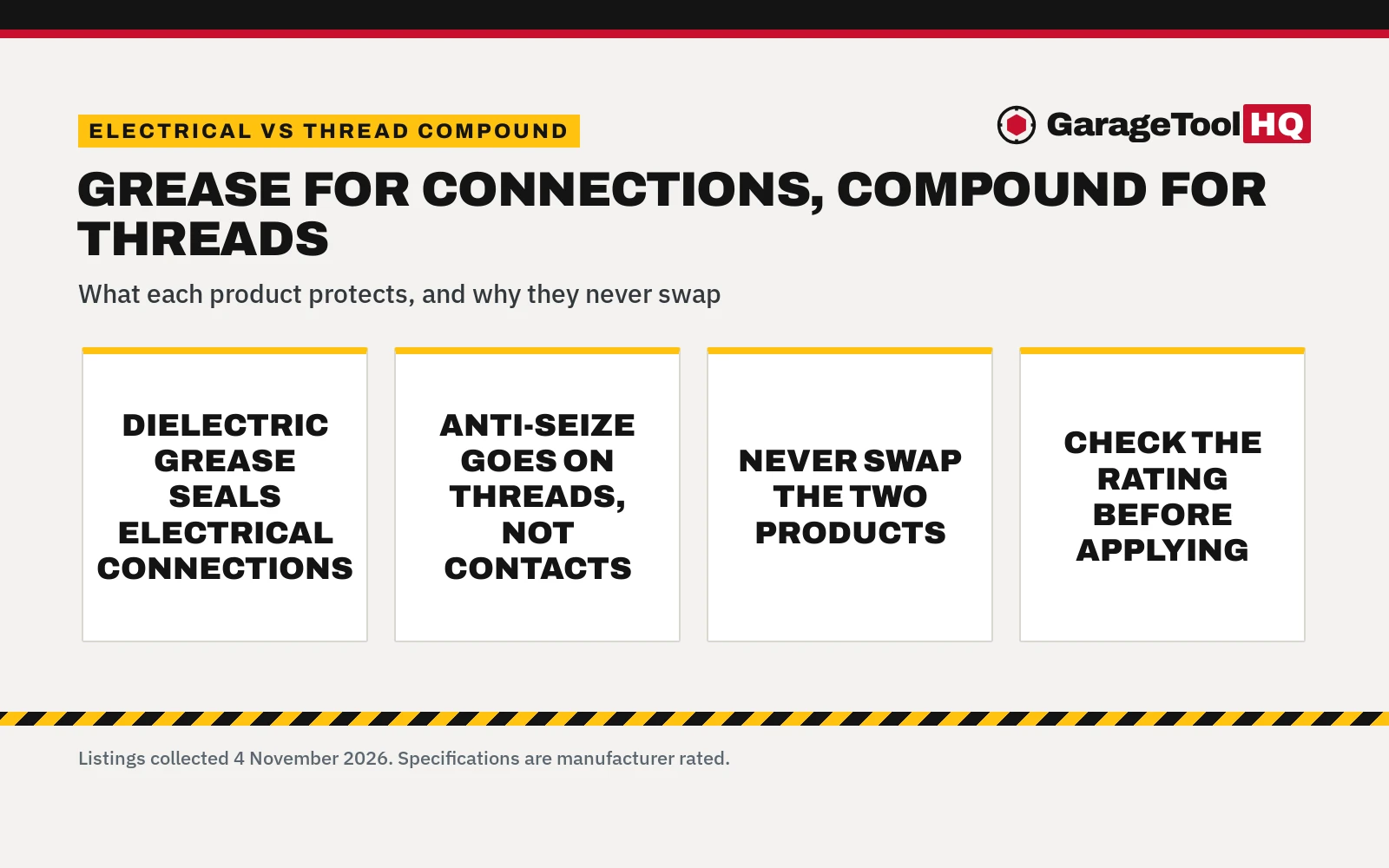
Dielectric grease vs anti seize comes down to what you are protecting: dielectric grease seals electrical connections against moisture and corrosion, while anti-seize coats threaded fasteners so they come apart later. Use dielectric grease on spark plug boots, battery terminals and bulb sockets, and anti-seize on bolts, studs and exhaust fasteners. Never swap them: dielectric grease on threads will not stop a bolt from seizing, and anti-seize across electrical contacts can foul the connection.
Other tools worth a look
 Permatex 81150 Dielectric Tune-Up GreaseCheck price on Amazon
 CRC Dielectric Grease BottleCheck price on Amazon
 Loctite 34395 Marine Grade Anti-Seize Compound 1 EachCheck price on Amazon
 Loctite 37617 Silver-Grade Anti-Seize StickCheck price on Amazon
 Loctite 234227 LOC51048 Moly Paste Anti-Seize CompoundCheck price on Amazon
 Loctite 37616 Copper Anti-Seize StickCheck price on Amazon
GarageToolHQ earns a commission when you buy through links on our product pages, at no extra cost to you. Read our affiliate disclosure.
Dielectric grease vs anti seize: what each one does
Dielectric grease is a non-conductive silicone grease for electrical connections. It forms a film that seals out moisture, salt and corrosion, helps prevent voltage leakage, flashover and misfires, and keeps boots from bonding to plugs. The listings here name automotive electrical connectors, marine electronics, battery terminals, pool gasket o-rings, ignition coils, spark plugs, brake caliper pins, bulb sockets and trailer connectors as uses. Because the film is non-conductive, it seals around the contacts while the metal surfaces still mate, so current passes normally.
Anti-seize is a thread compound, not an electrical product. It coats bolt and stud threads so heat, rust and corrosion do not seize them solid, which matters on exhaust fasteners, brake hardware and suspension bolts that live through heat cycles and road salt. It has no place on electrical contacts, where a conductive or gritty paste can bridge terminals or foul a connection. The confusion comes from the fact that both products fight corrosion, but they fight it in different places.
Where each one belongs
Reach for dielectric grease whenever a connection has to stay clean and dry: spark plug boots, battery terminals and posts, bulb sockets, trailer hitches and marine connectors are all named in the listings here. A thin film inside the boot or on the pins is enough, and the connection should be clean and dry before it goes on. Reach for anti-seize on threaded fasteners that will face heat and corrosion and that must come apart at the next service. Keep anti-seize off electrical contacts, and keep dielectric grease off threads that need a thread compound: each product does one job, and neither covers the other.
The gear: dielectric greases ranked
Four dielectric greases are in the data for this guide, ranked here from the most versatile shop pick to the smallest tube. First is the AGS silicone dielectric grease in the 8 oz brush-top can. It is twice the size of the AGS 4 oz can, and the brush in the cap applies a thin film inside boots and on pins with no tube to squeeze. It is rated -40 F to 400 F, is listed as safe on rubber and plastic, and will not swell EPDM, PVC or most elastomers. It suits shops, fleets and boat owners who service a lot of connectors.
Second is the BTAS dielectric grease, also in an 8 oz size, with a stated range from -40°F to 428°F. It is described as marine grade, and the listing names automotive electrical connectors, marine electronics, battery terminals, pool gasket o-rings, ignition coils, spark plugs and brake caliper pins. It adds rust and corrosion inhibitors and is listed as odourless and colourless. It is the pick when a wide stated temperature range matters and no brush applicator is needed.
Third is the Realth dielectric grease in a 1 oz size, also rated from -40°F to 428°F. It seals out moisture and contaminants to prevent arcing, short circuits and voltage leaks, resists rust, oxidation and galvanic corrosion on battery terminals and connectors, and lubricates spark plug boots so they do not bond to plugs. Its formula is listed as compatible with rubber seals, plastic housings and ceramic insulators, which makes it a good small tube for occasional jobs.
Fourth is the Permatex 81150 dielectric tune-up grease in a 0.33 oz tube. It protects electrical connections and wiring from salt, dirt and corrosion, prevents voltage leaks around any electrical connection, and extends the life of bulb sockets. Its suggested applications are marine and automotive electrical connections, spark plug boots, trailer hitches and battery terminals, and it is noted as required for modern high energy ignition systems. It is the smallest tube here, sized for a toolbox rather than a shop shelf.
Use rated jack stands on solid ground, wear eye protection with power and air tools, keep fuel-burning equipment out of a closed garage, and follow the manual for every tool. Read our Safety Disclaimer.
FAQ: garage tools
Can I use dielectric grease on battery terminals?
Yes. All four greases in this guide name battery terminals as a use, and the grease seals out moisture and corrosion that cause voltage leaks and poor contact.
Can dielectric grease replace anti-seize on bolts?
No. Dielectric grease seals electrical connections, while anti-seize is a thread compound that keeps fasteners from seizing. Use anti-seize on bolts and studs, and dielectric grease on boots, terminals and sockets.
Does dielectric grease conduct electricity?
No. The film is non-conductive, and it seals around the contacts while the metal surfaces still mate, so current passes normally through the connection itself.
What temperature range do these greases cover?
The AGS grease is rated -40 F to 400 F, while the BTAS and Realth greases are rated from -40°F to 428°F. Check the rating on the product you buy against the heat it will face.
Can I use dielectric grease on bulb sockets?
Yes. The Permatex and AGS listings name bulb sockets. The Permatex listing says the grease extends the life of bulb sockets by protecting the connection from salt, dirt and corrosion.
Related: our diagnostics and electrical hub, anti seize vs thread locker, and the best battery terminal protector guide.