Electric vs Gas Pressure Washer for Cars: Differences Explained
Electric and gas pressure washers compared for car detailing: water pressure, flow rates, paint safety, power sources, maintenance, and four concrete examples from manufacturer listings.

On this page
Top picks at a glance
As an Amazon Associate we earn from qualifying purchases.
- 1
 Westinghouse ePX3100v Electric Pressure Washer9.8/10View on Amazon
- 2
 Westinghouse WPX3400 Gas Pressure Washer9.6/10View on Amazon
- 3
 Westinghouse WPX3200 Gas Pressure Washer9.6/10View on Amazon
- 4
 CRAFTSMAN Electric Pressure WasherView on Amazon
- 5
 Greenworks 1800 PSIView on Amazon
- 6
 Sun Joe Pressure WasherView on Amazon
- 7
 Active 2.0 GPM Electric High-Pressure WasherView on Amazon
- 8
 Greenworks 3000 PSIView on Amazon
- 9
 Greenworks 2100 PSIView on Amazon
Verdict: Choose an electric pressure washer if you wash personal vehicles around a home garage, want manageable pressure levels and push-button starts, need quiet operation with zero exhaust fumes, and want zero engine maintenance. Choose a gas pressure washer if you wash large trucks, trailers, or muddy off-road equipment outdoors where mobility away from power cords is essential, and you are comfortable maintaining a 4-stroke small engine.
When deciding between an electric vs gas pressure washer for cars, the primary differences center on water pressure, water flow, vehicle paint safety, power sources, and routine maintenance. Choosing an electric or gas washer depends on whether you prioritize compact garage convenience or heavy-duty outdoor rinsing volume. This comparison covers how both types perform during vehicle washing, followed by four concrete examples from the manufacturer listings we reviewed.
GarageToolHQ earns a commission when you buy through links on this page, at no extra cost to you. Read our affiliate disclosure.


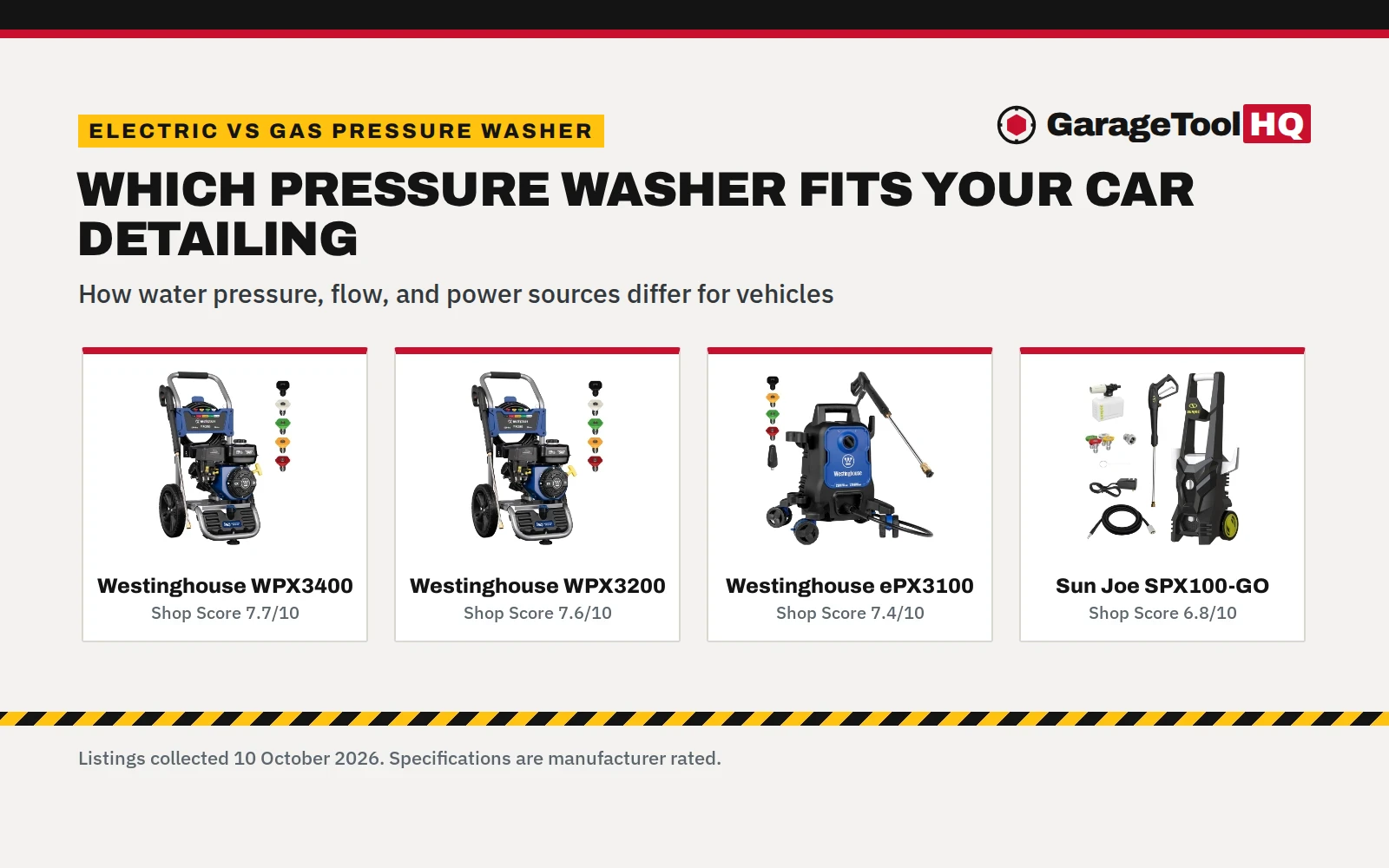
Westinghouse WPX3400 Gas Pressure Washer
A 3400 PSI gas pressure washer with a 212cc 4-stroke OHV engine, 2.6 GPM axial cam pump, steel frame, and 25-ft hose.
Pros
- 3400 PSI and 2.6 GPM provide strong water pressure and high flow
- Heavy duty 212cc 4-stroke OHV horizontal shaft engine with recoil start
- Steel frame with 12-inch high-profile never-flat wheels
- Includes 5 quick-connect nozzles (0°, 15°, 25°, 40°, soap) and a half-gallon soap tank
Cons
- Gas engine produces exhaust and must only be operated outdoors
- Item weight is 28.6 kg, requiring more garage storage space
- Spec table lists tank volume as 0.5 gallons, leaving fuel tank figure ambiguous
- No safety certification stated

Westinghouse WPX3200 Gas Pressure Washer
A 3200 PSI gas pressure washer powered by a 212cc 4-stroke OHV engine delivering 2.5 GPM with a 25-ft hose and steel cart.
Pros
- 3200 PSI and 2.5 GPM deliver strong cleaning power and rapid rinsing
- 212cc 4-stroke Westinghouse OHV engine with recoil start and manual choke
- Tough steel frame with 12-inch high-profile never-flat wheels
- Includes 5 quick-connect nozzles (0°, 15°, 25°, 40°, soap) and engine oil with funnel
Cons
- Exhaust fumes restrict operation strictly to open outdoor areas
- At 63 pounds, it is heavier to maneuver than electric models
- Spec table lists tank volume as 1.6 liters, conflicting with bullet fuel and soap figures
- No safety certification stated

Westinghouse ePX3100 Electric Pressure Washer
A compact 2300 max PSI electric pressure washer with four 360° steering wheels, 17.5-in wand, and 20 oz onboard soap tank.
Pros
- Publishes both 2300 max PSI (1.76 max GPM) and 1900 rated PSI (1.24 rated GPM)
- Four quick-lock wheels with 360° steering design and low center of gravity
- Pro-style steel extendable 17.5-inch wand with 5 nozzles including turbo and soap
- Lightweight at 19 pounds with automatic stop when trigger is released
Cons
- Spec table lists part number as ePX3050 instead of ePX3100
- Weight is stated as 19 pounds in bullets and 9 kg in the spec table
- Water flow of 1.76 max GPM is lower than gas-powered alternatives
- No safety certification stated
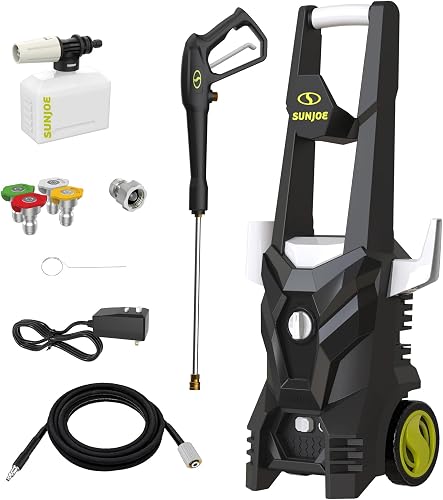
Sun Joe SPX100-GO Electric Pressure Washer
An 1800 PSI, 13-amp portable electric pressure washer weighing 14.33 lbs with 4 nozzles, foam bottle, and 35-ft cord.
Pros
- Lightweight design at 14.33 lbs with telescoping handle and wheels
- Includes 13.53 oz foam bottle for applying detergent through the spray wand
- Extended reach with 20-foot hose and 35-foot GFCI-protected power cord
- Total Stop System automatically shuts off motor when trigger is released
Cons
- Flow rate (GPM) is not stated anywhere in the listing
- 1800 PSI provides lower cleaning pressure than gas alternatives
- Spec table omits the warranty stated in bullets
- No safety certification stated
More options to compare
 CRAFTSMAN Electric Pressure WasherCheck price on Amazon
 Greenworks 1800 PSICheck price on Amazon
 Sun Joe Pressure WasherCheck price on Amazon
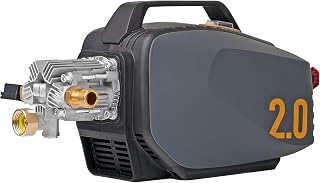 Active 2.0 GPM Electric High-Pressure WasherCheck price on Amazon
 Greenworks 3000 PSICheck price on Amazon
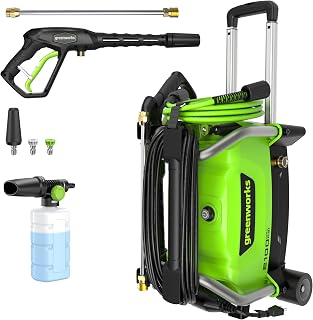 Greenworks 2100 PSICheck price on Amazon
Side by side
| Electric pressure washer | Gas pressure washer | Verdict | |
|---|---|---|---|
| Primary power source | AC electric cord (13-amp motor or AC power in examples) | 4-stroke gasoline OHV engine (recoil start) | Electric for plug-and-wash ease; gas for cordless reach |
| Typical pressure range (examples) | 1800 to 2300 max PSI (1900 rated PSI on ePX3100) | 3200 to 3400 PSI | Electric is gentler on car paint; gas strips heavy grime |
| Water flow rate (examples) | 1.76 max GPM (1.24 rated GPM on ePX3100); Sun Joe leaves GPM unstated | 2.5 to 2.6 GPM | Gas models publish higher flow; Sun Joe leaves flow unclear |
| Vehicle paint safety | Moderate pressure is more manageable on clear coats | High pressure requires care and wide fan nozzles (25° or 40°) | Both require wide fan nozzles; electric is more forgiving |
| Operating location and fumes | Zero exhaust emissions; safe near open garage doors | Emits engine exhaust and CO; strict outdoor use only | Electric is safe near garage doors; gas must stay outdoors |
| Motor and pump control | Automatic stop halts motor or pump when trigger released | Engine idles continuously while running | Electric is quieter and saves pump wear between passes |
| Engine maintenance | None required (no oil, spark plug, or fuel storage) | Periodic engine oil changes, spark plug checks, fuel care | Electric requires zero small-engine upkeep |
| Weight and portability (examples) | 14.33 lb (Sun Joe) to 19 lb (Westinghouse ePX3100) | 63 lb (WPX3200) to 28.6 kg (WPX3400 listing) | Electric is much lighter to carry and store |
| Onboard soap capacity (examples) | 13.53 oz foam bottle (Sun Joe); 20 oz soap tank (ePX3100) | Half-gallon onboard soap tank (0.5 gal / 1.6 L in tables) | Gas examples provide larger onboard soap tanks |
Example figures are manufacturer rated, as published on each listing and collected 9 October 2026.
Electric vs gas pressure washer for cars: water pressure and paint safety
Water pressure, measured in pounds per square inch (PSI), determines spray stripping force. Automotive clear coat, paint, and rubber trim can be damaged by excessive localized pressure.
In the listings reviewed here, the electric examples publish moderate pressure ratings: the Sun Joe SPX100-GO lists 1800 PSI, while the Westinghouse ePX3100 lists 2300 max PSI (and 1900 rated PSI). By comparison, the gas examples publish higher ratings: the Westinghouse WPX3200 lists 3200 PSI, and the Westinghouse WPX3400 lists 3400 PSI. Regardless of power source, nozzle choice dictates paint safety. Narrow 0-degree pinpoint jets can damage bodywork on any machine. Operators washing cars should use wide fan nozzles (such as a 25-degree tip, or 40-degree tip where included) and keep a safe distance from panels. Note that the Westinghouse ePX3100 includes a turbo nozzle; turbo nozzles rotate a pinpoint stream and should not be used on vehicle paint. For details on pressure thresholds, see our guide on what PSI pressure washer is safe for cars.
Water flow rate and cleaning speed
Flow rate, measured in gallons per minute (GPM), determines rinsing volume. Cleaning units represent pressure multiplied by flow (PSI multiplied by GPM). Higher flow flushes dirt, mud, and soap away quickly.
Between models that state flow rates, the gas examples publish higher figures: the Westinghouse WPX3200 delivers 2.5 GPM at 3200 PSI, and the Westinghouse WPX3400 provides 2.6 GPM at 3400 PSI. On the electric side, the Westinghouse ePX3100 lists 1.76 max GPM (and 1.24 rated GPM) alongside 2300 max PSI (and 1900 rated PSI). Crucially, the Sun Joe SPX100-GO listing does not state a GPM figure. This missing figure leaves Sun Joe’s flow rate unclear rather than confirming an electric-side deficit. Higher flow on gas models speeds rinsing on large trucks, while electric flow rates handle passenger car washing.
Power source, noise, and garage safety
Electric pressure washers run on standard AC cords. The Sun Joe uses a 13-amp motor with a 35-foot GFCI cord, while the Westinghouse ePX3100 connects via AC power. Because electric motors produce zero exhaust emissions, they can be operated near open garage doors without fume concerns. Both electric examples feature automatic shutoff systems (Total Stop System on Sun Joe; automatic pump stop on ePX3100) that stop the motor or pump when the trigger is released.
Gas pressure washers rely on 4-stroke combustion engines with recoil start (both Westinghouse gas examples feature 212cc OHV engines). The WPX3200 lists a 0.9-gallon gas tank in bullets, while the WPX3400 lists a 1-gallon gas tank. Combustion engines emit exhaust gases and carbon monoxide. For safety, gas washers must strictly run outdoors in open air, never in an enclosed garage or workshop. Operators must wear eye protection and never point spray wands at people or pets.
Maintenance and seasonal storage
Maintenance requirements diverge sharply. Electric pressure washers require no engine upkeep: there is no motor oil, spark plug, or fuel system to service. Seasonal winter storage requires draining water from the pump and storing the unit away from freezing temperatures.
Gas pressure washers require regular 4-stroke engine maintenance. Operators must inspect and change 10W-30 engine oil (both Westinghouse gas listings include engine oil with a funnel and a spark plug wrench). Preparing a gas unit for winter storage requires fuel stabilizer or draining the carburetor bowl. Westinghouse notes that factory inspections may leave minimal residual fuel or oil odor. After washing and drying a vehicle, DIYers moving on to paint correction can consult our guide on how to choose a car polisher for equipment advice.
Soap application and foam cannon use
Applying car wash soap through a pressure washer loosens road grime before hand washing. The Sun Joe electric washer includes an onboard detergent system with a 13.53-ounce foam bottle that attaches to the spray wand. The Westinghouse ePX3100 incorporates a 20-fluid-ounce onboard soap tank with a dedicated soap nozzle.
The gas models feature onboard soap tanks. Bullets for both the Westinghouse WPX3200 and WPX3400 state a half-gallon onboard soap tank (spec tables list tank volume as 1.6 liters on the WPX3200 and 0.5 gallons on the WPX3400). The WPX3400 listing also notes compatibility with M22 foam cannons, surface cleaners, and undercarriage cleaners. To learn more about applying thick vehicle foam, read our guide on how to use a foam cannon, or browse our roundup of the best foam cannon lances.
Choose an electric washer if
- You wash personal cars and daily drivers around a home garage
- You want moderate pressure ranges (1800 to 2300 max PSI in examples)
- You need quiet operation and zero exhaust emissions near the house
- You prefer zero engine maintenance, no oil changes, and compact storage
Choose a gas washer if
- You clean large trucks, trailers, muddy off-road rigs, or driveways
- You want higher water flow rates (2.5 to 2.6 GPM in examples) for faster rinsing
- You need portable cleaning power away from electrical cords
- You do not mind routine 4-stroke engine maintenance and outdoor-only operation
Example pressure washers
For more electric choices, see our guide to the best electric pressure washer for cars.
Keep electric pressure washers on a GFCI outlet, never point the wand at people or pets, wear eye protection with polishers and chemicals, and read the label before mixing any cleaning products. Read our Safety Disclaimer.
Frequently Asked Questions
Is an electric or gas pressure washer better for washing cars?
For most owners, an electric pressure washer is better for washing cars. Electric models deliver moderate pressure (1800 to 2300 max PSI in examples reviewed) that is manageable around paint, run quietly with zero exhaust fumes, and need no engine maintenance. Gas models excel for heavy mud on large trucks or cleaning driveways.
Can a gas pressure washer damage car paint?
Yes. Gas pressure washers produce high pressure (3200 to 3400 PSI in these examples) that can damage clear coat or loosen paint chips if used with narrow nozzles or held too close. Always use wide fan nozzles, such as a 25-degree or 40-degree tip, and maintain a safe distance from vehicle panels.
Can I run a pressure washer inside a garage?
Gas pressure washers must never run inside a garage due to carbon monoxide and exhaust fumes. Electric pressure washers produce no exhaust emissions and can sit near an open garage door, but washing should take place on a driveway where water drains safely.
What hose length and reach do these pressure washers provide?
The Sun Joe SPX100-GO includes a 20-foot hose and 35-foot power cord. The Westinghouse ePX3100 includes a 25-foot nylon braided hose. Both the Westinghouse WPX3200 and WPX3400 gas models include 25-foot super-flex hoses.
Do pressure washers need engine oil or pump maintenance?
Electric pressure washers require no engine oil, spark plug, or fuel upkeep. Gas pressure washers require regular oil changes, fuel stabilizer, and spark plug checks. Both types require pump winterization before freezing storage.
Related: the best electric pressure washer for cars, our guide on what PSI pressure washer is safe for cars, our tutorial on how to choose a car polisher, our guide on how to use a foam cannon, and our car detailing hub.