Electrical Contact Cleaner vs Compressed Air: Which One Should You Buy?
Contact cleaner dissolves oil, flux and oxidation from electrical contacts, while compressed air only moves loose dust; the job decides which one fits.

On this page
Top picks at a glance
As an Amazon Associate I earn from qualifying purchases.
- 1
 2 Pack 1 oz Electronic Contact Cleaner9.6/10View on Amazon
- 2
 YaberAuto 16-in-1 Jump Starter with Air Compressor 8000A9.7/10View on Amazon
- 3
 1 Pack 1 oz Electronic Contact Cleaner9.5/10View on Amazon
- 4
 CRC QD Contact CleanerView on Amazon
- 5
 Maxima 72920-4PK Electrical Contact Aerosol CleanerView on Amazon
- 6
 Maxima 72920-3PK Electrical Contact Aerosol CleanerView on Amazon
- 7
 GUNK NM1 Electric Motor Contact CleanerView on Amazon
- 8
 VASSON Compressed Air Duster 260000RPMView on Amazon
- 9
 HolyPoint Compressed Air DusterView on Amazon
A switch that works only when it feels like it can be a dirty contact, not a dead part. Electrical contact cleaner vs compressed air comes down to what is on the contact: cleaner removes oil, flux residue and oxidation, while compressed air moves loose dust. For a contact with oil, flux or corrosion on it, the cleaner is the tool; for loose dust on a clean contact, air is enough.
Other tools worth a look
 CRC QD Contact CleanerCheck price on Amazon
 Maxima 72920-4PK Electrical Contact Aerosol CleanerCheck price on Amazon
 Maxima 72920-3PK Electrical Contact Aerosol CleanerCheck price on Amazon
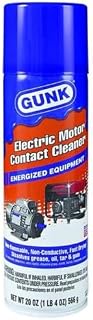 GUNK NM1 Electric Motor Contact CleanerCheck price on Amazon
 VASSON Compressed Air Duster 260000RPMCheck price on Amazon
 HolyPoint Compressed Air DusterCheck price on Amazon
GarageToolHQ earns a commission when you buy through links on our product pages, at no extra cost to you. Read our affiliate disclosure.
Below: what each one removes, how the four contact cleaners in this guide compare, and how to pick between them.
Electrical contact cleaner vs compressed air: what each one removes
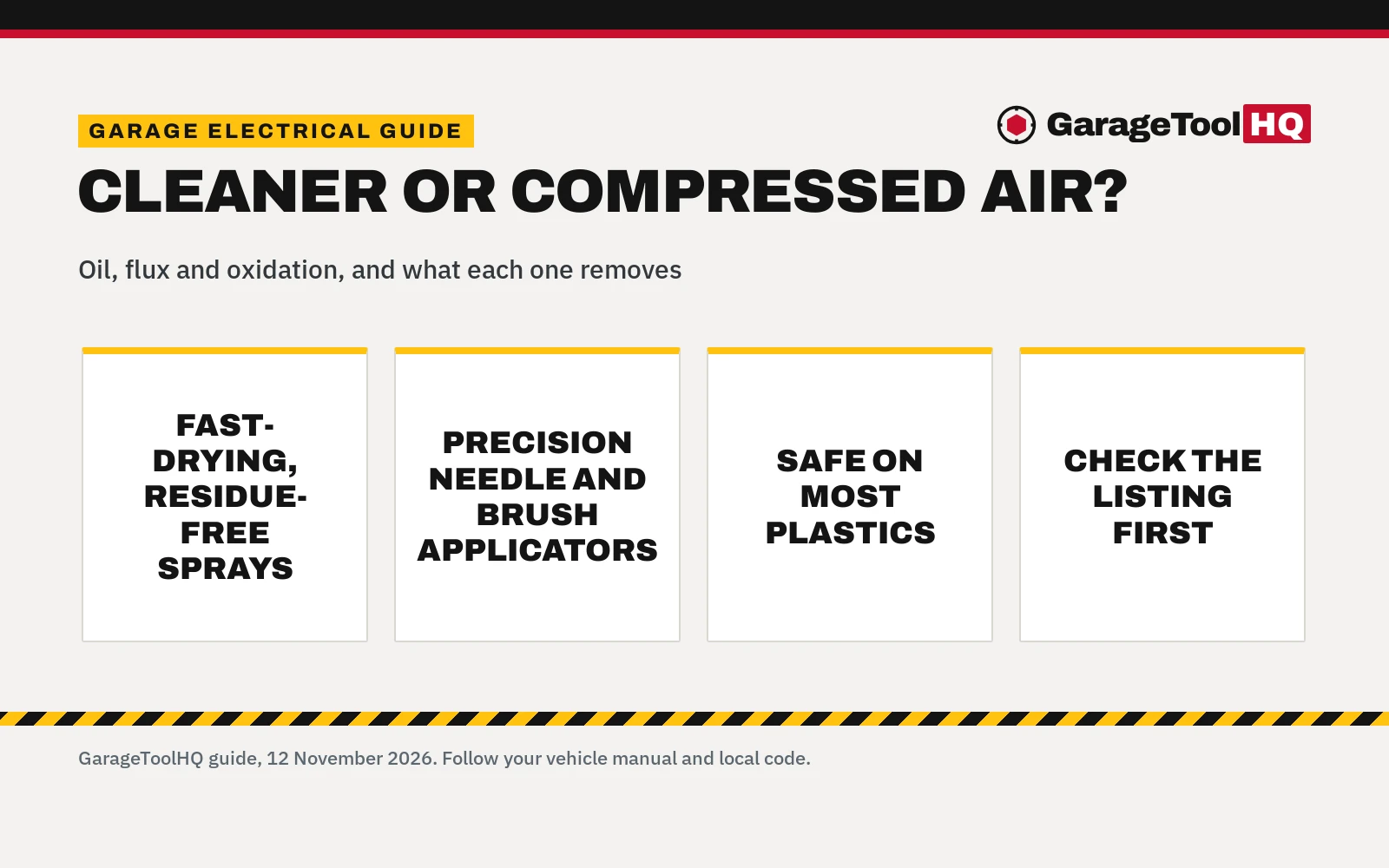
Contact cleaner comes as a spray or a liquid in a bottle: it loosens and carries away what sits on the metal. The listings here name what it removes: oil, dirt, grease, flux residue and condensation on the sprays, and oxidation and corrosion on the DeoxIT applicators. Compressed air appears in none of the listings here. Air moves loose dust and loose water off a contact, but it does not dissolve oil or flux or remove oxidation, so a contact with oil, flux or oxidation on it is a job for the cleaner.
| What sits on the contact | What the cleaner does | Listing that states it |
|---|---|---|
| Oil and dirt | Removes it | WD-40 Specialist, KRAKEN BOND |
| Flux residue | Removes it | WD-40 Specialist, KRAKEN BOND |
| Grease | Cleans it | KRAKEN BOND |
| Oxidation and corrosion | Removes it | CAIG DeoxIT needle and brush |
| Condensation and moisture | Displaces it | WD-40 Specialist, KRAKEN BOND, CAIG DeoxIT brush |
The sprays state fast-drying and residue-free, and the DeoxIT listings state that the liquid lubricates, seals and protects the contact after cleaning. A cleaner that leaves a protective layer is doing a second job: the KRAKEN listing states the layer helps prevent oxidation, and the DeoxIT listings state the liquid lubricates, seals and protects. Air leaves no protective layer, so it cannot protect the contact either.
The gear: four electrical contact cleaners
The four cleaners below are listed in order, strongest first.
WD-40 Specialist contact cleaner spray, 11 oz, 6-pack
The strongest listing here. It is a 6-pack of 11 oz cans of contact cleaner spray for battery terminals, motor contacts, circuit boards, controls, switches, precision instruments and electric panels. The formula is quick drying and residue-free, and it removes oil, dirt, flux residue and condensation. The listing calls it safe on metal and plastic, and safe to use on most plastics, with a note to check on plastic before using and to avoid adhesives, device screens and keyboards. The spray works with pinpoint precision.
KRAKEN BOND electronic contact cleaner spray, 11 oz, 12-pack
A 12-pack of 11 oz cans of electronic contact cleaner spray for sensitive electronics, automotive electronics, circuit boards, connectors, relays, controls, industrial panels, battery terminals, home devices, laptops and gaming consoles. The formula is non-conductive and non-corrosive, fast-drying and residue-free, and it cleans oil, dirt, grease, flux and condensation. It forms a thin protective layer that helps prevent oxidation. The dual-spray nozzle works with a straw for pinpoint precision or a wide nozzle for general cleaning, and it works upright or upside down to reach tight spaces.
CAIG DeoxIT D100L-25C needle applicator, 25 mL
A 25 mL bottle of DeoxIT with a precision needle applicator, for all metal connections: batteries, light bulbs, switches and relays, jacks and plugs, harnesses, grounding blocks, RCA jacks, XLRs, USB, HDMI and Ethernet. The listing says it improves conductivity without shorting, and it cleans, deoxidizes, lubricates and protects, reducing intermittent connections, arcing, RFI, wear and abrasion. The listing states no drying time and no residue claim.
CAIG DeoxIT D100L-2DB brush applicator, 7.4 mL
A 7.4 mL bottle of DeoxIT with a brush applicator, for the same metal connections: batteries, light bulb contacts, switches, relays, jacks, plugs, wiring harnesses, grounding blocks, RCA, XLR, USB, HDMI, Ethernet and other connectors. The listing says it removes oxidation and corrosion to restore electrical integrity, improves conductivity and signal quality without causing shorts, and it lubricates, seals and protects contacts from wear and vibration. It displaces moisture and contaminants. The listing states no drying time and no residue claim.
Use rated jack stands on solid ground, wear eye protection with power and air tools, keep fuel-burning equipment out of a closed garage, and follow the manual for every tool. Read our Safety Disclaimer.
How to pick between contact cleaner and compressed air
Start with what is on the contact. If the job is oil, dirt, grease, flux residue, condensation, oxidation or corrosion, the cleaner is the pick: the sprays cover boards, terminals and panels, and the DeoxIT applicators cover individual metal connections. If the contact is clean and only dusty, air moves the dust. For plastic, the WD-40 listing calls the cleaner safe on most plastics, with a note to check on plastic before using. For a battery terminal, the WD-40 and KRAKEN listings both name battery terminals. Match the cleaner to the contact, then to the size: a 12-pack of 11 oz cans for the shop, a 25 mL needle applicator for single connectors.
Spray or precision applicator: what the listings say
Two listings here are sprays and two are precision applicators. The WD-40 and KRAKEN sprays cover broad work: boards, panels, terminals and controls, with a straw for pinpoint precision on the KRAKEN can. The DeoxIT needle and brush applicators put the liquid on one connection at a time, and both list the same metal connections: jacks, plugs, switches, relays and grounding blocks. The sprays state fast-drying and residue-free; the DeoxIT listings state that the liquid lubricates, seals and protects.
FAQ: garage tools
What does electrical contact cleaner do?
It removes what sits on a contact: oil, dirt, grease, flux residue and condensation, per the spray listings, and oxidation and corrosion, per the DeoxIT listings. The sprays state fast-drying and residue-free, and DeoxIT states that it lubricates and protects the contact after cleaning.
What is the best way to clean electrical contacts?
Match the cleaner to the contact: the sprays here cover boards, terminals, panels and controls, and the DeoxIT needle and brush applicators cover individual metal connections such as jacks, plugs, switches and grounding blocks. For oxidation and corrosion, the DeoxIT listings describe removing them to restore conductivity.
Is electrical contact cleaner safe on plastic?
The WD-40 listing calls its cleaner safe on most plastics, with a note to check on plastic before using and to avoid adhesives, device screens and keyboards. The KRAKEN listing calls its formula non-corrosive and safe for sensitive electronics, circuit boards and connectors. The DeoxIT listings do not name plastic.
What is the best way to clean corroded electrical contacts?
The DeoxIT D100L-2DB listing describes removing oxidation and corrosion to restore electrical integrity, and the D100L-25C listing describes deoxidizing and improving conductivity without shorting. The sprays remove oil, dirt and flux, but only the DeoxIT listings name oxidation and corrosion.
Does contact cleaner leave a residue?
The WD-40 and KRAKEN listings state fast-drying and residue-free. The DeoxIT listings state something different: the liquid lubricates, seals and protects the contact, and the KRAKEN listing states a thin protective layer that helps prevent oxidation. That layer is stated as protection, not residue.
Related: electrical contact cleaner for car battery, wire crimping tool kit, the diagnostics and electrical hub and the garage upgrades hub. Also see our digital multimeter for the garage. Also see our best wire connectors. Also see our electrical tape for outdoor use. Also see our inline blade fuse holder with wires. Also see our spring loaded wire stripper. Also see our wire stripper and crimper. Also see our battery disconnect switch for RV.