Fuel Transfer Pump Parts: Components Explained
A fuel transfer pump moves fuel from a can or tank to a machine through a pump head, a hose, adapters and a nozzle, and the right parts depend on the fuel, the container and the power source.

On this page
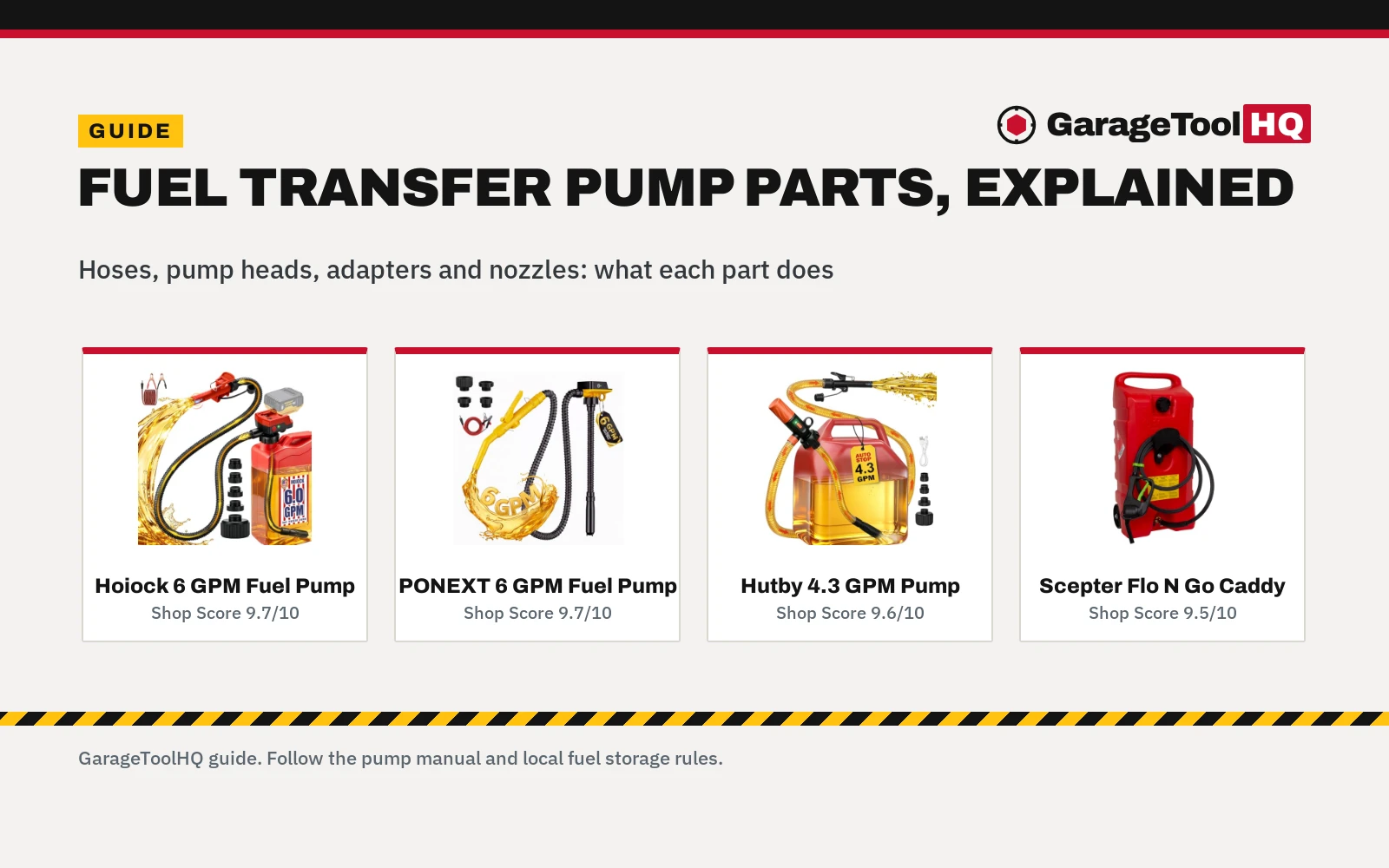
Top picks at a glance
As an Amazon Associate I earn from qualifying purchases.
- 1
 6 GPM Cordless Fuel Transfer Pump for DeWalt 20V9.7/10View on Amazon
- 2
 6 GPM Cordless Fuel Transfer Pump Battery Powered9.7/10View on Amazon
- 3
 Fuel Transfer Pump 4.3GPM with Auto-Stop9.6/10View on Amazon
- 4
 Scepter Duramax Flo ’N Go 14 Gallon Gas Caddy9.5/10View on Amazon
A mower sputters out halfway across the yard, a generator sits empty before a storm, and the fuel can in the corner is heavier than the job deserves. Fuel transfer pump parts are the pieces that move fuel from that can to the machine without lifting, pouring and spilling: a pump head that drives the flow, a hose that reaches the fill port, adapters that fit the can, and a nozzle that controls the stream. The right set matches the fuel, the container and the power source already in the garage.
GarageToolHQ earns a commission when you buy through links on our product pages, at no extra cost to you. Read our affiliate disclosure.
Below: the parts that make up a transfer pump, how each one works, how to match them to the job, and the gear that covers them.
6 GPM Cordless Fuel Transfer Pump for DeWalt 20V
A cordless fuel transfer pump rated up to 6 GPM with a 51 in discharge hose, an 18 in suction hose and 5 adapters, built to move gasoline, diesel, kerosene, light oil and non-potable water from cans and drums to machines.
Pros
- Up to 6 GPM flow rate
- 5 adapters in 2, 2.1, 2.5, 2.75 and 3.75 in sizes
- Auto shut-off sensor stops flow when the tank is full
- Runs on DeWalt 20V or Milwaukee 18V batteries, or 12V clamps
Cons
- Batteries not included
- 18 in suction hose is short for deep drums
- Rated for use from 41 F to 113 F only
- One-touch control, no manual trigger nozzle
6 GPM Cordless Fuel Transfer Pump Battery Powered
A cordless fuel transfer pump rated up to 6 GPM with a 65 in hose, a manual trigger nozzle and 4 adapters, built for refueling trucks, tractors, ATVs, boats, generators and lawn equipment.
Pros
- Up to 6 GPM flow rate
- 65 in flexible hose for hard-to-reach fill ports
- Manual trigger nozzle for flow control
- Low-level protection stops the pump when fuel runs low
Cons
- Batteries and charger not included
- 4 adapters, one fewer than the 5-adapter pick
- Needs a can opening wider than 1.25 in
- Auto-stop covers low fuel, not a full tank
Fuel Transfer Pump 4.3GPM with Auto-Stop
A cordless fuel transfer pump rated at 4.3 GPM with a 55 in clear hose, an auto-stop sensor and 4 adapters, powered by USB-C or 4 AA batteries for filling mowers, generators, boats, ATVs, tractors and snow blowers.
Pros
- 4.3 GPM flow rate
- Auto-stop sensor plus a beep alert at a full tank
- USB-C or 4 AA batteries, no tool battery needed
- 55 in clear hose with a nozzle clip and rubber cap
Cons
- 4.3 GPM is slower than the 6 GPM picks
- 4 AA batteries not included
- 4 adapters, fewer sizes than the 5-adapter pick
- USB-C power needs a power bank when no outlet is near
Scepter Duramax Flo ’N Go 14 Gallon Gas Caddy
A 14 gal (53 L) portable fuel caddy with a manual pump handle and a 10 ft hose, built as a wheeled fuel tank for filling vehicles and gas cans on farms, boats and around the home.
Pros
- 14 gal (53 L) capacity for farm, marine and home use
- 6 in wheels and a top handle for moving the caddy
- Gravity-flow mode for continuous flow when elevated
- Brass shut-off valve and spill-proof shut-off mechanism
Cons
- 2.0 GPM siphon-mode flow, slower than the electric picks
- Manual pump needs continuous use in siphon mode
- 19.0 lb empty weight
- No auto-stop sensor for a full tank
Fuel transfer pump parts: what each part does
A fuel transfer pump is a small set of parts that work in order. On an electric pump, the pump head, driven by a motor, pulls fuel from the can and pushes it along. The hose carries the fuel to the machine. Adapters join the pump to cans, drums and tanks of different openings. The nozzle sits in the fill port and controls the stream. A shut-off device stops the flow when the tank is full or the fuel runs low, and on an electric pump a power source runs the motor.
| Part | What it does | What to look for |
|---|---|---|
| Pump head and motor | Pulls fuel from the can and pushes it to the machine | Flow rate, listed in GPM |
| Hose | Carries fuel from the can to the fill port | Length and clarity: hoses here run 51 in, 55 in and 65 in, plus a 10 ft hose on the caddy |
| Adapters | Fit the pump to cans, drums and tanks | Count and sizes: 5 adapters in one pick, 4 in two others, none on the caddy |
| Nozzle | Controls the stream at the fill port | Trigger control, a clip for hands-free filling, a cap against drips |
| Power source | Runs the motor away from an outlet | Tool batteries, 12V clamps, USB-C or AA batteries |
| Shut-off | Stops flow at a full tank or low fuel | Auto-stop sensors, beep alerts, low-level protection |
The hose deserves the first look, because reach decides whether the job works at all. A short hose leaves the can balanced on a fender, while a longer hose lets the can sit on the ground.
How to match fuel transfer pump parts to the job
Start with the fuel. The electric picks here move gasoline and diesel, and two of them also list kerosene; one also moves light oil and non-potable water, so match the pump to every fuel it will carry. Then look at the container. Cans, drums and tanks have different openings, and any adapters in the box have to cover them. One pick states a fit rule plainly: the fuel can opening needs to be wider than 1.25 in (32 mm) for the pump head to fit.
Then look at power. Two picks run on DeWalt 20V or Milwaukee 18V batteries, with 12V battery clamps as a second option, and both are sold without batteries. A third runs on USB-C from a power bank or on 4 AA batteries. The caddy is different: it needs no power at all, since its manual pump and gravity-flow mode move the fuel by hand and by height.
Flow rate sets the pace. The electric picks list 6 GPM and 4.3 GPM, while the caddy lists a 2.0 GPM siphon-mode flow rate. A faster rate shortens a long fill, but a slower rate with a steady stream suits a small tank that fills quickly. Handle fuel outdoors or with the garage door open and fresh air moving, away from flames and sparks, and keep the cap on the can when the pump is not in use.
Fuel transfer pump parts: the gear that covers them
Each electric pick below covers a step from the parts table: the pump head moves the fuel, the hose reaches the fill port, and the adapters fit the can. The caddy covers the storage part of the job instead.
Read the manual before first use, wear eye protection, keep the work area clear and ventilated, and stay within every stated rating. Read our Safety Disclaimer.
FAQ: garage tools
What parts make up a fuel transfer pump?
An electric pump has a pump head with a motor, a suction hose and a discharge hose, adapters for the can or tank, a nozzle, a power source and a shut-off device. The pump head drives the flow, the hoses carry the fuel, the adapters make the fit, and the nozzle and shut-off control the stream. A manual caddy has a hand pump instead of a motor and needs no power source.
What size hose does a fuel transfer pump need?
Long enough to reach from the can on the ground to the fill port with slack to spare. The electric picks here list 51 in, 55 in and 65 in hoses, and the caddy lists a 10 ft hose. Measure the distance on the machine before ordering. One pick pairs a 51 in discharge hose with an 18 in suction hose, so check both hose lengths before you order.
Do fuel transfer pumps run on tool batteries?
Two of the picks here do, on DeWalt 20V or Milwaukee 18V batteries, with 12V battery clamps as a second option. Both are sold without batteries, and one is sold as tool only, with the charger not included. A third pick runs on USB-C or 4 AA batteries, and the caddy needs no battery at all.
What does auto-stop do on a fuel transfer pump?
It stops the flow without the operator watching the fill. One pick uses a liquid sensor that stops pumping when the tank is full, and another adds a beep alert when the flow stops. A third pick uses low-level protection instead, which stops the pump when fuel runs low and guards the motor against dry running.
Can a fuel transfer pump move diesel and gasoline?
Yes, the electric picks here are listed for both. One pick also lists kerosene, light oil and non-potable water, and another lists gasoline, diesel and kerosene. The Scepter caddy (on Amazon) is listed as a gasoline caddy. Match the pump to every fuel it will carry, and keep each fuel in its own marked can.
Related: best fuel transfer pump for a gas can, siphon vs electric fuel transfer pump, hand pump vs electric fluid transfer pump and the engine and shop equipment hub.