Garage Floor Coating Types: Epoxy and Beyond
Garage floor coating types compared: epoxy and polycuramine kits, sealers and paint, with ready times, hot tire pickup and how to pick the right type.

On this page
The main garage floor coating types are epoxy kits, polycuramine kits, polyurea and polyurethane topcoats, concrete sealers and floor paint, with tiles and mats as a non-coating alternative. Each type suits a different garage: a coating that builds a hard skin over concrete, a sealer that soaks in, or a tile that lays over the top. This guide sets out what each type does, what to check before buying, and how to pick the type that fits the garage.
As an Amazon Associate I earn from qualifying purchases. GarageToolHQ earns a commission when you buy through links on our product pages, at no extra cost to you. Read our affiliate disclosure.
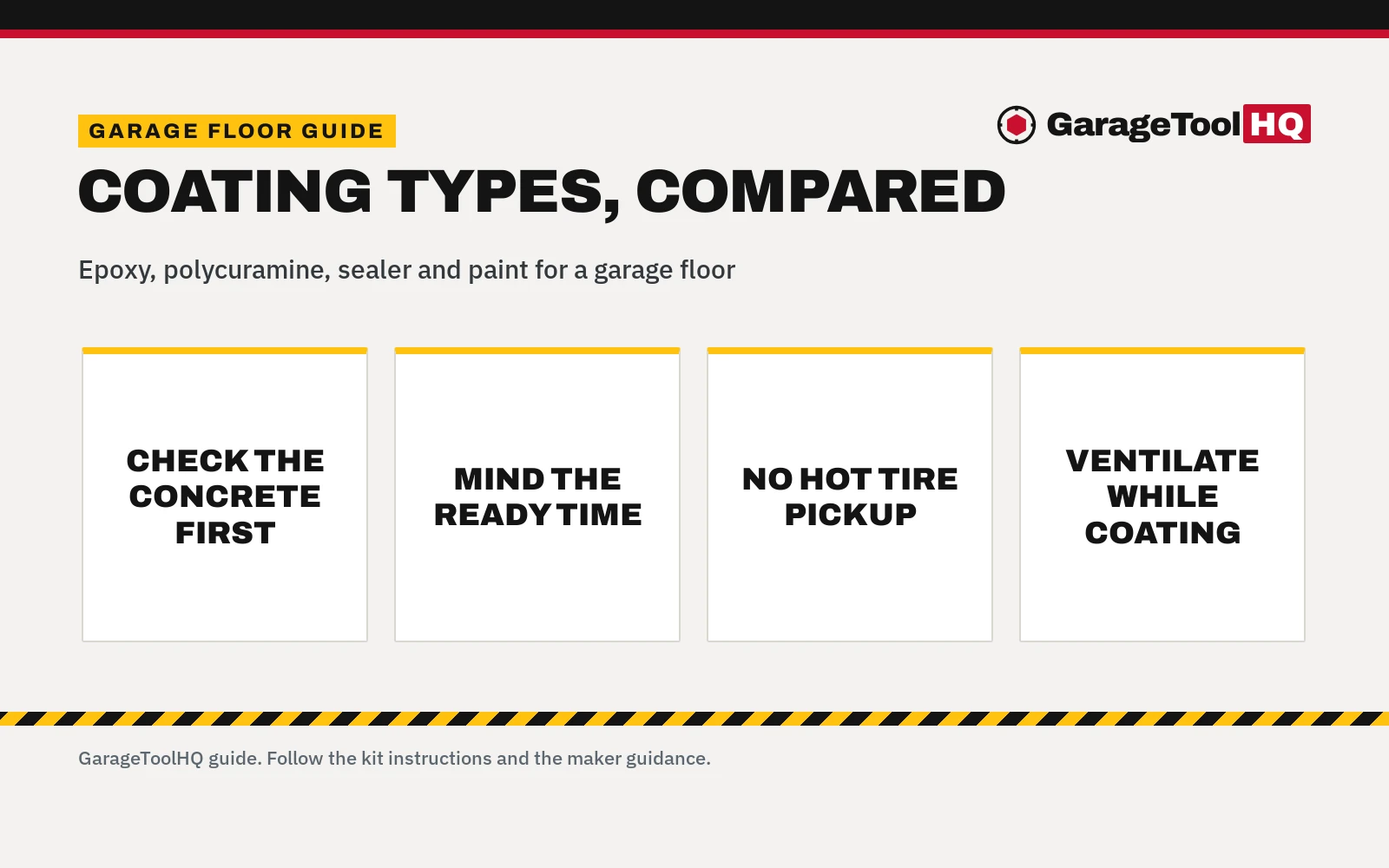
Below: the main coating types, how to choose between them, and the prep and safety steps to run before opening a kit.
Garage floor coating types: what each type is for
Start with the type, not the brand. A coating builds a layer on top of the concrete; a sealer soaks in and leaves the surface mostly as it was; paint sits between them, a thin color layer that wears faster than a coating. The table sets out the main types and what each type is for.
| Type | What it is | What to know |
|---|---|---|
| Epoxy kit | A resin coating that hardens into a hard-wearing skin over concrete | Needs clean, dry concrete and a prepared surface; check whether the kit directs etching, and check the kit’s stated ready time before driving on it |
| Polycuramine kit | A self-leveling coating sold as a kit with decorative chips and concrete etch | Foot traffic ready in 8-10 hours and full vehicle traffic ready in 24-36 hours, per the Rust-Oleum RockSolid listing; no hot tire pickup stated |
| Polyurea or polyurethane topcoat | A flexible topcoat, often used over epoxy for extra wear resistance | Adds chemical and wear resistance; check the maker’s stated ready time |
| Concrete sealer | A thin treatment that soaks into the concrete and seals the surface | Controls dust and light stains; wears faster than a coating and needs reapplying sooner |
| Floor paint | A paint made for concrete floors | A quick refresh for a garage that sees light use; chips and peels under hot tires sooner than a coating |
| Tiles and mats | Interlocking tiles or roll-out mats laid over the floor, not a coating | Can be lifted and changed, but seams and edges can lift under a car |
The Rust-Oleum RockSolid kits here are polycuramine kits in Dark Gray and Mocha, each a 2.5 Car kit, and the Dark Gray kit weighs 17.0 pounds. Each kit includes a burst pouch coating, a foam roller, decorative chips and concrete etch, and each states the same ready times and the same 7-day recoat window without sanding.
How to choose a garage floor coating type: the checklist
- Look at the concrete first. A coating needs sound, clean concrete. Fix cracks, clean oil stains and let the floor dry before coating, since a coating over damp or oily concrete may not bond.
- Match the type to the use. A garage that parks cars daily needs a coating that resists hot tires and chemicals; a garage used for storage can take a sealer or paint.
- Check the ready time. The Rust-Oleum RockSolid listing states foot traffic ready in 8-10 hours and full vehicle traffic ready in 24-36 hours, so plan the garage as out of use until the stated time.
- Check the recoat window. The same listing offers a 7-day recoat window without sanding, so another coat can go on within that window.
- Check hot tire pickup. The listing states no hot tire pickup, which matters where cars park every day: a coating that lifts under hot tires will peel where the tires sit.
- Check what the kit includes. The kits here include a burst pouch coating, a foam roller, decorative chips and concrete etch, and each kit is a 2.5 Car kit, so match the kit size to the garage.
- Check odor and ventilation. The listing states a low odor, indoor application, formulated without VOC-containing solvent, so the garage still needs fresh air while coating.
- Plan the prep. Etch the concrete as the kit directs, keep the floor clear, and keep cars, tools and boxes out until the stated ready time.
Coating products and solvents can give off vapors. Keep flames, heaters and sparking tools away from the garage while coating, ventilate the space, and follow the kit instructions.
Use rated jack stands on solid ground, wear eye protection with power and air tools, keep fuel-burning equipment out of a closed garage, and follow the manual for every tool. Read our Safety Disclaimer.
Epoxy or polycuramine: which kit type suits a garage
If the choice is between the kit types, compare these before buying:
- Finish: the polycuramine kit here is self-leveling and high gloss, with decorative chips included. Epoxy kits can give a similar skin, with the finish set by the kit.
- Ready time: the Rust-Oleum RockSolid polycuramine listing states foot traffic ready in 8-10 hours and full vehicle traffic ready in 24-36 hours. Check the epoxy kit’s stated ready time the same way before planning the garage as out of use.
- Hot tires: the polycuramine listing states no hot tire pickup and resistance to salt, oil, gasoline and other harsh chemicals. Check the epoxy listing for the same claims.
- Recoat: the polycuramine listing offers a 7-day recoat window without sanding. Check the epoxy kit’s recoat window before buying another coat.
Work out the kit size before buying, then compare real kits side by side in our garage floor coating kit picks and our epoxy kit picks. For a tile floor instead, see the garage floor tile picks.
Prep and safety while coating
Coating a garage floor is a prep job with a coating step at the end. Sweep and clean the concrete, etch it as the kit directs, and keep the floor dry before coating. Wear gloves and eye protection, ventilate the garage while coating, and keep the space clear until the stated ready time. Keep flames and sparking tools away from the garage while the coating is wet, and follow the kit instructions on every step.
Keep cars and heavy boxes out of the garage until the listing’s stated vehicle ready time. Moving a car back in early can mark or lift a coating that has not yet hardened, and the fix may be a recoat.
FAQ: garage tools
What is the best type of garage floor coating?
It depends on the garage. A polycuramine kit suits a garage that parks cars daily, since the listing states no hot tire pickup and resistance to salt, oil and gasoline. An epoxy kit suits the same job with a hard-wearing skin. A sealer or paint suits a garage that sees light use and needs a quick refresh rather than a hard-wearing coat.
How long before I can drive on a coated garage floor?
Follow the kit listing. The Rust-Oleum RockSolid listing states foot traffic ready in 8-10 hours and full vehicle traffic ready in 24-36 hours. Do not move a car back in early: a coating that has not yet hardened can mark or lift under tires.
What is hot tire pickup?
Hot tire pickup is a coating lifting off the concrete where hot tires sit. The Rust-Oleum RockSolid listing states no hot tire pickup, which is why the claim matters for a garage that parks cars every day.
Do I need to etch the concrete before coating?
Yes, where the kit directs it. The kits here include concrete etch, and the listing describes the coating as self-leveling. Etching opens the concrete so the coating can bond, and skipping prep is a common reason a coating peels.
Can I recoat a garage floor without sanding?
Within the stated window, yes. The Rust-Oleum RockSolid listing offers a 7-day recoat window without sanding, so another coat can go on within that window. After the window, follow the kit instructions for prep before recoating.
How big a garage floor coating kit do I need?
Match the kit size to the garage. The kits here are 2.5 Car kits, so a larger garage needs more kits or a larger kit size. Measure the floor and check the kit’s stated size before buying.
Related: garage floor epoxy picks, the concrete sealer vs epoxy guide, the epoxy vs polyurethane guide and the garage floor coating DIY guide.