How Does a Portable Tire Inflator Work? What to Know
How a portable tire inflator uses an electric motor, a reciprocating mini piston, and pressure monitoring to inflate tires, with operating tips and shop comparisons.

On this page
Top picks at a glance
As an Amazon Associate we earn from qualifying purchases.
- 1
 ALL-TOP Air Compressor Kit9.6/10View on Amazon
- 2
 AstroAI AIRUN H Tire Inflator Portable Air Compressor9.6/10View on Amazon
- 3
 NOCO Air AL5 17 LPM 12V Cordless Tire Inflator & Portable Air9.6/10View on Amazon
- 4
 ROCGORLD R8 Tire Inflator Portable Air CompressorView on Amazon
- 5
 Fanttik X8 APEX Tire Inflator Portable Air CompressorView on Amazon
- 6
 GSPSCN Heavy Duty Digital Tire Inflator 12V Portable AirView on Amazon
- 7
 AstroAI Tire Inflator Portable Air CompressorView on Amazon
- 8
 ETENWOLF VORTEX S6 Tire Inflator Portable Air CompressorView on Amazon
- 9
 CARSUN AC/DC Tire Inflator Portable Air CompressorView on Amazon
Before wrapping up a tire rotation or setting cold pressures on a neighbor’s car, you need air in the tires without dragging out a heavy shop hose. How does a portable tire inflator work? A portable tire inflator works by using an electric motor to drive a reciprocating piston inside a cylinder, drawing in ambient air through an intake port and compressing it into a high-pressure airstream. The compressed air travels past a one-way check valve through a hose into the tire valve stem, while an internal pressure gauge or digital sensor tracks line pressure, allowing manual shutoff or automatic cutoff at a preset target. It packs compressor mechanics into a compact housing powered by battery or vehicle current.
More options to compare
 ROCGORLD R8 Tire Inflator Portable Air CompressorCheck price on Amazon
 Fanttik X8 APEX Tire Inflator Portable Air CompressorCheck price on Amazon
 GSPSCN Heavy Duty Digital Tire Inflator 12V Portable AirCheck price on Amazon
 AstroAI Tire Inflator Portable Air CompressorCheck price on Amazon
 ETENWOLF VORTEX S6 Tire Inflator Portable Air CompressorCheck price on Amazon
 CARSUN AC/DC Tire Inflator Portable Air CompressorCheck price on Amazon
GarageToolHQ earns a commission when you buy through links on our product pages, at no extra cost to you. Read our affiliate disclosure.
Below: internal components, the compression cycle step by step, auto-stop cutoffs, and shop compressor comparisons.
How does a portable tire inflator work? Step by step inside the pump
A portable tire inflator is a positive displacement pump. It forces atmospheric air into a confined cylinder to build pressure through a repeating mechanical cycle:
- Motor drive and gear reduction. Power from an internal battery pack or vehicle cord drives a direct-current electric motor. A reduction gearbox lowers motor speed and multiplies torque to cycle the crank mechanism under load.
- Intake stroke. The connecting rod pulls the piston downward, creating a partial vacuum in the cylinder. Ambient air enters through housing vents, passes an intake filter, and unseats a flexible intake reed valve to fill the chamber.
- Compression stroke. Passing bottom dead center, the connecting rod pushes the piston upward. Rising pressure forces the intake reed valve shut, trapping air in the cylinder. Upward piston travel condenses the air volume, raising pressure and temperature.
- Discharge stroke. When cylinder pressure exceeds delivery hose and tire pressure, it pushes open a one-way check valve. Pressurized air flows through the hose into the tire. As the piston descends, the check valve shuts, preventing backflow.
- Pressure monitoring and cutoff. A pressure sensor or gauge taps into the cylinder head manifold. On analog models, a dial gauge shows line pressure for manual shutdown. On digital auto-stop models, an electronic transducer signals a microcontroller to cut motor power once preset pressure is reached.
Key internal components of a portable tire inflator
Inside the outer case, six synchronized assemblies generate and direct compressed air:
| Component | Internal Function | Garage Practicality |
|---|---|---|
| DC Electric Motor | Converts electrical power into rotation | Runs at high RPM, requiring cooling airflow to shed heat |
| Reduction Gearbox | Multiplies torque and drives crank | Converts high-speed rotation into linear piston strokes |
| Piston and Cylinder | Compresses air into high pressure | Uses an oil-free seal ring to deliver dry, clean air |
| One-Way Reed Valves | Directs airflow and prevents backflow | Maintains pressure flow from intake to delivery hose |
| Pressure Gauge or Transducer | Monitors delivery line pressure | Enables manual monitoring or digital auto-shutoff |
| Cooling Vents and Heat Sink | Disperses compression heat | Governs continuous runtime before thermal limits occur |
Unlike workshop compressors that use oil baths, portable inflators use dry, oil-free piston rings. This keeps units lightweight and clean for trunk or shelf storage, but requires heat to radiate directly through the metal cylinder sleeve and housing vents.
How to use a portable tire inflator correctly: the garage checklist
Following this operational sequence protects the valve stem, pump motor, and pressure sensor:
- Check the vehicle door placard. Locate the cold tire inflation pressure on the driver door jamb sticker. Never use the maximum pressure molded on the tire sidewall.
- Inspect valve stem threads. Clear grit from the stem before attaching the air chuck. Thread or clamp the chuck straight onto the Schrader valve until air hiss stops.
- Power on and read initial pressure. Turn on the unit to display current resting tire pressure on the gauge.
- Set the target pressure. On digital auto-stop units, select your pressure unit (such as PSI, BAR, or kPa) and enter your door placard target. On analog units, note the target mark on the dial face.
- Position the pump on clean ground. Place the inflator upright on clean pavement to prevent dust, leaves, or grit from entering the intake vents.
- Start inflation and monitor progress. Press start and allow the pump to cycle. Line pressure readings run elevated during active pumping due to airflow resistance.
- Allow cutoff or shut off manually. Let the auto-stop shut off motor power at the preset, or flip the power switch when the analog needle reaches target. Disconnect the chuck promptly and reinstall the valve cap.
- Allow the pump to cool. The pump head and brass hose chuck heat up after extended pumping. Allow the unit to cool before coiling the hose.
Never inflate tires to the maximum pressure on the sidewall. That figure is the tire maker’s structural limit at maximum load, not vehicle operating pressure. Over-inflation reduces traction, hardens ride quality, and causes uneven center-tread wear. Always use the cold pressure specified on the driver door jamb placard.
Drain the tank after use so water does not rust it from the inside, never exceed the tool's rated pressure, wear eye protection, and run 240V units on the circuit the manual calls for. Do not run a gas engine compressor in a closed garage. Read our Safety Disclaimer.
Portable tire inflator vs garage air compressor
While both tools pump air, their internal designs target different garage tasks:
- Tank volume vs direct delivery. Garage compressors store compressed air volume in a steel receiver tank for instant discharge. Portable inflators are tankless, delivering air directly from the piston into the tire.
- Airflow delivery rate. Workshop compressors supply high airflow volume suited for air tools or seating tire beads. Handheld inflators produce modest airflow tailored for controlled tire topping.
- Duty cycle and thermal limits. Heavy shop pumps run large cooling fins for prolonged run times. Mini inflators have compact cylinder heads that accumulate heat quickly, requiring rest periods between tires.
- Portability and power. Compact inflators store easily in a cargo area or tool drawer, running on internal batteries or vehicle power sockets without heavy air hoses or electrical cords.
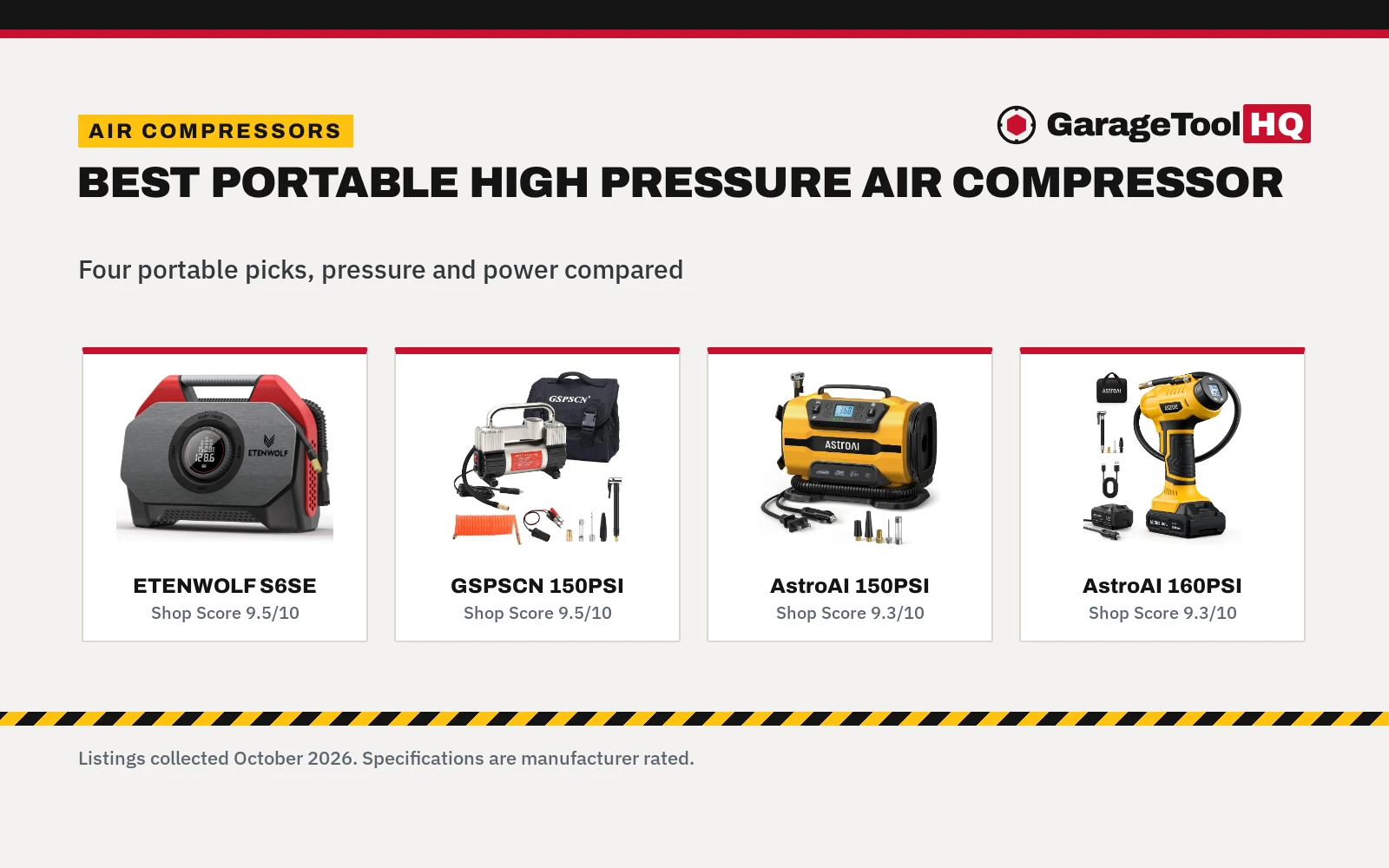
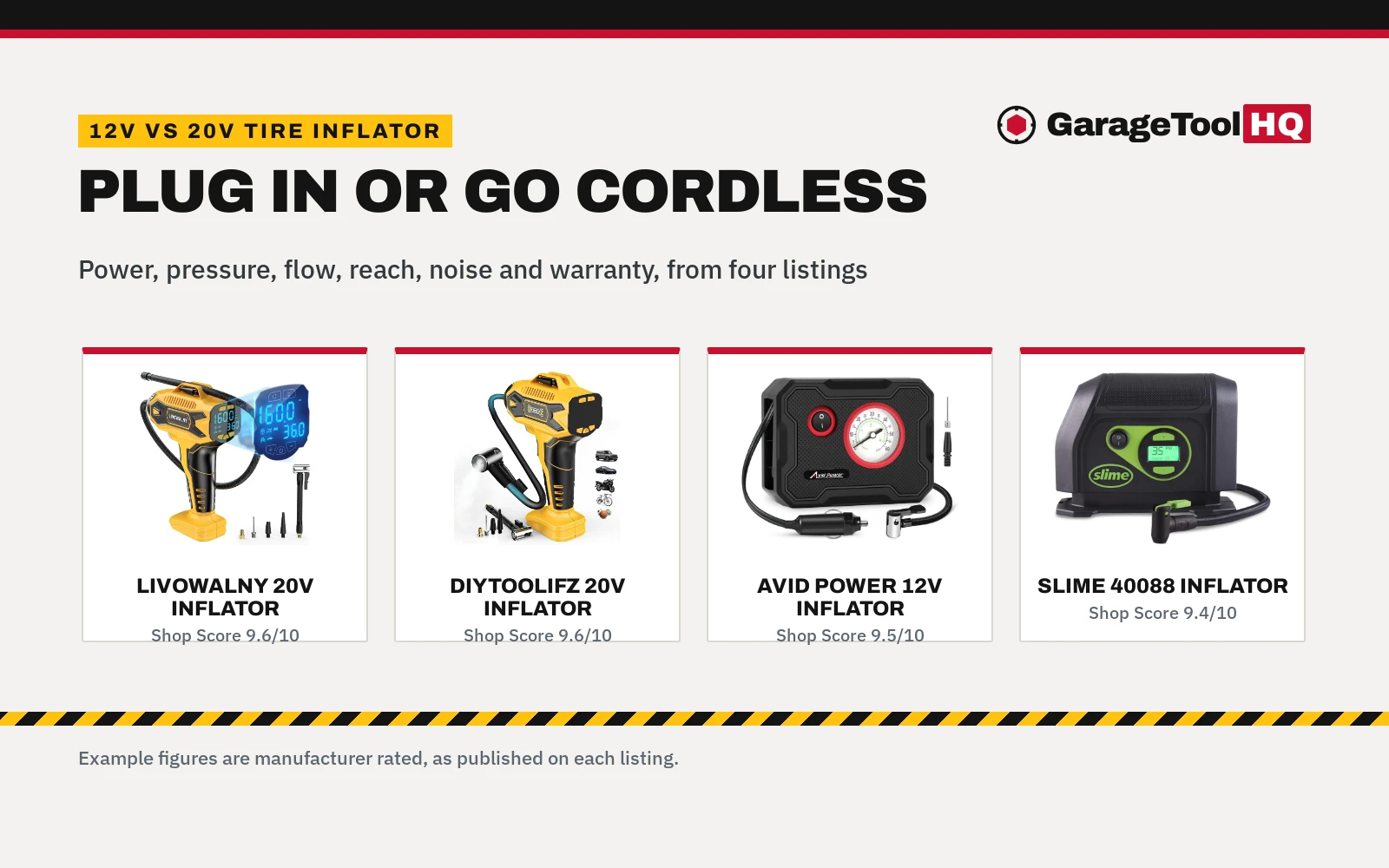
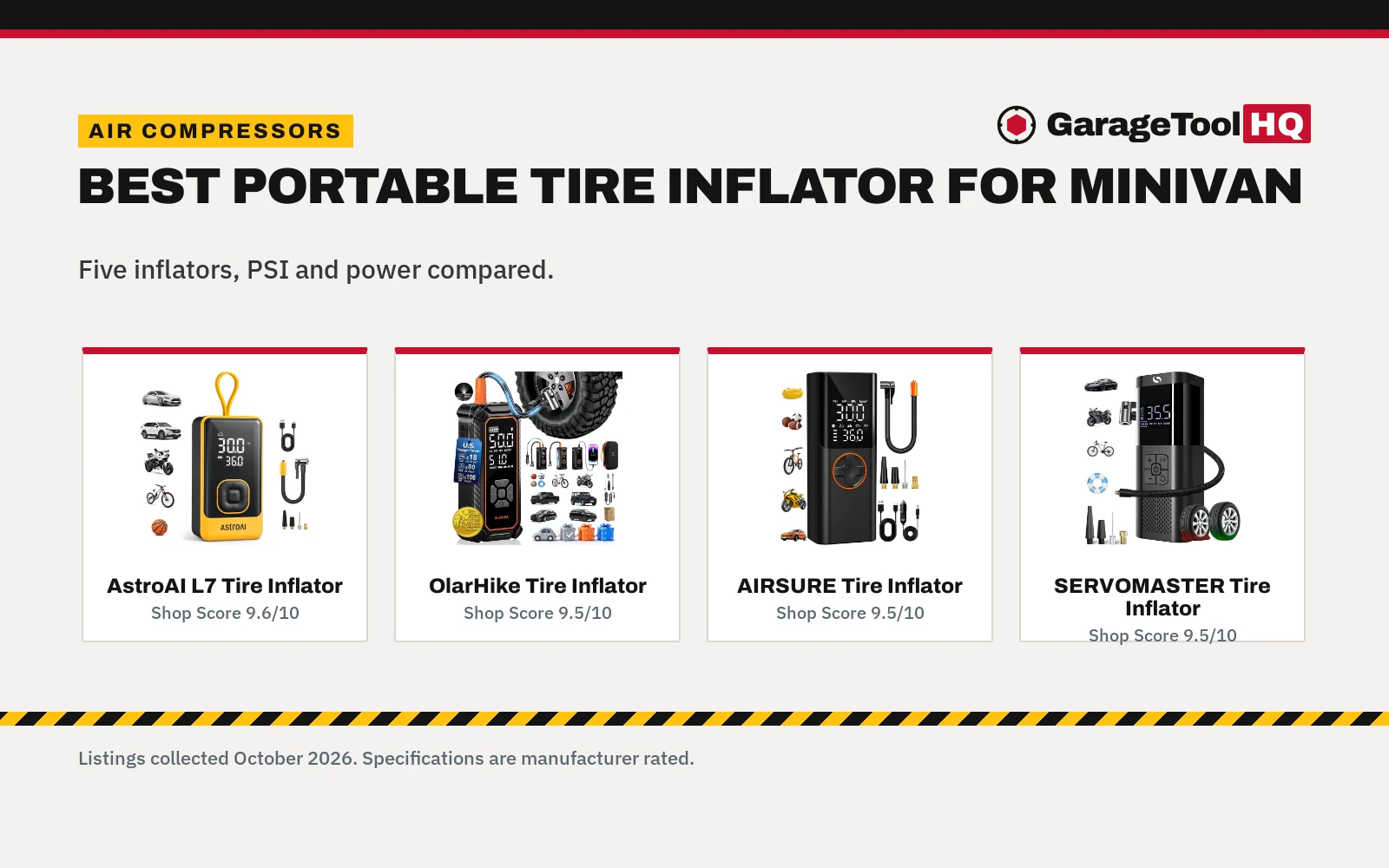
For quick roadside pressure checks and routine garage maintenance, a compact unit saves substantial setup time. Review our guide to the best portable tire inflator to compare top portable picks, or evaluate dedicated shop inflation gauges in our roundup of the best tire inflator with gauge. If your garage demands sustained air volume for air tools, see our picks for the best air compressor for home garage setups.
Battery power, heat buildup, and duty cycles
Compressing air generates thermal energy as work done on gas molecules raises temperature. In a handheld inflator, this heat transfers into the cylinder head, piston seal, and brass hose fitting.
Published manufacturer specifications show how individual models handle these loads. For example, the BEVA CAP02 listing specifies a 7.4-volt battery system, a maximum pressure rating of 150 PSI, and an airflow capacity of 23 liters per minute (though the listing spec table notes a capacity of 25 liters per minute alongside an airflow capacity of 23 liters per minute at a maximum current of 25 A). The maker lists a noise rating of 77 db, an 11.8-inch air hose, an item weight of 15.52 ounces, and dimensions of 9.64 inches long by 2.95 inches wide by 1.97 inches high.
To manage heat, BEVA lists dual-direction cooling to support 20 minutes of continuous runtime. The listing claims it inflates a 195/65 R15 car tire from 30 to 36 PSI in 1 minute, with digital pressure accuracy of ±0.5 PSI across 4 preset modes. The maker lists a battery charge time of 2.5 hours (noting 2 to 3 hours in bullet text) and claims one full charge handles up to 12 car tires topped off from 30 to 35 PSI, backed by a 1-year manufacturer warranty.
Adhering to manufacturer runtime limits prevents thermal damage to internal motor windings and dry piston seals. If the housing feels hot during use, pausing between tires allows cooling air to dissipate heat.
Frequently Asked Questions
Do portable tire inflators work well for passenger cars and SUVs?
Yes, portable tire inflators work effectively for maintaining recommended cold pressures, topping off seasonal drops, and handling slow leaks on passenger cars and crossover SUVs. However, large truck and heavy SUV tires contain significantly more air volume. Filling large tires from flat takes longer and strains compact duty cycles, so high-output units clipping directly to vehicle battery terminals are preferred for large truck tires.
How does portable tire inflator auto-shutoff work?
On auto-shutoff models, an electronic pressure transducer tracks pneumatic pressure in the delivery line. An internal microprocessor samples this signal, compensates for dynamic stroke pulses, and cuts motor power once line pressure reaches the user’s preset value, preventing over-inflation.
Why do portable tire inflators get hot during operation?
Compressing air generates heat because mechanical work done compressing air molecules increases gas temperature. In addition, the electric motor, gearbox, and reciprocating piston generate friction. Without large oil reservoirs or heavy cooling fins, heat accumulates quickly in the compact pump head and brass fitting.
Can a portable tire inflator seat a new tire bead?
Generally, no. Seating a tire bead requires an immediate high-volume surge of compressed air to push tire rubber against the wheel rim before air escapes. Portable inflators provide steady pressure at modest airflow rather than instantaneous high-volume bursts. Seating beads requires a shop compressor with a storage tank.
Can you run a portable tire inflator continuously?
No. Portable tire inflators have strict duty cycles due to heat buildup in compact, oil-free cylinders. While specific models with cooling fans, such as the BEVA CAP02 cited in listing specifications, rate continuous runtime up to 20 minutes, running any compact pump beyond its thermal limits risks damaging motor windings and piston seals. Letting the pump cool between tires protects internal parts.
How accurate are digital pressure gauges on portable inflators?
Digital inflators use electronic sensors that provide consistent readings. However, active pumping creates pressure pulses in the hose. Quality inflators dampen sensor noise or take readings during momentary stroke pauses. You can verify gauge precision against a standalone pencil or dial gauge when the pump is off.
Related: our guide to the best portable tire inflator, the best tire inflator with gauge, our diagnostics and electrical hub and the safety disclaimer. Also see our comparison of pancake air compressors for tire inflation.