How Long for Fuel Injector Cleaner to Work: The Tank Timeline
How long fuel injector cleaner takes to work: it cleans while you drive through the treated tank, with maker timelines of one can per 20 gallons and clean up in two uses.

On this page
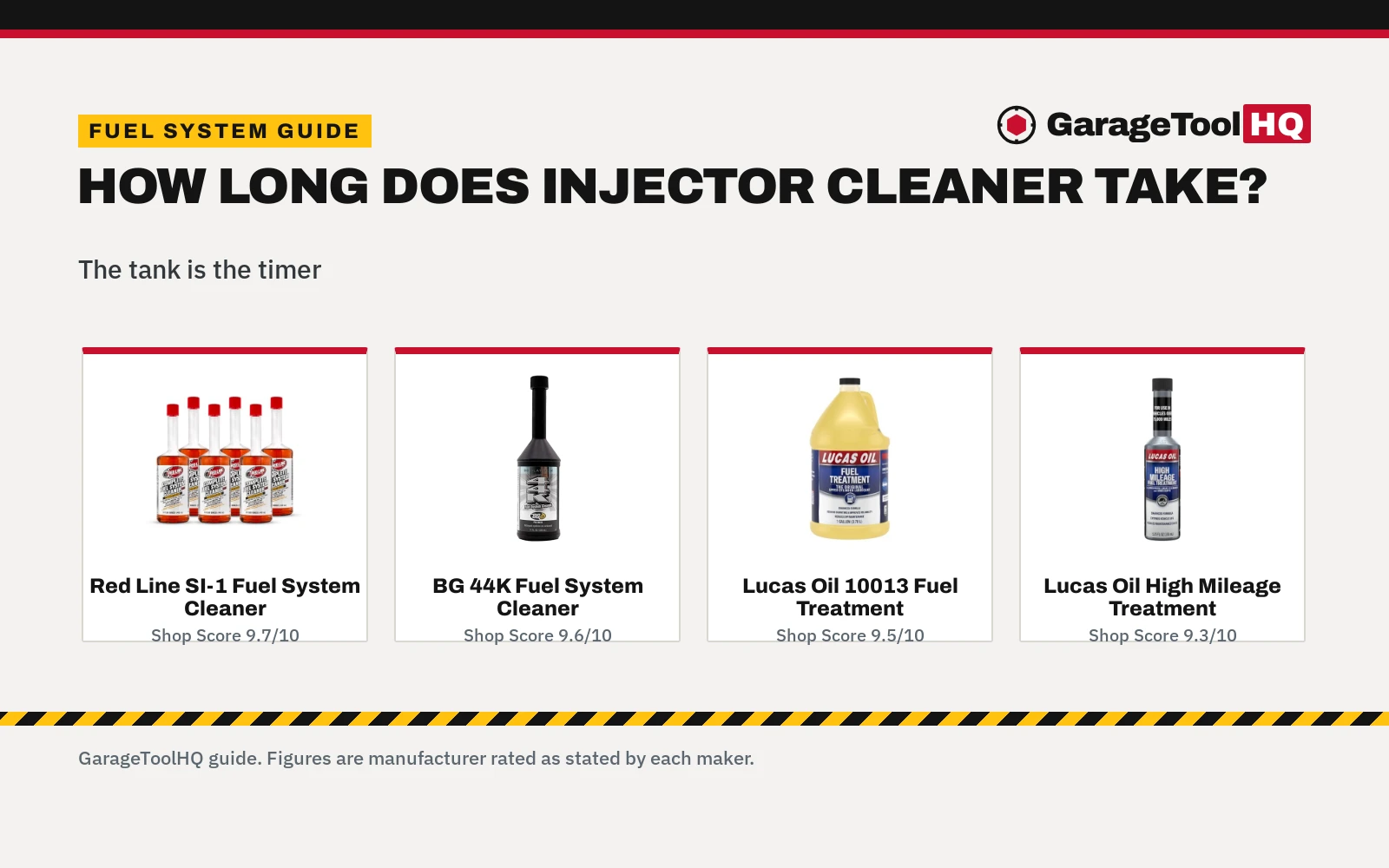
Top picks at a glance
As an Amazon Associate I earn from qualifying purchases.
- 1
 Red Line 60103 SI-1 Complete Fuel System Cleaner9.7/10View on Amazon
- 2
 BG 44K Fuel System Cleaner9.6/10View on Amazon
- 3
 Lucas Oil 10013 Fuel Treatment - 1 gal9.5/10View on Amazon
- 4
 Lucas Oil 5.25 Oz. High Mileage Fuel Treatment9.3/10View on Amazon
Fuel injector cleaner starts working as soon as the treated fuel reaches the injectors, and that is the honest answer to how long for fuel injector cleaner to work: the cleaning happens while you drive through the treated tank, not while the car sits in the driveway. The makers below describe the timeline in uses and tankfuls rather than minutes: Lucas Oil states fuel injector clean up “with two uses”, and BG states one can of 44K treats 20 gallons of gasoline. Expect the effect to build across the tank, judged after the treated fuel is used up.
GarageToolHQ earns a commission when you buy through links on our product pages, at no extra cost to you. Read our affiliate disclosure.
Below: how the timeline runs, what changes it, and the four cleaners compared.
Red Line 60103 SI-1 Complete Fuel System Cleaner
A 15 oz complete fuel system cleaner in a 6-pack, with high-temp and low-temp detergents for injectors, carburetors, valves and combustion chambers.
Pros
- 15 oz bottles in a 6-pack
- Cleans injectors, carburetors, valves and combustion chambers
- High-temp and low-temp detergents
- Nearly 100% efficiency in one treatment, per the listing
Cons
- No warranty term is stated
- No safety listing stated
- No ethanol blend compatibility stated
- No GDI cleaning stated
BG 44K Fuel System Cleaner
A fuel system cleaner; the maker states one can treats 20 gallons of gasoline.
Pros
- One can treats 20 gallons of gasoline, per the maker
- Cleans injectors, valves and combustion chambers, per the maker
- Compatible with alcohol-blended fuels, per the maker
- Single can doses up to 20 gallons
Cons
- Gasoline figure only; no diesel treat rate stated
- Treat rate assumes a 20 gallon fill
- No warranty term is stated
- No bottle volume stated
Lucas Oil 10013 Fuel Treatment - 1 gal
A 1 gallon treatment for gasoline and diesel; the maker states clean up with two uses.
Pros
- Stated for gasoline and diesel engines
- Maker states clean up with two uses
- Cleans and lubricates injectors and carburetor, per the maker
- 1 gallon size covers repeated treatments
Cons
- Gallon jug is a bulk size to store
- Two-use claim means one tank may not finish the job
- No per-tank treat rate stated
- No warranty term is stated
Lucas Oil 5.25 Oz. High Mileage Fuel Treatment
A 5.25 oz high mileage treatment; the maker states clean up with two uses.
Pros
- Maker states clean up with two uses
- Stated to prevent deposits, rust and corrosion
- Small 5.25 oz bottle
- High mileage positioning for older engines
Cons
- Small 5.25 oz bottle, so repeats mean repeat purchases
- No treat rate in gallons stated
- No fuel type stated
- No warranty term is stated
How long for fuel injector cleaner to work: the tank is the timer
An in-tank cleaner only touches the injectors when fuel flows through them, so the clock is fuel consumption. Add the cleaner, fill the tank, and drive: every mile on that tank runs treated fuel through the pump, lines and injectors. A car that burns through a tank in days of commuting finishes sooner than one that sips the same tank over weeks of short trips.
- One tank is the basic unit. BG states one can of 44K treats 20 gallons of gasoline, so one can covers up to 20 gallons of fuel and the treatment ends when that fuel is gone.
- Two uses is the stated clean-up timeline. Lucas Oil states “100% Fuel Injector Clean Up with Two Uses” on both its treatments here. Read that as the maker’s claim across two treatments, not a promise about your engine.
- Deposits decide the pace. Light deposits are the target of a single treatment. Heavier buildup is why makers describe repeat use: an early tank can loosen what it can reach, and a repeat treatment works on what remains.
What makes it work faster or slower
Three things move the timeline. Fuel flow: highway driving burns the treated tank faster than short trips, so the treatment finishes sooner in days. Dose: the cleaner has to match the fuel in the tank, which is why BG states a treat rate of one can per 20 gallons instead of a time. Injector condition: cleaner works on deposits it can dissolve as fuel passes, so a worn or faulty injector will not be fixed by any number of tanks. If symptoms persist after a full treated tank, the next step is diagnosis, not a stronger dose; our guide to checking a fuel injector covers the checks.
How to run a treatment
- Add the cleaner before filling, so the incoming fuel mixes it through the tank. Our guide to where fuel injector cleaner goes covers the basics.
- Fill the tank to the level the dose assumes. BG’s stated rate is one can per 20 gallons.
- Drive the tank down in normal use. Short trips still work; they just stretch the calendar time.
- Judge the result at the end of the tank, not after the first drive. Where the maker describes a two-use clean-up, as Lucas Oil does, a second treatment is the stated path.
The cleaners for this job
These four products handle the treatment step above: and they differ in bottle size, treat rate and stated timeline.
Read the manual before first use, wear eye protection, keep the work area clear and ventilated, and stay within every stated rating. Read our Safety Disclaimer.
Cleaner is not a repair
Fuel injector cleaner works on deposits. It does not repair a worn or faulty injector, and it does not replace fuel filter service. If rough running or hard starting persists after a treated tank, have the fuel system diagnosed.
FAQ: garage tools
How long does fuel injector cleaner take to work?
It works while you drive through the treated tank. Lucas Oil states clean up with two uses and BG states one can treats 20 gallons, so judge the result after the treated fuel is used up, or after the two uses where the maker states them.
Should I add cleaner before or after filling up?
Before filling, so the incoming fuel mixes the cleaner through the tank. Then fill to the level the dose assumes, such as BG’s stated one can per 20 gallons.
Can I use fuel injector cleaner in a diesel?
Only if the maker states diesel use. Lucas Oil states its 10013 treatment covers gasoline and diesel; the BG 44K figure here is for gasoline. See also our diesel injector additive picks.
What if one tank does not fix the problem?
Lucas Oil describes clean-up over two uses, so a second treatment is the maker’s stated next step. If symptoms remain, the cause is likely not deposits, and injector diagnosis is the right move.