How Much Torque Do You Need to Remove Lug Nuts? What to Know
How much torque is required to break lug nuts loose, why breakaway torque exceeds factory tightening specs, and how to remove stubborn wheel fasteners safely.

On this page
Top picks at a glance
As an Amazon Associate we earn from qualifying purchases.
- 1
 Alloyman Cordless Impact Wrench 1500 FT-LBS9.6/10View on Amazon
- 2
 1500 FT-LBS9.6/10View on Amazon
- 3
 1500 FT-LBS9.6/10View on Amazon
- 4
 OMT Torque Sticks 10pcs 1/2" Drive Torque Limiting ExtensionView on Amazon
- 5
 OMT Torque Limiting Extension Bar Set 5pcs 1/2" Drive TorqueView on Amazon
- 6
 1/2" Drive Torque Limiting Extension Bar SetView on Amazon
- 7
 1/2" Drive Torque Limiting Extension BarView on Amazon
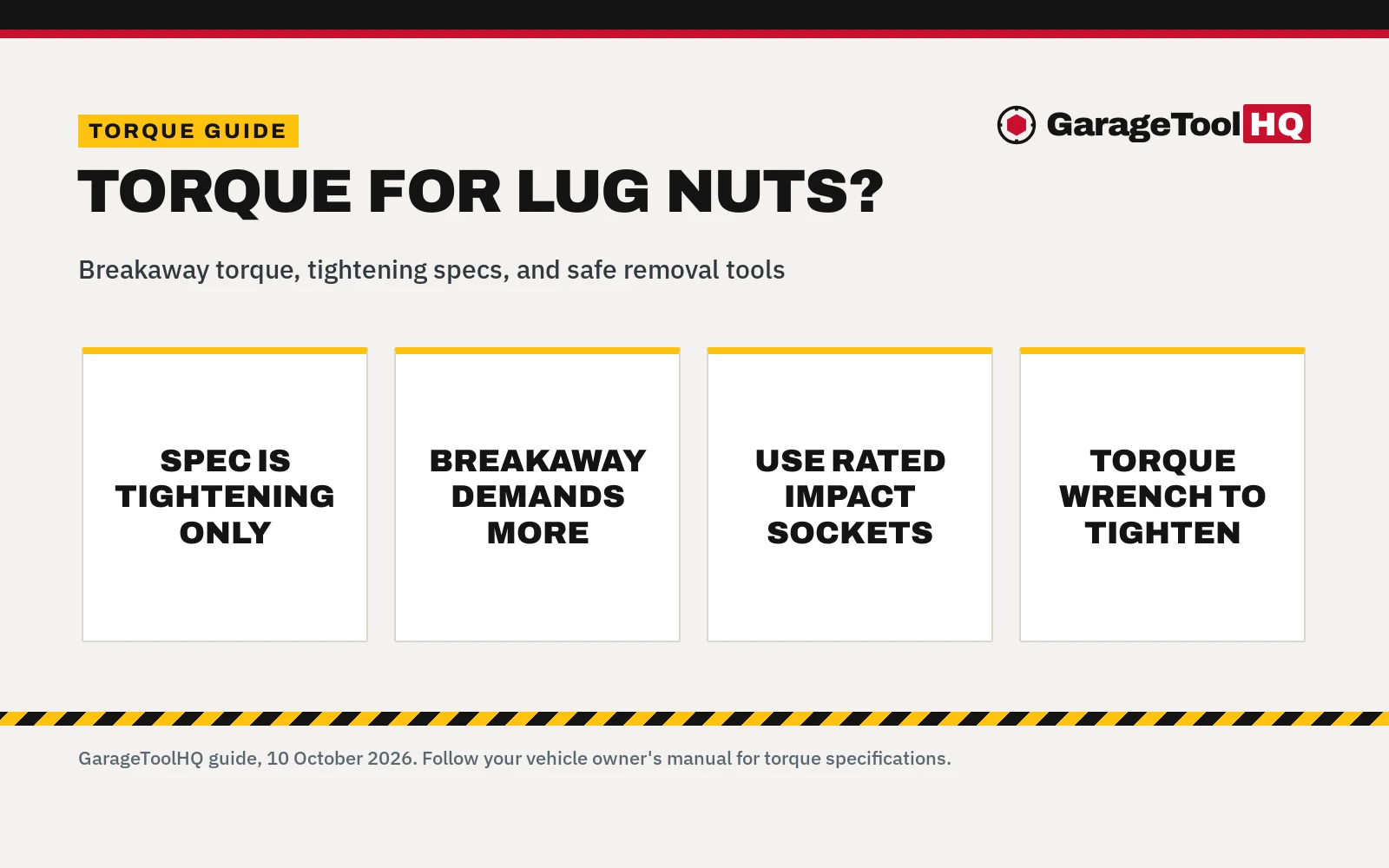
How much torque do you need to remove lug nuts? To remove lug nuts, your tool must deliver enough breakaway torque to match the initial tightening torque plus any added resistance from thread corrosion, road grime, and overtightening. While a clean, properly torqued fastener can break loose near its factory installation specification, environmental exposure and aggressive tire-shop air tools often increase the required removal torque significantly. When fasteners are rusted, heat-cycled, or seized, removing them safely requires mechanical advantage from an extended breaker bar, a geared torque multiplier, or a high-torque impact wrench.
More options to compare
 OMT Torque Sticks 10pcs 1/2" Drive Torque Limiting ExtensionCheck price on Amazon
 OMT Torque Limiting Extension Bar Set 5pcs 1/2" Drive TorqueCheck price on Amazon
 1/2" Drive Torque Limiting Extension Bar SetCheck price on Amazon
 1/2" Drive Torque Limiting Extension BarCheck price on Amazon
GarageToolHQ earns a commission when you buy through links on our product pages, at no extra cost to you. Read our affiliate disclosure.
Below: what creates fastener resistance, how tightening torque compares to breakaway torque, tool options for wheel service, and a step-by-step checklist to remove stubborn lug nuts safely.
How much torque do you need to remove lug nuts? Where the resistance comes from
When a wheel fastener is installed to factory specification, the applied torque stretches the wheel stud elastically, clamping the wheel hub against the rotor. Over time, environmental factors increase the torque necessary to rotate that fastener off the stud. Fastener resistance comes from several primary sources:
- Static friction. Fasteners held under clamping load develop static friction across the conical or flat lug nut seat. Once environmental exposure or overtightening increases surface binding, the initial breakaway effort exceeds the torque needed to spin the nut once movement starts.
- Thread corrosion and road salt. Moisture, winter road chemicals, and road grime work into exposed wheel stud threads. The resulting surface oxidation binds the metal threads together, dramatically increasing the force required for removal.
- Shop overtightening. Tire service shops often install wheel fasteners using pneumatic tools without calibrated torque sticks. Fasteners installed with uncontrolled air tools can be tightened far beyond factory specification, stretching the stud threads and making manual removal with a standard tire iron nearly impossible.
- Brake heat cycles. Braking generates severe heat that transfers into the wheel hub and studs. Repeated heating and cooling cycles expand and contract the metal, bonding road debris and anti-corrosion coatings into the thread mating surfaces.
Tool options for removing lug nuts, and how their torque compares
| Tool Type | Torque Mechanism | Removal Capability |
|---|---|---|
| Stock tire iron or lug wrench | Direct manual leverage | Suitable for factory-torqued fasteners; requires substantial user effort on stuck nuts |
| Telescoping lug wrench or breaker bar | Extended mechanical leverage | Multiplies manual input to break stubborn fasteners loose |
| Cordless or pneumatic impact wrench | Rapid rotational concussive blows | Delivers high breakaway torque to spin seized fasteners off quickly |
| Geared torque multiplier | Planetary gear reduction | Multiplies input force through internal gearing for heavy or seized fasteners |
Choosing the right tool depends on whether you are performing routine maintenance or dealing with stubborn fasteners. Manual leverage tools extend handle length to increase rotational torque. For example, the Spurtar telescoping lug wrench listing specifies an extendable handle that expands from 13.38 inches to 20.67 inches on a 1/2-inch drive, supplied with double-ended sockets covering 17mm, 19mm, 21mm, and 23mm. The additional handle length provides greater mechanical advantage over standard emergency tire tools.
When manual leverage on a standard bar is not enough, geared torque multipliers use planetary gear reduction to loosen stubborn fasteners without power tools. The Loksun torque multiplier listing states a 1:16 gear ratio delivering up to 680 Nm of output torque on a 1/2-inch drive with sockets including 17mm, 19mm, 21mm, and 22mm (11/16, 3/4, 13/16, and 7/8 inch). The COTOUXKER torque multiplier listing also specifies a 1:16 gear ratio with an output rating of 680 Nm on a 1/2-inch drive. For heavy commercial vehicles, the VEVOR torque multiplier listing states a 1:64 gear ratio delivering up to 6,800 Nm on a 1-inch drive with sockets from 24mm to 38mm.
Fastener removal also requires durable impact-grade sockets that withstand high rotational stress. The LEXIVON flip socket listing features impact-grade chrome molybdenum steel covering 17mm, 19mm, 21mm, and 22mm alongside 3/4, 13/16, 7/8, and 15/16 inch sizes with a 3-inch extension bar on a 1/2-inch drive. If previous removal attempts rounded the fastener corners, specialized extraction tools bite into damaged metal. The YEKEPRO bolt extractor listing includes reverse-spiral sockets in 17mm, 19mm, 21mm, and 22mm on a 1/2-inch drive, while the DPTOOL extractor listing provides a 22 piece set covering 3/8-inch and 1/2-inch drive sizes.
How to remove stubborn lug nuts safely: the step-by-step checklist
- Park on level, solid ground and set the parking brake. Position the vehicle on flat concrete or asphalt. Set the emergency brake and place wheel chocks against the tires on the axle you are not lifting.
- Break fastener tension on the ground when using manual tools. If you are using a manual lug wrench or breaker bar, loosen each fastener slightly before raising the vehicle so tire contact prevents the wheel from spinning. When using a powered impact tool, fasteners can be loosened after lifting because rotational hammer blows break tension without spinning the tire.
- Select the exact socket size. Match the socket profile precisely to the fastener hex. Never use a loose socket, which can slip and round the fastener shoulders.
- Seat the socket completely onto the fastener. Push the socket fully over the lug nut until it bottoms out against the wheel pocket. An incompletely seated socket can shear the nut edges or fracture under load.
- Apply steady, controlled upward force. Position the wrench handle so you are pulling upward with smooth leg and core strength rather than pushing downward toward the ground or kicking the wrench.
- Apply penetrating lubricant if the fastener binds. If rust prevents movement, spray penetrating oil directly onto the exposed wheel stud threads and allow it to soak. Before reassembly, thoroughly clean and dry the stud threads, as automaker torque specifications are calibrated for clean, dry fasteners.
- Use an extraction socket for damaged or rounded nuts. If fastener corners are stripped, tap an impact-grade reverse-spiral extractor socket onto the nut so the spiral teeth bite into the damaged metal.
- Lift the vehicle and support it on rated jack stands. Once every fastener is cracked loose, raise the vehicle using the automaker lift points and lower it onto rated jack stands. Never work around a vehicle supported only by a floor jack.
- Spin the loosened fasteners off and remove the wheel. With the wheel raised and supported on stands, use a cordless driver, impact tool, or hand socket to spin the nuts off the studs completely.
While high breakaway torque is helpful for fastener removal, never rely on an impact tool for final tightening. Uncontrolled impact tightening stretches wheel studs, distorts brake rotors, and makes future removal difficult. Always finish wheel installation with a calibrated torque wrench set to automaker specifications.
Use rated jack stands on solid ground, wear eye protection with power and air tools, keep fuel-burning equipment out of a closed garage, and follow the manual for every tool. Read our Safety Disclaimer.
Impact wrench vs breaker bar for lug nuts
Both cordless impact wrenches and manual breaker bars are common tools for wheel service, but they apply torque differently:
- Rotational delivery. A cordless impact tool applies rotational torque through thousands of rapid concussive hammer blows. This rapid impact action breaks corrosion and rust bonds quickly without transferring heavy twisting force to your arms. A manual breaker bar relies entirely on steady leverage and physical strength.
- Speed and shop efficiency. An impact wrench removes loosened lug nuts in seconds, significantly speeding up brake work and seasonal tire changes. A breaker bar requires turning each nut by hand once cracked loose. Compare dedicated cordless tools in our guide to the best cordless impact wrench for lug nuts.
- Sizing for the job. Choosing the right tool size ensures you have adequate breakaway capability without excess weight. Learn about drive sizes and power ratings in our guide on what size cordless impact wrench for lug nuts.
- Reliability and maintenance. A manual breaker bar has no battery to charge, no motor brushes to wear out, and no electronic switches, making it an essential backup tool to carry in your trunk for roadside emergencies.
For a detailed breakdown of tool mechanisms and when to use each, read our comparison of impact vs torque wrench.
Why torque wrenches belong on tightening, not removal
A common mistake in home garages is using a click-style torque wrench to break loose stubborn wheel fasteners. Click torque wrenches are precision measuring instruments, not breaker bars. Tools such as the EPAuto click torque wrench listing (rated for 25 to 250 ft-lb with a 150 ft-lb item rating) and the YIYEIE torque wrench listing (rated for 10 to 160 ft-lb with micro-adjustments down to 1 ft-lb) rely on an internal calibrated spring mechanism. Both tools use a 1/2-inch drive designed for setting fasteners to exact specifications.
While many click torque wrenches feature a reversing switch, that mechanism is intended for fasteners with left-hand threads, not for breaking loose seized fasteners. Using a precision torque wrench for removal applies reverse shock loads that can bend the internal pivot block, weaken the calibration spring, or throw the tool out of calibration. Once the internal spring loses calibration, the tool can no longer accurately torque fasteners to automaker specifications. Always reserve your torque wrench exclusively for final tightening. For reliable tightening options, explore our guide to the best torque wrench.
Frequently Asked Questions
Can an impact wrench remove lug nuts tightened by hand?
Yes. A quality cordless or pneumatic impact wrench easily removes fasteners that were properly torqued by hand. Because impact tools deliver rapid rotational blows directly to the socket, they break initial static resistance without spinning the tire or twisting the tool in your hands.
Why are lug nuts often harder to remove than to tighten?
Lug nuts often require more torque to remove because exposure to moisture, road salt, brake heat cycles, and tire-shop overtightening increase resistance over time. While clean fasteners installed to factory specification release near their installation torque, road corrosion and overtightening significantly elevate the breakaway torque needed for removal.
Can you use a torque wrench to remove lug nuts?
No. You should never use a precision click torque wrench to loosen or remove lug nuts. Breaking stubborn fasteners loose subjects the internal calibrated spring and ratcheting mechanism to severe reverse strain, which can ruin the tool calibration accuracy.
What should you do if a lug nut is completely stuck?
If a lug nut does not budge with a standard tire tool, do not jump or bounce on the handle. Apply penetrating oil to the exposed stud threads and allow it to soak. Then apply steady leverage with an extended breaker bar, a geared torque multiplier, or a high-torque impact wrench with a properly fitting impact socket.
Do you need impact-rated sockets to remove lug nuts?
Yes, whenever you use an impact wrench. Standard chrome hand sockets are made from harder, more brittle steel that can crack or shatter under impact hammer blows. Impact sockets are constructed from ductile alloy steel, such as chrome molybdenum, with thicker walls designed to absorb concussive force safely.
How much torque should you use when putting lug nuts back on?
Always follow the exact fastener torque specification listed in your vehicle owner’s manual. Tighten fasteners in a crisscross or star pattern using a calibrated torque wrench on clean, dry threads to ensure even clamping pressure across the wheel hub and brake rotor.
Related: our cordless tools hub, the best cordless impact wrench for lug nuts, our guide on what size cordless impact wrench for lug nuts, impact vs torque wrench, and the best torque wrench guide.