How to Check Car AC Refrigerant Level
Hook a manifold gauge set to the low and high side ports, read both gauges with the air conditioner running, and compare the readings with the pressure chart for your system.

On this page
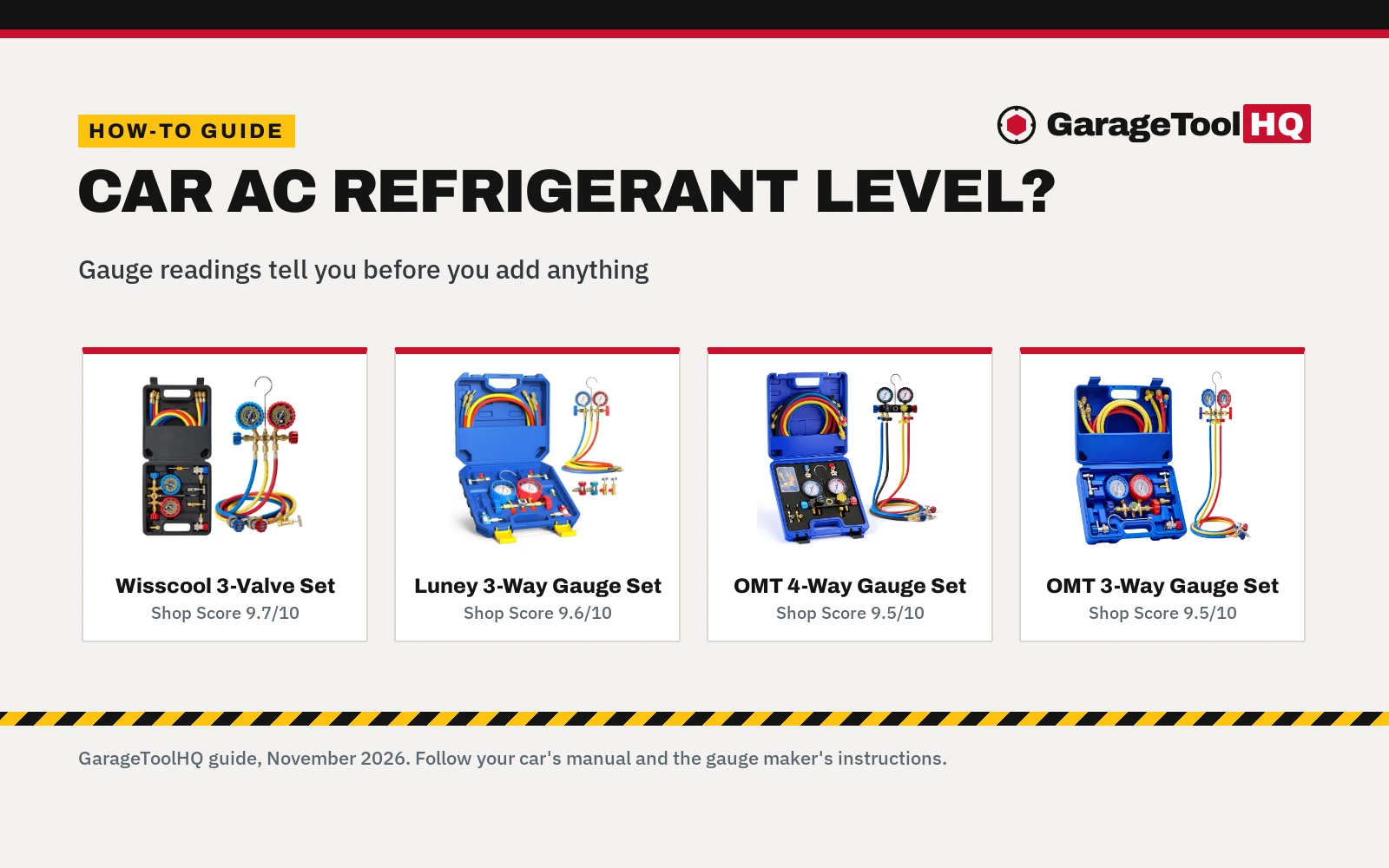
Top picks at a glance
As an Amazon Associate I earn from qualifying purchases.
- 1
 WISSCOOL HVAC Manifold Gauge Set 3-Valve9.7/10View on Amazon
- 2
 Luney 3-Way AC Manifold Gauge Set for R134a R129.6/10View on Amazon
- 3
 OMT 4 Way Automotive AC Diagnostic Manifold Gauge9.5/10View on Amazon
- 4
 OMT 3-Way AC Manifold Gauge Set for R12 R134a R5029.5/10View on Amazon
Warm air from the vents on a hot day can mean the air conditioner is low on refrigerant, and a manifold gauge set is how you read the pressures to check. How to check car ac refrigerant level comes down to one tool: a manifold gauge set hooked to the low and high side service ports, with both gauges read while the air conditioner runs. This guide explains what the gauges tell you, how to hook the set up, and which gauge sets cover the refrigerants in a home garage.
GarageToolHQ earns a commission when you buy through links on our product pages, at no extra cost to you. Read our affiliate disclosure.
Below: the short answer, what each gauge tells you, how to hook the set up, and the gauge sets that fit the job.
WISSCOOL HVAC Manifold Gauge Set 3-Valve
A 3-valve manifold gauge set for R134a, R22, R12 and R502, with three 5 ft hoses, a sight glass and a moisture indicator.
Pros
- Low-side gauge 0 to 350 PSI; high-side 0 to 450 PSI
- Three 5 ft color-coded hoses
- Sight glass shows refrigerant flow
- 1 year warranty
Cons
- Weighs 5.56 pounds
- No carrying box
- Three 5 ft hoses need shelf space
- Verify the adapter fit with your car before ordering
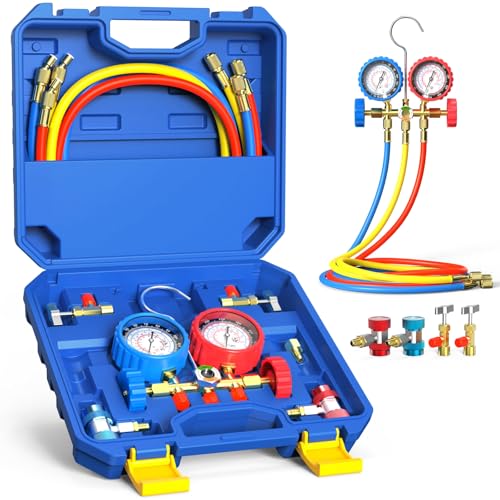
Luney 3-Way AC Manifold Gauge Set for R134a R12
A 3-way manifold gauge set for R134a, R12, R22 and R502, with 4 ft hoses, a carrying box and gauges rated at 1.6% accuracy.
Pros
- Covers R134a, R12, R22 and R502
- 4-layer hoses rated 600 PSI working and 3000 PSI burst
- Oil-filled gauges with 1.6% accuracy
- Carrying box, adapter and both can taps included
Cons
- No warranty
- 4 ft hoses; check the reach to your car's ports
- No sight glass
- Weighs 4.1 pounds

OMT 4 Way Automotive AC Diagnostic Manifold Gauge
A 4-way automotive AC manifold gauge set for R134a, R410a and R22, built from solid brass with 2.6 in hybrid antishock gauges. It includes 4 color-coded hoses rated 800 psi working and 4000 psi burst, 2 adjustable quick couplers, a 29 degree trap adapter, tank adapters and a puncture-style can tap. Calibration screws allow 1.6% accuracy, and a moisture indicator monitors the system. Who it is for: the DIYer or pro who wants the most complete analog kit here. Who should skip it: anyone servicing R134a only, who will not use the fourth way.
Pros
- 4-way manifold with a dedicated evacuation port and black hose.
- Hoses rated 800 psi working and 4000 psi burst, the highest here.
- 1.6% accuracy with calibration screws, plus a moisture indicator.
- 1 year warranty stated, with solid brass construction.
Cons
- The 4-way kit has more adapters to keep track of than a 2-way.
- No safety certification is stated.
- No carrying case is stated.

OMT 3-Way AC Manifold Gauge Set for R12 R134a R502
A 3-way AC manifold gauge set for R12, R134a, R502 and R22, with 5 ft hoses and 2.6 in shock-resistant gauges. The low side reads -15 to 350 psi and the high side 0 to 500 psi, with calibration screws for 1.6% accuracy. Hoses are reinforced with 4 layers, rated 600 psi working and 3000 psi burst, and the set comes in a blow-molded case with step-by-step instructions. Who it is for: the home garage covering older R12 and R22 systems plus R134a. Who should skip it: anyone wanting digital readouts.
Pros
- Covers R12, R134a, R502 and R22, the widest analog coverage here.
- 5 ft hoses rated 600 psi working and 3000 psi burst.
- 2.6 in gauges with -15 to 350 psi low and 0 to 500 psi high ranges.
- Blow-molded case and 1 year warranty stated.
Cons
- R12 and R502 coverage is legacy for most home garages.
- No fourth way for dedicated evacuation.
- No safety certification is stated.
- Solid brass and rubber build is heavier than aluminum sets; no weight is stated.
How to Check Car AC Refrigerant Level: The Short Answer
Hook the manifold gauge set to the low and high side service ports, then read both gauges with the air conditioner running. Compare the readings with the pressure chart for your system: readings below the chart can point to a system that is low on refrigerant, though low readings can also come from other faults. Have the system checked for leaks before adding refrigerant, since a low level means refrigerant has escaped somewhere.
What the Gauges Tell You
A manifold gauge set reads both pressures at once. The low-side gauge shows the suction side of the system and the high-side gauge shows the discharge side, and the pair together shows how the system is running. On the Wisscool set the low-side gauge measures 0 to 350 PSI and the high-side gauge measures 0 to 450 PSI, and both gauges read in degrees F at 1.6% accuracy, with calibration screws for fine adjustment. The Luney gauges are large 2.6 inch dual anti-shock gauges with an oil-filled core and a dry dial, also rated at 1.6% accuracy. Both full kits carry a moisture indicator, which helps monitor refrigerant condition during operation, and the Wisscool set adds a sight glass that shows refrigerant flow.
Hook Up the Gauge Set
Hook-up is color coded. On the Wisscool set the red, blue and yellow 5 ft hoses identify the high-side, low-side and charging connections, so the red hose goes to the high side, the blue hose to the low side and the yellow hose to the charging connection. The Luney set uses 3 color-coded reinforced hoses of 4 ft, with adjustable 1/4 inch quick couplers and a 1/4 inch to 1/2 inch Acme adapter, plus self-sealing and piercing can taps. The Wisscool kit adds a valve core key, an adapter, a pipe thimble and replacement seals, and its manifold carries a rear hanging hook. Check that every connection is tight before you read the gauges, and keep the hoses clear of hot and moving parts.
Car AC Refrigerant Level Gauges for the Garage
Each gauge set below handles one part of the check: the full kits read both sides and carry a moisture indicator, the Wisscool set adds a sight glass that shows flow, and the OMT sets cover the same check for the refrigerants in their titles.
Read the manual before first use, wear eye protection, keep the work area clear and ventilated, and stay within every stated rating. Read our Safety Disclaimer.
FAQ: garage tools
Can I check the refrigerant level without gauges?
No. You need pressures, not a look at the system. A manifold gauge set reads the low side and the high side at once, and both readings feed the check.
Which refrigerant does my car use?
Check the label under the hood or the car’s manual. The Wisscool and Luney sets cover R134a, R12, R22 and R502, and the OMT 4-way set also covers R410a.
What do the low and high side gauges read?
On the Wisscool set the low-side gauge measures 0 to 350 PSI and the high-side gauge measures 0 to 450 PSI. Both gauges read in degrees F at 1.6% accuracy, with calibration screws for fine adjustment.
What does the moisture indicator do?
The moisture indicator helps monitor refrigerant condition during operation. The Wisscool and Luney sets both list one, and the Wisscool set adds a sight glass that shows refrigerant flow.
Can one gauge set cover home and car air conditioners?
Yes, with the right set. The Luney set is designed for automotive AC, home air conditioners and commercial refrigeration units, and it covers R134a, R12, R22 and R502.
Related: the AC refrigerant types guide, the best auto AC manifold gauge set picks, manifold gauge vs recharge kit, the best AC leak detector and the engine and shop equipment hub.