How to Choose Garage Lighting: Setup Guide
How to choose garage lighting by matching fixture style, lumen output, color temperature, and mounting method to your workspace and ceiling height.

On this page
Top picks at a glance
As an Amazon Associate we earn from qualifying purchases.
- 1
 hykolity 2FT 150W LED Linear High Bay Shop Light9.8/10View on Amazon
- 2
 Comfort Zone Hard-Wired Ceiling Mount Garage Electric Space9.7/10View on Amazon
- 3
 Comfort Zone Hard-Wired Ceiling Mount Garage Space Heater9.7/10View on Amazon
- 4
 LZHOME Hexagon 5000K LED Garage Lights: 25 Pack UpdatedView on Amazon
- 5
 LZHOME LED Garage Lights Fixture: High Brightness 39000LM LEDView on Amazon
- 6
 Garage Lights 2 Pack 120WView on Amazon
- 7
 Work LightView on Amazon
- 8
 VEVOR Underhood Work LightView on Amazon
How to choose garage lighting comes down to matching your ceiling height and layout with the right fixture style, lumen output, and color temperature. For quick upgrades without new wiring, multi-panel LED bulbs screw directly into standard ceiling sockets. For even illumination across parking bays and workbenches, linear shop lights or flush-mount ceiling panels provide widespread coverage. Selecting fixtures with verified safety certifications and suitable mounting hardware ensures reliable workspace visibility.
More options to compare
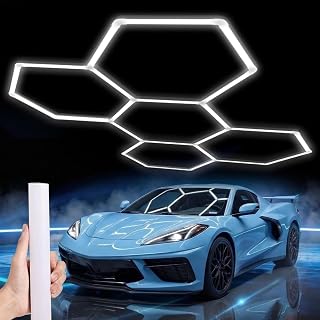 LZHOME Hexagon 5000K LED Garage Lights: 25 Pack UpdatedCheck price on Amazon
 LZHOME LED Garage Lights Fixture: High Brightness 39000LM LEDCheck price on Amazon
 Garage Lights 2 Pack 120WCheck price on Amazon
 Work LightCheck price on Amazon
 VEVOR Underhood Work LightCheck price on Amazon
GarageToolHQ earns a commission when you buy through links on our product pages, at no extra cost to you. Read our affiliate disclosure.
Below: core factors to evaluate before buying, how major fixture styles compare, a step-by-step selection checklist, and answers to common garage lighting questions.
How to choose garage lighting: key factors for your workspace
Proper illumination transforms a dark garage into a functional, safe workspace. Adequate light is critical when positioning floor jacks under vehicle lift points, inspecting brake components, using power tools, or checking for fluid leaks on concrete floors. Four central factors dictate which lighting setup will serve your space best:
- Ceiling height and clearance. In garages with low ceiling clearance or overhead roll-up doors, low-profile wraparounds or flush panels help prevent interference with open doors and raised vehicle hoods. Spaces with open rafters or higher ceilings offer greater clearance for suspended fixtures hung by chains.
- Total brightness and light spread. Ambient lighting provides baseline visibility across parking bays, but detailed mechanical work benefits from concentrated brightness. Spreading light across multiple fixtures helps minimize deep shadows.
- Color temperature and color rendering. Discerning wire colors, spotting bodywork flaws, and inspecting fluid conditions benefit from cool white or daylight illumination with accurate color rendering.
- Wiring and power source. Existing bare-bulb sockets allow instant screw-in upgrades. Standard 120-volt receptacles support plug-in and linkable shop lights, while direct junction boxes accommodate hardwired fixtures.
Primary types of garage lighting fixtures and where they fit
| Fixture Style | Light Distribution | Best Workspace Application | Installation Complexity |
|---|---|---|---|
| Deformable multi-panel LED bulbs | Directional downward and outward beam via adjustable wings | Garages with existing ceiling bulb sockets needing quick illumination upgrades | Screw directly into existing E26 or E27 sockets with no extra wiring |
| Linear LED shop lights (hanging or surface mount) | Continuous wide downlight along vehicle bays and workbenches | Multi-car garages, long workbenches, and open shop ceilings | Plug into standard 120V outlet, daisy-chain across linked units, or hardwire to junction box |
| Low-profile flush wraparounds and flat panels | Diffused, even illumination with minimal glare and low overhead clearance | Finished drywall ceilings, low-clearance garages, and utility areas | Hardwire to ceiling junction box or surface mount directly to ceiling |
| Modular hexagon grid lighting systems | Broad geometric ceiling coverage eliminating peripheral shadows | Dedicated detailing bays, vehicle showrooms, and full workshop ceilings | Assemble modular snap tubes and surface mount or suspend from ceiling |
Each fixture style serves distinct garage configurations based on published specifications:
- Deformable screw-in bulbs: These install into standard E26 or E27 sockets without extra wiring. The Meiqils deformable light draws 80 watts for 8,000 lumens in 6500K daylight white, using 3 adjustable panels with 0 to 90 degree tilt, CE, FCC, and RoHS certifications, and a 3-year replacement warranty. For higher output, the Aoretic GR-6 bulb produces 18,000 lumens at 180 watts across 6+1 panels with an aluminum heatsink and a 3 year warranty. The POLARPRA bulb advertises 40,000 lumens for its 2-pack set, with each light delivering 20,000 lumens at 200 watts across 8+1 panels with a 2 year warranty.
- Linear LED shop lights: Spreading illumination along an extended fixture housing reduces harsh shadows across vehicle bays. The Lithonia Lighting FMLWL 48-inch wraparound delivers 2,900 lumens (listed as 3,000 lumens in its description) at 41 watts with 4000K cool white light, 120V hardwiring, UL and CSA listings, and a 5-year warranty. The ALUSSO 4-foot linkable fixture outputs 4,800 lumens with selectable settings of 20, 30, or 40 watts and five switchable color temperatures from 2700K to 6500K, linking up to 4 units on a 59-inch power cord with ETL listing. Skymoatled 4-foot fixtures produce 7,500 lumens at 50 watts in 6000K white light with a 270-degree beam angle, available in an 8-pack set with 24-inch linking cables and a 2-year warranty.
- Flush panels and modular grids: The Lithonia Lighting CPANL 1×4 flat panel measures 1.26 inches deep, drawing 38 watts for 4,000 lumens with switchable 3500K, 4000K, and 5000K settings and CSA certification. The LZHOME hexagon grid draws 240 watts to output 26,400 lumens (listed as 26,300 lumens in its title) at 5000K with CRI >85 across a 25-pack tube layout with a 5ft power cable and a 2-year warranty.
Step-by-step garage lighting selection checklist
- Check overhead clearance. In garages with low ceilings or roll-up garage doors, slim fixtures like the Lithonia Lighting CPANL flat panel (measuring 1.26 inches in depth) help prevent obstructions when opening vehicle hoods or doors. Spaces with high open rafters allow chain-suspended shop lights.
- Plan total brightness. Match output to room size and planned activities. A compact area may need only a single 8,000-lumen Meiqils bulb, while full multi-bay garages benefit from several distributed fixtures. Learn more in our guide on how many lumens do I need for a garage.
- Select color temperature. Choose cool white or daylight output for workshop tasks. Settings range from 4000K cool white on the Lithonia Lighting wraparound to 6000K on Skymoatled shop lights and 6500K on Meiqils bulbs. Selectable fixtures like the ALUSSO shop light provide flexibility across five temperatures from 2700K to 6500K.
- Verify power connection. Existing light sockets accommodate screw-in E26 bulbs. Standard 120-volt outlets support plug-in and linkable shop lights. Hardwired wraparound fixtures connect directly to ceiling junction boxes.
- Confirm safety listings and build quality. Prioritize fixtures carrying recognized safety certifications such as UL or CSA listings (found on Lithonia Lighting fixtures) or ETL certification (found on ALUSSO lights). Look for aluminum heatsinks to dissipate heat during long projects.
- Add focused task lighting. Overhead lights alone leave shadows under vehicle hoods and below chassis lift points. Plan secondary bench lights or portable work lamps for detailed assemblies.
Never exceed the manufacturer maximum daisy-chain limit when connecting multiple shop lights on a single cord. For hardwired ceiling fixtures or adding new dedicated circuits, hire a licensed electrician to inspect your panel and ensure wiring meets local electrical codes.
Use rated jack stands on solid ground, wear eye protection with power and air tools, keep fuel-burning equipment out of a closed garage, and follow the manual for every tool. Read our Safety Disclaimer.
Linear shop lights vs screw-in deformable LED bulbs
When upgrading garage lighting, most homeowners choose between multi-panel screw-in bulbs and linear shop lights. Comparing their practical differences helps determine the right fit:
- Light distribution: Deformable bulbs screw into a single socket, broadcasting light outward from one central point. Units like the Meiqils 80-watt or Aoretic 180-watt bulbs allow angling panels from 0 to 90 degrees, but a single point source still casts shadows behind obstacles. In contrast, linear shop lights, such as 4-foot Skymoatled or ALUSSO fixtures, distribute light along a continuous housing, providing overlapping coverage that helps minimize shadows.
- Glare control: Many multi-panel screw-in bulbs place bright LED arrays in direct line of sight. Linear fixtures like the Lithonia Lighting FMLWL incorporate a white polycarbonate diffuser to spread 2,900 lumens evenly and soften direct glare when working underneath.
- Expandability: Deformable bulbs depend on pre-existing ceiling sockets. In contrast, linkable linear fixtures can connect in series across wider ceiling areas: ALUSSO allows linking up to 4 units on a 59-inch cord, while Skymoatled provides 24-inch connector cables to run multiple fixtures from a single switched connection.
Compare top options in our roundup of the best LED garage lights and our guide to the best garage lights ceiling LED fixtures.
Task lighting and shadow management around workbenches
Even a well-lit ceiling leaves dark zones when working around vehicles and workbenches. Leaning over an engine bay or standing at a tool bench blocks overhead light, casting shadows directly across your workspace.
Dedicated task fixtures solve this problem. Wall-mounted directional fixtures like the ISUERFY 100-watt shop light deliver 11,000 lumens with a 120-degree beam angle, an IP66 waterproof housing, and a 180-degree bracket to illuminate workbenches. Compact fixtures like the YAYIT 40-watt shop light provide 5,400 lumens with a 6.6-foot cord for targeted bench illumination.
When working under a vehicle on jack stands or inside an engine bay, fixed lights cannot reach recessed components. Supplementing fixed overhead fixtures with a dedicated rechargeable work light for mechanics delivers portable, magnetic illumination right where hand tools are positioned.
Frequently Asked Questions
How many lumens do I need for my garage?
Total lumen requirements depend on room dimensions, ceiling height, and the work performed. General parking requires moderate light, while mechanical repairs and detailing demand brighter illumination across the bay. Individual fixtures vary in output, from 4,000 lumens on a Lithonia Lighting panel to 7,500 lumens on a Skymoatled fixture or 11,000 lumens on an ISUERFY work light. Multiple units can be positioned across bays to provide uniform coverage throughout the workspace.
What color temperature is best for garage lighting?
Cool white and daylight color temperatures between 4000K and 6500K offer clear visibility for workshop projects. A 4000K fixture (such as the Lithonia Lighting FMLWL wraparound) delivers cool white light suitable for general garage tasks. A 5000K fixture (such as the LZHOME hexagon grid) provides daylight white suited for vehicle inspection. Ratings such as 6000K (Skymoatled) and 6500K (Meiqils) deliver sharp, cool daylight contrast. Multi-CCT fixtures like the ALUSSO light include 2700K, 3000K, 4000K, 5000K, and 6500K settings, allowing you to tailor the output to your preference.
Are screw-in multi-panel LED lights safe to use?
When installed in sound sockets, multi-panel LED bulbs provide a straightforward upgrade. Check that the fixture uses a quality aluminum heatsink, such as the hollow-out heatsink on the Aoretic GR-6, to manage heat from the LED driver. Verify socket condition, and ensure the fixture wattage (such as 80 watts on the Meiqils light or 180 watts on the Aoretic bulb) does not exceed the fixture or socket rating.
How many shop lights can be linked together on one outlet?
Maximum linked fixtures depend strictly on the manufacturer stated limit. For example, ALUSSO specifies linking up to 4 units of its 4-foot fixture on a single power cord. Always follow the manufacturer limit listed in the manual, and never connect more units than the cord and circuit breaker can handle.
Do garage ceiling lights need a licensed electrician to install?
Plug-in shop lights and screw-in deformable bulbs do not require an electrician; they plug into standard wall outlets or screw into existing E26 ceiling sockets. However, if you are installing hardwired fixtures (such as the Lithonia Lighting FMLWL wraparound connected to a junction box) or adding new circuits, hire a licensed electrician to ensure code compliance.
What does CRI mean when choosing garage lights?
CRI (Color Rendering Index) measures how accurately a light reveals colors compared to natural daylight. Higher CRI ratings help distinguish wiring colors, paint flaws, and fluid leaks. Listings in this category publish ratings such as CRI 80 on POLARPRA and Aoretic bulbs, and CRI >85 on LZHOME and YAYIT lights.
Related: how many lumens do I need for a garage, our roundup of the best LED garage lights, our guide to the best garage lights ceiling LED, the best rechargeable work light for mechanics and our garage upgrades hub.