How to Clean and Paint Brake Calipers
Clean the caliper until the brush stays clean, mask everything around it, brush on high temperature paint in thin coats, and let it dry before the wheels go back on.
On this page
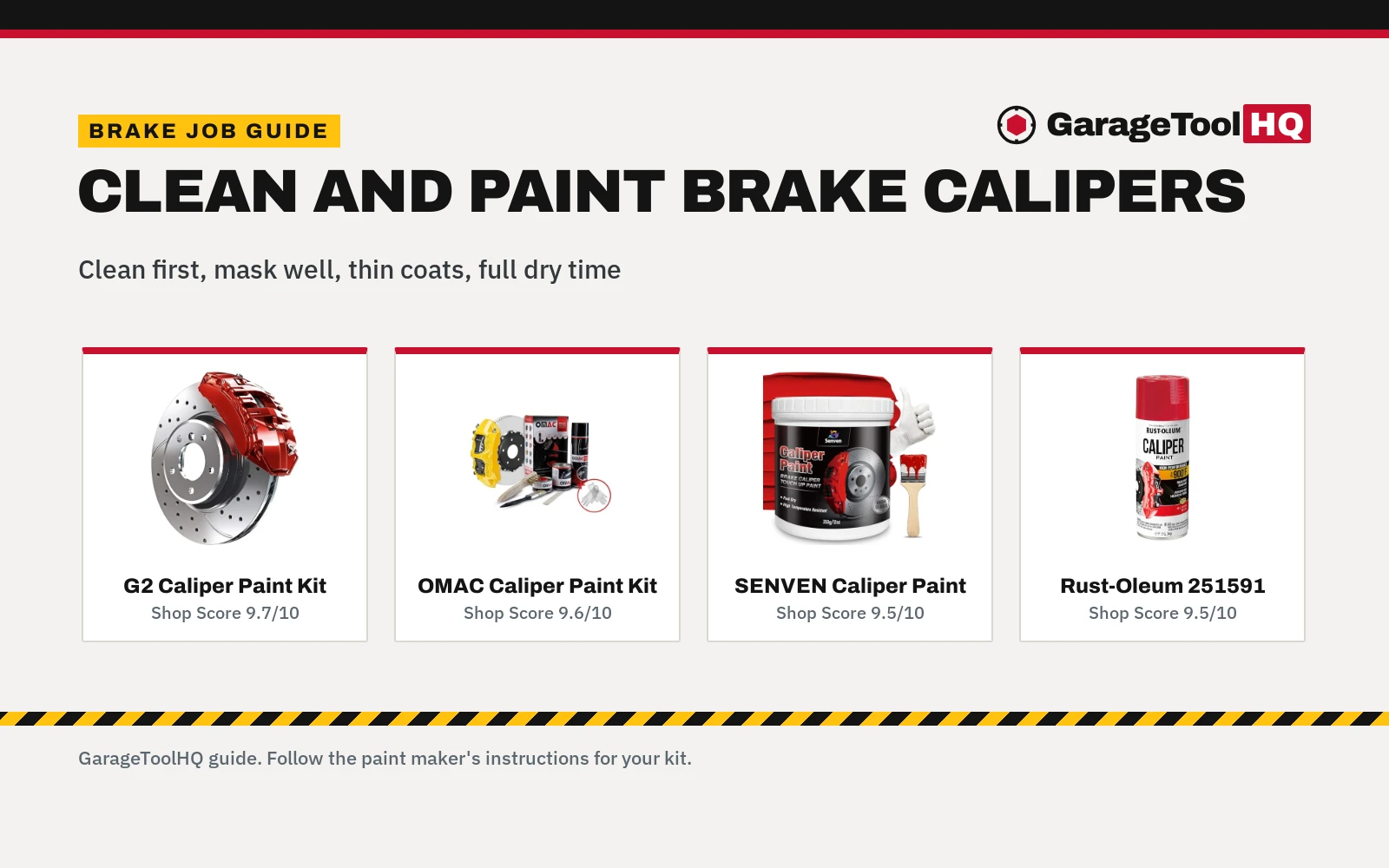
Top picks at a glance
As an Amazon Associate I earn from qualifying purchases.
- 1
 G2 High Temperature Brake Caliper Paint System Set9.7/10View on Amazon
- 2
 OMAC High Temperature Brake Caliper Paint System9.6/10View on Amazon
- 3
 Red Caliper Paint High Temperature Brake Caliper9.5/10View on Amazon
- 4
 Rust-Oleum 251591 Caliper Spray Paint, 12 oz, Red9.5/10View on Amazon
Your wheels come off for a brake job and the calipers behind them look rough: brake dust baked into the casting, road grime in every corner, and bare metal where the finish gave up long ago. This guide covers how to clean and paint brake calipers in a home garage. The short answer: remove the wheels, clean the caliper until the surface is free of dust and grime, cover every part except the caliper, apply high temperature caliper paint in thin, even coats, let it dry fully, then put the wheels back on.
GarageToolHQ earns a commission when you buy through links on our product pages, at no extra cost to you.
Below: the job in order, how brush-on kits differ from spray paint, the paints that handle each part of the work, and common questions.
G2 High Temperature Brake Caliper Paint System Set
A brush-on epoxy caliper paint system in red, rated by the maker to resist heat up to 980 degrees, with cleaner and brush included for the prep and coating steps.
Pros
- Rated to resist heat up to 980 degrees
- Complete kit covers 4 disc brake calipers
- Includes cleaner, brush, stirrer, and instructions manual
- 12 standard high gloss colors stated
Cons
- Brush application is slower than spraying
- Two-part epoxy must be mixed with the reactor
- Red is the color of this set
- Kit size is 330 milliliters
OMAC High Temperature Brake Caliper Paint System
A two-component epoxy caliper paint kit in California Yellow, rated by the maker to resist heat up to 900 degrees, with brake cleaner, steel brush, and gloves included.
Pros
- Rated to resist heat up to 900 degrees
- Kit paints 4 caliper brakes
- Includes brake cleaner and steel brush
- Includes painting brush and disposable gloves
Cons
- Heat figure is 900 degrees, below the 980 degree paints
- Lacquer amount is 4 oz with 1 oz hardener
- California Yellow is the color of this kit
- No warranty term is stated
Red Caliper Paint High Temperature Brake Caliper
A red gloss brush-on caliper touch up paint, rated by the maker to resist heat up to 980 degrees, with stated dry times between coats and before refitting wheels.
Pros
- Rated to resist heat up to 980 degrees
- Stated dry time of 3-4 hours before second coat
- Stated 24 hours before reassembling wheels
- Brush-on epoxy system with high gloss finish
Cons
- Touch up paint, with no cleaner or brush stated
- No coverage figure is stated
- No warranty term is stated
- Red gloss is the color of this pack
Rust-Oleum 251591 Caliper Spray Paint, 12 oz, Red
A red caliper spray paint in a 12 oz can, rated by the maker to resist heat up to 900-Degree F, with any angle spray technology for coating calipers in place.
Pros
- Rated to resist heat up to 900-Degree F
- Any angle spray technology stated
- Comfort-tip spray nozzle stated
- Formulated to resist brake dust
Cons
- Spray needs wider masking than a brush
- No cleaner, brush, or gloves stated
- No coverage or dry time figure is stated
- No warranty term with a concrete period is stated
How to clean and paint brake calipers: the job in order
Paint sticks to a clean surface and fails on a dirty one, so the cleaning step decides how the finish holds up. Work in this order:
- Remove the wheels. The caliper has to be reachable on every side you plan to paint, with room for a brush to move without dragging across the rotor or hose.
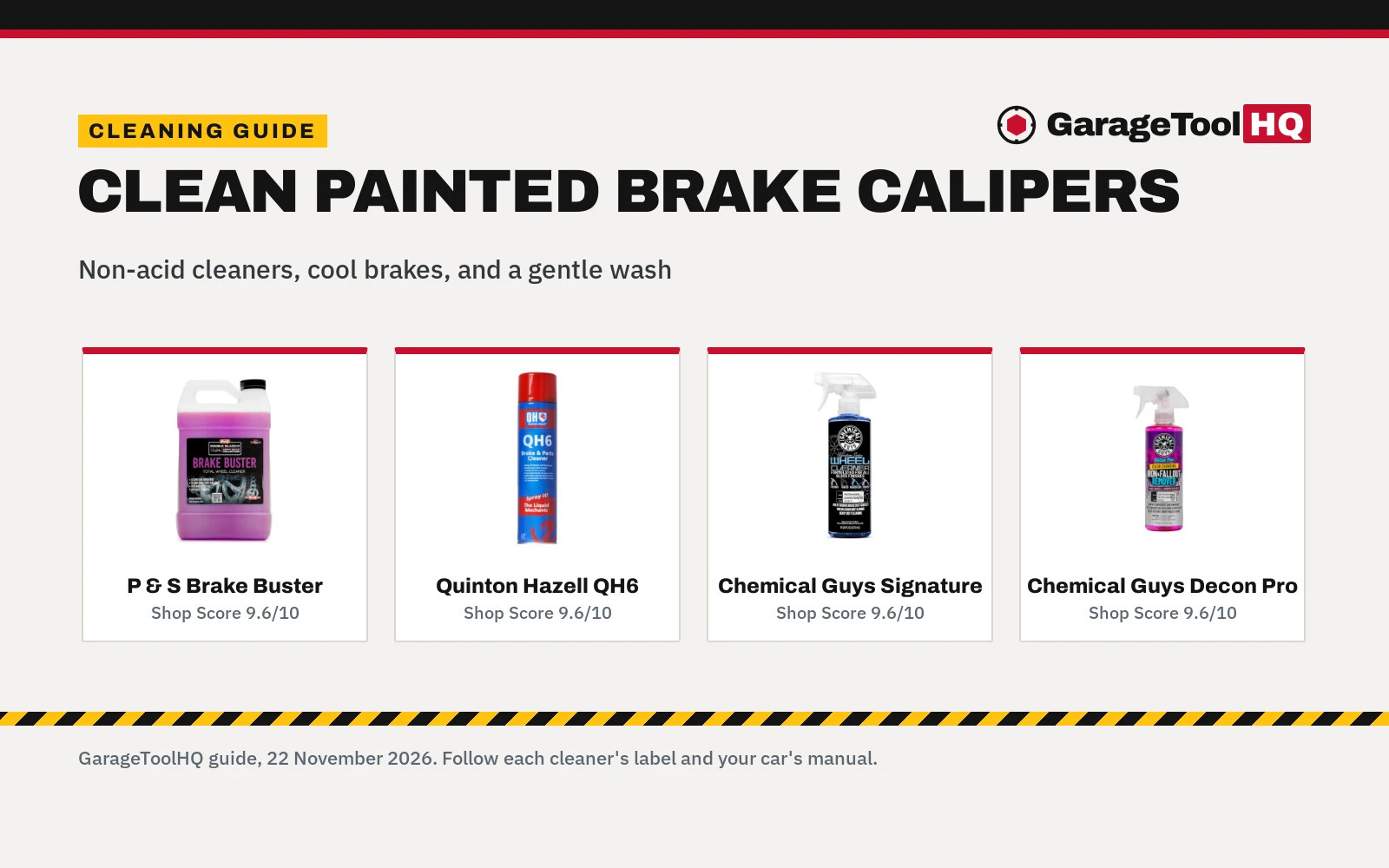
- Clean the brake caliper. Brake cleaner and a steel brush take off baked-on dust and loose grime. Keep going until the brush comes away clean. Paint over dust and the coating lifts with the dust.
- Cover all parts except the caliper. Mask the rotor, pads, hose, bleeder, and rubber parts. Paint belongs on the caliper body only.
- Prepare the paint as its maker directs, then apply the first coat in thin but even strokes. Thin coats level out and dry harder than a heavy coat. Keep paint off the piston area, bleeder screw, and pad contact points.
- Let the first coat dry, then apply a second coat where the paint calls for one. The SENVEN paint (on Amazon) states a dry time of 3-4 hours before the second coat.
- Let the paint dry fully before reassembling. The same maker states 24 hours of drying before reassembling wheels and operating the vehicle. Follow the dry time for the paint in your hand.
- Put the wheel back in place. Check that no paint reached the rotor face or pads, remove the masking, and refit the wheel.
Brush-on kits and spray paint: what changes
- Brush-on epoxy kits go on with a brush; the G2 and OMAC kits mix paint with a reactor or hardener. The G2 and OMAC makers state that the brush-on system dries harder and does not flake and chip the way spray-type paint can. A brush also keeps paint where you put it.
- Spray paint covers faster and reaches tight corners without brush marks. The Rust-Oleum spray (on Amazon) uses any angle spray technology with a comfort-tip nozzle. Spraying needs wider masking, since overspray travels.
- Heat resistance is stated for every paint here. The G2 and SENVEN paints state resistance up to 980 degrees. The OMAC system (on Amazon) and the Rust-Oleum spray state resistance up to 900 degrees. That stated heat figure is the spec to compare first.
- Protection beyond color: the G2, SENVEN, and OMAC makers state protection against brake fluids, road salt, dust, dirt, gravel, and discoloration for the coated surface.
Paints for cleaning and coating calipers
The cleaning and coating steps above need a paint rated for caliper heat, and the G2 and OMAC brush-on kits include the cleaner and brush for the prep work.
Where caliper paint jobs go wrong
- Painting over brake dust. The coating bonds to the dust instead of the metal and comes off with it.
- Skipping the masking. Paint on the rotor face, pads, or bleeder creates a braking problem. Cover all parts except the caliper before any paint opens.
- Laying on a heavy coat. Thick paint runs and dries soft underneath. Thin, even strokes give the harder finish, with a second coat where the paint calls for one.
- Rushing the wheels back on. A wheel fitted against soft paint marks the finish. The SENVEN paint states 24 hours before reassembling wheels.
- Using ordinary paint. Every paint here states a heat figure of 900 degrees or 980 degrees, which is the point of caliper paint over a general spray.
More shop equipment for brake work sits in our engine and shop equipment hub.
FAQ: garage tools
Do I need to remove the calipers to paint them?
The OMAC steps work with the caliper on the car: remove the wheels, clean the caliper, cover all parts except the caliper, and apply paint with the brush. Painting in place avoids opening the brake hydraulics.
How long does caliper paint need to dry?
The SENVEN paint states 3-4 hours before a second coat and 24 hours before reassembling wheels and operating the vehicle. Follow the dry time stated for your paint.
Is brush-on caliper paint better than spray?
The brush-on makers state that their epoxy dries harder and does not flake and chip compared with spray-type paint, and a brush keeps paint off nearby parts. Spray covers faster, with any angle spray technology on the Rust-Oleum can.
How many calipers does a kit cover?
The G2 kit covers 4 disc brake calipers or 2 drums. The OMAC kit paints 4 caliper brakes. The spray and touch up paints are sold as a 12 oz can or 12 fl. Oz. pack, with coverage not stated.
What heat can caliper paint handle?
The G2 and SENVEN paints state resistance up to 980 degrees. The OMAC system states up to 900 degrees, and the Rust-Oleum spray states up to 900-Degree F.
Related: our engine and shop equipment hub covers shop gear that supports brake work in a home garage.