How to Pull a Harmonic Balancer
Pull a pressed-on harmonic balancer with a 3-jaw puller or a yoke-and-bolt kit, using the forcing rods and bolts that fit the balancer in front of you.

On this page
The front of the engine is apart, the belts are off, and the harmonic balancer sits pressed onto the crankshaft with nowhere to go. That is the moment to learn how to pull a harmonic balancer: the balancer comes off with a puller that grips it and a forcing screw that pushes against the end of the crankshaft, easing the balancer off its press fit. A puller does the work, while prying risks the balancer, the crankshaft and the front seal.
As an Amazon Associate I earn from qualifying purchases. GarageToolHQ earns a commission when you buy through links on our product pages, at no extra cost to you. Read our affiliate disclosure.
Below: the steps, the puller styles, and the gear.

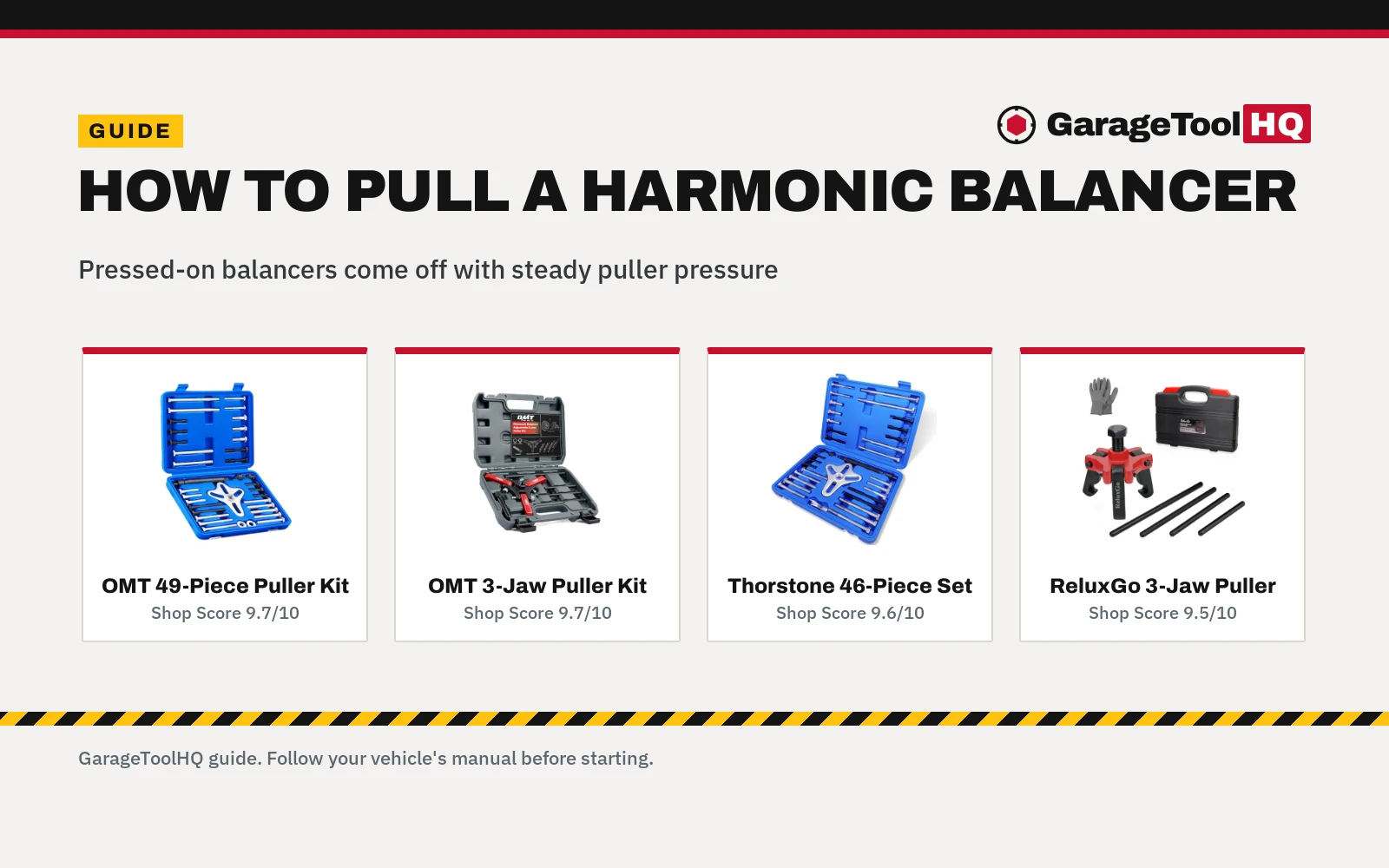
OMT Harmonic Balancer Puller
A 49-piece kit with a steel yoke, a pressure screw, 3 adaptors and 30 bolts in SAE and metric sizes for balancers, pulleys and steering wheels.
Pros
- 30 bolts in SAE and metric sizes, from 1/4"-28 to M10x1.5
- 4-slot yoke allows two or three-slot operation
- Stepped bolts for 1990 and newer GM 3300-3800 V6 pulleys
- Heat-treated, anodized adaptors; blackened metric bolts
Cons
- Title calls it a puller installer set; the bullets describe removal only
- Spec table lists NumberOfItems as 1, not a 49-piece set
- No forcing rods are listed
- No gloves are included

OMT Harmonic Balancer Puller Kit for Removing
A 3-jaw balancer puller kit with a push bolt for 19 mm hex drive and 3/8" square drive tools and 4 forcing rods, in AISI 1045 steel.
Pros
- 4 forcing rods in 4", 5.4", 6.2" and 7.5" lengths
- Push bolt fits 19 mm hex drive and 3/8" square drive tools
- No radiator disassembly needed for the removal
- Blow-molded case keeps the set organized
Cons
- Built for pressed-on balancers with a single center retainer bolt only
- No bolt-hole yoke for flange-type balancers
- Jaws need a sound balancer rim to grip
- No adaptors for other pulley types

Thorstone 46pcs Harmonic Balancer Puller Set
A 46-piece puller set with a steel yoke, a pressure screw, 30 bolts and a floating swivel for balancers, flywheels and steering wheels.
Pros
- 30 bolts in standard and metric threads
- Floating swivel prevents damage to shaft ends
- 4-yoke slot handles two or three hole applications
- Heavy duty blow molded carrying case included
Cons
- No warranty term is stated
- No weight or dimensions are stated
- No forcing rods are listed
- Steel grade is not stated

Harmonic Balancer Pulley Puller Set Adjustable
A 5-piece 3-jaw puller set with a forcing screw for 24 mm drive tools and 4 forcing rods, in heat-treated AISI 1045 steel.
Pros
- 4 forcing rods in 3-7/8", 5-1/5", 6-1/3" and 7-3/5" lengths
- Forcing screw fits 24 mm drive tools
- Works in tight engine compartments without removing the radiator
- Gloves and a storage case are included
Cons
- No warranty is offered
- Bullets call it a 5-piece set while the spec table lists NumberOfItems as 1
- No yoke or bolts for flange-type balancers
- No adaptors for steering wheels or gears
How to pull a harmonic balancer, step by step
Check the vehicle’s manual for the retainer bolt and the balancer type.
- Take out the center retainer bolt. The 3-jaw kits here are made for pressed-on balancers held by a single center retainer bolt, and the puller cannot seat until that bolt is out.
- Pick the forcing rods that suit the depth. The 3-jaw kits here carry 4 forcing rods each: the Orion Motor Tech kit lists 4″, 5.4″, 6.2″ and 7.5″ rods, and the ReluxGo kit lists 3-7/8″, 5-1/5″, 6-1/3″ and 7-3/5″ rods.
- Seat the puller on the balancer. With a 3-jaw puller, hook the jaws around the balancer rim for a firm grip. With a flange-type balancer that has bolt holes, thread the yoke bolts into the holes instead.
- Center the forcing screw on the crankshaft. The push bolt centers to drive the rods, and the Thorstone kit adds a floating swivel that prevents damage to shaft ends. The yoke, pressure screw and washers of the Orion Motor Tech 49-piece kit spread pressure evenly.
- Turn the screw and let the balancer ease off. The Orion Motor Tech 3-jaw kit takes a 19 mm hex drive or 3/8″ square drive tool on its push bolt, and the ReluxGo kit takes a 24 mm drive tool.
- Leave the radiator alone. The 3-jaw kits state there is no need to disassemble the radiator.
3-jaw pullers and yoke-and-bolt kits
Match the puller to the balancer in front of you: a 3-jaw puller needs a rim the jaws can grip, while a yoke kit needs bolt holes in the balancer face.
| Type | How it grips | When it fits |
|---|---|---|
| 3-jaw puller | Jaws hook the balancer rim; a forcing screw pushes the crankshaft end | Pressed-on balancers with a rim the jaws can grip |
| Yoke-and-bolt kit | Steel yoke with bolts threaded into the balancer; a pressure screw pushes the crankshaft end | Flange-type balancers with bolt holes, steering wheels and gears |
The 49-piece Orion Motor Tech kit and the 46-piece Thorstone kit are yoke-and-bolt kits with 30 bolts in standard and metric threads. The 3-jaw kits carry 4 forcing rods each and no yoke.
The gear for pulling a harmonic balancer
Every step above needs a puller that fits the balancer: the jaws or bolts grip it, the forcing screw centers on the crankshaft, and the rods reach the depth.
Use rated jack stands on solid ground, wear eye protection with power and air tools, keep fuel-burning equipment out of a closed garage, and follow the manual for every tool. Read our Safety Disclaimer.
FAQ: garage tools
Can I pull a harmonic balancer without a puller?
No. For a pressed-on balancer, only a puller grips it while pushing against the crankshaft end. Prying risks the balancer, the crankshaft and the front seal.
How do I know whether I need a 3-jaw puller or a yoke-and-bolt kit?
Look at the balancer face. A 3-jaw puller needs a rim the jaws can grip, which suits a pressed-on balancer. A yoke-and-bolt kit needs bolt holes in the balancer face.
Do I have to remove the radiator to pull a harmonic balancer?
Not with the 3-jaw kits in this guide. The 3-jaw kits state there is no need to disassemble the radiator.
Will these pullers fit my vehicle?
Check the listing against the vehicle. The Orion Motor Tech 3-jaw and ReluxGo listings cover Cadillacs since 1988, Chevrolet trucks since 2003, 1990 Chryslers, Fords since 1995, GM Generation II engines and the 1995 Mitsubishi Eclipse, and the 49-piece kit adds stepped bolts for 1990 and newer GM 3300-3800 V6 crankshaft pulleys.
Related: the best harmonic balancer puller for LS engine, bearing puller vs gear puller and how to use an air impact wrench.