How to Use a Dual Action Polisher: Technique and Setup Guide
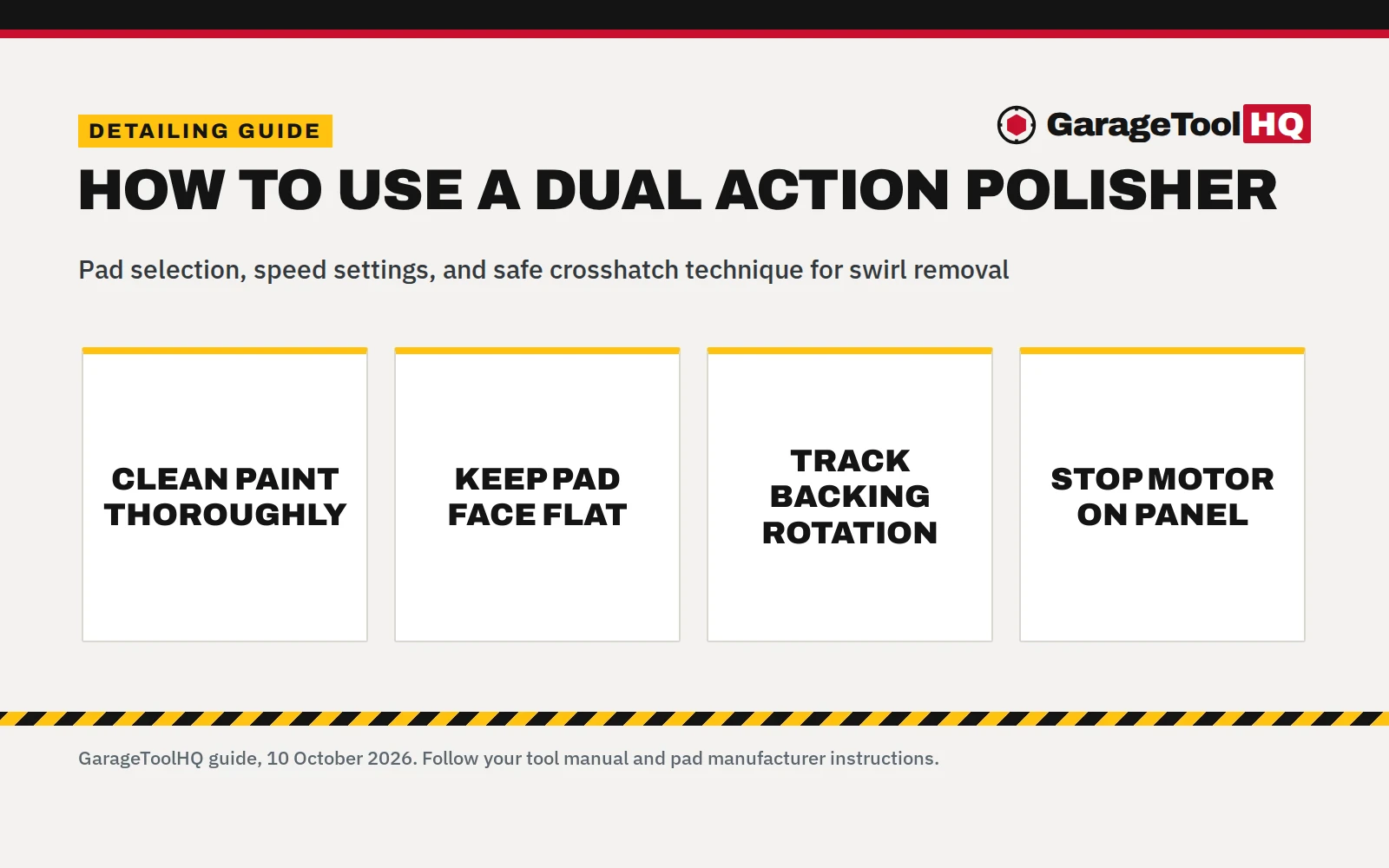
How to operate a dual action polisher safely on automotive clear coat: paint preparation, pad and compound selection, speed control and proper crosshatch technique.

On this page
Top picks at a glance
As an Amazon Associate we earn from qualifying purchases.
- 1
 Griot's Garage G9 Random Orbital Polisher9.6/10View on Amazon
- 2
 Cordless Car Buffer Polisher for Dewalt 20V Max9.6/10View on Amazon
- 3
 BATOCA 2026 New Dual Action Polisher9.5/10View on Amazon
- 4
 1200W 6" Rotary BufferView on Amazon
- 5
 SONAX EX 04-06 Dual Action Polishing CompoundView on Amazon
- 6
 Adam's Polishes Swirl Killer 15mm Car PolisherView on Amazon
- 7
 Makita PO5000C 5" Dual Action Random Orbit PolisherView on Amazon
- 8
 Adam's Polishes SK Pro 12mm Car PolisherView on Amazon
- 9
 Makita PO5000CX2 5" Dual Action Random Orbit PolisherView on Amazon
How to use a dual action polisher begins with clean paint, pad priming, and guiding the machine in overlapping crosshatch passes under light downward pressure. A dual action polisher pairs spindle rotation with eccentric orbital oscillation, dispersing friction to lower clear coat burn-through hazards compared with a rotary buffer. Work a modest section at a time, maintain steady pad rotation, and switch the motor off before lifting the tool away.
More options to compare
 1200W 6" Rotary BufferCheck price on Amazon
 SONAX EX 04-06 Dual Action Polishing CompoundCheck price on Amazon
 Adam's Polishes Swirl Killer 15mm Car PolisherCheck price on Amazon
 Makita PO5000C 5" Dual Action Random Orbit PolisherCheck price on Amazon
 Adam's Polishes SK Pro 12mm Car PolisherCheck price on Amazon
 Makita PO5000CX2 5" Dual Action Random Orbit PolisherCheck price on Amazon
GarageToolHQ earns a commission when you buy through links on our product pages, at no extra cost to you. Read our affiliate disclosure.
Below: how dual action orbital motion preserves paint, pad and speed selection across detailing stages, a step-by-step checklist for safe paint correction, and core da polisher technique.
How to use a dual action polisher: orbital motion and paint safety
Dual action polishers use an eccentric spindle that rotates and orbits simultaneously. This random orbital motion disperses friction across an irregular path rather than concentrating heat in one circle. Because rotation relies on momentum, excess pressure stalls pad spinning while oscillation continues, providing a built-in safety margin on clear coat.
Key mechanical factors include:
- Orbital throw: Published specifications include 9mm throws on the DEKOPRO, Chemical Guys TORQX, and GlimHirVox, and 15mm on the WORKPRO W125163AE and RUPES LHR 15ES (whose spec table also lists a 21 mm throw). A 9mm throw offers agile control on curves, while a 15mm throw clears broad panels faster.
- Backing plate and pad fitment: Plates and pads span 5″ or 6″, including the 125mm plate on the RUPES LHR 15ES, 5″ and 6″ discs on the AVID POWER AEP176, and 7 inch pads on the Milwaukee 2738-20. The AOBEN pairs a 6 inch plate with 6.5 inch foam pads to shield paint from the rigid backing edge.
- Motor power: Corded listings span 60 watts drawing 0.5 amp on the WEN 6010, 500 watts drawing 4.17 A on the RUPES LHR 15ES, 700 watts on the AOBEN, 800W on the Chemical Guys TORQX, 1080W drawing 9 Amp on the WORKPRO, and 1100 watts on the BATOCA B02PO24-US-KIT2. Cordless models include 18-Volt tools like the Milwaukee 2738-20 and 21V units like the GlimHirVox generating up to 900W.
- Pad rotation: Correction requires the pad to spin while oscillating. If heavy pressure halts spinning, the tool only vibrates in place without leveling defects.
Detailing stages, pad selection and speed settings
Pad density, liquid abrasives, and tool speed govern correction depth. Reference listings show 6 variable speeds on the AOBEN, BATOCA, WORKPRO, and DEKOPRO, or an 8-speed dial on the GlimHirVox, while waxers like the WEN 6010 run at a single 3500 rpm speed.
| Detailing Stage | Pad Material and Motion | Speed Dial and RPM Range |
|---|---|---|
| Compounding and defect removal | Wool pad or firm foam disc; orbital motion for defect reduction | High speed: 4500 rpm on the AOBEN to 5500 RPM on the BATOCA and DEKOPRO, or 6500 OPM on the AVID POWER |
| Polishing and paint refinement | Medium foam pad; orbital motion for gloss refinement | Medium speed: intermediate settings such as 2500 RPM on the BATOCA |
| Waxing, sealing and finishing | Soft foam pad or bonnet; low friction application | Low speed: 1000 rpm on the AOBEN, 1400 RPM on the WORKPRO, up to 1800 RPM on the DEKOPRO (or speed 1-3 on AOBEN; 3500 rpm on WEN 6010) |
As noted in the AOBEN instructions, low speed suits waxing, medium speed handles polishing, and high speed removes paint defects. If excessive pressure stops the unit in speed 1-3, the maker instructs restarting and selecting a higher speed.
How to use a dual action polisher: the step-by-step checklist
- Wash and decontaminate exterior paint. Wash thoroughly before polishing. Pre-washing with a foam lance, as covered in our guide on how to use foam cannon, softens dirt, while safe wash pressure from what PSI pressure washer is safe for cars protects clear coat. Follow with iron remover and clay to lift embedded particles.
- Mask trim and panel edges. Apply automotive masking tape over rubber seals, textured plastics, wiper cowls, badges, and sharp body lines where paint is thin and vulnerable to pad abrasion or compound staining.
- Attach and center the pad. Center your foam disc squarely on the hook-and-loop plate. Ensure the pad matches or overhangs the backing plate, such as pairing 6.5 inch foam pads with a 6 inch backing plate on the AOBEN AT3501.
- Prime the foam pad. Work a thin smear of compound into dry foam pores to create an even base, then add a few pea-sized drops of compound across the face.
- Perform a trial section. Polish a small area on a flat panel like the hood. Inspect the result, then adjust pad firmness or compound cut as needed.
- Dab product and spread at low speed. Rest the pad flat on the panel. Dab compound over the area with the tool off, then spread at low speed (such as 1000 rpm on the AOBEN or 1400 RPM on the WORKPRO) without sling.
- Work overlapping crosshatch passes. Set your working speed (such as 4500 rpm on the AOBEN or 5000 RPM on the WORKPRO). Guide the tool in overlapping horizontal paths, then switch to vertical paths across the same area.
- Maintain flat pad contact and track rotation. Tool weight, from 3.3lbs on cordless units like the GlimHirVox to 8 pounds on corded tools like the BATOCA, provides downward force. If a marker line on the plate stops spinning, ease pressure until rotation resumes.
- Turn the tool off on the panel. Switch off while the pad touches the paint. Once stopped, lift away, buff residue with a microfiber towel, and brush the pad face clean.
Hold the pad flat against the body panel before switching the motor on, and wait until it stops spinning before lifting it away. Starting or stopping in midair slings compound across the garage and stresses the backing plate.
Keep electric pressure washers on a GFCI outlet, never point the wand at people or pets, wear eye protection with polishers and chemicals, and read the label before mixing any cleaning products. Read our Safety Disclaimer.
Dual action polisher vs rotary buffer
Comparing orbital polishers and rotary buffers clarifies tool choice:
- Rotary buffers: A rotary buffer drives the pad on a fixed axis, with tools like the Milwaukee 2738-20 citing speeds of 2200 rpm. While rotary tools cut defects rapidly, direct circular motion concentrates heat and can burn clear coat edges or leave buffer trails (holograms).
- Dual action polishers: A dual action tool pairs rotation with eccentric oscillation (such as 9mm or 15mm throw). Because rotation relies on momentum, the pad slows under excess pressure or sharp contours, minimizing burn risk and leaving a swirl-free finish.
- Motor performance: Motors like the 1080W WORKPRO W125163AE and 1100W BATOCA B02PO24-US-KIT2 provide ample torque to clear swirls while maintaining orbital safety.
Compare beginner options in our guide to the best dual action polisher for beginners, or check ergonomics in how to choose a car polisher.
Power cords, battery weight and panel safety
When operating corded tools like the AOBEN (weighing 5.29lb) or the BATOCA (weighing 8 pounds), drape the power cord over your shoulder. Letting rubber cords drag across fenders can scratch newly polished paint.
Cordless polishers eliminate cord hazards entirely. Units like the GlimHirVox GHV-CCBP-001 with 21V 2.0Ah batteries weigh only 3.3lbs, reducing fatigue on vertical panels. To compare cordless models, see our roundup of the best cordless polisher buffer.
Frequently Asked Questions
Can a dual action polisher burn through clear coat?
The risk is low because the pad stalls when pressed hard or tilted against edges. However, lingering on sharp body creases or running an aggressive pad at high speed on thin plastic panels can still cause damage. Keep the pad flat and moving steadily.
How much downward pressure should I apply while polishing?
Apply light to moderate pressure. Tool weight, with listings citing 3.3lbs on cordless units like the GlimHirVox up to 8 pounds on corded tools like the BATOCA, provides most needed force. Add only enough guidance to compress the foam without stalling pad rotation.
What speed setting should I use on a dual action polisher?
Use low speed (such as 1000 rpm on the AOBEN, 1400 RPM on the WORKPRO, or speed 1-3) for spreading product and waxing. Use medium speed (around 2500 RPM on the BATOCA) for polishing gloss. Use high speed (4500 rpm on the AOBEN to 5500 RPM on the BATOCA and DEKOPRO, or 6500 OPM on the AVID POWER) for defect removal.
How do I know if the backing plate is still rotating?
Mark the backing plate edge with a permanent marker. While working, confirm the line is spinning. If it stops spinning and only vibrates, ease downward pressure until steady rotation resumes.
How often should I clean polishing pads?
Clean the pad after every section with a pad brush or compressed air to remove spent polish and clear coat residue. Switch to a fresh pad once foam becomes saturated or warm.
Should I choose a corded or cordless dual action polisher?
Corded tools provide continuous runtime, with motor power from 500 watts on the RUPES LHR 15ES to 1100 watts on the BATOCA. Cordless 21V models like the GlimHirVox at 3.3lbs eliminate cord drag across panels and simplify handling.
Related: best dual action polisher for beginners, our guide on how to choose a car polisher, the car detailing category hub, and our guide on how to use foam cannon. Also see our comparison on the best cordless polisher buffer.