How to Use Portable Car Battery Charger
Charge the pack, connect red to positive and black to a ground point, start the car, then disconnect and recharge the pack.

On this page
Top picks at a glance
As an Amazon Associate I earn from qualifying purchases.
- 1
 ANFLAG 8-in-1 Car Jump Starter with Air Compressor9.7/10View on Amazon
- 2
 Hulkman Alpha85 Smart Portable Jump Starter9.7/10View on Amazon
- 3
 HALO Bolt Air 58830 Portable Car Battery Jump9.6/10View on Amazon
- 4
 Clore Automotive Jump-N-Carry JNC660 1700 Peak Amp9.5/10View on Amazon
A dead battery turns a normal morning into a driveway job: the key turns, the starter clicks, and nothing else happens. A portable car battery charger gets the car going again without another car or a call for a tow. This guide explains how to use portable car battery charger from a charged pack to a running engine, step by step, and which of the picks below handles each part of the job.
GarageToolHQ earns a commission when you buy through links on our product pages, at no extra cost to you. Read our affiliate disclosure.
Below: the steps in order, what to check before you connect the clamps, and the gear that handles each part of the job.
ANFLAG 8-in-1 Car Jump Starter with Air Compressor
An 8-in-1 jump starter rated at 6000A peak with a 150 PSI inflator, 12V output, a 2.7-inch LCD and a 600-lumen light.
Pros
- 6000A peak current for all gas and up to 12.0L diesel engines
- 150 PSI inflator with 2.7-inch LCD, preset values and auto stopping
- 600-lumen light with flashlight, strobe and SOS modes for up to 80 hours
- Inflates a car tire from 28 to 36 PSI in 2 minutes, per the maker
Cons
- 150 PSI maximum suits car, motorcycle, bike and ball inflation only
- Detachable air hose and 3 nozzles are separate pieces to keep track of
- Stated range of -4°F to 140°F leaves colder or hotter days outside its rating
- Force Start covers dead or low-voltage batteries, not a damaged battery

Hulkman Alpha85 Smart Portable Jump Starter
A 2000A jump starter with 20000mAh capacity, 65W speed charging and a 2-year warranty, aimed at drivers who want a dead battery fixed now.
Pros
- 2000A peak current for up to 8.5L gas or 6.0L diesel engines
- Up to 60 jump starts per charge from the 20000mAh pack
- 65W speed charge: 0 to 80 percent in one hour
- 10-layer safety protection, IP65 shell and 2-year warranty
Cons
- 4.5 pounds is heavy for a glove box
- The listing says to recharge every 3 months
- It starts dead batteries; it does not maintain them in storage
- Power bank outputs share the 74Wh capacity
HALO Bolt Air 58830 Portable Car Battery Jump
A 12V jump starter rated at 500 amps with a 100 PSI air compressor, a 58.8Wh power bank and an LED floodlight.
Pros
- 500-amp jump starter for cars, SUVs and trucks
- 100 PSI compressor with 4 interchangeable nozzles and a digital screen
- 58.8Wh USB power bank for charging on the road
- TSA Approved, with an LED floodlight for night roadside work
Cons
- 500 amps is the lowest peak current of the picks here
- 100 PSI is the lowest maximum pressure here
- 90-day warranty is the shortest stated warranty term here
- 4 interchangeable nozzles are separate pieces to keep track of
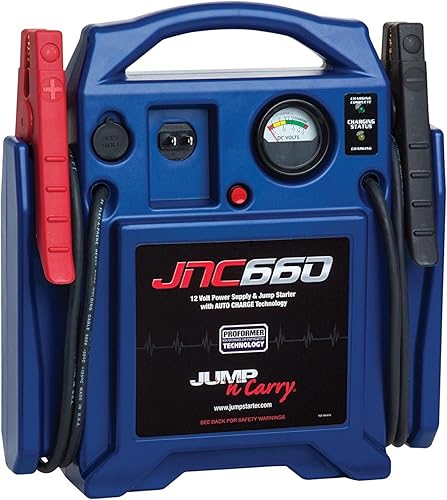
Clore Automotive Jump-N-Carry JNC660 1700 Peak Amp
A 22 Ah AGM lead-acid jump box with 46 in heavy-duty #2 AWG cables, a voltmeter and a 12V outlet, rated 1,700 peak amps.
Pros
- 22 Ah AGM battery built for jump starting
- 46 in #2 AWG cables, the heaviest here
- Built-in voltmeter shows charge
- 12V DC outlet for accessories
Cons
- 18 lb, does not fit a glovebox
- Rated engine size not stated
- No USB power bank
- 1 year warranty
How to use portable car battery charger: the steps
A portable car battery charger is a pack that holds a charge and delivers it through clamps, so the job is really about order: charge the pack, connect in the right order, start the car, disconnect in the right order, and recharge the pack. Follow the manual that comes with the pack for any step the maker states differently.
- Charge the pack first. Plug the pack into its wall adapter or charging cable and wait until its display shows a full charge. A pack that starts the job less than full may not finish it.
- Park on level ground and switch everything off. Set the parking brake, switch the ignition off, and switch off lights and accessories so the pack feeds the starter, not the lights.
- Find the battery terminals. The positive terminal wears a red cover or a plus sign, and the negative terminal wears a black cover or a minus sign. If the terminals are corroded, clean them before you connect.
- Connect red to positive first. Clip the red clamp onto the positive terminal and make sure it bites metal, not corrosion or a loose cover.
- Connect black to a ground point. Clip the black clamp onto a solid, unpainted metal part of the engine bay away from the battery, not onto the negative terminal. The ANFLAG and the HALO list reverse polarity protection, which guards against crossed clamps, but the ground-point habit still matters.
- Switch the pack on and start the car. Turn the pack on, wait for its display to show it is ready, then crank the engine. If the engine does not catch, switch the pack off, wait, and try again, following the manual.
- Disconnect black first, then red. Once the engine runs, switch the pack off, remove the black clamp, then remove the red clamp. Keep the clamps apart so they cannot touch each other.
- Recharge the pack right away. A jump drains the pack, so plug it in after the job and leave it until the display shows a full charge. A pack left empty is a pack that cannot help next time.
That order stays the same whatever the pack: red first on, black first off, and a full recharge at the end. The rest of the job is knowing what the pack in hand can and cannot do, which is where the gear below comes in.
Before you connect: what to check
What decides whether the job goes smoothly is the pack’s charge, the clamps, and the space around the battery.
- Charge level. The display on the pack shows its charge. If it shows less than full, top it up before the job rather than during it.
- Clamp condition. Check that the clamps open and close cleanly and that the cables are free of cuts and melted spots. A clamp that cannot grip the terminal will not pass a charge.
- Space around the battery. Keep the pack clear of belts, fans and hot parts, and keep open flame away from the battery. Flooded lead-acid batteries can release hydrogen while charging, and hydrogen ignites easily, so never smoke near a battery and never charge near an open flame.
- Engine size. Match the pack to the engine: the ANFLAG below is rated for all gas engines and up to 12.0L diesel, while the Hulkman is rated for up to 8.5L gas and 6.0L diesel. Check the rating for the engine in the driveway before buying.
The gear: portable car battery chargers for the driveway
The steps above need a charged pack with clamps that grip, a display that shows charge, and enough peak amps for the engine in the driveway. The picks below cover that job: each one jumps, the ANFLAG and HALO also inflate tires, and the ANFLAG, HALO and Hulkman light the work area.
Lead-acid batteries can release hydrogen while charging, so charge in a ventilated space away from sparks and flames, connect positive first and negative last, set the charger to the battery type (flooded, AGM, gel, lithium), and wear eye protection. Read our Safety Disclaimer.
If the choice is still between a charger and a set of cables, the comparison of car battery charger vs jumper cables lays out the difference, and the picks for the best battery charger for lead acid batteries cover mains chargers for a battery that needs a slow charge rather than a jump.
FAQ: garage tools
Can a portable car battery charger jump a dead battery?
Yes, that is the job these packs are built for. The ANFLAG has a Force Start function for completely dead or low-voltage batteries, and the HALO is rated to jump cars, SUVs and trucks. If the battery is damaged or swollen rather than flat, do not jump it; replace it instead.
How long does it take to charge a portable car battery charger?
No charge time is stated for these packs, so there is no figure to quote here. Charge the pack until its display shows full, and follow the manual for the pack in hand.
Can I use a portable car battery charger on a diesel?
It depends on the pack’s rating. The ANFLAG is rated for all gas engines and up to 12.0L diesel, and the Hulkman is rated for up to 8.5L gas and 6.0L diesel. Check the rating against the engine before buying, and check the manual before the first jump.
What does the air compressor on a jump starter do?
It inflates tires from the same pack. The HALO has a 100 PSI compressor with 4 interchangeable nozzles, and the ANFLAG has a 150 PSI compressor that the maker says inflates a car tire from 28 to 36 PSI in 2 minutes. Each shows pressure on a digital screen, so the tire can be filled to the pressure the car maker states.
Do I need to recharge the pack after every jump?
Yes. A jump drains the pack, and a pack left empty may not start the next car. Plug it into its wall adapter or charging cable after the job and leave it until the display shows a full charge.
Can I leave the clamps connected while the car runs?
No. Once the engine runs, switch the pack off and remove the black clamp first, then the red clamp. Leaving the pack connected risks damage to the pack and the car, and the clamps can slip and short if they touch.
Related: car battery charger for trucks, car battery charger for winter, how much a battery charger costs and battery terminal connectors.