Indoor vs Outdoor Extension Cord: Which One Should You Buy?
When an indoor cord is the right call and when only an outdoor cord will do: jacket, gauge, length and the gear for each side.

On this page
Indoor vs outdoor extension cord comes down to the jacket and where the cord will live. An indoor cord is built for dry rooms, with a light jacket for a lamp, a charger, or a small tool. An outdoor cord carries a tougher jacket built for sun, rain, and rough ground, and it is the only one of the two that belongs outside. Use the indoor cord inside only; an outdoor cord works indoors too, but never take an indoor cord outside.
As an Amazon Associate I earn from qualifying purchases. GarageToolHQ earns a commission when you buy through links on our product pages, at no extra cost to you. Read our affiliate disclosure.
Below: what sets an indoor cord apart from an outdoor cord, how to read the jacket and the gauge, and the gear for each side.
Indoor vs outdoor extension cord: where the difference comes from
The jacket is the difference. An indoor cord wears a light, flexible jacket that stays soft in a warm room and bends easily around furniture. An outdoor cord wears a thick, tough jacket that stands up to sun, rain, cold, and being dragged across concrete. The jacket is what the label means when it says indoor or outdoor, and an indoor cord used outside wears out early.
The wire inside matters too, and the gauge tells the story. Both cords here use 16 AWG wire, which the listings rate at 13 amps and 125V. A lower gauge number means thicker wire and more current, so a heavy tool on a long run needs a lower gauge than a lamp on a short run. Check the tool’s manual for the gauge it calls for, and match the cord to the load, not to the outlet.
Length is the other leg of the choice. Both cords here are 6 ft, which suits a short hop from an outlet to a bench or a bedside table. A longer run needs a longer cord, and a longer cord needs a thicker gauge to carry the same load without dropping voltage. Never join two cords to make a longer one: each joint is a weak point, and a joined cord is a cord the maker never rated.
Two kinds of cord, and which one belongs where
| Type | Jacket and build | Belongs where |
|---|---|---|
| Indoor cord | Light jacket, built for dry rooms | Inside, for lamps, chargers, small tools and media gear |
| Outdoor cord | Heavy jacket, built for sun, rain and rough ground | Outside, for yard tools and jobs that run in wet weather |
The label and the manual decide which group a cord is in, not the color or the plug shape. If the label says indoor use only, it does not go outside, however short the job.
How to pick the right cord: the checklist
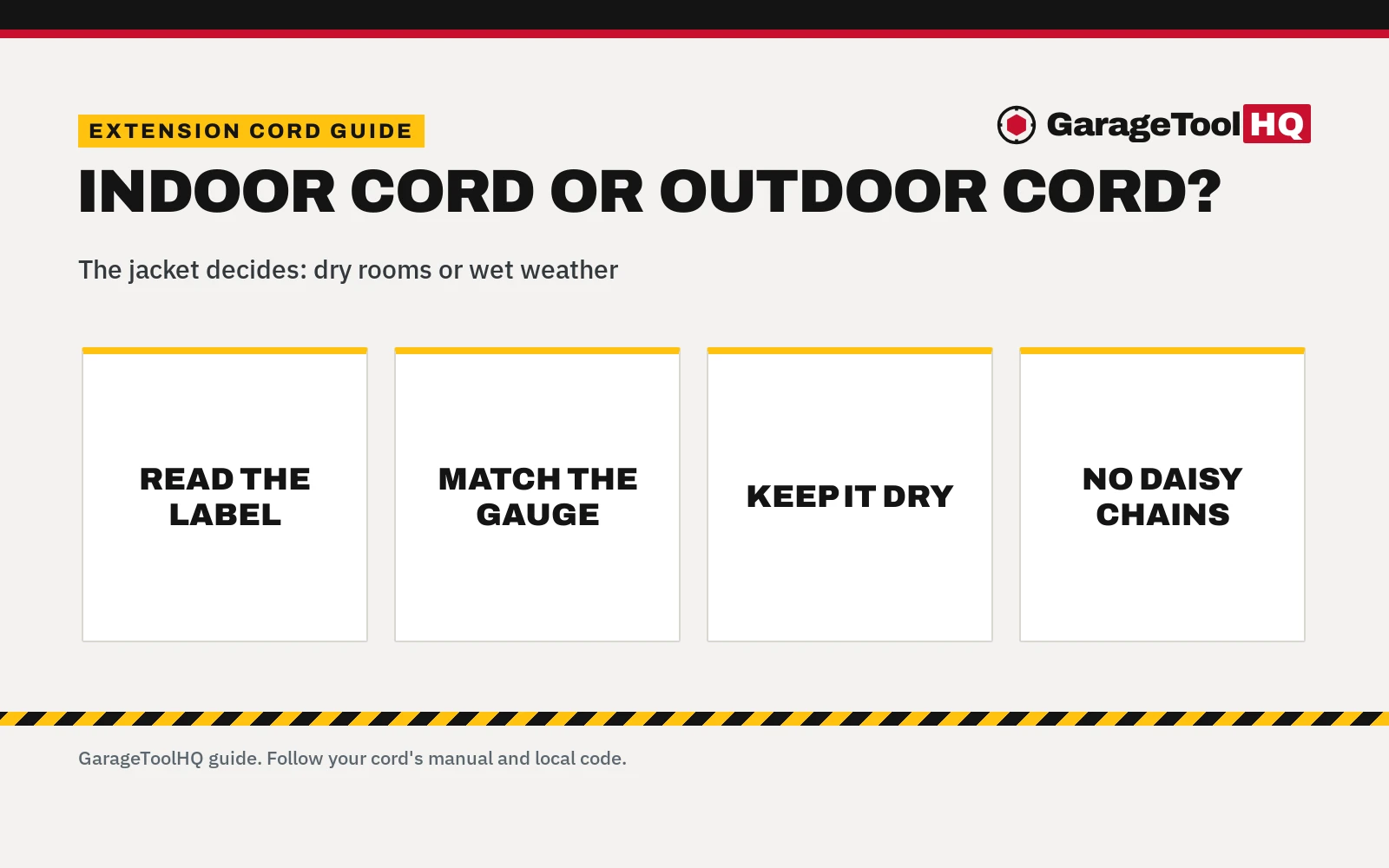
- Read the label for indoor or outdoor use. The label on the jacket is the maker’s word, and it beats any guess about the weather.
- Match the gauge to the load. Both cords here use 16 AWG wire and carry 13 amps at 125V. A heavier load or a longer run needs a thicker gauge, so check the tool’s manual before you buy.
- Measure the run. Both cords here are 6 ft. Buy a cord that just reaches, and never join two cords to make a longer one.
- Keep connections dry. An indoor cord is not rated for outdoor use, so keep its plugs out of rain and puddles, and keep the joint where the cord meets the tool dry too.
- Check the plug. The TROND flat plug sits 0.33 inches off the wall and fits tight spaces behind furniture, while a standard plug would push furniture out from the wall.
- Do not exceed the power limit. The TROND states a max of 1625W, and the Amazon Basics states 13 amps at 125V. Check the tool’s draw against the cord’s limit before you plug in.
- Store cords coiled and out of the way. Keep them away from heat, sharp edges, and anything that can crush the jacket, and coil them loosely so the wire inside does not kink.
- Use a licensed electrician for fixed power. If a tool needs power in the same spot every day, ask a licensed electrician to add an outlet instead of living on a cord.
An extension cord is a temporary link, not a permanent wire. Never run one through a wall or as a substitute for a fixed outlet. If a tool needs power in the same spot every day, ask a licensed electrician to add an outlet.
Use rated jack stands on solid ground, wear eye protection with power and air tools, keep fuel-burning equipment out of a closed garage, and follow the manual for every tool. Read our Safety Disclaimer.
Length, gauge and power
Both cords here are 6 ft long with 16 AWG wire, and both carry 13 amps at 125V. The TROND states a max of 1625W at 125V and 13A, while the Amazon Basics states 13 amps at 125V and no watt figure. The two cords match on length, gauge, and amps, so the choice between them comes down to the outlets and the plug, not the power.
For a longer run, the gauge matters more than the brand. A long, thin cord drops voltage over the run, and a tool at the far end runs hot and weak. Buy a cord that just reaches the job, and step up to a thicker gauge when the run gets long or the load gets heavy. Our light-duty vs heavy-duty outdoor extension cord comparison covers heavier outdoor cords.
The gear for each side
Both cords here are indoor cords, so they show the indoor side of the choice. The TROND ranks first on its outlets, its ETL listing, and its 18-month warranty; the Amazon Basics is the plain cord that does the job with one outlet and no extras.
| Product | Amps | Length | Outlets |
|---|---|---|---|
| TROND 6ft Flat Plug | 13 A | 6 ft | 3 grounded outlets |
| Amazon Basics 6ft Cord | 13 A | 6 ft | 1 outlet |
The TROND is the more versatile cord here. It packs 3 grounded outlets into a cube with a flat plug that sits 0.33 inches off the wall, carries 13 amps at 125V to a max of 1625W on 16 AWG wire, and states an ETL listing with UL94 V-0 flame-retardant materials and an 18-month warranty. It fits tight spaces behind furniture, where a standard plug would push the furniture out from the wall. It suits a home office or a bench where more than one tool shares an outlet.
The Amazon Basics cord is the plain one: one 3-prong outlet on a 6 ft, 16 AWG cord rated 13 amps at 125V, weighing 0.55 pounds by the bullets. The listing states no warranty and no safety listing. Note the weight: the bullets say 0.55 pounds while the spec table says 0.545625 pounds; we trust the bullets. It suits a lamp, a charger, or a small tool that needs a short hop to an outlet.
For heavier outdoor cords, see our best heavy-duty extension cord picks.
FAQ: garage tools
Can I use an indoor extension cord outside?
No. An indoor cord is not rated for outdoor use, so rain and sun wear the jacket down. Use an outdoor cord outside, and keep indoor cords inside.
What gauge extension cord do I need?
Match the gauge to the load. Both cords here use 16 AWG wire and carry 13 amps at 125V. A heavier load or a longer run needs a thicker gauge; check the tool’s manual for the gauge it calls for.
How long can an extension cord be?
Both cords here are 6 ft. A longer cord drops more voltage over the run, so buy a cord that just reaches and never join two cords to make a longer one.
Can I use an extension cord for a power tool in the garage?
Yes, if the cord is rated for the tool’s load. The Amazon Basics cord lists power tools among its uses, and both cords here carry 13 amps at 125V. Check the tool’s amp draw against the cord’s limit before you plug in.
Is the TROND cord right for a microwave?
The listing names microwaves among its household uses, and it states a max of 1625W. Check the microwave’s draw against that max before you plug it in.
Do I need an outdoor cord for a garage?
An indoor cord fits garage jobs as long as the cord stays dry and out of the weather. Run an outdoor cord if the run leaves the garage or crosses wet ground.
Related: can you run an air compressor on an extension cord, the best extension cord for a garage heater, our garage upgrades hub and our shop power guides.