Can You Run an Air Compressor on an Extension Cord?
When you can run an air compressor on an extension cord and when you should not: wire gauge ratings, voltage drop risks, and why extending the air hose is often the safer choice.

On this page
Top picks at a glance
As an Amazon Associate we earn from qualifying purchases.
- 1
 AstroAI AIRUN H Tire Inflator Portable Air Compressor9.6/10View on Amazon
- 2
 Ironton Oil-Free Pancake Air Compressor9.4/10View on Amazon
- 3
 AstroAI AIRUN H Tire Inflator Portable Air Compressor9.3/10View on Amazon
- 4
 Metabo HPT Portable Pancake Air CompressorView on Amazon
- 5
 Makita MAC2400 2.5 HP* Big Bore™ Air CompressorView on Amazon
- 6
 DEWALT Air Compressor for TrimView on Amazon
- 7
 VEVOR 5HP Air Compressor Electric MotorView on Amazon
- 8
 Klutch 20-Gallon Air CompressorView on Amazon
- 9
 Stark USA 3.5HP 10 Gallons Air Compressor Tank Ultra QuietView on Amazon
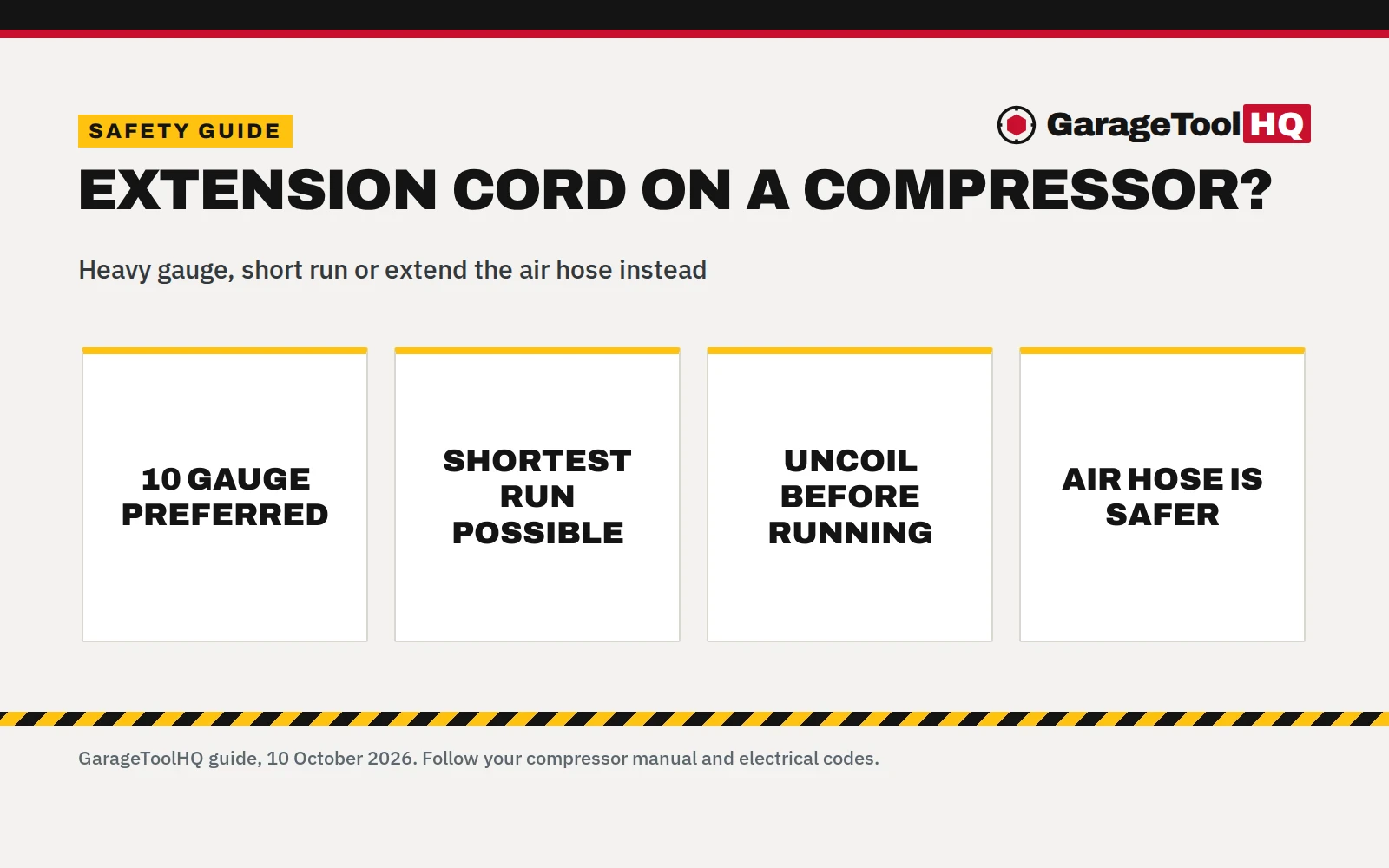
Can you run an air compressor on an extension cord? Yes, but only if you use a heavy-duty, properly sized cord, though manufacturers generally recommend plugging directly into a wall outlet or extending the air hose instead. Standard light-duty household cords drop voltage under motor startup load, which can overheat the compressor motor and trip breakers. When you must use an extension cord, you need a heavy cord of sufficient wire gauge rated for the electrical load and distance.
More options to compare
 Metabo HPT Portable Pancake Air CompressorCheck price on Amazon
 Makita MAC2400 2.5 HP* Big Bore™ Air CompressorCheck price on Amazon
 DEWALT Air Compressor for TrimCheck price on Amazon
 VEVOR 5HP Air Compressor Electric MotorCheck price on Amazon
 Klutch 20-Gallon Air CompressorCheck price on Amazon
 Stark USA 3.5HP 10 Gallons Air Compressor Tank Ultra QuietCheck price on Amazon
GarageToolHQ earns a commission when you buy through links on our product pages, at no extra cost to you. Read our affiliate disclosure.
Below: what makes an extension cord risky for a compressor motor, how wire gauge and cord length interact, and a checklist to run before you plug in.
Can you run an air compressor on an extension cord? Where the risk comes from
Electric air compressors present a different electrical load than simple resistive tools such as incandescent shop lights or space heaters. Starting an electric motor against tank head pressure demands a large surge of current. An extension cord adds electrical resistance along the circuit. In a home workshop or garage, that combination introduces several distinct hazards:
- Voltage drop. Long or undersized conductors add electrical resistance between the wall receptacle and the compressor. When the motor starts against air pressure, current rushes through that resistance and causes voltage to drop at the motor terminals. Starving the motor of voltage prevents it from reaching operational speed quickly.
- Motor overheating. When voltage falls, an induction motor draws higher current to overcome mechanical resistance. That extra current generates excessive heat inside the motor windings. Prolonged operation on low voltage breaks down winding insulation and burns out the motor.
- Nuisance breaker trips. The startup current spike on a low-voltage line often exceeds circuit limits, causing the circuit breaker or the thermal overload reset button on the compressor motor to trip. We explain these electrical symptoms in our guide on why does my air compressor keep tripping the breaker.
- Cord heat and fire hazard. Forcing continuous electrical current through undersized copper wire generates heat along the entire cable length. If a cord is coiled, tightly wrapped, or covered, that heat cannot dissipate, creating a fire hazard on the garage floor.
Compressor extension cord gauge and cord length: which cords belong in a shop
| Wire gauge | Stated length and rating | Suitable for compressor? |
|---|---|---|
| 10 Gauge (extra heavy duty) | 25 Ft (IRON FORGE CABLE) to 100 Ft (GEARit), rated 15 Amps and 125V (1875 watts) | Recommended choice when an extension cord must be used; thicker copper conductors minimize voltage drop over distance |
| 12 Gauge (heavy duty) | 25 ft (Power By GoGreen), rated 15 amps and 125 volts (1875 watts) | Acceptable for short distances with smaller compressors; check your compressor manual for minimum conductor requirements |
| 14 Gauge (light to medium duty) | 6 FT (POWTECH, BN-LINK) to 25 ft (ELECTERY), rated 15 Amps and 125V (1875 Watts) | Avoid for air compressors; thin conductors create significant voltage drop under heavy motor starting loads |
The manufacturer manual and cord rating decide whether a cord can power your equipment, not convenience. In wire sizing, smaller American Wire Gauge numbers represent thicker copper conductors. Thicker wire carries high current with lower electrical resistance, which protects your compressor motor from dangerous voltage drops.
How to run an air compressor safely: the checklist
- Check the compressor manual first. Many compressor makers state explicitly whether an extension cord is permitted and specify minimum wire gauge and maximum length. If the manual prohibits extension cords, following that instruction preserves your equipment and warranty.
- Pick the heaviest practical wire gauge. If you must run a cord, choose a heavy 10 Gauge or 12 Gauge cord rather than a thin household wire. Cords such as the GEARit 10 Gauge or IRON FORGE CABLE 10 Gauge provide thick conductors that keep voltage stable under load.
- Keep the cord run as short as possible. Electrical resistance increases directly with distance. A shorter run, such as 25 Ft, creates far less voltage drop than a long run. Never daisy-chain multiple extension cords together, as each plug connection adds resistance and creates points of failure.
- Uncoil the cord completely before starting. Leaving an extension cord coiled on a reel or bundled on the garage floor traps heat generated by electrical current. Always lay the cable out flat along the floor so ambient air can keep the jacket cool.
- Verify a grounded 3-prong connection. Power cords for workshop equipment require an equipment ground. Ensure the cord features a grounded 3 prong plug connected to a properly grounded wall outlet. Do not use cheater adapters.
- Inspect the jacket and connectors. Check the cord jacket for cuts, cracks, or exposed wire, and ensure the plug blades are clean and straight. Cords with an SJTW jacket, such as those from IRON FORGE CABLE or GEARit, provide water and abrasion resistance suited for shop floors.
- Plug directly into a dedicated circuit. Plug the cord into a dedicated wall outlet rather than sharing a circuit with heavy tools, shop heaters, or bench equipment. Sharing an active circuit increases the chance of tripping the breaker when the compressor motor cycles on.
- Monitor motor startup and cord temperature. When starting the compressor, listen to the motor. If it hums, hesitates, struggles to turn over, or trips the reset switch, shut it off immediately. Feel the cord jacket after running; if the cable or plugs feel hot to the touch, disconnect power right away.
- Consult a licensed electrician for garage wiring. If your garage outlets cannot supply stable voltage to your compressor, do not attempt dangerous electrical work yourself. Have a licensed electrician inspect your shop wiring, assess branch circuit capacity, or install a dedicated outlet close to your work area.
Compressor manufacturers almost universally recommend extending your air hose instead of extending the power cord. Air hoses experience pressure drop over distance rather than electrical voltage drop. Pressure drop merely slows pneumatic tool performance, whereas electrical voltage drop overheats and destroys electric motors. Running a longer air hose or lead-in hose keeps your compressor plugged directly into the wall outlet safely.
Drain the tank after use so water does not rust it from the inside, never exceed the tool's rated pressure, wear eye protection, and run 240V units on the circuit the manual calls for. Do not run a gas engine compressor in a closed garage. Read our Safety Disclaimer.
Extension cords vs longer air hoses
If you need reach across the garage or driveway, you have two practical choices: run an extension cord to the compressor, or plug the compressor directly into the wall outlet and run a longer air hose. Compare these factors before deciding:
- Motor protection: An air hose carries compressed air, so length has zero effect on electrical supply or motor health. An extension cord carries electricity where voltage drop directly threatens motor windings and switches.
- Performance impact: A long air hose causes friction loss, resulting in slight pressure drop at the tool during continuous airflow. A long power cord starves the motor of electrical power during startup, risking motor stall and tripped breakers.
- Durability and safety: Hybrid rubber and PVC air hoses, such as the Hromee hybrid lead-in air hose rated for 300PSI working pressure (900PSI burst pressure), resist garage oil and abrasion. Electrical cords on shop floors can suffer insulation damage, posing shock hazards.
- Handling and storage: Heavy 10 Gauge extension cords with thick copper wire are heavy and stiff. A flexible air hose or recoil hose reel is lighter, easier to store, and safer to drag around vehicles.
If you are setting up your workspace, read our guide on how to choose an air compressor to match tank size and air delivery to your tools. When selecting a primary shop machine, compare top models in our review of the best air compressor for home garage. For permanent garage setups, learning how to plumb compressed air lines in a garage eliminates extension cords and loose hoses completely.
Cold starts and compressor maintenance increase electrical load
Cold garage temperatures thicken compressor pump oil and increase mechanical resistance during startup. When combined with the electrical resistance of an extension cord, a cold compressor pump struggles to rotate, drawing sustained startup current that trips thermal overloads. Routine care, such as checking unloader valves and seasonal oil changes outlined in our guide to air compressor maintenance, keeps mechanical resistance low. Regularly learning how to drain water from an air compressor tank also preserves usable tank volume and prevents internal corrosion. If your machine fails to pressurize after starting, consult our troubleshooting guide on why is my air compressor not building pressure.
Frequently Asked Questions
Can I use a regular household extension cord for an air compressor?
No. Standard household extension cords typically feature thin wire, such as 14 Gauge or lighter, which cannot support the high surge current required when an electric compressor motor starts. Using a lightweight cord creates severe voltage drop, causing the motor to overheat and potentially tripping your circuit breaker.
What gauge extension cord do I need for an air compressor?
If an extension cord must be used, choose a heavy-duty cord with 10 Gauge or 12 Gauge copper conductors. Heavy 10 Gauge cords, such as 25 Ft or 100 Ft cords from IRON FORGE CABLE or GEARit rated for 15 Amps and 125V (1875 watts), provide the low electrical resistance necessary to minimize voltage drop under motor load.
Why does my air compressor trip the breaker on an extension cord?
An extension cord adds electrical resistance between the wall receptacle and the compressor. When the motor attempts to start against tank pressure, that resistance causes a voltage drop. Starved of proper voltage, the motor draws excess amperage to start, which exceeds the breaker threshold and trips the circuit.
Is it better to use a longer air hose or an extension cord?
A longer air hose is almost always the better and safer choice. Extending the air hose creates minor air pressure drop at your tool, which merely reduces air tool speed slightly. Extending the electrical cord creates voltage drop, which can permanently damage the electric motor windings.
Can I plug an air compressor into a surge protector or power strip?
No. You should never plug an air compressor into a power strip, surge protector, or multi-outlet tap. These devices are rated for light electronics and household appliances, not the heavy inductive startup surge of a compressor motor. Always plug directly into a dedicated wall receptacle.
Will running an air compressor on an extension cord void the warranty?
In many cases, yes. Several compressor manufacturers state in their operating manuals that damage caused by operating the unit on an undersized extension cord voids the manufacturer warranty. Always check the manufacturer manual before connecting any cord.
Related: the air compressors hub, our guide on what size air compressor do I need for air tools, troubleshooting why an air compressor is not building pressure, and step-by-step air compressor maintenance.