Multimeter vs OBD2 Scanner: Which One Should You Buy?
A multimeter measures volts, amps, ohms and continuity at its probes; an OBD2 scanner reads fault codes from your car's computer, and this guide ranks four listed meters.

On this page
Top picks at a glance
As an Amazon Associate we earn from qualifying purchases.
- 1
 KAIWEETS Digital Multimeter 20000 Counts Auto-Range Voltmeter9.8/10View on Amazon
- 2
 XTOOL IP500 for BMW OBD2 Scanner9.8/10View on Amazon
- 3
 KINGBOLEN Ediag Elite OBD2 Scanner Bluetooth9.7/10View on Amazon
- 4
 TM-510 Digital MultimeterView on Amazon
- 5
 AstroAI Digital Clamp Meter Multimeter 2000 Counts AmpView on Amazon
- 6
 Fieldpiece Compact HVACR Clamp Multimeter SC260View on Amazon
- 7
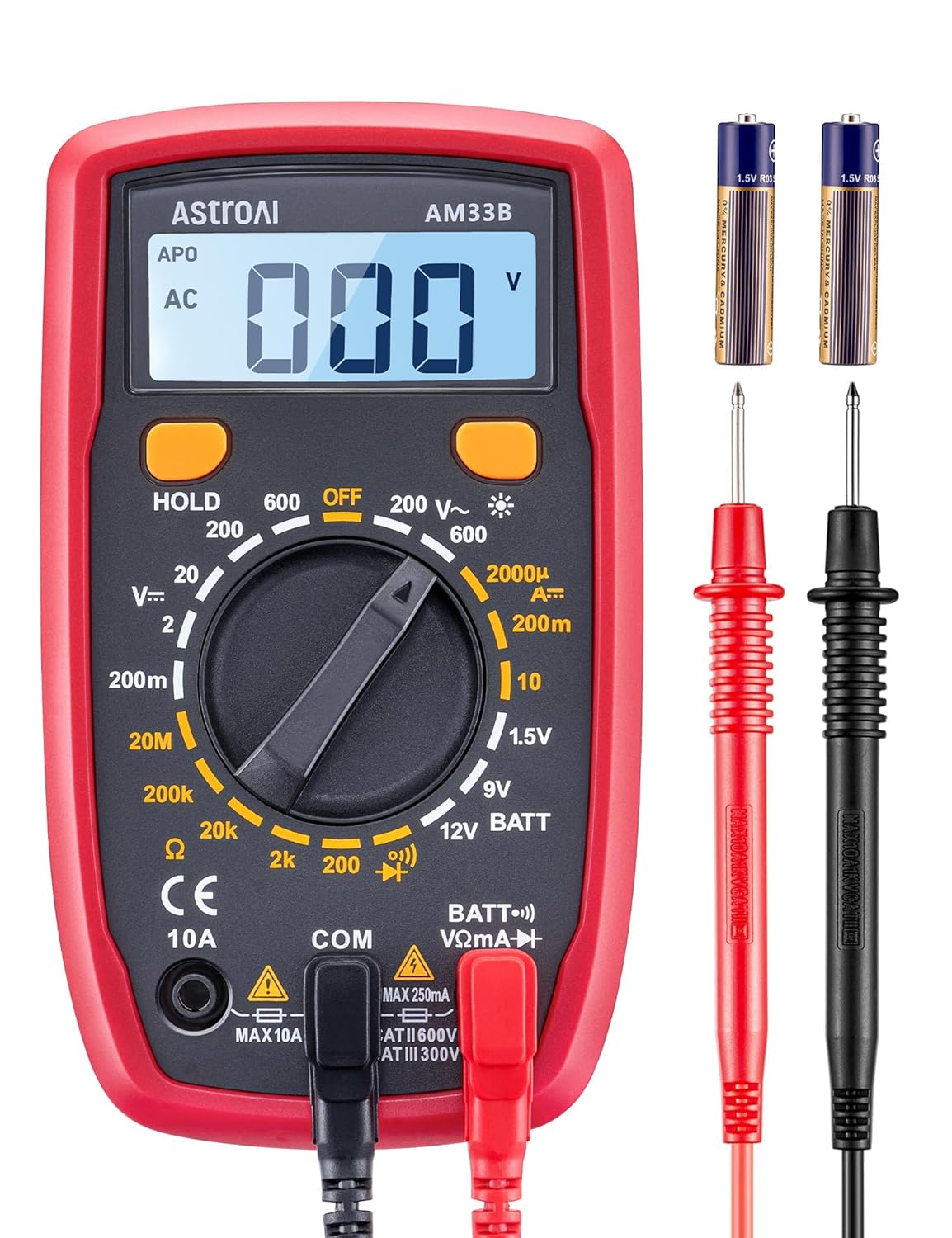 AstroAI Digital Multimeter Tester 2000 Counts with DC ACView on Amazon
- 8
 KAIWEETS Smart Multimeter Rechargeable Electrical Tester withView on Amazon
- 9
 Fluke 17B+ Digital MultimeterView on Amazon
The battery is dead again, and the toolbox offers two very different answers. A multimeter vs obd2 scanner is really a question about which kind of answer you need: a multimeter measures what is happening in a circuit right now, volts, amps, ohms and continuity at the probes, while an OBD2 scanner asks the car’s computer what it has recorded, fault codes and sensor data. The four products in this guide all sit on one side of that divide: every listing here is a multimeter or a meter kit, so the scanner half is answered in general terms and the gear section ranks the four listed meters.
More options to compare
 TM-510 Digital MultimeterCheck price on Amazon
 AstroAI Digital Clamp Meter Multimeter 2000 Counts AmpCheck price on Amazon
 Fieldpiece Compact HVACR Clamp Multimeter SC260Check price on Amazon
 AstroAI Digital Multimeter Tester 2000 Counts with DC ACCheck price on Amazon
 KAIWEETS Smart Multimeter Rechargeable Electrical Tester withCheck price on Amazon
 Fluke 17B+ Digital MultimeterCheck price on Amazon
GarageToolHQ earns a commission when you buy through links on our product pages, at no extra cost to you. Read our affiliate disclosure.
Below: what each tool actually does, the four listed meters ranked, and how to pick by the job.
Multimeter vs OBD2 scanner: the quick answer
Buy the answer you need. “Is this wire live, is this fuse blown, is the battery holding voltage” is meter work: probes on the circuit, a reading on the screen. “Why is the check-engine light on” is scanner work: plug into the diagnostic port and read what the computer stored. A meter cannot read fault codes, and a scanner cannot probe voltage at the plug itself. Most home garages end up with both, because the scanner points at the system and the meter proves the circuit.
One honest note: none of the four listings here is a scanner. The comparison below covers both sides in general terms; the ranked gear section covers the meter side.
What a multimeter does
A multimeter is a direct-measurement tool: probes on two points, a reading of the electrical reality between them. Voltage across a battery, resistance through a sensor, continuity through a fuse, current through a circuit. The listings show the usual spread. The KAIWEETS KM100 measures AC/DC voltage, DC current (not AC current), resistance, continuity and diodes. The TESMEN TM-510 covers AC/DC voltage, resistance and continuity with a smart auto mode that selects the range. The AstroAI CM2K0R adds AC current through its clamp jaw, plus capacitance and live-wire detection. The Klein kit’s meter reads up to 600V AC/DC voltage, 10A DC current and 2 MOhms resistance.
Two details matter more than the feature lists. Current measurement is not universal: the KAIWEETS does DC but not AC, the TESMEN listing states no current measurement at all, and the AstroAI clamp does AC but not DC. And the clamp jaw measures current only; the AstroAI listing warns against measuring voltage by clamping a conductor. On safety, the KAIWEETS claims IEC CAT III 600V with CE and RoHS marks, the TESMEN claims CAT II 600V, and the AstroAI listing says it passed pollution degree 2 and overvoltage category III 600V standards. Higher CAT numbers cover circuits closer to the building’s supply, where transient energy is greater, so match the meter to the job and read the manual before measuring anything beyond a car battery.
What an OBD2 scanner does
An OBD2 scanner does not measure the circuit; it interviews the car. It plugs into the diagnostic port and reads what the onboard computer stored: fault codes, and on more capable units, live sensor data. A meter tells you what is true at the probes right now; a scanner tells you what the computer noticed and when. That makes it the faster first move for a check-engine light or an emissions failure, and the wrong tool for a dead battery with no codes stored, where only a meter reading at the terminals settles the question.
No scanner appears in these listings, so there are no scanner figures to compare. For the scanner side in depth, see our OBD2 scanner types guide and bluetooth vs standalone OBD2 scanner.
The gear: four listed multimeters, ranked
All four listings are meters, ranked by what each one states it can do.
1. Klein 3-piece electrical kit
The fullest box here. Per the title and bullets: a manual-ranging digital multimeter (up to 600V AC/DC, 10A DC, 2 MOhms, with visual and audible continuity indicators), a non-contact voltage detector (50 to 1000 VAC, bright LED and tone), and an outlet wiring checker that detects wiring configurations and common faults. Leads and batteries are included; the spec table lists a UL mark. Read carefully, though: the spec table names a different model, an 80016 2-piece circuit breaker finder, against the title’s 69149P 3-piece kit. The title and bullets agree, so trust those and treat the table’s model number as a listing error. The warranty line only points to an attached warranty document, with no term stated.
2. KAIWEETS KM100 multimeter
The strongest standalone meter on stated safety: IEC CAT III 600V with CE and RoHS marks, double fuses, anti-burn protection and overload protection on all ranges. It measures AC/DC voltage, DC current, resistance, continuity and diodes, with data hold and a backlit LCD. The box includes two AAA batteries (pre-installed), a carrying case and two 48-inch copper-and-PVC leads; the meter is listed at 5.04 x 2.64 x 1.42 inches and 8.05 ounces. Two caveats: no AC current measurement, and the “lifetime after sale service” is service and support, not a warranty term with a stated length.
3. TESMEN TM-510 multimeter
The easiest to pick up. Smart auto mode switches between AC/DC voltage, resistance and continuity without selecting a range, and the non-contact voltage function alarms without touching the wire. The listing states CAT II 600V with CE and RoHS marks, internal overload protection and a silicone cover. Extras: data hold, automatic shutdown, low-battery indicator, backlit display and flashlight. The trade-off is in the spec table: no current and no diode measurement are stated, so this is a voltage, resistance and continuity meter. Odd line: in auto mode, a battery reading below 0.8V switches the device to measuring resistance. No warranty term stated.
4. AstroAI CM2K0R clamp meter
The specialist. The clamp jaw reads AC current without breaking the circuit, handy on household wiring; the listing also covers AC/DC voltage, capacitance, resistance, diode continuity, live-wire detection and non-contact voltage with sound-and-light alarms. A 2000-count auto-ranging meter with data hold, max/min, auto shut-off, continuity buzzer, backlit LCD and flashlight, listed at 2.68 x 1.14 x 7.67 inches and 415 grams, with two AAA batteries. Limits are explicit: no DC current measurement, and the clamp jaw is for current only, so never clamp a conductor to measure voltage. The safety line claims passed pollution degree 2 and overvoltage category III 600V standards; the spec table oddly lists “Beep” under Specification Met. For car work the missing DC current is the real limitation. No warranty term stated.
What the listings tell you
Four meters, four different measurement sets. Two state a CAT rating (KAIWEETS CAT III 600V, TESMEN CAT II 600V); the AstroAI claims passed category III 600V standards in different words; the Klein table lists a UL mark. Three include non-contact voltage detection; the KAIWEETS does not. Only the AstroAI states AC current; the KAIWEETS and Klein handle DC current; the TESMEN states none. No listing states a warranty term with a length. Remember the quirks: the Klein table describes a different model number, and the AstroAI table lists “Beep” as a specification.
Pick by the job
A parasitic drain, a dead battery or a blown fuse is meter work: probes on the circuit and a real reading. A check-engine light or an emissions failure starts with a scanner reading the computer’s codes. The scanner points at the system; the meter proves the circuit.
If the meter is the missing half: the Klein kit for the detector and outlet checker alongside the meter, the KAIWEETS for the highest stated safety rating and diode measurement, the TESMEN for simple auto-ranging voltage work, the AstroAI for clamp-on AC current. Read the manual first, never measure beyond the stated rating, and remember the clamp jaw is for current only.
Use rated jack stands on solid ground, wear eye protection with power and air tools, keep fuel-burning equipment out of a closed garage, and follow the manual for every tool. Read our Safety Disclaimer.
Frequently Asked Questions
Can a multimeter read check-engine codes?
No. A multimeter measures electrical values at its probes: voltage, current, resistance and continuity. It has no connection to the car’s computer and cannot read stored fault codes. Reading codes is the scanner’s job.
Do I need both a multimeter and an OBD2 scanner?
They answer different questions. A scanner reads what the computer recorded, the fast first move when a warning light comes on. A meter verifies the circuit itself, the only way to confirm a drain, a bad ground or a weak battery. For the meter half, see how to use an automotive multimeter; for the scanner half, our best OBD2 scanner for transmission roundup is a solid starting point.
What does the CAT III 600V rating on the KAIWEETS listing mean?
It is the safety rating the listing claims: IEC rated CAT III 600V, with CE and RoHS marks, double fuses and overload protection on all ranges. Higher CAT numbers cover circuits closer to the building’s supply; the TESMEN states the lower CAT II 600V. Match the meter to the circuit and never measure beyond the stated rating.
Why can’t the AstroAI clamp meter measure DC current?
The listing states it plainly: this clamp meter cannot measure DC current; the jaw reads AC current only. Its handling rules: clamp around one wire, not the whole cord; keep the conductor centered in the head; never use the clamp to measure voltage. The clamp jaw is for current, period.
What is actually in the Klein 3-piece kit?
Per the title and bullets: a manual-ranging multimeter (up to 600V AC/DC, 10A DC, 2 MOhms), a non-contact voltage detector (50 to 1000 VAC, LED and tone) and an outlet wiring checker, with leads and batteries included. Ignore the spec table’s model number: it describes an 80016 2-piece circuit breaker finder, contradicting the title’s 69149P 3-piece kit. Trust the title and bullets.
Which of these meters measures AC current?
Only the AstroAI, through its clamp jaw. The KAIWEETS handles DC current but not AC, the Klein is rated for 10A DC, and the TESMEN states no current measurement at all. For automotive DC work the KAIWEETS and Klein cover current; for household AC circuits the AstroAI’s clamp reads current without breaking the circuit.
Related: best OBD2 scanner for transmission, best OBD2 scanner for electric cars, OBD2 scanner types and bluetooth vs standalone OBD2 scanner. Also see how to use an automotive multimeter and OBD2 scanner vs reader.