Parts Washer With Filter: Options and Setup
A parts washer with filter keeps its solvent cleaner for longer: filter bags, mats and inline screens explained, with setup steps and change intervals.

On this page
A greasy bracket comes out of the wash tank, and the solvent that should clean it leaves a gray film behind instead. The fluid carries the grit and sludge from every part that went in before it. A parts washer with filter breaks that cycle: the solvent passes through a filter that traps particles before the fluid returns to the tank, so the wash stays cleaner and the parts come out cleaner too.
As an Amazon Associate I earn from qualifying purchases. GarageToolHQ earns a commission when you buy through links on our product pages, at no extra cost to you. Read our affiliate disclosure.
Below: what a filter does, the filter types, a setup checklist, and the questions owners ask most.
Parts washer with filter: what the filter actually does
A parts washer circulates solvent over dirty parts, and the solvent carries away grease, oil and grit. Without a filter, much of what the solvent lifts off one part stays in the fluid and can land on the next part. A filter sits in that loop and catches the solids, so the solvent reaching the parts is cleaner.
The filter does not make dirty solvent new again. The Zep listing for its Dyna-Trap filter bag states the bag is intended for a continuous waste-minimizing program, not as a remedy for a badly contaminated system. The filter keeps working solvent in service longer; it does not rescue fluid that is already spent.
What a filter traps depends on the media. The CRC OzzyMat FL-4 filter mat traps particulate down to 50 microns, and CRC pairs it with the SmartWasher system, where the maker states the mat breaks down grease and oil into carbon dioxide and water. Mesh screens work coarser: the Sooprinse garden hose inlet filter kit, a water-line screen and not a parts washer listing, uses a 40 mesh screen and includes 2 extra 100 mesh screens for finer filtration.
Filter bags catch a different load again. The Zep Dyna-Trap bag selectively removes 1/2 to 1-1/2 quarts of motor oil from dirty solvent, depending on oil type, and holds the same amount of filter media as the Dyna Reclaim Element. As fluid percolates through the medium, it removes limited amounts of greases and oils and traps particulate matter. A bag that has taken up its load is spent and needs replacing, not rinsing out.
Filter types for a parts washer
Filter bags, filter mats and inline screens cover most parts washer setups. Each suits a different spot in the machine, and the right choice depends on where it can sit and what it must catch.
| Type | What it traps | How it is used |
|---|---|---|
| Filter bag | Particulate matter and limited amounts of grease and oil | Sits in the solvent path; fluid percolates through the media; replace when loaded |
| Filter mat | Particulate down to 50 microns | Lays in the tank with the SmartWasher system; maker states it keeps the fluid clean and strong |
| Inline mesh screen | Sediment and debris at 40 mesh, with 100 mesh screens for finer filtration | Garden hose water-line screen; shown for mesh sizes, not listed for solvent washers |
The listing, not the shape, decides which group a filter belongs in. A bag sold for a solvent parts washer and a mesh screen sold for a garden hose both filter fluid, but only the parts washer listing states the solvent, the oil load and the tank it fits. The Zep bag measures 14.5 inches by 7.5 inches by 21.7 inches, and the CRC mat measures 30.0 inches by 8.0 inches by 6.0 inches, so check the tank before ordering.
How to set up a parts washer with filter: the checklist
- Match the filter to the fluid. Use a filter the maker lists for solvent parts washers, not a screen made for water lines.
- Check the rating. Note the micron or mesh rating: the CRC mat traps particulate down to 50 microns, and the Sooprinse kit uses a 40 mesh screen.
- Check the fit. Measure the space where the filter sits. The Zep bag measures 14.5 inches by 7.5 inches by 21.7 inches and the CRC mat measures 30.0 inches by 8.0 inches by 6.0 inches.
- Fit it the way the maker shows. Seat the bag or mat so solvent flows through the media, not around it. A filter that bypasses does no filtering at all.
- Keep spares on hand. The Zep bag comes in a pack of 2, so a spare is ready when the bag loads up; the Sooprinse kit includes 2 extra 100 mesh screens for its own hose fitting.
- Watch the flow. When flow through the filter slows, the media is loaded, so change the filter before the next job. If the solvent itself runs cloudy, the fluid is spent, so change the fluid first.
- Give the solvent fresh air. Work with ventilation, keep solvent away from flames and hot surfaces, and follow the maker’s instructions for handling and storage.
- Dispose of spent filters the right way. A used bag or mat holds the oil, grease and grit it trapped. Follow local rules for oily waste.
- Keep the pump covered. Keep the solvent level where the maker states so the pump stays covered.
The Zep listing states its filter bag is intended for a continuous waste-minimizing program, not as a remedy for a badly contaminated system. If the solvent is already thick with sludge, change the fluid first and let the filter keep the fresh fill clean.
Use rated jack stands on solid ground, wear eye protection with power and air tools, keep fuel-burning equipment out of a closed garage, and follow the manual for every tool. Read our Safety Disclaimer.
Filter bag vs filter mat vs inline screen
Compare the groups on what they trap and how they are changed:
- Trapping oil: the Zep bag selectively removes 1/2 to 1-1/2 quarts of motor oil from dirty solvent, depending on oil type. The CRC mat is listed for breaking down grease and oil in the SmartWasher system, while mesh screens are not listed for oil uptake, so a bag suits a solvent washer that sees oily parts.
- Fine particles: the CRC mat traps particulate down to 50 microns. A 40 mesh screen catches coarser sediment and leaves finer particles in the fluid.
- Changing it: a bag is lifted out and replaced when loaded; the Zep bag comes in a pack of 2. A mat is lifted out and swapped for a fresh one. A mesh screen is rinsed or swapped, and the Sooprinse kit supplies 2 extra 100 mesh screens for its garden hose fitting.
- System fit: the CRC mat is made to pair with the CRC SmartWasher bioremediating parts washing system, where the maker states the fluid stays clean and strong without changing or hauling away dirty fluid. A bag fits a standard solvent washer; a screen needs its own listing to state solvent use and its fitting.
Solvent, filter and fire safety in the garage
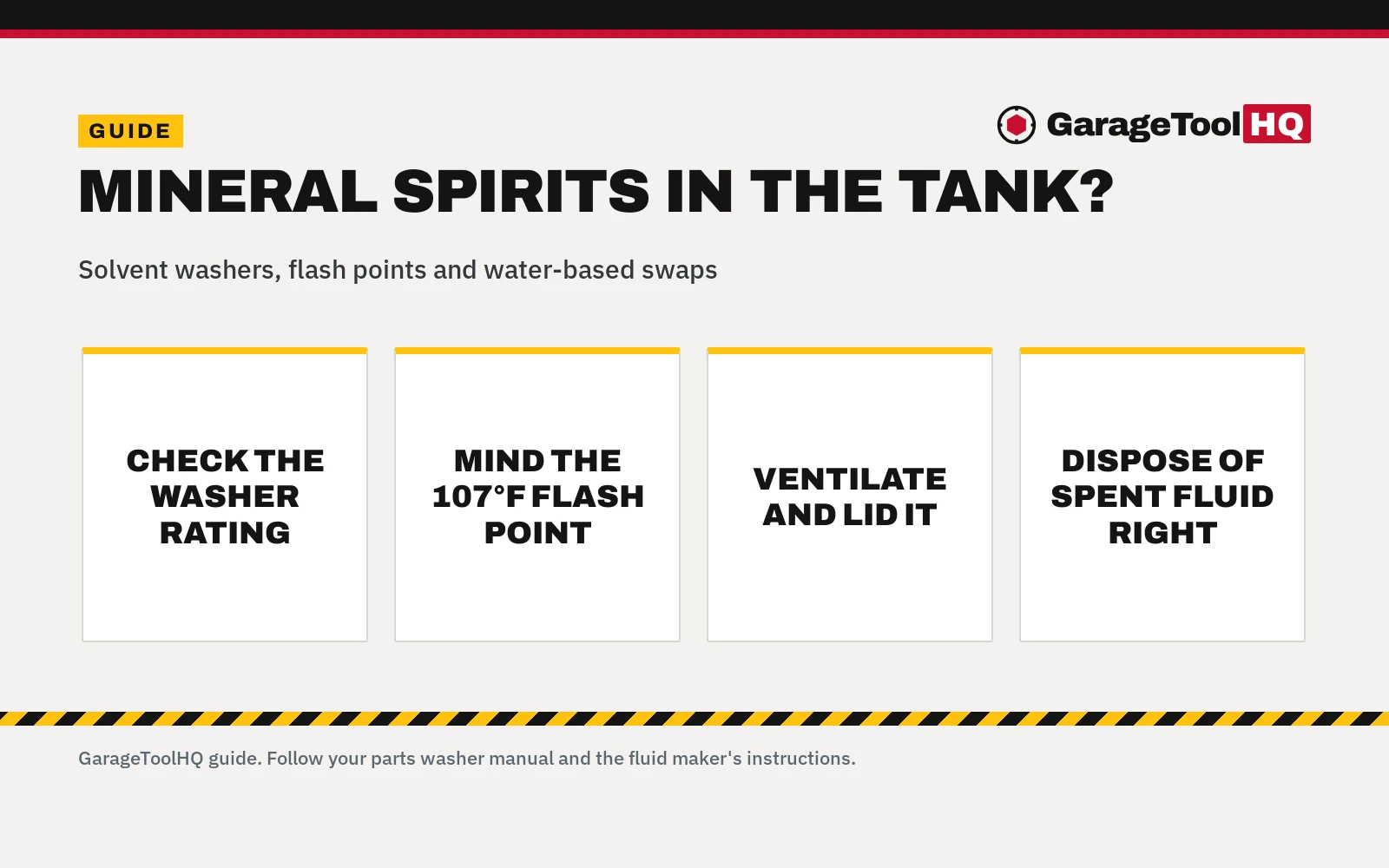
Solvent and open flame do not mix. Keep the washer away from heaters, grinders and anything that throws sparks, and never smoke near an open parts washer. Store solvent in its closed container.
Ventilation matters as much as distance. Solvent vapor builds up in a closed garage, so open the door or run the ventilation the shop has before a long wash session, and never run a fuel engine or an unvented heater in a closed garage while washing parts. Gloves and eye protection keep solvent off skin and out of eyes, and a lid on the tank between jobs cuts vapor and keeps dust out.
FAQ: garage tools
Do I need a filter on my parts washer?
Not every washer needs one, but a filter keeps the solvent cleaner for longer by trapping the grit and sludge each part leaves behind.
What does a parts washer filter trap?
It depends on the media. The CRC OzzyMat FL-4 mat traps particulate down to 50 microns, the Zep Dyna-Trap bag traps particulate matter and selectively removes 1/2 to 1-1/2 quarts of motor oil, and mesh screens catch sediment by mesh size; the Sooprinse garden hose kit uses a 40 mesh screen but is a water-line filter, not a parts washer listing.
How often should I change a parts washer filter?
When it loads up. Watch for slower flow through the filter, and change the bag or mat when the fluid stops coming clean. Cloudy solvent means the fluid itself is spent, so change the fluid first and check the maker’s instructions before setting a routine.
Can I clean and reuse a parts washer filter?
Some screens can be rinsed and reused, and the Sooprinse kit includes 2 extra 100 mesh screens for replacement. Filter bags and mats are consumables: the Zep bag traps oil and grit in its media, and a loaded bag is replaced, not rinsed out.
Will a filter keep my solvent clean forever?
No. A filter extends the life of working solvent by trapping solids and, in the Zep bag’s case, limited amounts of oil, but it is not a remedy for a badly contaminated system. When the fluid is spent, change it and let the filter keep the new fill clean.
What size filter fits my parts washer?
Check the tank and the maker’s instructions. As a guide, the Zep Dyna-Trap bag measures 14.5 inches by 7.5 inches by 21.7 inches and the CRC OzzyMat FL-4 mat measures 30.0 inches by 8.0 inches by 6.0 inches, so measure the space before ordering.
Related: clean shop air with an air line filter, the best oil filter cutter, our shop vacuum picks for cleanup, the best oil drain pan under 40 and our air compressor filter picks.