Mineral Spirits Parts Washer: Can You Use It Safely
Mineral spirits works in a cold solvent parts washer, but the 107°F flash point, ventilation, and the washer's own fluid rating decide whether your tank is the right place for it.

On this page
A greasy control arm comes off the car and needs a wash before it goes back on, and the solvent tank on the bench looks like the fast way to clean it. A mineral spirits parts washer is a parts washer filled with mineral spirits, a petroleum solvent that cuts grease and oil off metal parts. It works in a washer built for cold solvent, and it does not belong in a washer built for water-based fluid, so the washer’s own rating decides before the first part goes in.
As an Amazon Associate I earn from qualifying purchases. GarageToolHQ earns a commission when you buy through links on our product pages, at no extra cost to you. Read our affiliate disclosure.
Below: where the risk comes from, the three kinds of parts washer fluid, a checklist for filling the tank, and the questions owners ask.
Mineral Spirits Parts Washer: Where the Risk Comes From
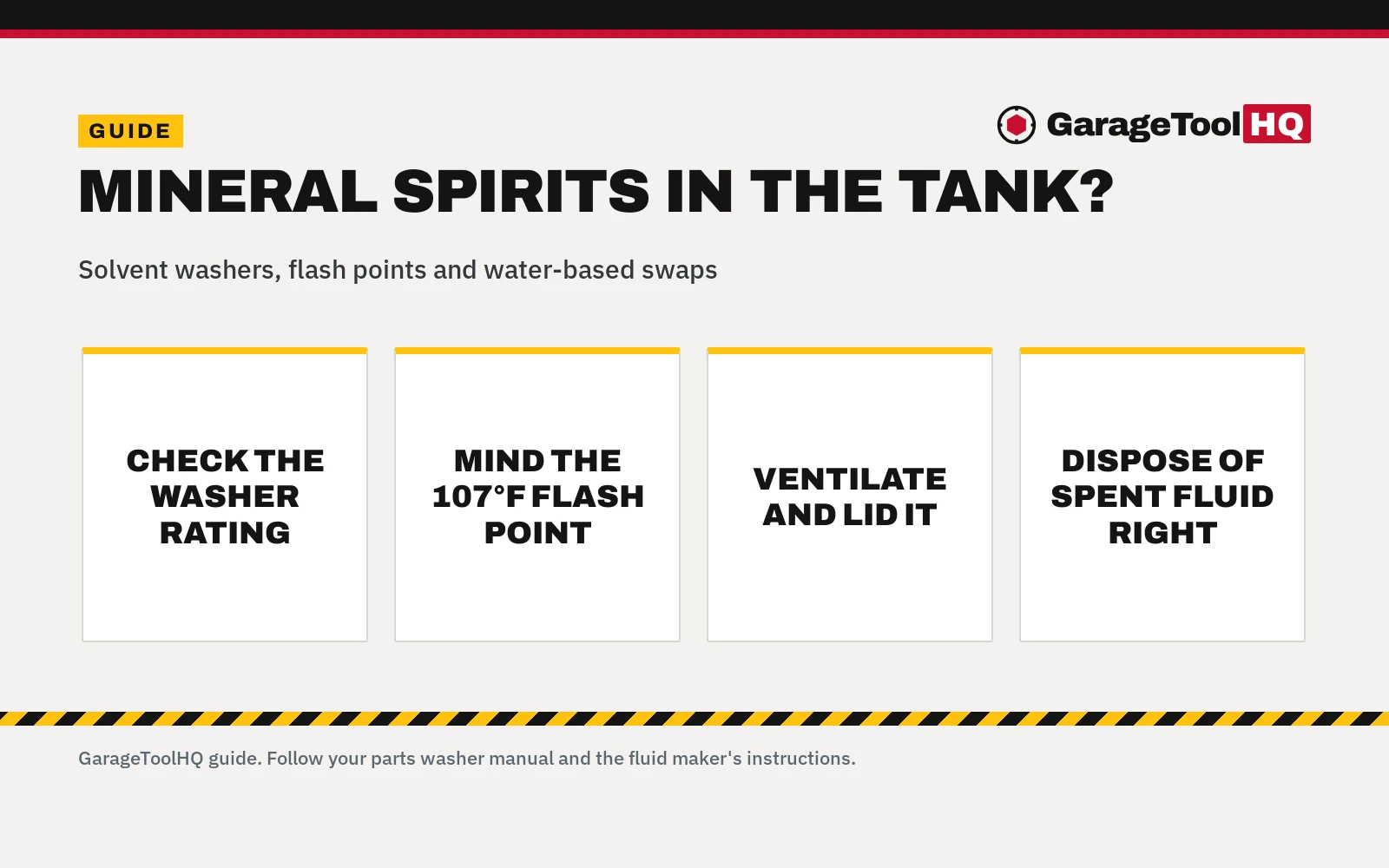
Mineral spirits cleans because it dissolves grease and oil, and as a petroleum solvent it is flammable, which makes it a fire risk in a closed garage. The Zep Dyna 143 listing puts the flash point of mineral spirits at 107°F, which means vapor above a warm tank can catch from a spark, a grinder, or a heater element. A solvent washer is safe to run only when the fluid, the ventilation, and the ignition sources are all handled together.
- Flammable vapor. The Zep Dyna 143 listing states a flash point of 143°F for its own solvent against 107°F for mineral spirits, so mineral spirits gives off ignitable vapor at a lower temperature. Keep the washer away from flames, sparks, and heaters, and keep the lid closed between jobs.
- Vapor buildup. Solvent vapor builds up in a closed garage, so open the door or run the ventilation the shop has before a long wash session, and never run a fuel engine or an unvented heater in a closed garage while washing parts.
- Wrong washer. A washer built for water-based fluid has seals, a pump, and often a heater that are not rated for solvent, so check the washer manual for the fluid it lists before filling the tank.
- Skin and eyes. Solvent strips oil from skin as readily as it strips grease from parts, so wear gloves and eye protection, and wash up after handling the fluid.
Three Kinds of Parts Washer Fluid, and Which Ones Belong in a Solvent Washer
| Type | What it is | In a solvent washer? |
|---|---|---|
| Mineral spirits | Petroleum solvent that cuts grease and oil off metal parts; flash point 107°F per the Zep Dyna 143 listing | Yes, in a washer listed for cold solvent tanks |
| Refined parts washer solvent | Blends such as Zep Dyna 143, flash point 143°F, and the B’laster solvent, flash point 145°F, made for parts washing | Yes, where the maker lists it for parts washers |
| Water-based cleaner | Aqueous fluid such as CRC OzzyJuice, pH neutral and non-flammable, or EcoGen, which mixes at a 1:3 ratio | No, only in a washer built for water-based fluid |
The label and the manual decide which group a fluid is in, not the jug it came in. A parts washer solvent such as Zep R19835 is listed for cold solvent cleaning tanks and carries a citrus fragrance, while the Zep Dyna 143 listing states its solvent is highly refined and odorless with a low evaporation rate. Water-based fluids are a different family: the CRC OzzyJuice listing states it is pH neutral, non-corrosive, non-flammable, and non-toxic, and the EcoGen listing states its formula is water-based, biodegradable, and non-flammable.
How to Use Mineral Spirits in a Parts Washer: The Checklist
- Confirm the washer takes solvent. Check the washer manual for the fluid it lists. A water-based washer takes aqueous fluid, not mineral spirits.
- Check the flash point. The Zep Dyna 143 listing states mineral spirits at a flash point of 107°F against 143°F for its own solvent, and the B’laster solvent listing states a flash point of 145°F. A higher flash point means the fluid needs more heat before it gives off ignitable vapor.
- Ventilate the shop. Open the door or run the ventilation the shop has before a long wash session, and never run a fuel engine or an unvented heater in a closed garage.
- Clear ignition sources. Keep the washer away from heaters, grinders, and anything that throws sparks, and never smoke near an open parts washer.
- Check the parts going in. The Zep Dyna 143 listing states its solvent is designed for metallic parts and is not advisable on plastics, while the B’laster solvent listing states it works on all metals, most plastics, and painted surfaces. Match the fluid’s own label to the parts in the tank.
- Keep the lid closed between jobs. A lid on the tank cuts vapor and keeps dust out of the fluid, and it slows evaporation between jobs.
- Keep the pump covered. Keep the solvent level where the maker states so the pump stays covered.
- Gloves and eye protection. Wear them for every wash session, and keep solvent off skin and out of eyes.
- Store the container closed. Store solvent in its closed container, away from flames and hot surfaces, and follow the maker’s instructions for handling and storage.
The Zep Dyna 143 listing puts the flash point of mineral spirits at 107°F. Never use it near an open flame, a heater, or a grinder, and never heat the fluid or run the washer with the garage closed up.
Use rated jack stands on solid ground, wear eye protection with power and air tools, keep fuel-burning equipment out of a closed garage, and follow the manual for every tool. Read our Safety Disclaimer.
Mineral Spirits vs Water-Based Parts Washer Fluid
If you are still choosing, compare these before filling the tank:
- Fire risk: mineral spirits carries a flash point of 107°F per the Zep Dyna 143 listing, while the CRC OzzyJuice and EcoGen listings both state their water-based fluids are non-flammable.
- What it cleans: mineral spirits dissolves grease and oil off metal parts. Water-based fluids such as CRC OzzyJuice are listed as heavy duty degreasing solutions, and the EcoGen listing states its formula removes oil, grease, and grime.
- Mixing and dilution: water-based concentrates stretch further. The Zep Industrial Purple listing states a 5-gallon container makes up to 128 gallons of cleaner, the EcoGen listing states its formula mixes at a 1:3 ratio, and the HORHIZA listing states 1 gallon of concentrate makes 9 gallons of cleaning solution, adding 14 ounces of concentrate per gallon.
- Heat: the Zep Part Wash powder listing states its detergent de-foams at 140°F and is made for hot vat or recirculating spray wash cabinets, while mineral spirits belongs in a cold solvent tank with no heater.
- Disposal: spent solvent and spent water-based fluid both need the disposal route the maker and local rules state, and neither goes down a drain or onto the ground.
Work out which fluid your washer is built for first, then compare real fluids in our picks for the best parts cleaner for parts washer. For degreaser choices outside the tank, see engine degreaser vs brake cleaner and engine degreaser vs dish soap.
What to Do With Spent Mineral Spirits
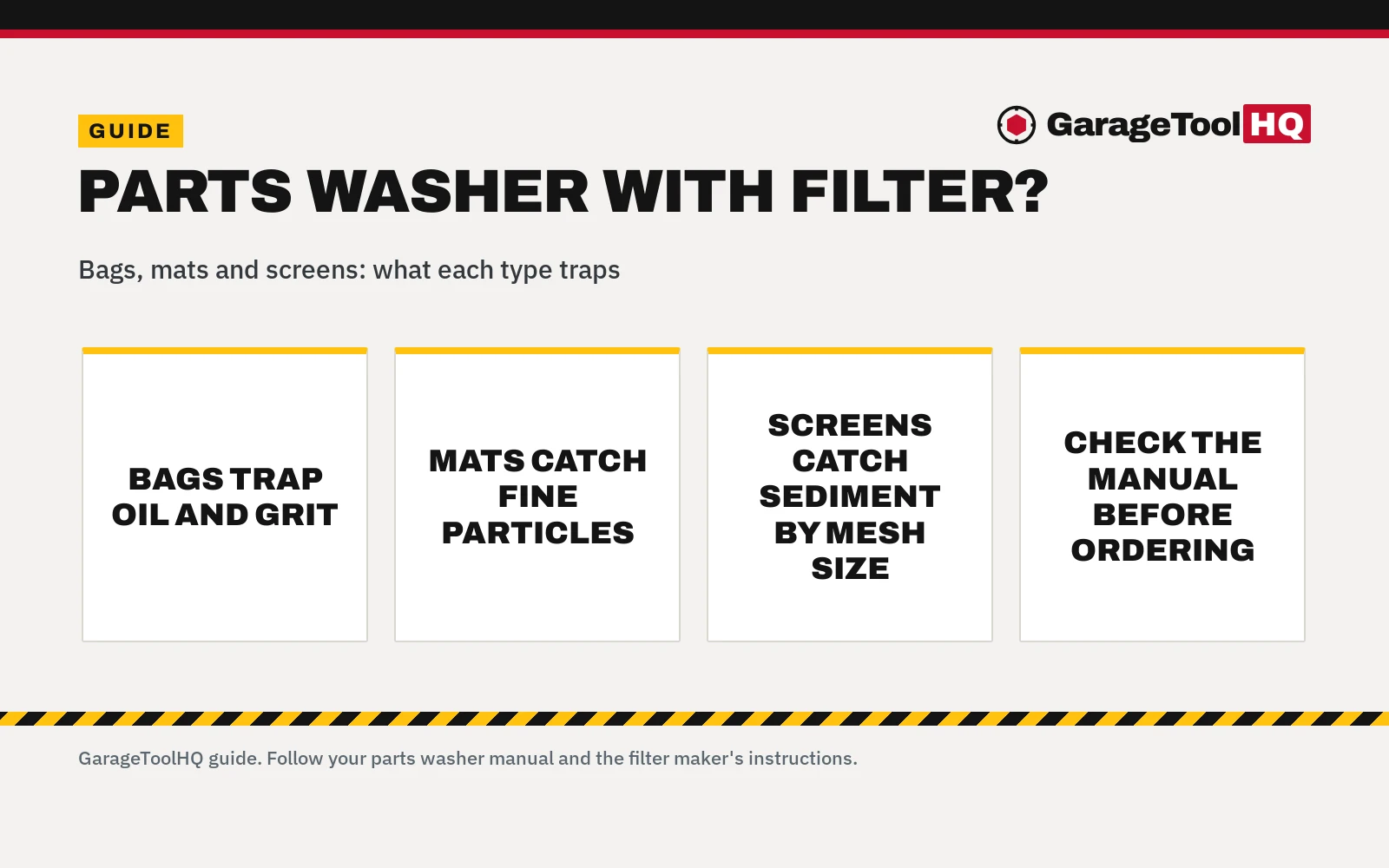
Solvent that has washed part after part carries the grease, oil, and grit it lifted, and it stops cleaning well. A filter in the loop traps the solids and keeps working fluid in service longer, but it does not make spent solvent new again, so change the fluid when parts stop coming clean.
Pour the spent fluid into its closed container and follow local rules for oily waste. Never pour it down a drain, into the yard, or into a storm drain, and never mix it with a water-based cleaner. Keep the container labeled and stored away from flames and hot surfaces until disposal.
FAQ: garage tools
Can I use mineral spirits in any parts washer?
No. Use it only in a washer the maker lists for solvent or cold solvent tanks, such as the Zep R19835 solvent listing for cold solvent cleaning tanks. A washer built for water-based fluid takes aqueous fluid, not mineral spirits.
Is mineral spirits flammable?
Yes. The Zep Dyna 143 listing states the flash point of mineral spirits at 107°F, against 143°F for its own solvent. Keep it away from flames, sparks, and heaters, ventilate the shop, and keep the lid closed.
Can I mix mineral spirits with a water-based cleaner?
No. Use one fluid in the tank and follow the fluid maker’s instructions. Mixing a petroleum solvent with a water-based cleaner leaves a fluid neither maker lists, and it needs the same disposal route as spent solvent.
How often should I change the mineral spirits?
When it stops cleaning. Watch for parts coming out with a film still on them and for grit settling in the tank, and change the fluid before the next job. A filter keeps working fluid in service longer, but it does not rescue fluid that is already spent.
Can mineral spirits clean plastic parts?
Check the fluid’s own label. The Zep Dyna 143 listing states its solvent is not advisable on plastics, while the B’laster solvent listing states it works on most plastics and painted surfaces, so the answer depends on the fluid in the tank.
What do I do with used mineral spirits?
Pour it into a closed container and follow local rules for oily waste. Never pour it down a drain or onto the ground, and store the container away from flames and hot surfaces until disposal.
Related: our picks for the best parts cleaner for parts washer, engine degreaser vs brake cleaner and engine degreaser vs dish soap. Also see our how we pick.