Rolling vs Stationary Tool Chest: Which One Should You Buy?
A rolling tool chest moves with the job on casters, while a stationary chest holds tools in a fixed spot by the bench.

On this page
Rolling vs stationary tool chest: the answer comes down to how the tools move during a job. A rolling chest rides on casters and follows the work from the bench to the car and back, while a stationary chest stays in its spot and holds tools within reach of the bench. Each style stores wrenches, sockets and drivers in drawers, so the choice is about movement, floor space and how the garage gets used day to day.
As an Amazon Associate I earn from qualifying purchases. GarageToolHQ earns a commission when you buy through links on our product pages, at no extra cost to you. Read our affiliate disclosure.
Below: how each style works in a home garage, the gear covered in this guide, and a checklist for picking between them.
Rolling vs stationary tool chest: the core difference
A rolling tool chest stands on casters. The maker fits a handle and wheels so the chest moves across the garage floor, and brakes on some of the wheels hold it still while work goes on. A stationary chest has no wheels: it sits on a bench, a shelf or the floor where it was placed, and it moves only when lifted and carried. Each style stores tools in drawers, so the real difference is whether the storage travels to the job or the job comes to the storage.
Rolling chests suit a garage where the work moves: brake jobs near the lift, an oil change at another, and a bench project in between. A chest that rolls keeps sockets and wrenches beside the car instead of across the room. Stationary chests suit a fixed bench setup, where the tools live in a fixed spot and the mechanic walks to them. A portable chest with carry handles, like the Olympia Tools chest below, splits the difference: it lifts onto a bench or a shelf and moves by hand, with no casters at all.
Weight matters on each side of the choice. A rolling chest carries its own weight on casters. A stationary chest has to be lifted, so its listed weight is one thing to check before it rides on a bench. Check the listing weight before buying, and check whether the chest arrives assembled or needs the wheels and handle fitted: the Garvee chest below arrives mostly pre-assembled, with the wheels and handle left to fit.
The gear in this guide
The gear below covers the spread of the choice: rolling chests on casters, and a portable stationary chest with carry handles. They are ranked by how well each listing delivers what it promises for its class.
TUFFIOM 5-Drawer Rolling Tool Chest. The listing states 5 drawers plus a bottom cabinet with a removable and adjustable inner shelf, and a side rack with holes for small tools. It rides on 4 wheels, with brakes on 2 of them, and a handle for moving it around. Locking bars keep the drawers from sliding out and the cabinet door from opening during movement. The top chest detaches and fits inside the bottom cabinet for storage and transport, with the inner shelf removed, and handles on each side of the top chest help with lifting it. The body is steel with a powder coating finish. The listing states 40.0 pounds and dimensions of 11.0 inches x 23.0 inches x 40.0 inches.
Olympia Tools 26-Inch 4-Drawer Portable Tool Chest. This is the stationary pick of the group: a portable metal chest with 4 drawers, built-in side carry handles and no wheels. The listing states 21-gauge steel with a black powder-coated finish, ball-bearing drawers with a 50-pound capacity, and a locking lid and drawer system that holds the drawers and lid together. It suits a bench or a shelf, where it lifts into place by the handles. The listing states 21.61 pounds and dimensions of 25.98 inches x 12.01 inches x 16.72 inches.
SFTORMAS 3 Drawer Rolling Tool Chest. A compact rolling cabinet with 3 drawers, sized at 15.35 inches x 17.71 inches x 23.62 inches, that fits beside a workbench or in a utility room. The listing states steel construction, a lock, metal drawer slides and swivel casters, with a deep bottom drawer for bulkier items. The sturdy steel cabinet supports up to 330 lbs in total, according to the listing. The listing states 37.5 pounds.
Garvee Rolling Tool Chest. A rolling cabinet with a handle, 4 wheels and brakes on 2 of them, a lock and keys, and drawer liners that protect against scratches. The listing states a powder-coated steel body and a sturdy tabletop for working on projects. Read the drawer count with care: the title states 5 drawers, while a bullet states six spacious drawers, so the listing contradicts itself on that point. The chest arrives mostly pre-assembled, with the wheels and handle left to fit. The listing states 57.1 pounds, dimensions of 13.0 inches x 24.3 inches x 25.4 inches, and an orange finish.
| Chest | Drawers | Wheels | Lock | Weight |
|---|---|---|---|---|
| TUFFIOM 5-Drawer Rolling Tool Chest | 5 | 4, brakes on 2 | Locking bars | 40.0 pounds |
| Olympia Tools 26-Inch 4-Drawer Tool Chest | 4 | None, carry handles | Locking lid | 21.61 pounds |
| SFTORMAS 3 Drawer Rolling Tool Chest | 3 | Swivel casters | Lock | 37.5 pounds |
| Garvee 5 Drawers Rolling Tool Chest | 5 | 4, brakes on 2 | Lock and keys | 57.1 pounds |
How to choose between rolling and stationary
Walk through this checklist with the tape measure and the listing open:
- Map the route. A rolling chest needs a clear path across the floor, from its parking spot to the car and back. A stationary chest needs a bench or shelf spot with room for the lid or the top drawer to open.
- Check the floor. Casters roll well on smooth concrete and fight cracks, cords and floor mats. If the garage floor is rough, a stationary chest on the bench may serve better.
- Check the brakes. Brakes on the wheels hold a rolling chest still while drawers open and shut. The TUFFIOM and Garvee chests list brakes on 2 of their 4 wheels.
- Check the lock. A lock helps keep drawers shut in transit and helps keep tools safe when the garage stands empty. The Olympia chest locks lid and drawers together, the SFTORMAS chest has an integrated lock, and the Garvee chest ships with a lock and keys.
- Check drawer capacity. Ball-bearing slides and a stated drawer capacity, like the 50-pound capacity on the Olympia chest, matter when drawers hold sockets and wrenches. Compare drawer counts from the listing, and watch for contradictions like the Garvee drawer count above.
- Check the weight. The listing weight is one thing to check before a stationary chest lifts onto a bench, and a loaded rolling chest takes more effort over a lip or a ramp. The chests in this guide range from 21.61 pounds to 57.1 pounds.
Use rated jack stands on solid ground, wear eye protection with power and air tools, keep fuel-burning equipment out of a closed garage, and follow the manual for every tool. Read our Safety Disclaimer.
FAQ: garage tools
Is a rolling tool chest better than a stationary chest for a small garage?
It depends on the floor plan. A rolling chest tucks beside the bench and rolls out to the car when needed; one with braked wheels holds its spot once the brakes are set. A stationary chest suits a garage where the bench never moves and the tools live in a fixed spot. Measure the parking spot and the route before choosing.
Can a rolling tool chest stay put?
Yes, if the chest has braked wheels: lock them and the chest holds its spot while drawers open and shut. The TUFFIOM and Garvee chests in this guide list brakes on 2 of their 4 wheels, and the TUFFIOM locking bars keep its drawers from sliding out during movement.
Do stationary tool chests hold more tools than rolling chests?
Not by rule. Drawer count, drawer depth and weight capacity decide how much a chest holds, not whether it has wheels. A 5-drawer rolling chest can hold more than a 4-drawer portable chest, and a deep bottom drawer gives bulkier items extra room.
What should I check before moving a loaded rolling chest?
Shut and lock the drawers, set the locking bars where the listing provides them, and clear the path of cords, hoses and floor mats. Move slowly over lips and cracks in the floor, and never push a chest with open drawers.
Are locking drawers worth it on a tool chest?
Yes. A lock helps keep drawers shut while a rolling chest moves, so tools stay inside, and it helps keep the contents safe when the garage stands empty. Every chest in this guide lists a lock of some kind, from a locking lid to a lock and keys.
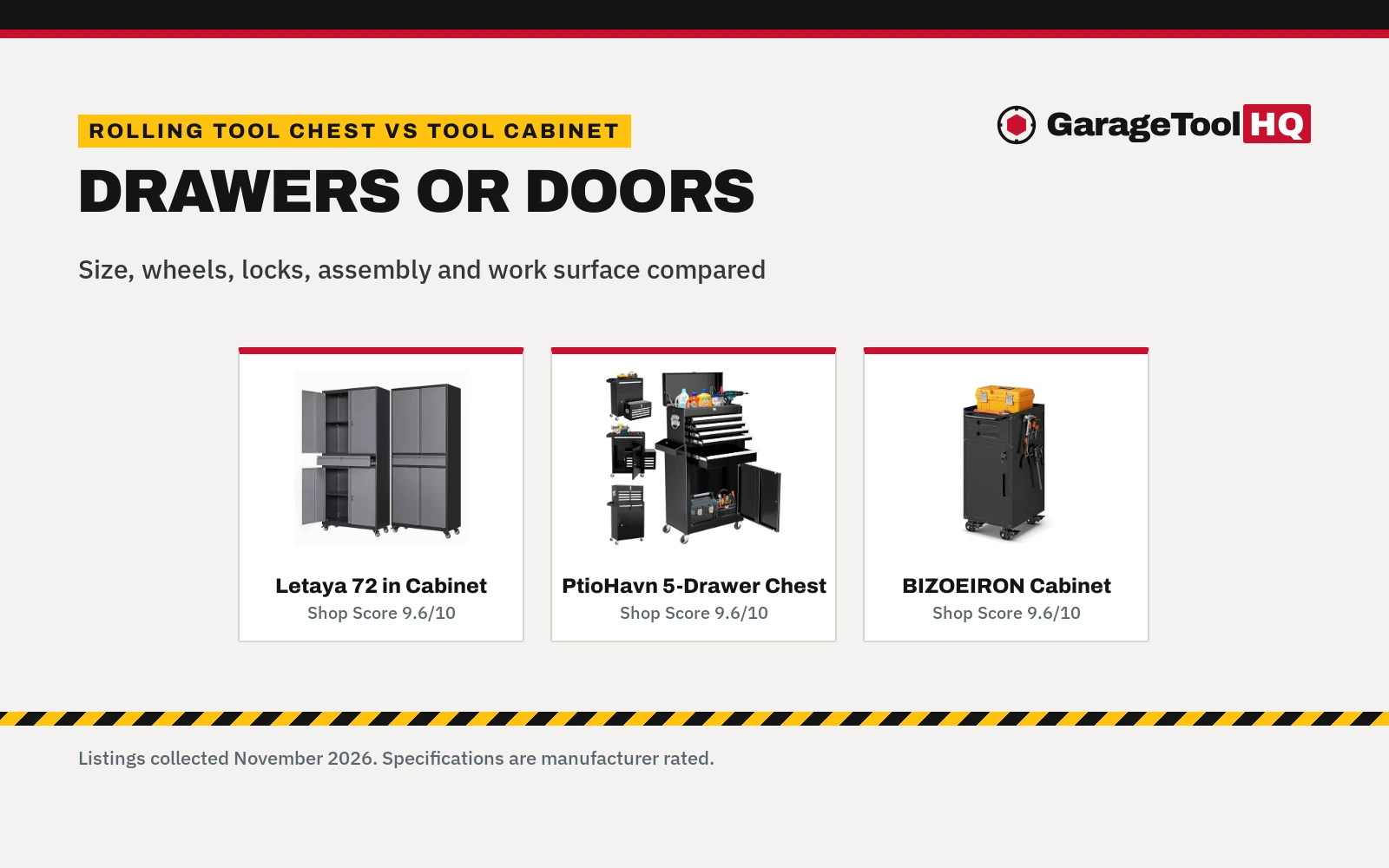
Related: rolling tool chest vs tool cabinet, our roll around tool chest picks and the best workbench for home mechanics.