Swivel vs Fixed Bench Vise: Which One Should You Buy?
Swivel vs fixed bench vise compared: how each mount works, which jobs each one suits, and four vises from current listings ranked by Shop Score.

On this page
Top picks at a glance
As an Amazon Associate we earn from qualifying purchases.
- 1
 Lisle 57030 Standard Oil Filter Swivel Wrench9.7/10View on Amazon
- 2
 Wilton Mechanics Pro Bench Vise9.7/10View on Amazon
- 3
 Yost Vises 455 Combination Vise9.6/10View on Amazon
- 4
 [Upgraded] Bench Vise 6" Table ViceView on Amazon
- 5
 VEVOR Bench ViseView on Amazon
- 6
 VEVOR Bench Vise 6 InchView on Amazon
- 7
 4.5" Heavy Duty Bench Vise with 270° Swivel Locking BaseView on Amazon
- 8
 Dual-Purpose Combined Universal Vise 3.3" with 360° SwivelView on Amazon
- 9
 Small Bench Vise 3.2" Clamp-OnView on Amazon
Swivel vs fixed bench vise: which one should you buy? A swivel base wins when you hold parts at odd angles; a fixed mount wins when you want the stiffest hold under heavy force. Most home garage jobs sit between those two extremes, so the right pick depends on jaw width, how the vise mounts to your bench and the work you actually do. A light clamp-on swivel vise suits drilling and sawing small parts, while a heavy bolt-down swivel vise with a big anvil suits repair and fabrication work.
More options to compare
 [Upgraded] Bench Vise 6" Table ViceCheck price on Amazon
 VEVOR Bench ViseCheck price on Amazon
 VEVOR Bench Vise 6 InchCheck price on Amazon
 4.5" Heavy Duty Bench Vise with 270° Swivel Locking BaseCheck price on Amazon
 Dual-Purpose Combined Universal Vise 3.3" with 360° SwivelCheck price on Amazon
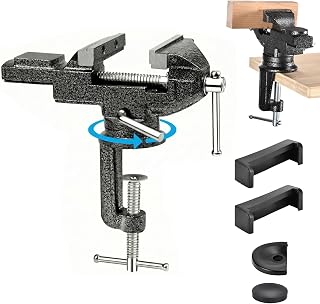 Small Bench Vise 3.2" Clamp-OnCheck price on Amazon
GarageToolHQ earns a commission when you buy through links on our product pages, at no extra cost to you. Read our affiliate disclosure.
Below: how the two mounts differ, what to check on jaw size and mounting, and four vises from current listings ranked by Shop Score, with the specs each listing actually states.
Swivel vs fixed bench vise: how the two mounts differ
A fixed bench vise bolts straight to the bench and points one way. With no rotating parts between the base and the jaws, the load path is short and direct, which is what you want when you lean into a breaker bar or beat on a stuck part with a hammer. The trade-off is simple: the part meets you where the vise points, so you reposition the work instead of the vise.
A swivel base puts a rotating joint between the bench and the vise body. Every swivel listing in this guide rotates a full 360 degrees, and each one locks down once you set the angle: the Yost 760-DI uses two lockdowns on an interlocking V-grooved base, the Wilton 550P uses a rotating head indexed at 30-degree increments, the Real Avid locks a ball-and-socket joint with a locking pin, and the Nuovoware clamps to the bench edge on a 360-degree base. You turn the vise to the work, which helps when you drill angled holes, file a curved edge or hold an odd-shaped part where the bench layout fights you.
Rotation is the only moving joint a fixed vise does not have, so on paper a fixed mount is the stiffer choice. In practice the listings here show swivel bases as the standard for general garage work, and the difference comes down to how well the base locks: two lockdowns and indexed detents give you repeatable positions, while a single clamp ring gives infinite adjustment with less holding confidence. Check the manual of any vise you buy for how the maker says to lock the base before loading it.
What to check before you pick
- Jaw width. The four listings here run from 2.75 inches to 6 inches of jaw width. Wider jaws hold bigger stock flat; narrow jaws suit small parts.
- Max jaw opening and throat depth. The Nuovoware lists a 3-inch max opening with 2.5 inches of throat; the Yost lists a 5.90-inch opening with 4.31 inches of throat. These two numbers decide how big a part actually fits.
- Weight and mounting. The Nuovoware weighs 3.6 pounds and clamps to a bench edge; the Yost weighs 75.8 lbs and bolts down. Light clamp-on vises move between benches; heavy bolt-down vises stay put under real force.
- Jaw and anvil features. The Yost lists three sets of replaceable jaws (bench, pipe and V-jaws) plus a large anvil work surface; the Wilton lists replaceable hardened steel jaws and a large built-in anvil. An anvil surface matters when you shape and flatten metal on the vise.
- Warranty term. The Yost lists a 3-year limited warranty with lifetime tech support, the Wilton lists a lifetime warranty against manufacturing defects, the Real Avid lists a 2-year manufacturer warranty, and the Nuovoware listing states no warranty term.
The gear: four vises from current listings, ranked by Shop Score
All four listings here are swivel models, ranked highest Shop Score first. Specs below come from each listing exactly as published; where a listing contradicts itself, that is called out.
1. Yost Vises 760-DI Multi-Jaw Rotating Vise
The 760-DI is the heavyweight of this group. The listing states a 6-inch jaw width, a 5.90-inch max opening, 4.31 inches of throat depth and 75.8 lbs of weight, in 60,000 PSI ductile iron with hardened steel jaws. The dual jaw system brings three sets of replaceable jaws, parallel serrated bench jaws, pipe jaws and V-jaws, so flat and round stock both get a proper grip, and the large anvil work surface adds a place to shape and flatten metal. The vise body rotates 360 degrees on an interlocking V-grooved swivel base with two lockdowns, and the vise head itself rotates 360 degrees with locking at every 30 degrees. The listing backs it with a 3-year limited warranty, a 90-day return and lifetime tech support. For a home garage that does repair and fabrication, this is the most capable swivel vise of the four: the size, the jaw options and the stated warranty term all read like a vise meant for steady work, and the two lockdowns on the base are the most positive swivel lock in this group.
2. Wilton 550P Multi-Purpose Bench Vise
The Wilton is the runner-up on build and warranty. The title states a 5-1/2 inch jaw width, a 5-inch max jaw opening and 2-3/4 inches of throat depth, while the spec table on the same listing states 4-1/2 inches, 4-1/4 inches and 2-1/4 inches: per this site’s rules the title and bullets win, so use the 5-1/2, 5 and 2-3/4 figures. The head rotates a full 360 degrees with indexing at 30-degree increments for quick setup, and the listing states replaceable steel pipe jaws, a large built-in anvil and replaceable hardened steel jaws with a serrated pattern. It is backed by Wilton’s lifetime warranty against manufacturing defects, the longest stated term in this group. The spec table also lists two different weights, 21.3 pounds net and 40 pounds item weight, so treat the weight as not reliably stated. It scores below the Yost because of the self-contradiction in the listing, but the lifetime warranty and the replaceable jaws keep it ahead of the two lighter models. To compare real models side by side, see our best bench vise for a garage picks and the best heavy duty bench vise roundup.
3. Real Avid 360 Swiveling Bench Vise
The Real Avid is the precision-oriented pick. The listing states a 5-inch jaw width, an 11-pound weight in aluminum and hardened steel, and a 360-degree swiveling capability through a ball-and-socket joint that locks with a pin for high-torque applications up to 100 ft-lb. An integrated leveling knob gives plus-or-minus 3 degrees of side-to-side adjustment for alignment work, and the reversible jaw sleeves are shaped for firearms parts: rifle barrels, rails, bolt carriers and wooden stocks. The maker lists it for gunsmithing, cleaning and maintenance as well as woodworking and general DIY, and backs it with a 2-year manufacturer warranty. It ranks third because it is a specialist tool: the ball joint and leveling knob suit fine positioning, while the 11-pound weight and the firearm-focused jaws suit lighter work rather than heavy fabrication.
4. Nuovoware 3 Inch Clamp-On Table Vise
The Nuovoware is the light-duty entry of the group. The listing states a 2.75-inch (70 mm) jaw width, a 3-inch (77.5 mm) max opening, 2.5 inches of throat, a 360-degree swivel base and a 3.6-pound weight in cast iron with a chrome-plated spindle. It clamps to the edge of a bench or table instead of bolting down, and the maker lists it for light applications: cutting conduit, drilling, gluing, woodworking, metalworking, sanding, planing and sawing. The listing states a 1,500-pound tensile strength figure and no warranty term. It ranks last because it is the lowest-weight vise here with the smallest stated capacity and no stated warranty, but it fills a real slot: a portable clamp-on vise you can move between the bench and a work table for small jobs.
Use rated jack stands on solid ground, wear eye protection with power and air tools, keep fuel-burning equipment out of a closed garage, and follow the manual for every tool. Read our Safety Disclaimer.
Frequently Asked Questions
Do I need a swivel base on a bench vise?
Not always, but it helps whenever the work does not line up with the bench. All four listings in this guide are swivel models, each rotating a full 360 degrees, which shows swivel bases are the standard choice for general garage work. Pick a fixed mount only when you want the stiffest possible hold and never need to change angles; otherwise a swivel base with a solid lockdown gives you both.
What jaw width do I need for a home garage?
The four listings here span 2.75 inches to 6 inches. Match the jaw to the parts you hold most: small repair and hobby parts sit comfortably in the 2.75 to 5-inch range, while 6-inch jaws and a wide opening like the Yost 5.90-inch opening suit bigger fabrication work. If you are unsure, size up within your bench and mounting limits, and check the vise manual for how the maker says to mount it.
Can a clamp-on vise handle real garage work?
It can handle light work. The 3.6-pound Nuovoware clamps to a bench edge and the maker lists it for light applications like drilling, gluing and sawing small parts. For heavy leverage or hammering, a bolt-down vise in the 75.8-lb class stays put where a clamp-on can shift, so match the mounting to the force.
Should I bolt the vise through the bench top?
For a heavy vise, yes: through-bolting to a solid bench is how a vise in the 75.8-lb class reaches its full holding ability, and the Yost listing assumes a solid bench mount. For a light clamp-on vise the whole point is portability, so the bench-edge clamp is the design. Either way, the bench itself must be solid and stable before the vise goes on, and the manual of the vise you buy states the mounting hardware it needs.
What does throat depth tell me?
Throat depth is how deep a part can sit between the jaws, measured from the jaw face back toward the slide. The listings here state from 2.5 inches on the Nuovoware to 4.31 inches on the Yost. Deep throats hold long or wide parts without them tipping; shallow throats suit small parts close to the jaw faces.
Related: our best bench vise for a garage picks, the best heavy duty bench vise roundup, a primer on bench vise types and the work bench with vise picks for the bench to mount it on.