Tie Rod Separator vs Pickle Fork: Which One Should You Buy?
A pickle fork is one kind of tie rod separator: the wedge kind, driven by a hammer, while screw separators press the joint apart without hammering.

On this page
Top picks at a glance
As an Amazon Associate I earn from qualifying purchases.
- 1
 OMT Ball Joint Separator9.7/10View on Amazon
- 2
 5-Piece Ball Joint Separator Set9.6/10View on Amazon
- 3
 DAYUAN 5Pcs Ball Joint Separator9.6/10View on Amazon
- 4
 GEARWRENCH 12" Tie Rod SeparatorView on Amazon
- 5
 Lisle 18520 Tie Rod SeparatorView on Amazon
- 6
 ARES 12016-15/16-inch Pickle Fork Ball Joint SeparatorView on Amazon
- 7
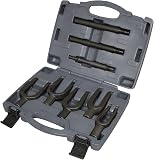 Lisle 41220 5 Pc. Thick Pickle Fork SetView on Amazon
Tie rod separator vs pickle fork: a pickle fork is a kind of tie rod separator, not a different tool family. The fork is a tapered wedge driven between the joint and the arm with a hammer, while a screw-type separator presses the joint apart with a socket drive. The fork is driven with a hammer, while the screw separator is driven with a socket wrench.
Other tools worth a look
 GEARWRENCH 12" Tie Rod SeparatorCheck price on Amazon
 Lisle 18520 Tie Rod SeparatorCheck price on Amazon
 ARES 12016-15/16-inch Pickle Fork Ball Joint SeparatorCheck price on Amazon
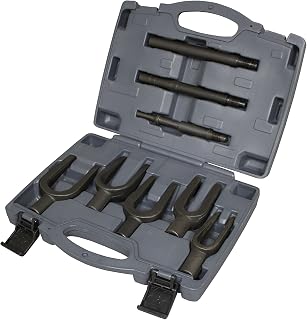 Lisle 41220 5 Pc. Thick Pickle Fork SetCheck price on Amazon
GarageToolHQ earns a commission when you buy through links on our product pages, at no extra cost to you. Read our affiliate disclosure.
Tie rod separator vs pickle fork: how they differ
Both tools do the same job: separate a tapered joint, such as a tie rod end or a ball joint, from the arm it sits in. They differ in how force reaches the joint. A pickle fork is a tapered fork wedge. The OEMTOOLS listing describes striking the handle with a hammer to separate the ball joint cleanly, and the DURATECH set adds an adapter handle for use with an air hammer. A screw separator works differently: the OMT puller listing describes a socket-driven tool that separates ball joints from the spindle support arm without needing other tools, and states that it separates ball joints without damaging other components.
| Tool | How it separates | What drives it | Watch out for |
|---|---|---|---|
| Pickle fork | Tapered wedge driven between joint and arm | Hammer, or air hammer with an adapter handle | Hand-hammer use needs room to swing a hammer |
| Screw separator | Presses the joint apart | Socket wrench | Check that the opening range fits the joint |
| Full kit | Pullers and separators in one case | Wrench-driven tools | Heavier case to store |
The fork listings describe hammer work, so a fork suits a job where hammer access is easy. The screw separator suits a job where hammer swing room is limited, since the OMT puller works with a socket wrench; that listing also states it separates ball joints without damaging other components. A kit suits a garage that services several joint types, since it covers ball joints, tie rods and pitman arms in one case.
The gear: separators and fork sets, ranked
Ranked by coverage first, then by adjustability and stated warranty, the four listings here run from full sets down to a single fork.
DURATECH 5-piece set. A 5-piece set: a complete set of 5 pieces, with a track rod fork at 11/16 in, a ball joint fork at 15/16 in and a pitman arm fork at 1-1/8 in, plus a 7-7⁄8 in knurled striking handle for conventional hammers and a 6-31⁄32 in adapter handle for an air hammer. Forks interchange with either handle. The 40# steel has been forged and heat treated, chrome-plated surfaces protect against corrosion, and knurled handles give a sure grip and protect tool threads. A blow-molded case keeps the set organized. Listed weight is 4.53 pounds, with package dimensions of 11.73 x 7.64 x 2.24 inches.
Orion Motor Tech 5-tool front end kit. An all-in-one front end service kit with 5 tools: a ball joint separator, a tie rod and ball joint remover, a conical pitman arm puller, a pitman arm and tie rod end puller, and a pitman arm puller, in a well-organized ABS case. The listing states hardened alloy construction for tough jobs, and compatibility with small, domestic rear-wheel-drive vehicles, import vehicles and light trucks. Listed weight is 10.62 pounds, with package dimensions of 13.54 x 11.81 x 3.5 inches.
Orion Motor Tech adjustable ball joint puller. A screw-type separator with a removable pin that fits different pivot points, giving an adjustable opening range of 1.2 in to 2.3 in for most passenger vehicles. It is made from premium AISI 1045 medium carbon steel, cold forged and heat treated, with black oxide coated pins for corrosion resistance. The included 1/2 inch Cr-V structured socket works with a socket wrench, and the listing states separation without damaging other components. A 1 year warranty is stated. Listed weight is 3.23 pounds, with product dimensions of 9 x 5 x 3 inches.
OEMTOOLS 25202 pickle fork. A single classic fork with a 15/16 inch opening for a firm hold and secure removal. The listing describes a tapered fork wedge design, heat treated steel alloy construction, zinc plating that resists rust, and a long knurled handle with a nonslip texture. Striking the handle with a hammer separates the ball joint cleanly. Listed weight is 1.55 pounds, with product dimensions of 14.8 x 2.75 x 1 inches.
Which one should you buy?
Pick a fork set when the work is mostly hammer-driven separation and several joint sizes are in play: the DURATECH set covers three fork openings and both hammer styles. Pick the screw separator when hammer room is tight: the OMT puller presses the joint apart with a socket wrench and adjusts from 1.2 in to 2.3 in. That listing also states it separates ball joints without damaging other components. Pick a full kit when the garage services ball joints, tie rods and pitman arms across several vehicles, since the OMT kit puts all five tools in one ABS case. Pick the single OEMTOOLS fork when only one opening size is needed and a simple hammer tool will do.
Never get under a vehicle supported by a jack alone. Use rated stands on solid, level ground, and follow the owner’s manual lift points before any front end work.
Use rated jack stands on solid ground, wear eye protection with power and air tools, keep fuel-burning equipment out of a closed garage, and follow the manual for every tool. Read our Safety Disclaimer.
FAQ: garage tools
Is a pickle fork the same as a tie rod separator?
A pickle fork is one kind of tie rod separator: the wedge kind, driven with a hammer. A screw separator is another kind, pressing the joint apart with a socket drive. Both separate tapered joints such as tie rod ends and ball joints.
Do I need a hammer with a pickle fork?
Yes for the standard handle: the listings describe striking the handle with a hammer to separate the joint. The DURATECH set also includes an adapter handle for use with an air hammer.
Will a separator damage the parts around the joint?
The OMT puller listing states that it separates ball joints without damaging other components. That statement is specific to that listing; the fork listings make no such statement.
What size fork opening do I need?
Match the opening to the joint. The forks here cover 11/16 in, 15/16 in and 1-1/8 in, while the adjustable OMT puller covers an opening range of 1.2 in to 2.3 in. Check the joint size and the vehicle manual before ordering.
Can one tool cover ball joints, tie rods and pitman arms?
A set or kit can. The OMT kit lists tools for ball joints, tie rods and pitman arms in one case, and the DURATECH set lists forks for track rods, ball joints and pitman arms. A single fork covers only the joints its opening fits.
Related: best tie rod end separator, pickle fork vs ball joint press, best ball joint press kit and the engine and shop equipment hub.