Tire Inflation Chart: How to Read and Use It
A tire inflation chart lists the pressure for a tire size and load; a gauge with an inflator lets you check it and set it right.

On this page
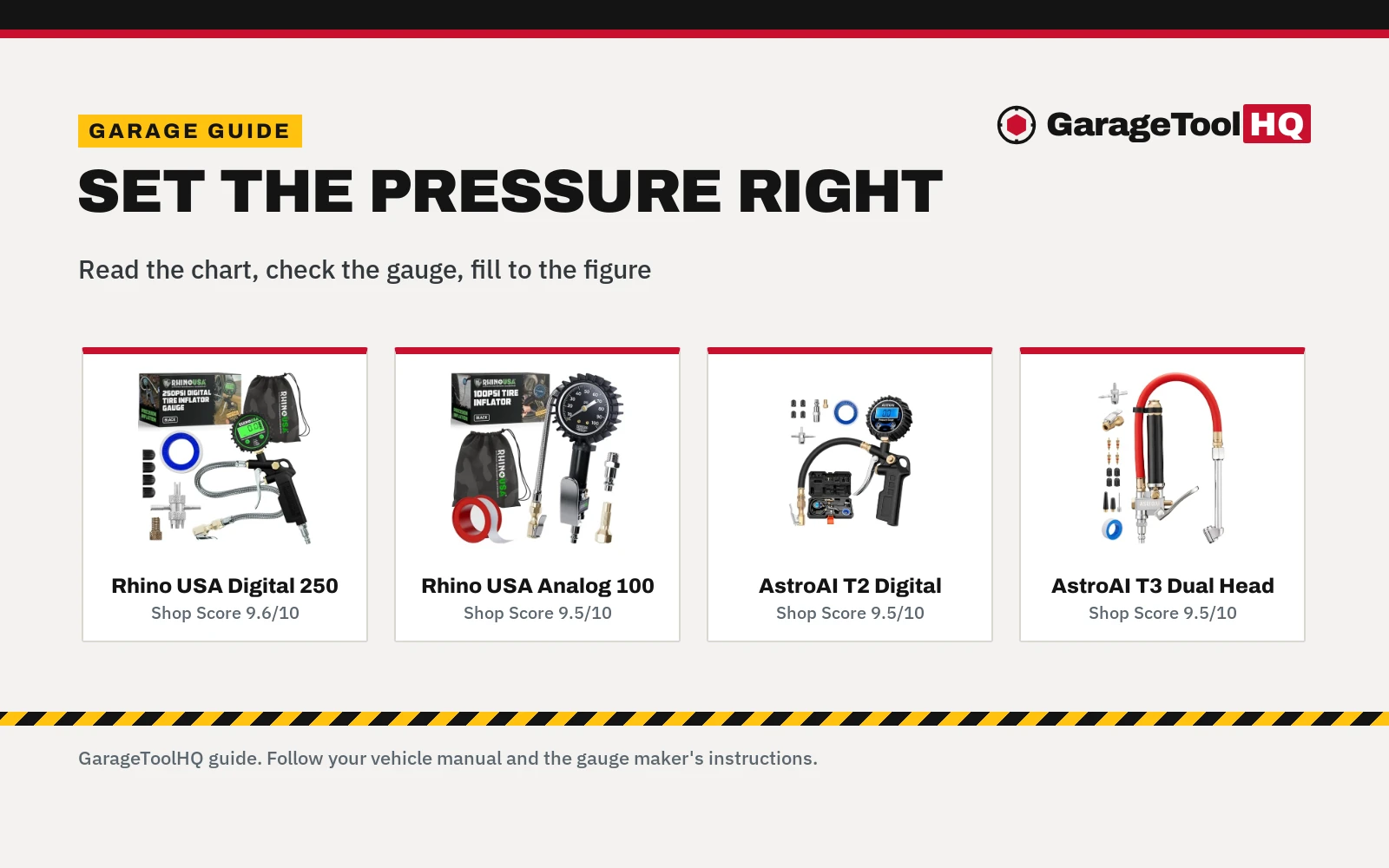
Top picks at a glance
As an Amazon Associate I earn from qualifying purchases.
- 1
 Rhino USA Digital Tire Pressure Gauge9.6/10View on Amazon
- 2
 Rhino USA Tire Pressure Gauge with Inflator9.5/10View on Amazon
- 3
 AstroAI Digital Tire Pressure Gauge with Inflator9.5/10View on Amazon
- 4
 AstroAI T3 Heavy-Duty Tire Pressure Gauge9.5/10View on Amazon
A tire looks right at a glance and still rides low, and the wear shows up on the shoulders long before the gauge comes out. The pressure a tire needs is not a guess and not one figure for every tire. A tire inflation chart lists the pressure for a tire size and load, so the driver can match the tire on the car to the pressure it needs. Find the size and the load, read the pressure off the chart, and check it with a gauge.
GarageToolHQ earns a commission when you buy through links on our product pages, at no extra cost to you. Read our affiliate disclosure.
Below: what a tire inflation chart lists, how to read one, the gauges that handle each part of the job, and answers to the questions that come up most.
Rhino USA Digital Tire Pressure Gauge
A digital tire pressure gauge with inflator, a 250 PSI range, a 0.1 display resolution, a straight locking chuck, a hose and a bleed valve, in stainless steel and brass.
Pros
- 250 PSI range with a 0.1 display resolution
- Inflator, gauge, hose and bleed valve in one tool
- Straight locking chuck, leak-proof, in stainless steel and brass
- Lifetime replacement from the maker
Cons
- Range gives 250 PSI at the top with no low end stated
- Straight chuck only, with no dual-head option for inner dual wheels
- No valve tools or caps in the box
- Needs an air compressor connection to inflate
Rhino USA Tire Pressure Gauge with Inflator
An analog tire pressure gauge with inflator, a 0-100 PSI range, a braided stainless hose, a large analog dial and solid brass hardware, with a locking chuck and bleed valve.
Pros
- 0-100 PSI range on a large analog dial
- Braided stainless hose with solid brass fittings
- No-battery design, always ready for use
- Lifetime replacement from the maker
Cons
- 0-100 PSI range tops out below the digital gauges here
- Analog dial, with no digital readout
- No valve tools or caps in the box
- 8.0 x 4.0 x 3.0 inch body, larger than the AstroAI T2 digital unit
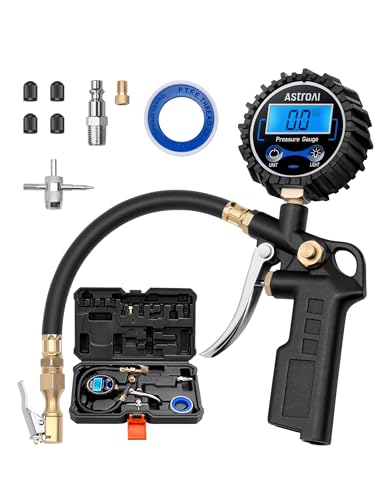
AstroAI Digital Tire Pressure Gauge with Inflator
A digital tire pressure gauge with inflator, a 3-250 PSI range, a 0.1 display resolution, accuracy within 1%, a straight locking chuck and a case, in stainless steel and brass.
Pros
- 3-250 PSI range with a 0.1 display resolution
- Accurate within 1% of the exact pressure
- Straight locking chuck, hose and bleed valve in one unit
- Valve tools, valve stem caps, 4-way valve tool and brass presta adapters included
Cons
- 3-Year warranty, shorter than the lifetime cover on the Rhino gauges
- Straight chuck only, with no dual-head option for inner dual wheels
- Digital display needs power, unlike an analog dial
- Meant for Schrader valves, with presta use only through the included adapters
AstroAI T3 Heavy-Duty Tire Pressure Gauge
A mechanical tire pressure gauge with inflator, a 10-120 PSI range, ANSI B40.1 accuracy, a dual-head chuck and a 1/4-inch quick-connect fitting, in stainless steel and brass.
Pros
- Calibrated to the ANSI B40.1 accuracy standard
- Dual-head chuck reaches inner and exterior dual wheels
- ±2 accuracy from 80-120 PSI, ±3 below 80 PSI
- Works from -14°F to 122°F
Cons
- No warranty term is stated
- Needs an air pump connected to inflate
- 10 PSI low end, so it does not read below 10 PSI
- Mechanical indicator bar, with no digital readout
Tire Inflation Chart: What It Lists and Where to Find It
A tire inflation chart, also called a tire load inflation chart, pairs a tire size with a load and gives the pressure for that pair. The chart is the reference; the pressure for the car itself sits on the vehicle placard and in the vehicle manual. Match the tire size and the load on the chart, read the pressure, and use a gauge to set it.
How to Read a Tire Inflation Chart
- Find the tire size and the load. Read the size off the tire sidewall, then find that size and the load it carries on the chart.
- Read the pressure for that pair. The chart gives one pressure for the size and load; that is the figure to set.
- Check the tire cold. Check the pressure before driving, when the tire is cold, since driving warms the tire and lifts the reading.
- Set it with a gauge and inflator. Press the chuck onto the valve, read the gauge, add air to reach the figure or press the bleed valve to let air out.
- Check each tire the same way. Work around the car and set each tire to the figure the chart gives for its size and load.
What the Gauge Has to Cover
The gauge has to read the pressure the chart gives, fit the valve, and reach the tire. A digital gauge with a 0.1 display resolution shows small changes, an analog dial reads at a glance with no battery, and a dual-head chuck reaches inner dual wheels. Range matters most: the gauges here run from 0-100 PSI to 3-250 PSI, so match the range to the tires on the car.
| Gauge | Range | Display | Chuck |
|---|---|---|---|
| Rhino USA Digital 250 | 250 PSI | Digital, 0.1 resolution | Straight locking chuck |
| Rhino USA Analog 100 | 0-100 PSI | Analog dial | Locking chuck |
| AstroAI T2 Digital | 3-250 PSI | Digital, 0.1 resolution | Straight locking chuck |
| AstroAI T3 Dual Head | 10-120 PSI | Indicator bar | Dual-head chuck |
The Gauges for a Tire Inflation Chart
Each of the 4 gauges below handles one part of the job: the range covers the pressure the chart gives, the chuck fits the valve, and the bleed valve lets extra air out.
Match the Gauge Range to the Tire
Range decides the pick. The Rhino USA analog gauge (on Amazon) covers 0-100 PSI on a large dial for daily car and truck use, the AstroAI T3 (on Amazon) covers 10-120 PSI with ANSI B40.1 accuracy and a dual-head chuck for dual wheels, and the two digital gauges cover 3-250 PSI and 250 PSI for cars, trucks, motorcycles, SUVs, RVs, trailers and more. Accuracy runs within 1% on the AstroAI T2, and the AstroAI T3 reads ±2 from 80-120 PSI and ±3 below 80 PSI. The T3 also works from -14°F to 122°F, and the T2 carries a 3-Year warranty while both Rhino gauges carry a lifetime replacement.
Drain the tank after use so water does not rust it from the inside, never exceed the tool's rated pressure, wear eye protection, and run 240V units on the circuit the manual calls for. Do not run a gas engine compressor in a closed garage. Read our Safety Disclaimer.
FAQ: garage tools
Where do I find the right pressure for my tires?
On the vehicle placard and in the vehicle manual, matched to the tire size and load on a tire inflation chart. The figure on the tire sidewall is a maximum, not the pressure the car needs.
Do I check tire pressure hot or cold?
Cold, before driving. Driving warms the tire and lifts the reading, so a hot check reads higher than the cold figure the chart gives.
What does a tire load inflation chart show?
It pairs a tire size with a load and gives the pressure for that pair. Find the size and the load, read the pressure, and set it with a gauge.
Can one gauge cover cars and trucks?
Yes, if the range covers the pressures involved. The AstroAI T2 and the Rhino USA digital gauge (on Amazon) cover 3-250 PSI and 250 PSI, and both suit cars, trucks, motorcycles, SUVs, RVs, trailers and more.
Does an analog gauge need a battery?
No. The Rhino USA analog gauge has a no-battery design and is always ready for use. A digital gauge shows its reading on a display instead.
Related: air compressors, our picks for the best air compressor for a home garage and the best air compressor for an impact wrench.