Tire Depth Gauge Chart and Tread Limits
A tire depth gauge chart turns a tread reading into a plain answer: green means safe, yellow means watch closely, and red means replace the tire.

On this page
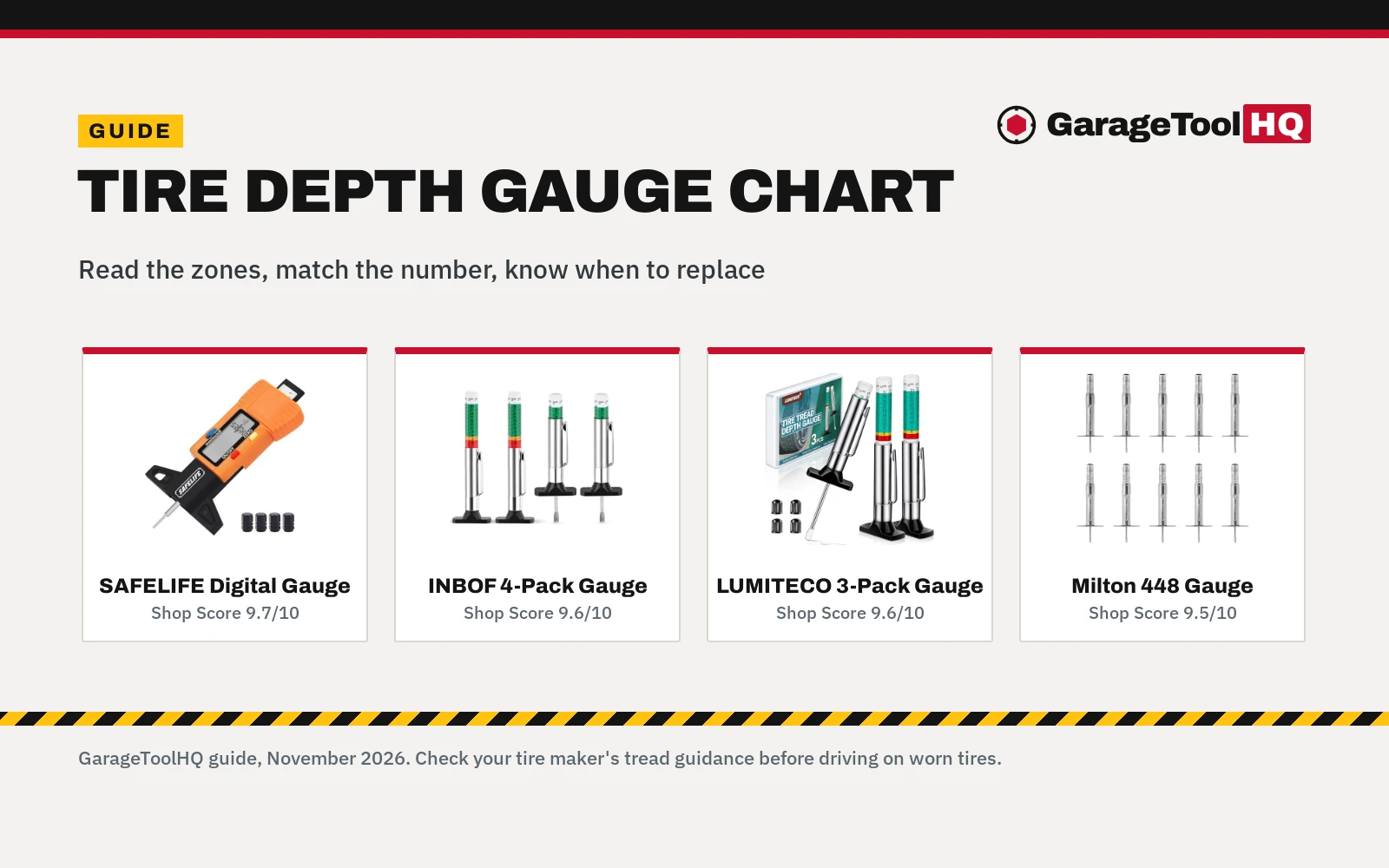
Top picks at a glance
As an Amazon Associate I earn from qualifying purchases.
- 1
 SAFELIFE Digital Tire Tread Depth Gauge9.7/10View on Amazon
- 2
 INBOF 4 Pack Tire Tread Depth Gauge9.6/10View on Amazon
- 3
 LUMITECO 3-Pack Tire Tread Depth Gauge9.6/10View on Amazon
- 4
 Milton 448 Tire Tread Depth Gauge - Box of 109.5/10View on Amazon
A worn tire can look fine from across the garage and still be past its safe limit, which is why a tire depth gauge chart matters. The chart turns a tread depth reading into a plain answer: green means the tread is safe, yellow means watch it closely, and red means the tire needs replacing. Read the gauge, find the reading on the chart, and you know where the tire stands.
GarageToolHQ earns a commission when you buy through links on our product pages, at no extra cost to you. Read our affiliate disclosure.
Below: how to read each zone on the chart, how to take a tread depth reading, and the gauges that match the chart.
SAFELIFE Digital Tire Tread Depth Gauge
A digital tire tread depth gauge with 3 modes, fractional inch, decimal inch and millimeter, readable from 0-25.4mm or 0-1 inch, with a large LCD display and a 1 YEAR warranty.
Pros
- 3 modes: fractional inch, decimal inch and millimeter, switched with one touch
- Readable range 0-25.4mm in metric or 0-1 inch in SAE
- Zeroable at any position, with auto shutoff after 5 minutes
- Large LCD display, plus a depth bar that still reads when the battery has run down
Cons
- Single unit in the box, so one gauge covers one vehicle at a time
- Needs the included 3V CR2032 battery for the display
- No pocket clip is listed, unlike the pencil gauges here
- No color-coded zones: you read the number and match it to the chart yourself
INBOF 4 Pack Tire Tread Depth Gauge
A 4-pack of color-coded tire tread depth gauges in 32nds with a stainless steel probe and ABS plastic body.
Pros
- Color-coded zones: green for safe, yellow for caution, red for replacement
- Stainless steel probe and ABS plastic body, rustproof and durable
- 4 gauges in the pack for different vehicles or replacements
- Checks tread depth in 3 seconds and fits in a glove compartment
Cons
- No warranty term is stated
- No digital readout: you read the color zone and the 32nds scale by eye
- No extras in the box beyond the 4 gauges
- Measures in 32nds only, with no millimeter mode stated
LUMITECO 3-Pack Tire Tread Depth Gauge
A 3-pack of color-coded tire tread depth gauges in 1/32 inch with a pocket clip and 4 extra valve caps.
Pros
- Color-coded zones: red for 0-3/32, yellow for 3/32-6/32, green for 6/32-32/32
- Calibrated from 0 to 1 inch in 1/32 inch with clear markings
- 3 gauges in the pack, plus 4 extra valve caps for replacement
- Pocket-sized with a pocket clip for a vehicle or toolbox
Cons
- No warranty term is stated
- No digital readout: you read the color bar and the 32nds scale by eye
- No millimeter scale is stated
- The flat black edge must sit on both sides of the tread, so placement matters for an accurate read
Milton 448 Tire Tread Depth Gauge - Box of 10
A box of 10 tire tread depth gauges with a round aluminum indicator bar, calibrated from 0 to 1 inch in 1/32 inch markings, with a pocket clip.
Pros
- Round aluminum indicator bar, calibrated from 0 to 1 inch in 1/32 inch markings
- Box of 10 gauges in one purchase
- Made in USA
- Pocket clip included for storage
Cons
- No color-coded zones: you read the 32nds scale and match it to the chart yourself
- No digital readout and no millimeter scale is stated
- No extras beyond the gauges: no valve caps are listed
- A box of 10 suits a shop, but a single-vehicle owner may not need 10
Tire Depth Gauge Chart: How to Read the Zones
A tire depth gauge chart sorts readings into color zones. Each zone pairs a tread depth range with what to do next.
| Zone | Reading | What it means |
|---|---|---|
| Green | 6/32-32/32 | Safe tread depth |
| Yellow | 3/32-6/32 | Caution, close monitoring needed |
| Red | 0-3/32 | Danger, replacement recommended |
The chart sorts readings into three zones. Green runs from 6/32 to 32/32 and marks safe tread depth. Yellow runs from 3/32 to 6/32 and signals caution, so a tire in yellow needs close monitoring. Red runs from 0 to 3/32, warns of danger, and means replacement is recommended.
Minimum tread depths vary by driving condition: least 1.6mm for normal driving, least 3mm at high speed, and least 4mm in rainy and snowy weather.
How to Measure Tread Depth with a Gauge
The steps below are for a color-coded gauge. A digital gauge measures the same way at the tread, but its reading shows on a display instead of a color bar. Check more than one groove, since tread can wear unevenly across the face.
- Place the flat black edge of the gauge on both sides of the tire tread.
- Press down the color bar until it reaches the bottom of the tread groove.
- Read the depth measurement on the indicator bar. Note the reading in 32nds, or in millimeters on a digital gauge.
- Match the reading to the chart. Green means safe, yellow means caution, red means replacement is recommended.
Check tire tread depth every month or every 5,000 to 7,500 miles, and more often before rainy, winter, or snowy weather and before long highway trips. The digital gauge in this guide, the SAFELIFE, adds a large LCD display and 3 modes: fractional inch, decimal inch and millimeter. It can be zeroed at any position, and it shows tread depth from 0-25.4mm in metric or 0-1 inch in SAE.
Tire Depth Gauges for Reading the Chart
Each gauge below takes the tread depth reading the chart needs, from a pocket pencil gauge to a digital gauge with a large LCD display.
FAQ: garage tools
What does a red zone reading mean on a tire depth gauge chart?
A red zone reading runs from 0-3/32 and warns of danger, with replacement recommended. Plan a replacement rather than waiting for the next check.
How often should I check tire tread depth?
Check tire tread depth every month or every 5,000 to 7,500 miles. Check more often before rainy, winter, or snowy weather, and before long or frequent highway trips.
What is the minimum tread depth for driving in rain and snow?
Least 4mm in rainy and snowy weather. For comparison, normal driving needs least 1.6mm, and high-speed driving needs least 3mm.
Can a tire depth gauge measure in millimeters?
A digital gauge with a millimeter mode can: the SAFELIFE in this guide reads from 0-25.4mm in metric, alongside 0-1 inch in SAE. Pencil gauges in 32nds read in fractions of an inch.
Do I need a digital gauge or a color-coded gauge?
Both read the same chart. A color-coded gauge shows green, yellow or red at a glance, while a digital gauge shows the exact reading on its display. Pick the color-coded gauge for a quick zone check and the digital gauge when you want the exact number.
Related: our picks for the best car tire tread depth gauge, the best digital tread depth gauge, our guide to digital vs analog tread depth gauges, and the tire inflation chart.