Transmission Jack vs Floor Jack: Which One Should You Buy?
What separates a transmission jack from a floor jack, four transmission-side examples ranked by capacity and range, and the adapter that bridges them.

On this page
Top picks at a glance
As an Amazon Associate we earn from qualifying purchases.
- 1
 High Lift Hydraulic Transmission Jack9.7/10View on Amazon
- 2
 Pro-Lift F-767 Low Profile Floor Jack9.6/10View on Amazon
- 3
 Transmission Jack Adapter for Cars9.5/10View on Amazon
- 4
 1100 lb Hydraulic Transmission JackView on Amazon
- 5
 Powerbuilt 2 Ton Triple Lift Floor JackView on Amazon
- 6
 BIG RED Hydraulic Trolley Service/Floor Jack with Extra SaddleView on Amazon
- 7
 ARCAN 3-Ton Aluminum Low Profile Floor JackView on Amazon
- 8
 VEVOR Low Profile Floor Jack 2 TonView on Amazon
The transmission jack vs floor jack question is not really a competition, because the two do different jobs. A floor jack lifts the vehicle; a transmission jack holds, balances and positions the transmission or drivetrain component while you unbolt it and lower it out. For drivetrain work you usually need both, and a transmission jack adapter can turn the floor jack you already own into the second tool. Below: what each one does, four examples from the listings, and how to choose.
More options to compare
 1100 lb Hydraulic Transmission JackCheck price on Amazon
 Powerbuilt 2 Ton Triple Lift Floor JackCheck price on Amazon
 BIG RED Hydraulic Trolley Service/Floor Jack with Extra SaddleCheck price on Amazon
 ARCAN 3-Ton Aluminum Low Profile Floor JackCheck price on Amazon
 VEVOR Low Profile Floor Jack 2 TonCheck price on Amazon
GarageToolHQ earns a commission when you buy through links on our product pages, at no extra cost to you. Read our affiliate disclosure.
Transmission Jack vs Floor Jack: What Each One Does
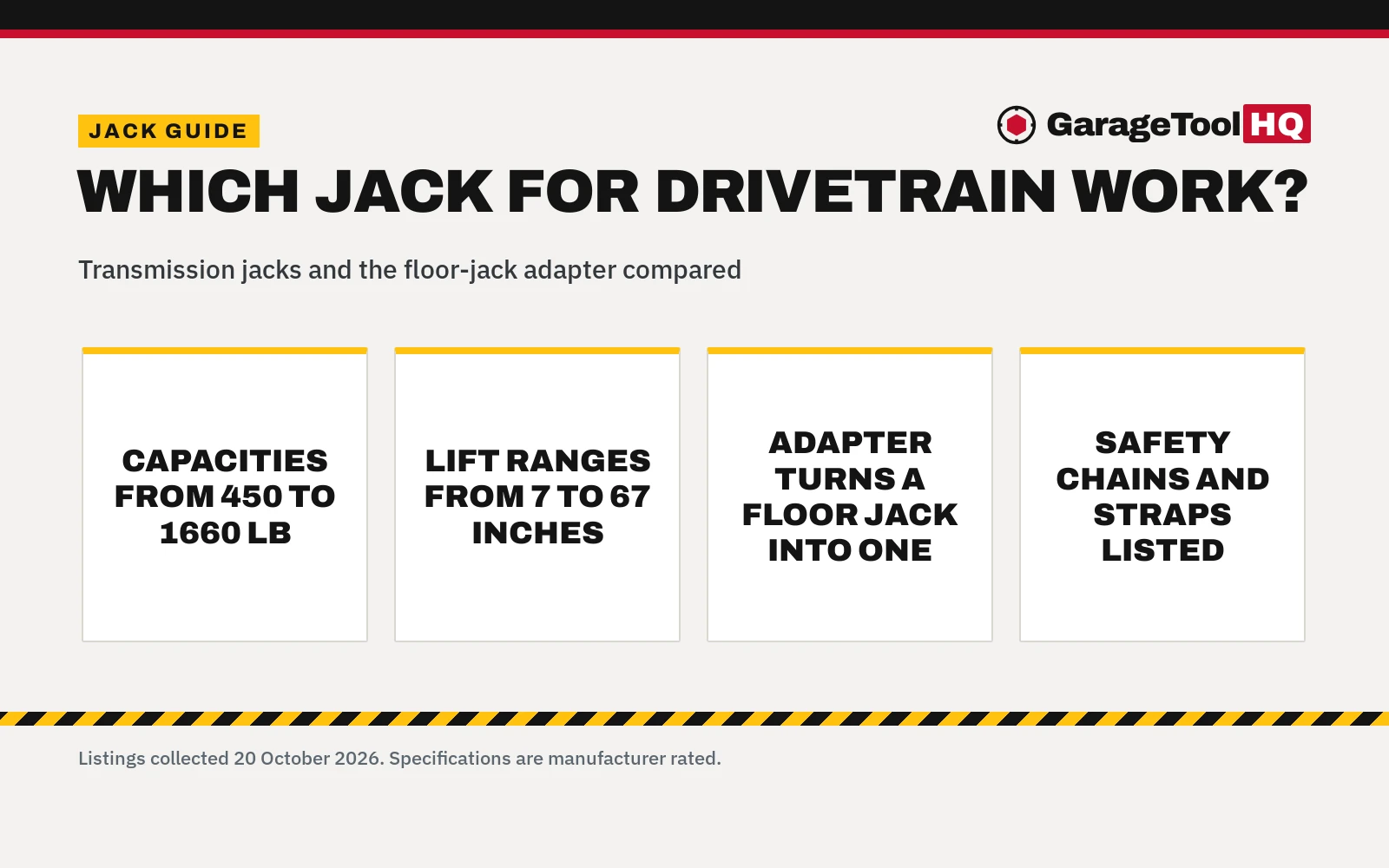
A floor jack rolls under the car, lifts it by the frame or a lift point, and holds it there only while you position rated jack stands under it. The stands, not the jack, hold the vehicle once it is lowered onto them. A transmission jack is a second, smaller lift that goes under the transmission itself: it carries the weight of the gearbox, tilts it into alignment, and lowers it out once the bolts are out. The four listings here are all on the transmission side, with capacities from 450 to 1660 lb, lift ranges from 7 to 67 in, and tilt or rotation adjustments on three of the four for lining the unit up with the engine.
The four examples, ranked
1. VEVOR 0.75-ton telescopic transmission jack
The biggest capacity here: 1660 lb with a 33-1/2 to 67 in telescoping lift range, a foot-operated pedal, an adjustable saddle with 30-degree tilt, four 360-degree swivel casters and two heavy-duty safety anchor chains on an alloy steel frame. It weighs 86 lb and measures 29.1 x 16.5 x 10.6 in. One listing wrinkle: the model number reads 0.6T while the title states 0.75 ton and 1660 lb; the title and bullets win. No warranty is stated. Who it suits: a home shop pulling truck transmissions at height. Who should skip it: anyone working on low cars, since the 33-1/2 in starting height is the tallest here.
2. VEVOR transmission jack adapter
The bridge between the two sides of this comparison: an 1100 lb (0.5 ton) adapter that fits a floor jack with a 1.2 in removable saddle shaft, turning that floor jack into a transmission jack. The listing states it is not suitable for high-lift transmission jacks. The tray rotates 360 degrees and tilts up to 30 degrees, the plate width adjusts from 8.5 to 11.8 in, the claw width from 5.1 to 13.6 in, and two 31.5 in chains secure the load. It weighs 19.4 lb. No warranty is stated. Who it suits: anyone who already owns a floor jack with a 1.2 in saddle and wants transmission capability without a second lift. Who should skip it: anyone whose floor jack saddle is not 1.2 in and removable.
3. MOTOOS 1100 lb transmission jack
A mid-range low-profile unit: 1100 lb capacity with a 7.68 to 24.8 in lift range, an adjustable tilt saddle for forward and backward alignment, four 360-degree swivel casters and a heavy-duty steel build. It weighs 99.1 lb, the heaviest here, and measures 34.65 x 18.11 x 10.24 in. The spec table lists the style name as “Floor Jack”, which does not match the transmission jack title; the title wins. No warranty is stated. Who it suits: passenger cars, SUVs and light trucks in a home garage. Who should skip it: anyone who needs the tall reach of the telescopic pick.
4. Garvee 450 lb transmission jack
The smallest and lowest-weight dedicated unit: 450 lb capacity with a 7 to 23 in low-profile range, 2-meter safety straps, four brake wheels that lock for positioning, and an alloy steel build. It weighs 45.4 lb and measures 18.11 x 17.32 x 7.68 in. The warranty description reads only “1”, which is not a stated term, so no warranty is counted. Who it suits: compact cars and small trucks where a lighter jack is easier to maneuver. Who should skip it: anyone lifting heavy truck transmissions, since 450 lb is the lowest capacity here.
Choosing: capacity and lift range
Capacity first. The listings run 450, 1100, 1100 and 1660 lb; the adapter rates 1100 lb on a floor jack. Match the rating to the transmission plus the margin the job needs, and note that the adapter’s rating assumes the floor jack beneath it is rated for the same load. Lift range second: the Garvee and MOTOOS start at 7 and 7.68 in for low cars, while the VEVOR telescopic starts at 33-1/2 in and reaches 67 in for trucks on a lift. Measure the working height before choosing, since a jack that cannot reach the component is the wrong tool.
The adapter option
The VEVOR adapter deserves its own note because it answers the comparison directly: instead of buying a transmission jack, you fit this 1100 lb adapter to a floor jack with a 1.2 in removable saddle shaft. You get the 360-degree rotation and 30-degree tilt of a transmission saddle on the jack you own. The limits are stated too: it is not suitable for high-lift transmission jacks, and it only fits the 1.2 in saddle size. If your floor jack qualifies, it adds transmission capability without a second lift.
A jack is for lifting, not holding. Never work under a vehicle supported only by a jack: set it on rated jack stands, on solid, level ground, at the manufacturer's lift points, chock the wheels, and give the car a firm shake before you go under. Read our Safety Disclaimer.
Working safely with jacks
Never get under a vehicle supported only by a jack. Lift with the jack, then set rated jack stands on solid, level ground and lower the vehicle onto them before any part of you goes underneath. Use the lift points your owner’s manual specifies, keep the transmission load chained or strapped to the saddle before moving it, and chock the wheels that stay on the ground.
Frequently Asked Questions
Can I use a floor jack instead of a transmission jack?
A floor jack on its own has no tilting transmission saddle, no controlled rotation and no built-in way to secure a transmission. The adapter example here fits a floor jack with a 1.2 in saddle and adds a 360-degree rotating, 30-degree tilting tray rated at 1100 lb.
What capacity do I need?
The listings here run 450, 1100 and 1660 lb. Match the rating to the transmission you will pull, and check that a floor jack plus adapter is rated for the same load as the component.
What lift range fits my car?
The Garvee starts at 7 in and the MOTOOS at 7.68 in for low cars; the VEVOR telescopic runs 33-1/2 to 67 in for trucks at height. Measure the working height first.
Do these include safety chains or straps?
The VEVOR telescopic lists two safety anchor chains, the adapter two 31.5 in chains, and the Garvee 2-meter safety straps. The MOTOOS lists none.
Which of these state a warranty?
None with a clear term. The VEVOR telescopic states no warranty, the Garvee warranty field reads only “1”, and the adapter and MOTOOS state none.
Related: the best floor jack for lifted trucks and 2 ton floor jack with stands roundups, pin type vs ratchet jack stands and air jack vs bottle jack.