Pin Type vs Ratchet Jack Stands: Which One Should You Buy?
Pin type vs ratchet jack stands: how the pin lock and the ratchet pawl differ on security, adjustment speed, capacity and height range, with listing figures.

On this page
Top picks at a glance
As an Amazon Associate we earn from qualifying purchases.
- 1
 Pro-LifT T-6903D Double Pin Jack Stands9.7/10View on Amazon
- 2
 DNA Motoring 2 Ton Car Jack and Stands Kit Red/Black 2T9.5/10View on Amazon
- 3
 Pro-Lift T-6906D Double Pin Jack Stand9.7/10View on Amazon
- 4
 Sunex 1410 10-TonView on Amazon
- 5
 Sunex 1310 10-Ton Medium Height Pin Type Jack StandsView on Amazon
- 6
 BIG RED Heavy Duty Pin Type Professional Car Jack Stand withView on Amazon
- 7
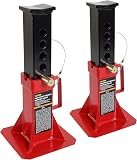 Torin 12 Ton Heavy Duty Pin Style Adjustable HeightView on Amazon
Pin type vs ratchet jack stands comes down to how the stand locks at height. A pin-type stand holds the load on a steel pin dropped through holes in the support column, like the Sunex 1410 with its 10 height intervals in 2 in. increments. A ratchet stand holds the load on a pawl that engages teeth on the column, adjusted with a lever, like the ratchet lever described on the Torin 12-ton listing. Pick pin type for a positive mechanical lock at fixed heights; pick ratchet for faster one-handed height adjustment.
More options to compare
 Sunex 1410 10-TonCheck price on Amazon
 Sunex 1310 10-Ton Medium Height Pin Type Jack StandsCheck price on Amazon
 BIG RED Heavy Duty Pin Type Professional Car Jack Stand withCheck price on Amazon
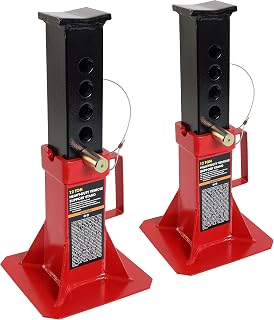 Torin 12 Ton Heavy Duty Pin Style Adjustable HeightCheck price on Amazon
GarageToolHQ earns a commission when you buy through links on this page, at no extra cost to you. Affiliate disclosure.
How a pin-type jack stand works
A pin-type stand is a base, a support tube with a row of holes, and a steel pin. You lift the inner column to the hole nearest your target height and slide the pin through; the vehicle then rests on the pin itself. The Sunex 1310 listing describes exactly this: multiple hole locations in the support tube with the pin attached to the stand so it cannot get lost. Because the pin passes fully through the column, the lock is visible and checkable at a glance, which is why heavy equipment favors it: the Sunex 1522A 22-ton pair and the VOWAGH 22-ton pair are both pin type, rated 44,000 lb across the pair, for trucks, trailers and fleet work.
The trade is granularity. Pin stands lock only where the holes are. The Sunex 1410 gives 10 intervals in 2 in. steps across its 28.1 to 46.5 in. range; the Sunex 1310 gives 6 adjustments. If your ideal saddle height falls between holes, you take the lower hole, never a partial engagement.
How a ratchet jack stand works
A ratchet stand replaces the pin with a toothed column and a spring-loaded pawl on a lever. Lift the saddle and the pawl clicks up the teeth; lower the lever and the pawl locks against a tooth to hold the load. The Torin 12-ton listing describes this mechanism directly: with the handle up the ratchet adjusts freely to any height, and with the handle down it locks automatically. Adjustment is one-handed and continuous across the teeth, which is faster than pulling and re-seating a pin, and the Torin 12-ton listing describes both a ratchet lever and a steel pin.
The trade is trust in a moving part. A pawl depends on its spring and on full tooth engagement, so ratchet stands demand a look at the engagement before every use and benefit from the secondary pin where one is provided.
Pin type vs ratchet jack stands: locking security versus height adjustment
This is the real comparison the keyword asks about. A pin is a positive lock: once through the column, it cannot slip a tooth, and the engagement is obvious from across the garage. That is why the heaviest stands in the listings, the 22-ton Sunex, VOWAGH and Garvee pairs, all use pins. A ratchet trades some of that certainty for speed and fine adjustment: no fixed holes to hunt, just lift to height and let the pawl catch.
In practice, most home garages do fine with either, because both types here carry serious ratings: 10-ton pairs like the Sunex 1410 at 105 lb with its 15.7 in. square base, 12-ton pairs like the BIG RED at 42.7 lb, and 22-ton pairs for trucks and RVs. Match the lock type to your habit: if you set stands once and leave them, the pin’s visible lock wins; if you raise and lower often, the ratchet’s lever wins.
Capacity: what the tonnage means
Stand capacity is rated across the pair, and the listings state it plainly: 10 tons is 20,000 lb across the pair, 12 tons is 26,400 lb, and 22 tons is 44,000 lb. A 12-ton pair like the BIG RED or the Torin covers cars, sedans, trucks, SUVs, ATVs and UTVs per their listings; the 10-ton Sunex pairs suit trucks and trailers; the 22-ton pairs suit heavy trucks, RVs and equipment. Buy capacity for the heaviest vehicle you will lift, not the one in the bay today, and always use the stands as a matched pair.
Height range and vehicle fit
Height range decides which vehicles a stand can serve. The tall Sunex 1410 spans 28.1 to 46.5 in. for high-clearance trucks; the mid-range BIG RED spans 12-5/8 to 18-1/8 in.; the Torin spans 12.6 to 18.2 in.; the Garvee 22-ton spans 13 to 19 in.; and the VOWAGH 22-ton spans 11.88 to 19.75 in. Measure your vehicle’s lift points at the height you work: the saddle must reach the frame or axle with the suspension hanging, and the stand must sit on flat, solid ground. A 3.1 by 5.1 in. saddle like the Sunex 1410’s helps center the contact; V-style saddles cradle axles.
Safety rules that apply to both types
Whichever lock you choose, the safety discipline is the same. Jack stands support a lifted vehicle; they are not the lifting device, so lift with a jack, then set the stands, then lower the vehicle onto them. Work on level concrete, chock the wheels that stay on the ground, and give each stand a shake before going under. The Torin listing notes its stands meet PASE-2019 safety standards; treat any stand without a stated standard with extra care, and retire a stand with a bent column, a damaged pin or a pawl that does not click cleanly. Never work under a vehicle held only by a jack.
Which one should you buy?
- Choose pin type if you want the most positive, visible lock, you work on heavy trucks or equipment, or you set the height once per job. The 22-ton pin pairs exist for exactly this user.
- Choose ratchet if you adjust height often, work alone, or want the fastest setup, and you will check pawl engagement every time. A stand with both mechanisms, like the Torin example, splits the difference.
- Either way, buy the pair rating for your heaviest vehicle, match the height range to your lift points, and use the stands as a pair on solid ground.
Frequently Asked Questions
Is a pin-type jack stand safer than a ratchet one?
A pin gives a positive mechanical lock you can see, which is why the 22-ton heavy-duty pairs use pins. A ratchet is safe when the pawl fully engages and is checked, and the Torin 12-ton listing describes both a ratchet lever and a steel pin.
Can I use just one jack stand?
No. The listings rate capacity across the pair, and every listing here sells or describes them as pairs. Always support the vehicle on a matched pair.
What height range do I need?
Measure your lift points with the suspension hanging. Passenger cars and SUVs fit the 12 to 18 in. class like the BIG RED 12-5/8 to 18-1/8 in. or the Torin 12.6 to 18.2 in.; high-clearance trucks need the tall class like the Sunex 1410 at 28.1 to 46.5 in.
Do pin-type stands need any maintenance?
Keep the pin with the stand, since several listings attach it with a lanyard or bracket to prevent loss, and check that holes are not elongated and the pin seats fully. A lost pin is a useless stand.
What does the tonnage rating cover?
The pair. A 10-ton pair supports 20,000 lb total, a 12-ton pair 26,400 lb, and a 22-ton pair 44,000 lb, per the listings. The rating is for the two stands together, not each.
Can I leave a car on jack stands long term?
The listings describe stands for service and repair work, not indefinite storage. For long-term storage, the listings’ own framing is inspection, maintenance and repair; check the stands periodically and keep them dry and clean.