V Belt Measurement Tool: How to Size a V-Belt
A v belt measurement tool reads the outside circumference of a V-belt so you can order the right replacement, with gauges that cover A and B belts up to 100 in and automotive V and Micro-V belts up to 120 in.

On this page
The old belt slips off the pulley on a Saturday job, and the replacement has to match the one that came off. A v belt measurement tool is a gauge that reads the outside circumference of a V-belt, so you can order the right size instead of guessing from the worn belt in your hand. This guide explains what the tool measures, how the two common gauges differ, and how to use the reading to order a replacement.
As an Amazon Associate I earn from qualifying purchases. GarageToolHQ earns a commission when you buy through links on our product pages, at no extra cost to you. Read our affiliate disclosure.
Below: what a belt gauge measures, how the Stens and Gates gauges differ, and a step-by-step way to measure a belt and order its replacement.
What a v belt measurement tool measures
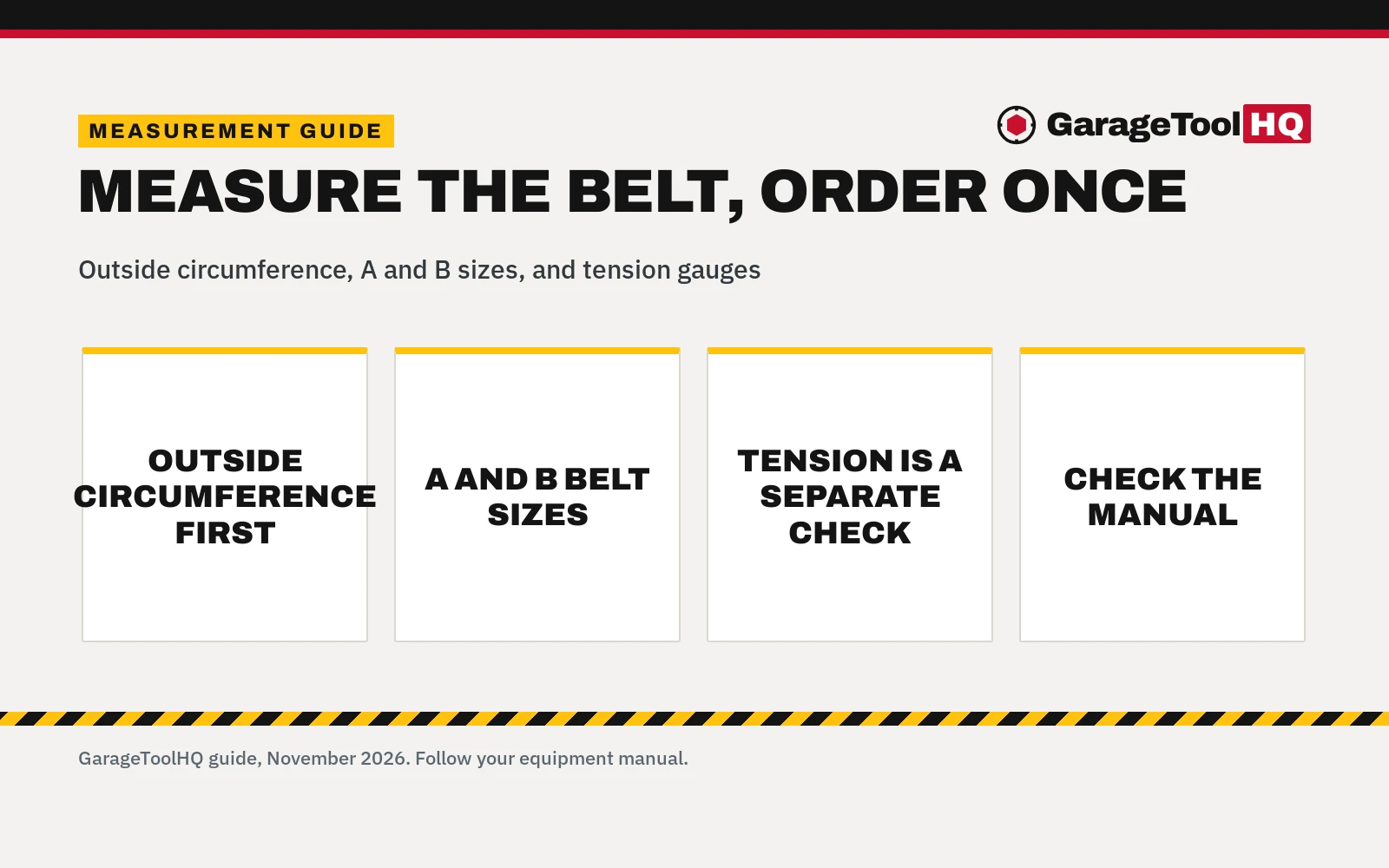
A V-belt is identified by its cross-section type and a length figure. A v belt measurement tool reads the outside circumference, the length around the outside of the loop: you run the belt through the gauge and read the length off its scale, instead of laying a tape along a floppy loop. That outside reading is a measurement to work from, not the size on the box by itself, since belt sizes are listed by different length standards. The Stens 752-998 Belt-Measurer states that it measures the outside circumference of a belt and reads in 1/2 in increments, and that it covers FHP, power rated, A and B belts up to 100 in. The Gates 91219 Belt Size Gauge covers automotive V and Micro-V belts up to 120 in, with a dual-sided design and Micro-V measurements in inches as well as millimeters.
Cross-section matters as much as length. A and B are belt cross-section sizes, and a belt that is the right length but the wrong section will sit too high or too low in the pulley groove and slip or wear fast. The gauge tells you the length; the section comes from the belt you are replacing, so read the markings on the old belt or match it against the gauge maker’s guidance before you order.
Two gauges for length: Stens and Gates
| Gauge | Belts it measures | Longest belt | How it reads |
|---|---|---|---|
| Stens 752-998 Belt-Measurer | FHP, power rated, A and B belts | Up to 100 in | Outside circumference, 1/2 in increments |
| Gates 91219 Belt Size Gauge | Automotive V and Micro-V belts | Up to 120 in | Dual-sided; Micro-V side in inches and millimeters |
Pick the gauge that covers the belts you own. The Stens gauge is the one for FHP, power rated, A and B belts, and the listing states it is made in the USA. The Gates gauge is the one for automotive V and Micro-V belts, and its dual-sided design puts the Micro-V scale on the other side. Each reads outside circumference, so use the number you get with the belt section and the printed size to work out the order.
One small contradiction in the Stens listing: the bullets list a package weight of 3.04 lb while the spec table lists an item weight of 3.05 lb. The difference is small, and the length figures are the ones that matter for sizing a belt.
How to measure a V-belt step by step
- Take the belt off the pulleys. A belt still on the machine cannot be run through a gauge, and the pulleys hide the length you need.
- Read the markings on the old belt first. The printed size on the belt is the quickest guide to its replacement, and the gauge reading confirms it.
- Run the belt through the gauge. Feed the loop through the measuring tool the way the maker describes, and let the belt sit flat in the gauge without twists.
- Read the outside circumference off the scale. The Stens gauge reads in 1/2 in increments, so note the nearest mark the belt lines up with.
- Note the belt section. A and B are different cross-sections, so a length alone is not enough: match the section of the old belt too.
- Order by section and size. Give the supplier the belt section and the size from the printed markings or the manual, use the gauge reading to confirm, and check how the supplier lists sizes before you buy.
- Check the manual. The equipment manual lists the belt size the machine was built for, and it is the final check on any gauge reading.
A length gauge and a tension gauge do different jobs. The Stens and Gates tools above measure length. A tension gauge measures how tight the belt runs, and it cannot tell you the belt size.
Belt tension gauges: a separate check
Tension is a separate measurement from length, and it has its own tools. The KZDAZ belt tension gauge carries a 10-pound specification: set the rubber O-ring stopper at the 10 lb mark, place the gauge against the belt, and read the measurement to check belt tension. If the belt deflects too much, it is too loose; if it barely moves, it is too tight. The listing states it fits motorcycles, ATVs and vehicles with a secondary drive belt and a 10 lb weight.
The Gates Unitta U-550 sonic belt tension meter works a different way: it measures the vibration frequency of the belt, with a measurement time of 0.2S and a measuring accuracy of +/-1%. Its range covers 10-5000Hz and 0.01-99900N, with frequency ranges of HIGH (900-5000 Hz), STANDARD (10-1000 Hz) and LOW (10-50 Hz), for multi-ribbed V- and synchronous belts. It displays in Newton or Hz, and the listing states a 1 year warranty.
Use rated jack stands on solid ground, wear eye protection with power and air tools, keep fuel-burning equipment out of a closed garage, and follow the manual for every tool. Read our Safety Disclaimer.
Reading the result and ordering the replacement
Match the replacement belt by section first, then by size, using the gauge reading to confirm the printed size. A and B belts are different cross-sections, so a belt with the right length and the wrong section will not seat in the pulley groove. If the old belt is stretched, the gauge measures the stretched length, so the reading runs longer than the size to order and the printed size is the better guide; if the printed size is worn off, use the gauge reading with the manual. When the two disagree, check the equipment manual for the size the machine was built for.
Keep the gauge where you can reach it. The Gates gauge lists dimensions of 49.2 x 6.3 x 4.0 in and a weight of 2.0 lb, so it is a long tool that hangs on a wall or lies on a shelf, not a pocket tool. The Stens gauge lists an item weight of 3.05 lb. A gauge that lives in the garage gets used; one buried in a drawer does not.
For the rest of the belt job, a torque wrench holds the fasteners to spec: see the best torque wrench guide. Measuring tools in general live in the measuring and inspection hub, and the engine and shop equipment hub covers the rest of the shop.
FAQ: garage tools
What does a v belt measurement tool measure?
It measures the outside circumference of a V-belt, the length around the outside of the loop. The Stens gauge reads in 1/2 in increments and covers A and B belts up to 100 in, and the Gates gauge covers automotive V and Micro-V belts up to 120 in.
How do I know if my belt is an A or B belt?
A and B are belt cross-section sizes. Read the markings printed on the old belt, or match the belt against the gauge maker’s guidance. A length reading alone does not identify the section, so check both before you order.
Can I measure a V-belt with a tape measure?
A tape measure can follow the outside of the loop, but a floppy belt is hard to hold flat and the reading wanders. A belt gauge holds the loop in shape and reads the outside circumference off a fixed scale, which is why the Stens and Gates gauges exist.
What is the difference between a belt length gauge and a belt tension gauge?
A length gauge reads the outside circumference, which you use with the section and the manual to order the right size. A tension gauge checks how tight the belt runs: the KZDAZ gauge uses a 10 lb mark, and the U-550 meter reads vibration frequency from 10 to 5000 Hz. Length and tension are different measurements, and one tool does not do the other’s job.
Does a sonic belt tension meter work on V-belts?
The U-550 listing states it is for multi-ribbed V- and synchronous belts, with a range of 10-5000Hz and 0.01-99900N. Check the listing for your belt type before you buy, and follow the meter’s instructions for the frequency range to use.
Related: torque wrenches for the fasteners around a belt job, the best digital angle gauge, a guide to how to use a tire pressure gauge, the measuring and inspection hub and the engine and shop equipment hub.