Vertical vs Horizontal Air Compressor: Differences Explained
How vertical and horizontal air compressors differ in floor space, center of gravity, portability and tank drainage to help you choose the right garage setup.

On this page
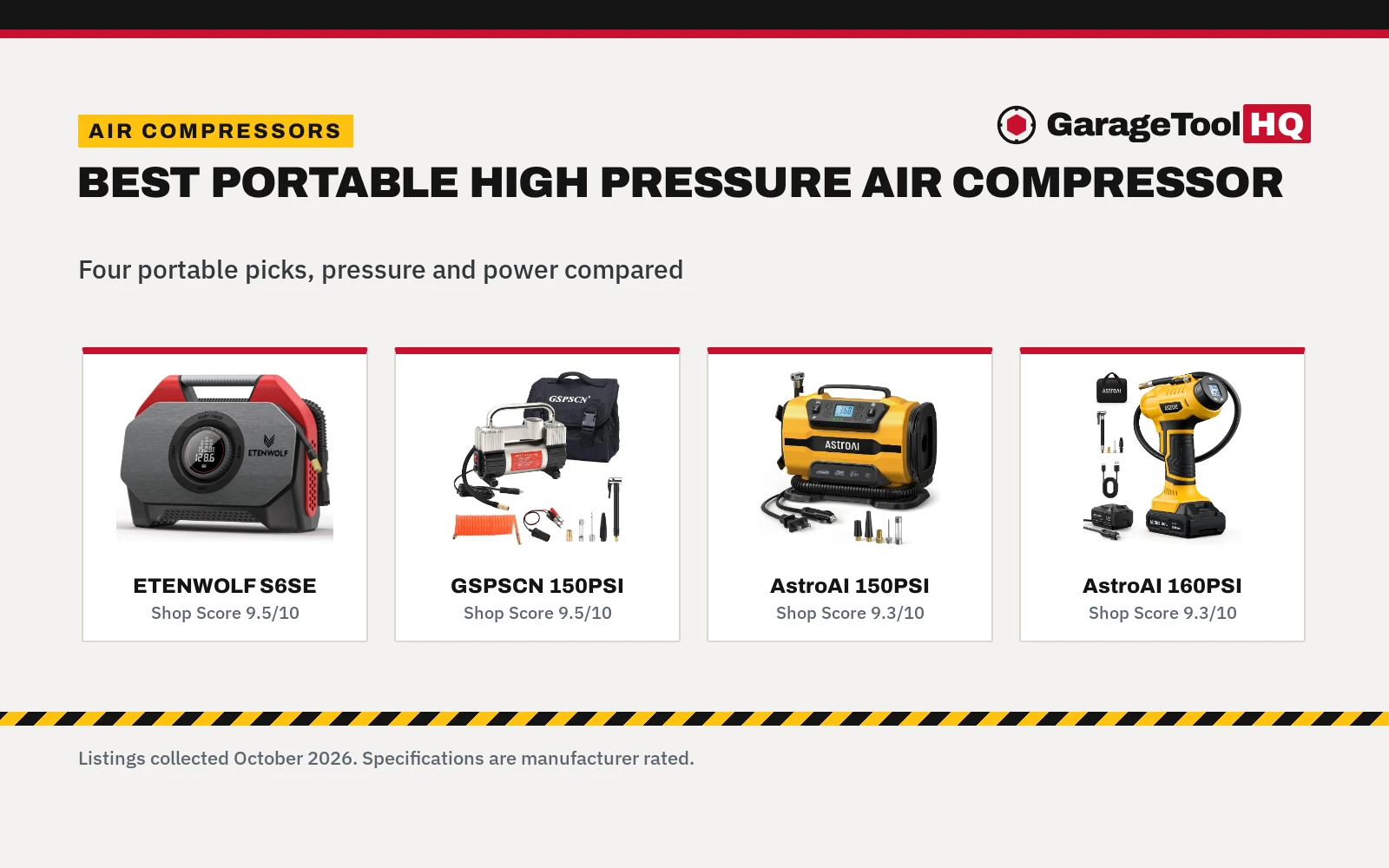
Top picks at a glance
As an Amazon Associate we earn from qualifying purchases.
- 1
 Campbell Hausfeld 80-Gallon Vertical Electric Air Compressor9.7/10View on Amazon
- 2
 Stark USA 3.5HP 10 Gallons Air Compressor Tank Ultra Quiet9.3/10View on Amazon
- 3
 ONEAND 1 GAL. 120 PSI Portable 18V Horizontal AIR Compressor9.3/10View on Amazon
- 4
 90-120 PSI Air Compressor Pressure Control Switch Valve WithView on Amazon
- 5
 Quincy QT-54 Splash Lubricated Reciprocating Air CompressorView on Amazon
- 6
 CAMPBELL HAUSFELD 30 Gallon Horizontal Air CompressorView on Amazon
- 7
 Ingersoll Rand SS3L3 Single Stage Air CompressorView on Amazon
- 8
 Ingersoll Rand 2475N7.5 7.5 HP Two-Stage Air CompressorView on Amazon
- 9
 VEVOR 15HP Gas Powered Air CompressorView on Amazon
When evaluating a vertical vs horizontal air compressor, the primary difference is the shape of the tank and the floor space it occupies, while the motor, pump, and delivered airflow perform identically for equivalent mechanical ratings. A vertical air compressor uses an upright tank that occupies minimal floor area, making it well suited for stationary garage corners. A horizontal air compressor mounts a tank lying flat, providing a lower center of gravity that resists tipping during transport or when rolling across uneven workshop floors. Choosing between a vertical or horizontal tank configuration depends on your available floor area, ceiling clearance, mobility demands, and drain valve access rather than pneumatic power.
More options to compare
 90-120 PSI Air Compressor Pressure Control Switch Valve WithCheck price on Amazon
 Quincy QT-54 Splash Lubricated Reciprocating Air CompressorCheck price on Amazon
 CAMPBELL HAUSFELD 30 Gallon Horizontal Air CompressorCheck price on Amazon
 Ingersoll Rand SS3L3 Single Stage Air CompressorCheck price on Amazon
 Ingersoll Rand 2475N7.5 7.5 HP Two-Stage Air CompressorCheck price on Amazon
 VEVOR 15HP Gas Powered Air CompressorCheck price on Amazon
GarageToolHQ earns a commission when you buy through links on our product pages, at no extra cost to you. Read our affiliate disclosure.
Below: how vertical and horizontal air compressors compare, how tank layout influences floor footprint and stability, moisture drainage considerations, and how to choose the right tank orientation for your garage.
Vertical vs horizontal air compressor: what changes and what stays the same
An air compressor pump functions identically whether the storage tank stands vertically or lies horizontally. In both layouts, an electric motor drives a pump that draws in air, compresses it inside cylinders, and delivers it into a steel pressure vessel. Pneumatic airflow and pressure delivery depend strictly on pump displacement, motor horsepower, and pressure ratings rather than vessel orientation.
Manufacturer specifications confirm that tank orientation does not alter compressor output. For stationary shop installations, Campbell Hausfeld lists a 60-gallon vertical compressor delivering 7.6 SCFM at 90 PSI with a 175 PSI maximum pressure powered by a 3.7 running HP motor on a 230V electrical supply. Similarly, DEWALT lists a 60-gallon vertical stationary compressor delivering 14.6 SCFM at 90 PSI and 17 cfm at 40 psi with a 175 PSI maximum pressure powered by a 5 HP motor on a 240V circuit. An equivalent pump and motor assembly mounted to a horizontal tank produces matching airflow and pressure. To understand how tool demand connects to pump ratings, read our guide on what CFM at 90 PSI means and review what CFM air tools need before selecting equipment.
| Feature | Vertical Air Compressor | Horizontal Air Compressor |
|---|---|---|
| Floor Footprint | Compact, upright footprint that preserves floor space in crowded shops | Longer, wider footprint that occupies more open floor area |
| Center of Gravity | Higher center of gravity; benefits from stationary installation | Low center of gravity; highly stable against tipping when bumped or moved |
| Mobility and Transport | Tall profile can feel top-heavy on rough ground; stores easily in corners | Stable when rolled on wheels or hauled in vehicles; compact units slide under benches |
| Condensation Drainage | Moisture settles directly over a bottom drain valve at the lowest point | Moisture pools along cylinder length; draining depends on proper tank pitch toward valve |
| Overhead Clearance | Requires ample vertical clearance for tall tanks | Lower overhead profile; compact portable models can fit beneath workbenches or shelving |
| Pneumatic Output | Air delivery (CFM and PSI) depends on pump and motor, not tank shape | Air delivery (CFM and PSI) depends on pump and motor, not tank shape |
Floor footprint and workshop space planning
Floor area is often the most restricted resource in a residential garage. Vertical air compressors utilize vertical height to minimize their floor footprint. In stationary sizes, Campbell Hausfeld states that its 60-gallon vertical tank features a compact footprint of 23 x 23-inch dimensions while standing 77 inches tall with an overall weight of 255 pounds. This upright design allows a stationary unit to tuck into a shop corner or along a wall while maintaining manufacturer-specified clearance for cooling airflow. Portable vertical units provide similar floor-saving benefits. For example, California Air Tools lists its 10-gallon steel tank compressor with dimensions of 16"L x 15.1"W x 35.9"H weighing 82.5 pounds, while RyanTek lists a 15-gallon vertical model weighing 68.3 pounds. NorthStar lists an 8-gallon vertical portable compressor with a weight of 97 pounds.
Horizontal air compressors spread their volume along the floor. For example, MZB lists a 13.2-gallon portable compressor with dimensions of 24"L x 13"W x 26"H weighing 72 pounds. While the 24-inch length occupies more open floor area than an upright tank of similar capacity, the 26-inch height allows a compact portable unit to store beneath sturdy workbenches, welding tables, or low shelving. Large stationary horizontal compressors occupy substantial floor area and are not designed for under-bench placement. For broader sizing recommendations across different tank volumes, see our guide on how to choose an air compressor.
Center of gravity, stability, and mobility
An air compressor’s mechanical stability depends directly on its center of gravity. On a horizontal compressor, the heavy pump and motor mount low to the ground directly atop the horizontal cylinder. This low center of gravity keeps the machine stable against accidental bumps, hose tugs, or movement across cracked concrete. For mobile applications, horizontal units are easier to transport in a pickup truck bed or trailer because the low profile resists rolling or tipping during turns.
Vertical compressors mount the motor and pump near the top or upper side of the upright cylinder, creating a higher center of gravity. For portable units, this upright profile requires greater care during movement. For example, DEWALT lists a 15-gallon vertical portable compressor (D55168) with dimensions of 24.5"L x 20"W x 44.75"H, and Campbell Hausfeld lists a 15-gallon vertical portable compressor (C151CH.COM) weighing 75 pounds. Moving an upright compressor across rough gravel or doorway thresholds requires a steady grip to avoid tipping. For stationary 60-gallon vertical models from Campbell Hausfeld and DEWALT, the tall profile is designed to remain permanently anchored to a concrete floor over vibration isolation pads.
Tank condensation drainage and maintenance
Compressing humid air generates moisture that condenses against steel tank walls. If left inside the vessel, water causes internal rust and enters air tools.
Tank orientation changes how condensation pools and drains:
- Vertical tank drainage: Gravity pulls moisture down the vertical walls to a central low point on the bottom dome, where manufacturers place the drain valve for clean drainage.
- Horizontal tank drainage: Condensation settles along the bottom length of the cylinder. Complete drainage depends on tank pitch, requiring the tank to tilt toward the drain valve so water does not remain pooled in low spots.
Drain the tank after every work session. For proper care procedures, follow our walkthrough on how to drain water from an air compressor tank and consult our air compressor maintenance guide.
Never weld, patch, drill, or modify an air compressor tank. Verify that a stationary tank carries an ASME certification, inspect for exterior rust, and manually check the safety pressure relief valve per manufacturer guidelines. Remove damaged or leaking vessels from service immediately.
Drain the tank after use so water does not rust it from the inside, never exceed the tool's rated pressure, wear eye protection, and run 240V units on the circuit the manual calls for. Do not run a gas engine compressor in a closed garage. Read our Safety Disclaimer.
Pump mechanisms, noise levels, and electrical supply
Tank orientation does not influence pump style, sound levels, or electrical requirements.
Quiet operation depends on low-RPM motor and pump engineering. For example, California Air Tools lists an oil-free dual piston pump operating at 70 dBA at 1680 RPM, NorthStar lists an oil-free pump running at 1750 RPM producing 70 dB on a 115V circuit drawing 12 Amp, and RyanTek lists an oil-free twin-cylinder pump operating at 66 dB. Conversely, Campbell Hausfeld lists a 15-gallon vertical portable compressor producing 81 db, and DEWALT lists a 15-gallon vertical portable compressor producing 78 db.
For heavy workshop duty, stationary compressors often utilize oil-lubricated cast-iron pumps. Campbell Hausfeld states that its 60-gallon vertical compressor features an oil-lubricated two-stage cast-iron pump engineered for up to 10,000 hours of pump life based on the B-10 bearing rating, while DEWALT lists a 60-gallon vertical stationary model using an oil-lubricated single-stage pump. Compare designs in our breakdown of oil-free vs oil-lubricated air compressors and our guide on single stage vs two stage air compressors.
Portable compressors run on standard 110V or 120V circuits, such as the Campbell Hausfeld 15-gallon model rated for 15A at 120V. Stationary units require dedicated 230V or 240V circuits, such as the DEWALT 60-gallon model requiring a 20A circuit at 240V. Have a licensed electrician install dedicated 240V circuits.
How to choose: vertical or horizontal tank configuration
Selecting between an upright vertical tank and a flat horizontal tank comes down to your shop space, layout constraints, and mobility plans:
- Evaluate available floor area. If floor space is tight, an upright vertical compressor occupies the smallest footprint in a shop corner.
- Check overhead clearances. If storing under a workbench or low shelving, choose a low-profile horizontal portable model.
- Determine mobility demands. For frequent hauling in a truck bed or over rough terrain, a horizontal model provides a stable, tip-resistant center of gravity. For fixed garage setups, a vertical tank preserves floor area.
- Inspect drain valve access. Ensure the drain valve is reachable to discharge moisture after every project.
- Match pneumatic output to your tools. Base sizing on CFM delivery at 90 PSI and tank volume rather than tank shape alone.
Compare workshop models in our guide to the best air compressor for home garage and recommendations for the best air compressor for impact wrench use.
Frequently Asked Questions
Does a vertical air compressor produce more pressure than a horizontal compressor?
No. Tank orientation has zero effect on pressure or airflow. CFM and PSI depend entirely on pump displacement and motor horsepower.
Which tank orientation drains condensation more effectively?
A vertical tank drains condensation more directly because gravity pulls moisture to a central drain valve at the lowest point of the bottom dome. Horizontal tanks require proper pitch toward the drain valve so water does not sit along the cylinder bottom.
Can you lay a vertical air compressor on its side during transport?
No. Never transport an oil-lubricated compressor on its side because crankcase oil enters the cylinders and air lines. On oil-free units, laying a compressor flat risks damaging gauges, handles, and switch manifolds. Transport compressors upright.
Is a horizontal air compressor more stable than a vertical model?
Yes. A horizontal compressor places the pump and motor low above the cylinder, creating a low center of gravity that resists tipping during movement or vehicle transport.
Do vertical air compressors save garage floor space?
Yes. An upright compressor provides equal air storage while occupying a significantly smaller floor footprint than a horizontal tank.
Related: our air compressors hub, quietest air compressor for shop, hot dog vs pancake air compressor, and how to plumb compressed air lines in a garage.