What Is a Speed Handle and How to Use One
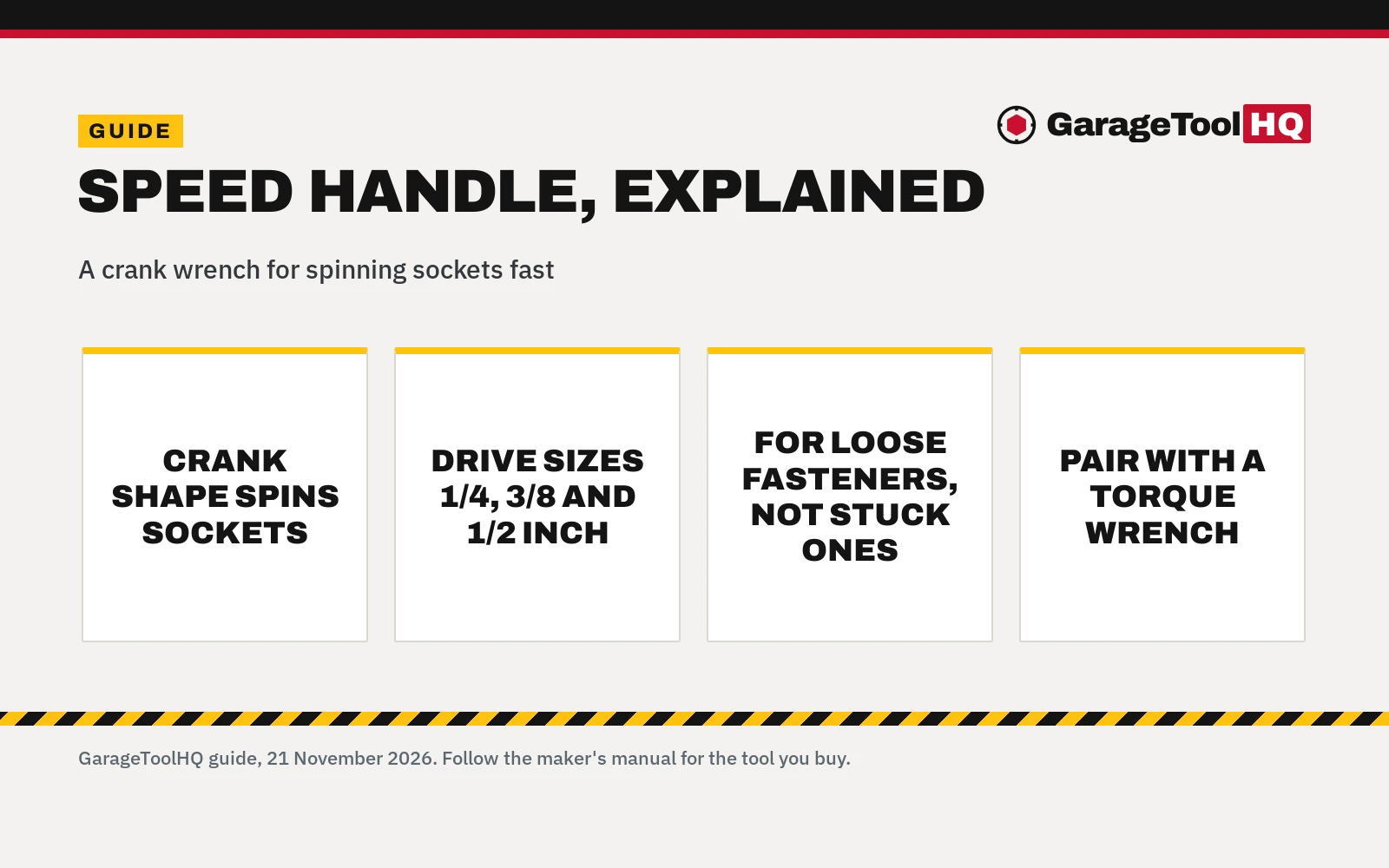
A speed handle is a crank-shaped wrench that spins sockets fast: what it is, how it differs from a ratchet, and when to reach for one in the garage.

On this page
Top picks at a glance
As an Amazon Associate I earn from qualifying purchases.
- 1
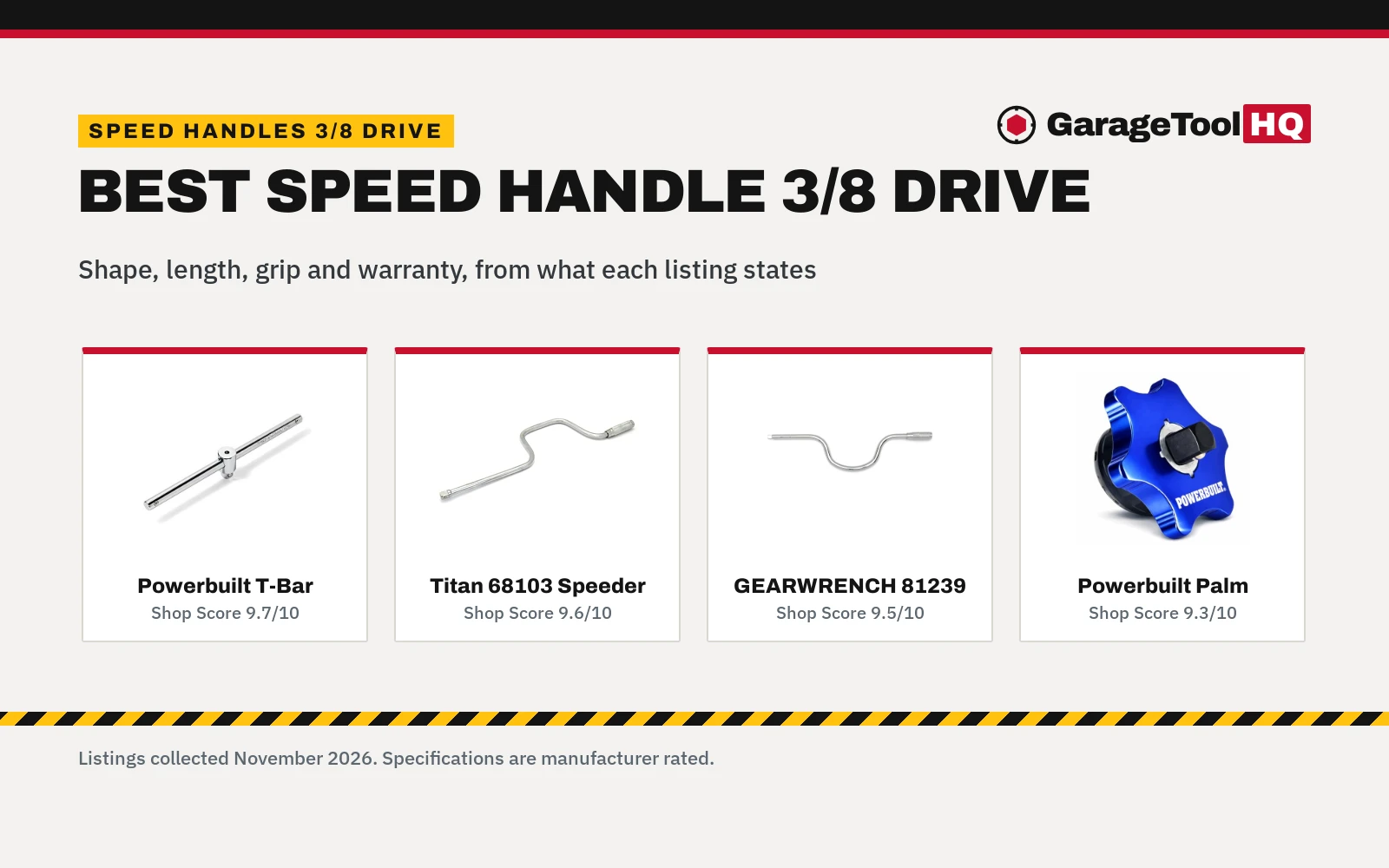
 Powerbuilt 3/8-Inch Drive 8-Inch Sliding T-Bar9.7/10View on Amazon
- 2
 Titan 68103 3/8-Inch Drive Speeder Handle9.6/10View on Amazon
- 3
 GEARWRENCH 3/8" Drive Speeder Handle9.5/10View on Amazon
A wheel is off the car, the lug nuts are loose, and they still have to come off before the brake job can start. That is the moment for a speed handle. What is a speed handle? It is a crank-shaped wrench with a socket drive at one end and a spinning grip at the other, made to turn a socket fast by hand. It runs fasteners in and out far quicker than a fixed wrench, and it does the job with no ratchet mechanism inside.
GarageToolHQ earns a commission when you buy through links on our product pages, at no extra cost to you. Read our affiliate disclosure.
Below: how a speed handle works, how it differs from a ratchet, the steps for using one, and how to pick the drive size and length for the garage.
What Is a Speed Handle?
A speed handle, also called a speeder handle, is a hand tool shaped like a crank. One end carries a square drive that takes a socket, and the other end carries a grip that spins freely in the hand. The shaft between them has a large bend, and turning the grip around that bend spins the socket. The PANSHIYON speeder handle (on Amazon) states it plainly: the large bend in the shaft lets the shaft be turned rapidly to quickly rotate the socket and tighten or loosen a fastener.
The crank shape is the whole idea. A ratchet moves a socket back and forth in small arcs, while a speed handle moves it in full circles. When a fastener is already loose, full circles run it off the threads in a few turns of the wrist. When a fastener is going back on, the same motion runs it down to snug before a torque wrench finishes the job. The PANSHIYON handle measures 15-1/2 inches long, comes with a 1/2-inch to 3/8-inch adapter, and is made of chrome vanadium steel.
Speed handles come in the same drive sizes as sockets and ratchets: 1/4-inch, 3/8-inch and 1/2-inch drives. The adapter that ships with the PANSHIYON handle bridges 1/2-inch drive to 3/8-inch sockets, so match the drive to the socket set already in the box.
Speed Handle vs Ratchet: What Each One Does
A ratchet and a speed handle both turn sockets, but they solve different problems. A ratchet is for a tight spot where the handle can only move a little. A speed handle is for running a loose fastener fast where the crank has room to swing.
| Tool | How it moves a socket | Best job |
|---|---|---|
| Speed handle | Full circles of a crank grip | Spinning loose fasteners on and off fast |
| Ratchet | Short back-and-forth arcs with a pawl and gear | Tightening and loosening where swing room is short |
| Breaker bar | One long pull with no ratchet | Breaking a stuck fastener loose |
The ratchet numbers show why it owns tight spaces. The WORKPRO 3/8-inch drive ratchet uses a 72-tooth mechanism with a 5-degree swing arc, so the handle only needs a small movement to turn the fastener. The GEARWRENCH 120XP (on Amazon) uses 120 positions from two double stacked 60-tooth pawls and a 3-degree swing arc. A speed handle has no such mechanism, so it needs room for full circles to keep a fastener turning.
One tool tries to bridge the gap. The Wera Zyklop Speed Ratchet 8000 B is a ratchet with a swivel head that locks in 5 positions at 0, 15 and 90 degree points left and right, and it combines the features of 5 ratchets into 1 tool. It is still a ratchet at heart, with teeth and a pawl, while a true speed handle is a plain crank.
How to Use a Speed Handle
- Break the fastener loose first. A speed handle is for spinning, not for breaking a stuck fastener free. Loosen the fastener with a ratchet or a breaker bar until it turns by hand. For a brake caliper bolt, the guide to how to loosen brake caliper bolts with a breaker bar shows the setup.
- Seat the socket fully. Push the socket onto the drive square until it sits flat. If the socket is a 3/8-inch drive socket and the handle is a 1/2-inch drive handle, fit the 1/2-inch to 3/8-inch adapter first.
- Spin the crank. Hold the grip and turn it in full circles. Keep the socket square on the fastener and let the crank do the work. The bend in the shaft turns hand motion into fast rotation, so a long run of threads comes off in a few seconds.
- Run the fastener down by hand. To refit, start the fastener by hand so the threads engage straight, then spin it down with the speed handle until it is snug. Never force a fastener that binds, and back it out and start it again if the threads feel wrong.
- Finish with a torque wrench. A speed handle cannot set torque. Tighten the fastener to the figure in the vehicle manual with a torque wrench. See the picks for the best torque wrench for automotive work.
Drive Size and Length
Drive size comes first. A 1/4-inch drive suits small fasteners and tight engine bays. A 3/8-inch drive is the common middle size for garage work. A 1/2-inch drive suits larger sockets and lug nuts, and the PANSHIYON speeder handle is a 1/2-inch drive tool with a 3/8-inch adapter, so it covers both sizes with one handle.
Length is about reach and leverage. The PANSHIYON handle at 15-1/2 inches gives a long crank with room to spin, and its maker states that it gives extra leverage with greater strength than ratchets. For comparison, the WORKPRO extra long ratchet carries an 18-inch handle for extended reach. A longer ratchet handle reaches further and gives more leverage, while a speed handle needs room for its crank to turn, so match the length to the space under the hood and under the car.
Check the socket set before buying the handle. A handle that matches the drive size of the sockets already in the box is the one that gets used. The picks for the best socket set for money show what a matched set looks like, and the impact socket dimensions chart lists drive sizes by socket size.
What a Speed Handle Is Not For
A speed handle is not a breaker bar. It is built for rapid rotation, and a fastener that will not move needs a breaker bar or a long ratchet first, not more spinning. The Performance Tool ratcheting adapter converts (on Amazon) a breaker bar or a sliding T-handle into a ratchet, and it handles a maximum torque of 164.5 ft/lbs (223 Nm). That figure belongs to the adapter, and it shows the kind of load a breaker bar setup is made for.
A speed handle is also not a torque wrench. It has no way to measure or limit torque, so a fastener finished with a speed handle alone may be too loose or too tight. Always finish with a torque wrench set to the vehicle manual figure. And where the crank cannot turn a full circle, a ratchet with a 5-degree swing arc, like the WORKPRO 72-tooth ratchet, or a 3-degree swing arc, like the GEARWRENCH 120XP, is the right tool.
FAQ: garage tools
What is a speed handle used for?
Running fasteners in and out fast. Once a bolt or nut is loose, a speed handle spins the socket in full circles and runs it off the threads in a few turns. It suits tire rotations, oil changes and any job with a run of fasteners to remove and refit.
Is a speed handle the same as a ratchet?
No. A ratchet has a gear and pawl mechanism that lets the handle work back and forth in short arcs, like the 72-tooth mechanism with a 5-degree swing arc on the WORKPRO ratchet. A speed handle has no ratchet mechanism. It is a plain crank that turns the socket in full circles, which is faster but needs room to swing.
What drive size speed handle do I need?
Match the drive size of the socket set. A 3/8-inch drive covers many garage fasteners, a 1/2-inch drive suits larger sockets and lug nuts, and a 1/4-inch drive suits small fasteners. The PANSHIYON handle is a 1/2-inch drive tool with a 1/2-inch to 3/8-inch adapter, so it covers two drive sizes with one handle.
Can a speed handle loosen a stuck bolt?
Not well. A speed handle is made for rapid rotation of a fastener that already turns. For a stuck bolt, break it loose with a breaker bar first, then spin it out with the speed handle.
Can I use a speed handle with any socket?
Any socket with a matching drive square fits. A 1/2-inch drive handle takes 1/2-inch drive sockets, and an adapter bridges it to 3/8-inch drive sockets. Check the drive size on the socket before buying, and see the impact socket dimensions chart for sizes.
Do I still need a torque wrench if I own a speed handle?
Yes. A speed handle cannot measure torque, so it cannot finish a fastener to a set figure. Run the fastener down with the speed handle, then tighten it to the vehicle manual figure with a torque wrench.
Related: best socket set for money, the best torque wrench for automotive work, the guide to how to loosen brake caliper bolts with a breaker bar and the engine and shop equipment hub.